

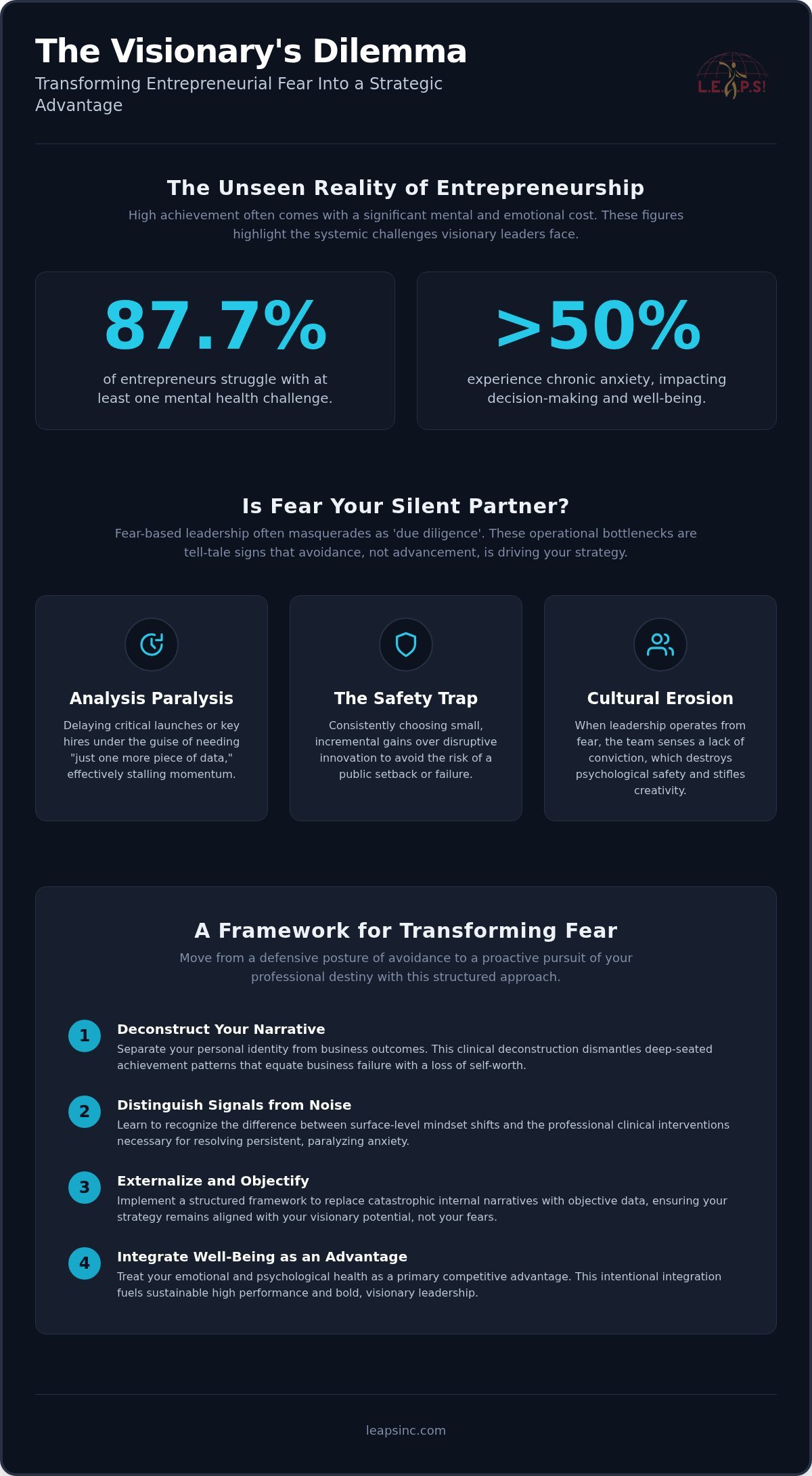
Did you know that 87.7% of entrepreneurs struggle with at least one mental health challenge, with over half experiencing chronic anxiety? This isn’t just a personal hurdle; it’s a systemic reality of the visionary path. You likely recognize the weight of the “loneliness of leadership,” where every decision feels like a potential precipice and analysis paralysis keeps you awake at midnight. Overcoming fear of failure as an entrepreneur isn’t about erasing your natural response to risk. It’s about deconstructing the psychological narrative that keeps you stuck. You’ve felt the physical symptoms of stress, the tightening in your chest, and the isolation of carrying a company’s future on your shoulders.
This guide offers a sophisticated bridge between therapeutic depth and executive strategy. We’ll explore how to master the psychological frameworks and clinical insights needed to transform paralyzing fear into a powerful catalyst for your professional destiny. You’ll gain a clear framework for risk assessment and learn tools for emotional regulation during high-stakes moments. We’ll align your deepest personal purpose with your business strategy, ensuring your leadership is fueled by vision rather than avoidance. By the end, you’ll see failure not as a threat, but as the raw material for your strategic advancement and ultimate growth.
Key Takeaways
- Discover why high-achieving leaders are uniquely susceptible to atychiphobia and how to identify the subtle ways fear acts as a silent partner in your executive decisions.
- Gain clinical insights into overcoming fear of failure as an entrepreneur by separating your personal identity from business outcomes and deconstructing deep-seated achievement patterns.
- Learn to distinguish between surface-level mindset shifts and the professional clinical interventions necessary for resolving persistent, paralyzing anxiety.
- Implement a structured framework to externalize catastrophic narratives and replace them with objective data, ensuring your strategy remains aligned with your visionary potential.
- Integrate emotional well-being as a primary competitive advantage to transition from a defensive posture of avoidance to a proactive pursuit of your professional destiny.
The Entrepreneurial Paradox: Why Fear of Failure is Your Silent Partner
In the high-stakes environment of executive leadership, fear of failure is rarely a loud, sudden event. Instead, it operates as a silent partner, whispering caution when bold action is required. For the high-achiever, this manifests as atychiphobia, a persistent and irrational fear of failing that feels tied to one’s very identity. While a standard business owner might fear losing capital, the visionary leader often fears losing their sense of purpose or professional destiny. This internal pressure is exacerbated by the loneliness of leadership, where the lack of a peer safety net makes every strategic pivot feel like a solo walk on a tightrope.
When you face these pressures, your brain’s executive function often pays the highest price. Chronic stress floods the system with cortisol, impairing the prefrontal cortex and making nuanced decision-making nearly impossible. Understanding the psychological roots of fear helps clarify why even seasoned founders experience these physical symptoms. Overcoming fear of failure as an entrepreneur requires more than just gritting it out; it demands a structured approach to emotional regulation and strategic clarity.
The Spectrum of Fear: Action vs. Inaction
Organizational psychologist Adam Grant suggests that we often regret our inactions more than our failed attempts. In the context of entrepreneurship coaching, we must distinguish between healthy risk-awareness, which protects your assets, and paralyzing fear, which stifles your growth. The Entrepreneurial Paradox is the constant, vibrating tension between a visionary’s desire to build a legacy and the primitive survival instinct to avoid perceived danger.
Symptoms of Fear-Based Leadership
Fear-based leadership is often masked as due diligence, but it eventually reveals itself through specific operational bottlenecks that stall your progress. Identifying these patterns is the first step toward reclaiming your agency. Look for these indicators in your daily operations:
- Analysis Paralysis: You find yourself delaying critical launches or key hires under the guise of needing more data.
- The Safety Trap: You consistently choose incremental gains over disruptive innovation to avoid the risk of a public setback.
- Cultural Erosion: When you operate from a place of fear, your team senses the lack of conviction, which destroys trust and stifles collective creativity.
Stagnation is the inevitable result of playing it safe. When you prioritize avoidance over advancement, you aren’t just protecting your business; you’re actively limiting its maximum potential. True transformation begins when you recognize these symptoms not as permanent character flaws, but as signals that your strategic resilience requires a deeper, more clinical intervention.
Deconstructing the Narrative: The Psychological Roots of Avoidance
Logic is a powerful tool for scaling a business, but it’s often helpless against the visceral grip of deep-seated anxiety. You can analyze market data and project cash flow with clinical precision, yet still feel a paralyzing dread when it’s time to sign a major lease or pivot your product line. This disconnect happens because your fear isn’t rooted in the present spreadsheet; it’s anchored in psychological narratives formed long before you launched your first venture. Many visionary founders find themselves trapped in an Imposter Syndrome loop, where every success feels like a fluke and every setback feels like an exposure of their fundamental inadequacy.
These patterns often trace back to childhood achievement structures. If you were praised primarily for being “smart” or “successful” rather than for your effort, your adult identity likely became fused with your external output. In this framework, a business failure isn’t just a loss of capital; it’s a total annihilation of your self-worth. Breaking this cycle requires more than just willpower. It requires a clinical deconstruction of the beliefs that equate your professional performance with your personal value.
Worldview and Business Reality
Your perspective acts as the lens through which you interpret every email, meeting, and market shift. By defining your worldview, you begin to see that setbacks aren’t indictments of your character but data points in a larger strategic evolution. Research from Warwick Business School suggests that how leaders cope with the fear of failure depends heavily on their ability to reframe these events through a lens of growth rather than threat. Moving from a fixed mindset to a visionary one allows you to view risk as a necessary catalyst for reaching your professional destiny.
The Neurobiology of the ‘Fail’ Response
When a high-stakes deal falls through, your brain doesn’t just process a financial loss. The amygdala, your brain’s emotional command center, often reacts as if you’re facing a physical predator. This “amygdala hijack” shuts down creative problem-solving and triggers a fight-or-flight response, making overcoming fear of failure as an entrepreneur a biological challenge as much as a strategic one. You can’t think your way out of a physiological state that’s designed for survival rather than innovation.
Using individual therapy provides a structured environment to identify these triggers and de-escalate the nervous system before it compromises your leadership. Neuroplasticity ensures that the brain remains capable of reorganization, allowing even the most anxious leaders to unlearn fear-based habits and replace them with resilient, purpose-driven responses. If you’re ready to move beyond these cycles and reclaim your visionary edge, you may find that professional support is the key to unlocking your next level of growth.
Reframing vs. Resolving: Comparing Mindset Shifts and Clinical Interventions
Many founders spend years cycling through productivity “hacks” and tactical planning, hoping that more structure will finally quiet their internal dread. While preparation is essential, it often fails to address the underlying clinical issues that planning alone cannot fix. Surface-level business coaching might help you organize your calendar, but it rarely touches the root of why you feel paralyzed before a board meeting. Real transformation requires a move from temporary reframing to permanent resolution.
The return on investment for emotional intelligence often far outweighs technical skill at the highest levels of leadership. You can hire for technical expertise, but you cannot outsource your own strategic resilience. Overcoming fear of failure as an entrepreneur is less about learning new business tactics and more about resolving the internal conflicts that sabotage your execution. When you resolve these psychological blocks, your capacity for visionary leadership expands exponentially.
Traditional Coaching vs. Clinical Therapy
It’s vital to understand the distinct roles of different professional interventions. Traditional executive coaching typically focuses on the “what” and the “how” of your performance. It’s designed to optimize your current skills and refine your external strategy. However, coaching often hits a ceiling when the obstacle isn’t a lack of knowledge, but a deep-seated emotional response.
Clinical therapy addresses the “why” behind your behaviors. It investigates the psychological foundations that drive your risk tolerance and decision-making patterns. You’ll find that your executive coaching is significantly more effective when it’s paired with a high level of emotional awareness. Identifying when a “business problem” is actually a personal psychological block is the first step toward reaching your maximum potential.
The Power of the Intensive Format
Time is the most scarce resource for any visionary leader. The traditional model of weekly fifty-minute sessions can feel agonizingly slow when you’re in the middle of a high-growth phase or a critical pivot. This is exactly why many high-performers now opt for therapy intensives. These deep-dive sessions condense months of traditional work into a single, focused weekend of transformation.
- Rapid Processing: The intensive format allows you to stay in the “work” without the interruption of weekly life, leading to faster breakthroughs.
- Holistic Integration: You can weave corporate visioning directly into your psychological work, ensuring your business strategy and personal purpose are perfectly aligned.
- Sustained Momentum: By bypassing the slow build-up of weekly sessions, you gain immediate tools to regulate your emotions during high-stakes moments.
By choosing a more rigorous, clinical approach, you aren’t just managing symptoms. You’re re-engineering your internal world to support the weight of your professional destiny. This structured, methodical intervention provides the grounded foundation necessary for any leader who refuses to be limited by fear.
A Visionary Framework for Transforming Fear into Strategic Momentum
Transitioning from a state of paralysis to one of purposeful action requires a structured methodology that bridges clinical psychology and executive strategy. Overcoming fear of failure as an entrepreneur isn’t a one-time event; it’s a disciplined practice of emotional regulation and tactical planning. By following a visionary framework, you can move beyond the “survival mode” that limits your business growth and step into the professional destiny you were meant to fulfill. This process demands that you challenge your internal narratives with the same rigor you apply to your market research.
Transformation begins with five essential steps designed to recalibrate your response to risk:
- Externalize the Fear: Separate your personhood from your business results. If a venture fails, it’s a failed experiment, not a failed life.
- Fact-Check the Narrative: Use objective data to counter catastrophic thinking. Data from the U.S. Bureau of Labor Statistics shows that 20-22% of small businesses fail in their first year. While real, these odds are a baseline to navigate, not a reason to retreat.
- Leverage Professional Guidance: Utilize entrepreneurship coaching to build a resilient strategic plan that accounts for setbacks without losing sight of the peak state.
- Run Failure Experiments: Implement small-scale, low-risk tests to desensitize your nervous system. These “micro-failures” teach your brain that setbacks are survivable.
- Align Daily Actions: Ensure every task is a direct reflection of your higher purpose, making the fear of missing your destiny greater than the fear of a temporary mistake.
Identity Decoupling for Founders
You are not your EBITDA. Many high-achievers fuse their self-worth so tightly with their business success that every dip in revenue feels like a personal wound. Breaking this fusion is critical. Creating a “professional persona” allows you to handle rejection and market volatility with clinical detachment. Through individual therapy, you can build a stable core identity that remains unshaken regardless of your company’s quarterly performance. This psychological distance is what allows for truly bold, visionary leadership.
Strategic Risk Mitigation
True resilience turns “what if” into “even if.” Instead of obsessing over potential disasters, build contingency plans that calm the mind and protect the mission. A “failure budget” for innovation allows your team to explore disruptive ideas without the threat of total catastrophe. Using business coaching helps you create these structured environments where bold leaps are supported by strategic safety nets. When you have a plan for the worst, you’re finally free to pursue the best. If you’re ready to build this resilience, schedule your strategy session today to begin your transformation.
Beyond the Leap: Integrating Mind and Business for Maximum Potential
In the volatile business landscape of 2026, emotional health has transitioned from a wellness trend to the ultimate competitive advantage. While your competitors are busy managing their anxiety through surface-level tactics, the visionary leader invests in the deep, clinical work required for true strategic resilience. Overcoming fear of failure as an entrepreneur isn’t just about survival; it’s about the fundamental shift from a defensive posture of fear-avoidance to a proactive state of purpose-pursuit. This integration allows you to make high-stakes decisions with a level of clarity and conviction that others simply cannot replicate.
At LEAPS Inc., we provide a unique synergy of professional therapy and executive coaching led by Dr. John E. N. Daniel. We believe that your internal world is the primary driver of your external results. By merging clinical depth with strategic business advancement, we help you unlock latent abilities and reach your peak state. This isn’t a passive support system; it’s a mission-oriented partnership focused on your maximum potential. You’ve already built the foundation; now it’s time to build the leader capable of sustaining it.
The Visionary Mentor Advantage
High-performers require a specialized guide who is comfortable in both the boardroom and on the clinical couch. Standard business advice often ignores the psychological gravity of leadership, leaving founders to struggle in isolation. Through corporate visioning, we align your individual emotional health with your company’s long-term mission, ensuring that your personal growth fuels the growth of your organization. Maximum Potential is the perfect intersection of emotional well-being and professional excellence, where your personal purpose and business strategy become one.
Your Next Strategic Step
Navigating the complexities of leadership requires a secure, confidential space where you can explore vulnerability without compromising your authority. Our expert-centric approach is anchored in years of seasoned experience, providing a methodical and structured framework for your transformation. We don’t rush the process; we move steadily from establishing a philosophical foundation to implementing high-impact solutions. You don’t have to carry the weight of your professional destiny alone.
To begin this journey, you can schedule an appointment for a professional consultation. This is your opportunity to move beyond the limitations of fear and step into the high-energy, visionary leadership that your company deserves. Take the leap toward your destiny today.
Step Into Your Professional Destiny
The journey from paralyzing anxiety to strategic resilience marks a profound psychological evolution. By decoupling your self-worth from business metrics and resolving the clinical “why” behind your stress, you unlock a capacity for leadership that remains unshaken by market volatility. Overcoming fear of failure as an entrepreneur is not about the absence of risk; it’s about the presence of a structured, resilient mind. You have already proven your ability to build; now it’s time to refine the inner architecture that sustains that success.
Led by Dr. John E. N. Daniel, LEAPS Inc. provides a sophisticated holistic approach that bridges the gap between mental health and business strategy. Through specialized therapy intensives designed for the high-performing lifestyle, we help you transform emotional vulnerability into an executive competitive advantage. You don’t have to carry the weight of leadership in isolation. Your future potential is waiting to be unlocked. Schedule your consultation to transform fear into visionary momentum and reclaim your visionary edge today. Your destiny is calling; it’s time to answer with conviction.
Frequently Asked Questions
How can I tell if my fear of failure is a normal business concern or a clinical issue?
Normal business concerns are typically situational and manageable through strategic planning or risk assessment. Clinical issues manifest as pervasive physiological symptoms, persistent insomnia, or chronic analysis paralysis that disrupts your daily executive function. If your anxiety remains constant regardless of positive market data, it often indicates a deeper psychological block. Seeking professional evaluation helps clarify if your response is a rational reaction to risk or a deep-seated pattern requiring intervention.
Can entrepreneurship coaching help with deep-seated anxiety?
Entrepreneurship coaching primarily focuses on strategic performance, tactical execution, and external business growth. While it’s an excellent tool for professional advancement, it isn’t a substitute for clinical treatment of deep-seated anxiety. Real transformation occurs when you address the “why” behind your fear through therapeutic work. Pairing coaching with clinical support ensures you aren’t just managing your business, but resolving the internal narratives that hinder your maximum potential.
What is a therapy intensive, and how does it benefit busy founders?
A therapy intensive is a condensed, high-impact format where we focus on deep psychological work over several consecutive hours or days. This structure is ideal for busy founders who cannot commit to weekly appointments but require rapid breakthroughs. By bypassing the slow build-up of traditional sessions, you can process complex emotional hurdles and implement regulation tools immediately. It provides a dedicated space for profound transformation without the constant interruptions of the boardroom.
How do I stop my self-worth from being tied to my business’s success?
Overcoming fear of failure as an entrepreneur requires a deliberate decoupling of your identity from your company’s performance metrics. You must recognize that a business setback is a data point in a strategic experiment, not an indictment of your personal value. Building a stable core identity involves externalizing your professional persona. This allows you to handle market volatility with clinical detachment, ensuring your self-worth remains constant even when your revenue fluctuates.
Is it possible to be a successful entrepreneur without being ‘fearless’?
True success doesn’t require being “fearless,” but it does require being strategically resilient. Fear is a natural biological response to high-stakes risk; trying to suppress it often leads to burnout or poor decision-making. When overcoming fear of failure as an entrepreneur, focus on emotional regulation and purpose-pursuit rather than total fearlessness. The most effective leaders aren’t those who feel no fear, but those who have the clinical tools to lead decisively in spite of it.
What are the first steps to overcoming imposter syndrome as a CEO?
The first steps involve externalizing the “imposter” voice and fact-checking your catastrophic narratives with objective data. CEO imposter syndrome often stems from childhood achievement patterns where success was fused with self-image. Start by documenting your tangible wins and identifying the specific triggers that spark feelings of inadequacy. Professional clinical support can help you unlearn these habits, allowing you to inhabit your leadership role with genuine authority and visionary confidence.
How does LEAPS Inc. integrate therapy with executive coaching?
LEAPS Inc. integrates these disciplines by treating emotional health and executive performance as two sides of the same coin. Led by Dr. John E. N. Daniel, our approach uses clinical insights to resolve psychological blocks while simultaneously applying strategic coaching to drive business growth. This synergy ensures that your personal development directly fuels your professional advancement. We bridge the gap between the boardroom and the clinical couch to facilitate total personal and professional transformation.
What happens during a corporate consulting intensive for business owners?
During a corporate consulting intensive, we conduct a high-level audit of your leadership impact and organizational vision. We move methodically through structured categorization of your business development, strategic marketing, and brand development goals. This process isn’t just about spreadsheets; it’s about aligning your corporate visioning with your personal purpose. You’ll leave with a clear, actionable framework designed to scale your impact while maintaining your internal well-being and strategic clarity.