

What if the same strategic precision you apply to your professional life could be the catalyst for a profound relational transformation? Many high-achieving partners find themselves trapped in a cycle of surface-level logistics, feeling more like efficient roommates than intimate companions. You might find it difficult to transition from a corporate “fix-it” mindset to a state of emotional vulnerability, fearing that the original spark has permanently faded. It’s a common struggle for those who prioritize excellence in all areas except the one that matters most. By integrating structured emotional intimacy exercises for couples into your daily rhythm, you can begin to unlock the latent potential within your relationship.
We’ll provide a clear roadmap for reconnection, offering practical tools that respect the demands of a busy, visionary lifestyle. You’ll learn how to move beyond simple communication toward a shared sense of destiny and deep psychological safety. This article also outlines when to leverage professional Couple Therapy or a focused Therapy Intensive to accelerate your growth. Prepare to move past mere coexistence and step into a partnership defined by purpose, depth, and unwavering support.
Key Takeaways
- Redefine intimacy as a core pillar of your visionary partnership, moving beyond surface-level interactions toward a shared professional and personal legacy.
- Implement high-impact emotional intimacy exercises for couples like the “Vision Sync” to ensure your daily logistics don’t overshadow your emotional connection.
- Discover how to use non-verbal methods and structured writing to dissolve internal barriers and foster deep vulnerability without immediate conflict.
- Identify the psychological traps, such as “Executive Mode,” that prevent successful professionals from maintaining emotional presence with their partners.
- Learn to recognize when your relationship requires the structured support of Intimacy Therapy or a Therapy Intensive to reach its maximum potential.
What is Emotional Intimacy? Beyond the Surface Connection
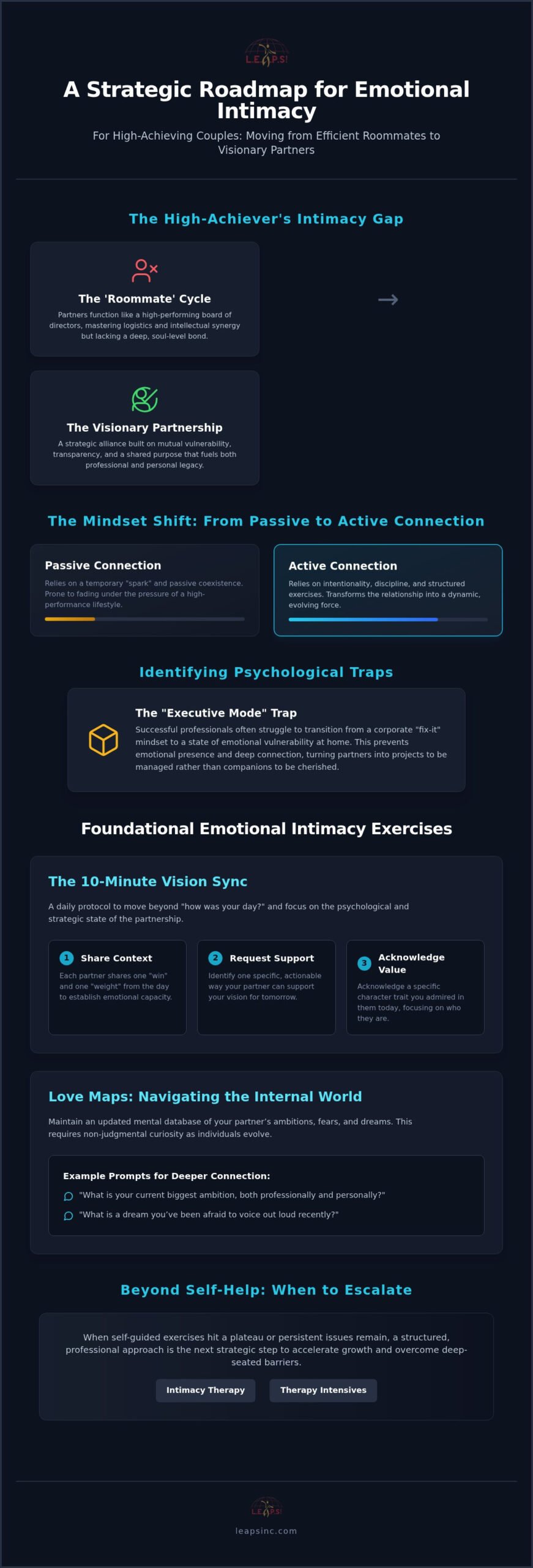
Emotional intimacy is far more than a warm sentiment or a lack of conflict. It is a strategic alliance built on mutual vulnerability, absolute transparency, and a shared sense of purpose. In a visionary partnership, your emotional health acts as the foundational fuel for your professional and personal legacy. While many high-achieving couples master intellectual synergy and physical connection, they often stumble into the “Intimacy Gap.” This is a state where partners function like a high-performing board of directors but lack the soul-level bond necessary for true fulfillment. Understanding What is Emotional Intimacy? requires looking past shared interests toward the deep, resonant transparency that allows two people to be fully seen and known.
To better understand how these dynamics play out in real-time, watch this helpful video:
The Clinical Anatomy of Connection
Relational connection is a biological imperative that influences every aspect of your performance. Co-regulation allows partners to stabilize each other’s nervous systems, creating a psychological baseline that fosters better decision-making and sharper executive function. Vulnerability is the courageous act of exposing one’s internal state to facilitate genuine connection, serving as a clinical strength that builds long-term resilience rather than a sign of weakness. Empathy serves as the primary tool for navigating high-stakes life transitions. It ensures that professional success does not come at the cost of relational decay, allowing both partners to feel supported during periods of intense growth.
Why ‘Exercises’ are Necessary for Growth
You wouldn’t expect a business to scale without a strategic plan, and you shouldn’t expect a relationship to deepen through passive coexistence. Utilizing structured emotional intimacy exercises for couples is a form of active maintenance, comparable to executive coaching or elite physical training. Passive connection relies on a temporary “spark,” while active connection relies on intentionality and discipline. Our therapeutic philosophy emphasizes that relational mastery requires consistent practice. Integrating emotional intimacy exercises for couples into your weekly routine transforms your relationship from a static arrangement into a dynamic, evolving force capable of sustaining your highest ambitions.
Foundational Emotional Intimacy Exercises for Daily Life
Building a high-impact life requires more than just professional alignment; it demands a daily commitment to relational recalibration. These foundational emotional intimacy exercises for couples are designed to integrate seamlessly into a high-performance lifestyle, ensuring that your connection remains as sharp and resilient as your career strategy. By moving from passive cohabitation to active engagement, you create a secure base from which both partners can pursue their maximum potential.
The 10-Minute Vision Sync
The 10-Minute Vision Sync is a structured protocol for daily alignment. It moves beyond the mundane “how was your day” and focuses on the psychological and strategic state of the partnership. Start by sharing one “win” and one “weight” from the day to provide context for your emotional capacity. Next, identify one specific way your partner can support your vision tomorrow; this transforms support into an actionable deliverable. Finally, acknowledge a specific character trait you admired in them today. Focusing on who they are, rather than just what they do, reinforces their inherent value within the relationship.
Love Maps: Navigating Your Partner’s Internal World
Love Maps involve maintaining an updated mental database of your partner’s internal landscape. As individuals evolve, their ambitions and fears shift. For 2026, integrate prompts such as: “What is your current biggest ambition?” and “What is a dream you’ve been afraid to voice?” This exercise requires non-judgmental curiosity. You are an explorer of their inner world, not a critic of their choices. If internal blocks prevent you from engaging fully, Individual Therapy for Personal Growth can provide the clarity needed to show up more authentically for your partner.
Active listening drills, specifically the “Mirroring” technique, ensure felt-safety by reflecting back what you’ve heard before responding. This is a staple in many clinical Couples Therapy Exercises because it halts the “fix-it” instinct and prioritizes understanding. Finally, implement an Appreciation Audit to move from a deficit mindset to an abundance mindset. By consciously documenting and voicing specific appreciations, you reframe the relationship as a source of strength. If you are ready to move from theory to transformation, you can schedule an appointment to begin your journey toward a visionary partnership.
Vulnerability-Based Exercises for Deep Breakthroughs
Moving beyond foundational routines requires a willingness to engage in emotional intimacy exercises for couples that challenge the ego’s protective barriers. While daily logistics keep the relationship functional, breakthroughs occur when you address the internal blocks that prevent total transparency. The “Unsent Letter” exercise is a powerful tool for this process. It allows you to write out raw emotions, frustrations, or hidden desires without the immediate pressure of an interpersonal conflict. By externalizing these thoughts, you clear the psychological space needed to show up fully and authentically for your partner during your next alignment session.
Similarly, the “Vulnerability Share” utilizes structured “I feel” statements to bypass the ego’s natural defense mechanisms. High-achieving partners often default to an analytical “fix-it” mode, which can come across as critical or dismissive. Instead of saying “You always prioritize work,” stating “I feel lonely when our evening time is interrupted” invites your partner into your inner experience. This shift from accusation to revelation is vital for maintaining a high-level partnership where both individuals feel secure enough to be seen without judgment.
Designing Your Shared Destiny
Intimacy thrives when individual career paths are intentionally aligned with a broader family “Corporate Vision.” Shared Meaning represents the pinnacle of the Gottman Method, serving as the final layer where couples move beyond basic friendship to create a shared culture of legacy and purpose. To facilitate this alignment, create a “Couple’s Manifesto” that outlines your non-negotiable values and long-term mission. This document acts as a strategic compass, ensuring that your professional ambitions serve your relational destiny. Your manifesto should include:
- Your core values as a primary partnership.
- Shared 5-year financial and lifestyle objectives.
- A commitment to how you will navigate high-stakes conflict.
- The specific legacy you wish to leave for your family or community.
The Power of Non-Verbal Connection
Breaking through intellectual barriers often requires returning to the body. The 4-Minute Eye Gaze is one of the most effective emotional intimacy exercises for couples because it leverages the neurobiology of oxytocin to re-establish deep trust. Sustained eye contact signals safety to the nervous system, dropping the “professional guard” that many leaders carry. Complement this with safe touch exercises designed to reclaim physical closeness through the lens of emotional security. These non-verbal moments act as a reset for the relationship’s energetic state. For a deeper exploration of these dynamics, consult our Modern Connection: The Visionary Guide to Couples Counseling.
Overcoming Resistance: Why Intimacy Exercises Sometimes Fail
Resistance to emotional intimacy exercises for couples is a common psychological defense mechanism. It often manifests as a “cheesiness” barrier, where partners dismiss the work as awkward, forced, or unnecessary. This dismissal is usually a shield for the “Protector” ego, an internal part of the personality designed to prevent vulnerability by maintaining control. When you feel the urge to roll your eyes or retreat into silence, you are likely encountering a threshold of growth. Acknowledging this discomfort is the first step toward dismantling the armor that prevents a truly visionary partnership. Growth requires the courage to be seen in your rawest state, even when it feels counterintuitive to your professional identity.
When the ‘Fix-It’ Mindset Blocks the ‘Feel-It’ Moment
High-achieving professionals often fall into the “Executive Mode” trap. In this state, the brain is wired for efficiency, problem-solving, and outcome-oriented logic. While these traits are essential for building a legacy in the marketplace, they are often toxic to emotional presence. To successfully transition, leaders must learn to “clock out” of their professional identity before engaging in relational work. Our Executive Coaching for the Mindful Leader provides tools for this exact cognitive shift, helping you balance professional drive with personal depth.
Implement the “Listen Only” rule during your exercises. This protocol requires you to validate your partner’s experience without offering a single solution or counter-argument. It forces the brain out of “fix-it” mode and into a state of empathetic resonance. By withholding the urge to solve, you create the psychological safety required for your partner to reveal their deepest internal world. This creates a secure environment where emotional intimacy exercises for couples can actually take root.
Identifying Deeper Blocks
Sometimes, resistance isn’t just a habit; it’s a symptom of past trauma or an avoidant attachment style. If an exercise triggers a “fight or flight” response, manifesting as intense anger, shut-down, or a sudden need to leave the room, it’s a sign that the nervous system perceives intimacy as a threat. In these high-tension moments, utilize “The Pause.” This is a strategic withdrawal of at least 20 minutes to allow the heart rate to return to baseline before re-engaging. If you find that your progress is consistently stalled by these deeper wounds, it’s time to move beyond self-help. You can schedule an appointment to explore how structured clinical support can help you navigate these complex emotional terrains.
Beyond Self-Help: Transitioning to Intimacy Therapy
Self-guided growth has its limits. Even the most effective emotional intimacy exercises for couples can reach a stagnation point where the needle simply stops moving. This plateau often occurs when deep-seated patterns or unresolved attachment wounds require more than just a weekly routine. It’s the difference between minor maintenance and a complete system overhaul. Traditional counseling often focuses on crisis management or conflict resolution. In contrast, Intimacy Therapy is a proactive, strategic intervention designed to align your relational health with your visionary potential.
The Stagnation Point is not a sign of failure. It is a signal that you’ve reached the boundaries of your current framework. Moving beyond this requires a high-level expert who can provide a “Visionary Lens” to your partnership. This perspective treats your relationship as the core engine of your professional success and personal legacy. When you hit this wall, continuing with basic emotional intimacy exercises for couples without professional guidance can lead to frustration rather than breakthrough.
The LEAPS Inc. Approach to Couples Intensives
For busy entrepreneurs and executives, time is the most valuable asset. Weekly sessions can sometimes feel fragmented, losing momentum between appointments. The LEAPS Inc. Therapy Intensive offers a condensed, high-impact alternative. Over the course of a single weekend, couples engage in deep clinical intervention and strategic alignment. This format allows for the dissolution of long-standing barriers that might take six months to address in traditional settings. You aren’t just discussing problems; you are architecting a new way of being. Explore our Couples Therapy Intensives to see how this focused approach can accelerate your transformation.
Taking the Next Step Toward Your Destiny
Initiating the conversation about professional help requires a shift in perspective. Frame the transition as a “level up” rather than a repair job. Tell your partner that you value the partnership enough to invest in its maximum potential. An expert-led intervention provides the structured categorization of issues and the visionary mentorship needed to unlock latent abilities within the relationship. This is about fulfilling a shared destiny, not just surviving a rough patch. If you are ready to transition from surface-level coexistence to a profound, purpose-driven partnership, schedule your visionary consultation today.
Architect Your Relational Destiny
Integrating emotional intimacy exercises for couples into your life is a strategic investment in your shared future. You’ve learned to bridge the “Intimacy Gap” through daily alignment and non-verbal connection, moving past the ego’s defenses to find genuine vulnerability. These practices transform your relationship from a logistical arrangement into a high-octane partnership that sustains your highest ambitions. While self-guided tools provide the foundation, reaching your peak state often requires the precision of professional guidance.
LEAPS Inc. provides the visionary mentorship necessary to turn relational potential into a permanent legacy. Led by Dr. John E. N. Daniel, our practice offers nationally recognized clinical expertise tailored for entrepreneurs and executives. Whether through weekly sessions or our specialized weekend Therapy Intensives for rapid transformation, we provide the structured framework your partnership deserves. Ready to elevate your connection? Schedule an appointment for Intimacy Therapy or a Couples Intensive today. It’s time to stop merely coexisting and start building the profound, purpose-driven partnership you were meant to lead.
Frequently Asked Questions
What are the best emotional intimacy exercises for beginners?
Gratitude rituals and “High-Low” shares are the most effective starting points for those new to intentional relational work. These low-stakes interactions help shift the brain from a critical, defensive state to one of receptivity and appreciation. By focusing on positive reinforcement first, you build the psychological safety necessary to eventually tackle deeper, more vulnerable topics without triggering a fight or flight response.
How often should we do intimacy exercises to see results?
Consistency is far more impactful than intensity; aim for brief daily check-ins and one deeper session per week. Treat these emotional intimacy exercises for couples as a non-negotiable part of your executive schedule. Research indicates that even fifteen minutes of focused, uninterrupted attention daily can significantly lower relational stress and improve overall partnership satisfaction within just a few weeks.
What if my partner refuses to do intimacy exercises?
Focus on your own emotional growth and model the vulnerability you wish to see in the relationship. Resistance often stems from fear or a feeling of being “handled” rather than a lack of love. If your partner is hesitant, start by expressing your own needs using “I” statements. Invitation is always more effective than demand when you’re trying to dismantle a partner’s protective ego.
Can emotional intimacy exercises help after infidelity?
Exercises can facilitate healing after betrayal, but they must be conducted within a framework of absolute safety and transparency. Rebuilding trust requires a structured approach that addresses the root causes of the disconnect. In these cases, professional guidance or a focused Therapy Intensive is often necessary to ensure that the exercises don’t inadvertently trigger more trauma or lead to unproductive conflict.
Is intimacy therapy different from regular marriage counseling?
Intimacy therapy is a proactive, growth-oriented intervention that focuses on the deep psychological and spiritual connection between partners. While regular marriage counseling often centers on conflict resolution and basic communication skills, intimacy therapy seeks to unlock the visionary potential of the partnership. It’s about architecting a shared destiny and legacy rather than just solving immediate problems or managing household logistics.
How long does it take to rebuild emotional intimacy?
The timeline varies based on the depth of the disconnect; however, many couples report significant shifts within three to six months of consistent practice. It’s vital to remember that the average couple waits six years after problems begin before seeking professional help. Patience and disciplined intentionality are required to reverse years of emotional distance and re-establish a sense of deep, soul-level connection.
What should we do if an exercise causes an argument?
Utilize “The Pause” immediately to allow both nervous systems to return to a baseline state of safety. Arguments during these sessions are often signs that you’ve touched on a sensitive “Protector” part of the personality. Stop the exercise, acknowledge the emotional activation without judgment, and agree to revisit the topic only when both partners feel regulated, secure, and ready for a calm conversation.
Are there specific exercises for long-distance couples?
Digital emotional intimacy exercises for couples like “Synchronized Visioning” or reading a professional development book together are highly effective for long-distance partners. You can also utilize video calls for non-verbal connection drills, such as shared meditation or sustained eye contact. The goal is to maintain a shared internal world despite the physical distance, ensuring you remain strategically and emotionally aligned on your long-term mission.