

Why does the modern workforce feel like a revolving door despite the millions invested in surface-level wellness perks? You’ve likely noticed that traditional benefits packages often fail to touch the deeper psychological needs of your high-performing teams. The fundamental connection between mental health and employee retention has evolved into a complex, strategic priority that demands more than just a standard phone-line EAP. As we look toward 2026, the organizations that thrive won’t be those with the most perks, but those that master the integration of clinical-grade support with executive vision.
It’s frustrating to watch talent walk out the door while your leadership team battles the quiet erosion of burnout. You’re right to believe that a healthier culture should lead to higher loyalty, yet the execution often feels fragmented. This guide promises to reveal a visionary framework for bridging the gap between corporate wellness and clinical excellence to secure your organization’s most valuable assets. We will examine how to transform your retention strategy by addressing the inner lives of your leaders, moving beyond basic interventions toward a model of holistic professional and personal growth.
Key Takeaways
- Recognize why the strategic alignment of mental health and employee retention is the primary driver of organizational stability in the 2026 landscape.
- Move beyond the “check-the-box” trap of generic wellness apps by identifying the systemic barriers that prevent employees from seeking meaningful support.
- Explore the transformative impact of clinical-grade interventions, such as Therapy Intensives, in resolving leadership burnout and restoring organizational vision.
- Master a structured, visionary framework for auditing psychological safety and aligning corporate purpose with individual executive coaching.
- Shift from passive wellness perks to a mission-oriented talent ecosystem that treats emotional health and professional success as a single, integrated goal.
The Silent Catalyst: How Mental Health Dictates Modern Employee Retention
The workforce of 2026 has undergone a fundamental psychological shift. We’ve moved past the era where a competitive salary alone could command long-term loyalty. Today, the “Retention-Wellness Gap” represents the distance between what traditional corporate structures offer and what modern professionals actually need to stay engaged. While global health data identifies billions of lost working days due to mental health challenges, the real crisis for visionary leaders is the quiet erosion of talent. When the link between mental health and employee retention is ignored, the result isn’t just turnover; it’s the loss of organizational soul.
Moving from a defensive posture of preventing illness to a proactive stance of promoting maximum potential is the hallmark of a visionary organization. High-stakes environments demand leaders who recognize that clinical-grade support is a catalyst for transformation, not just a safety net for crisis. By addressing the internal depth of your team, you secure the external stability of your firm.
The ROI of Psychological Safety
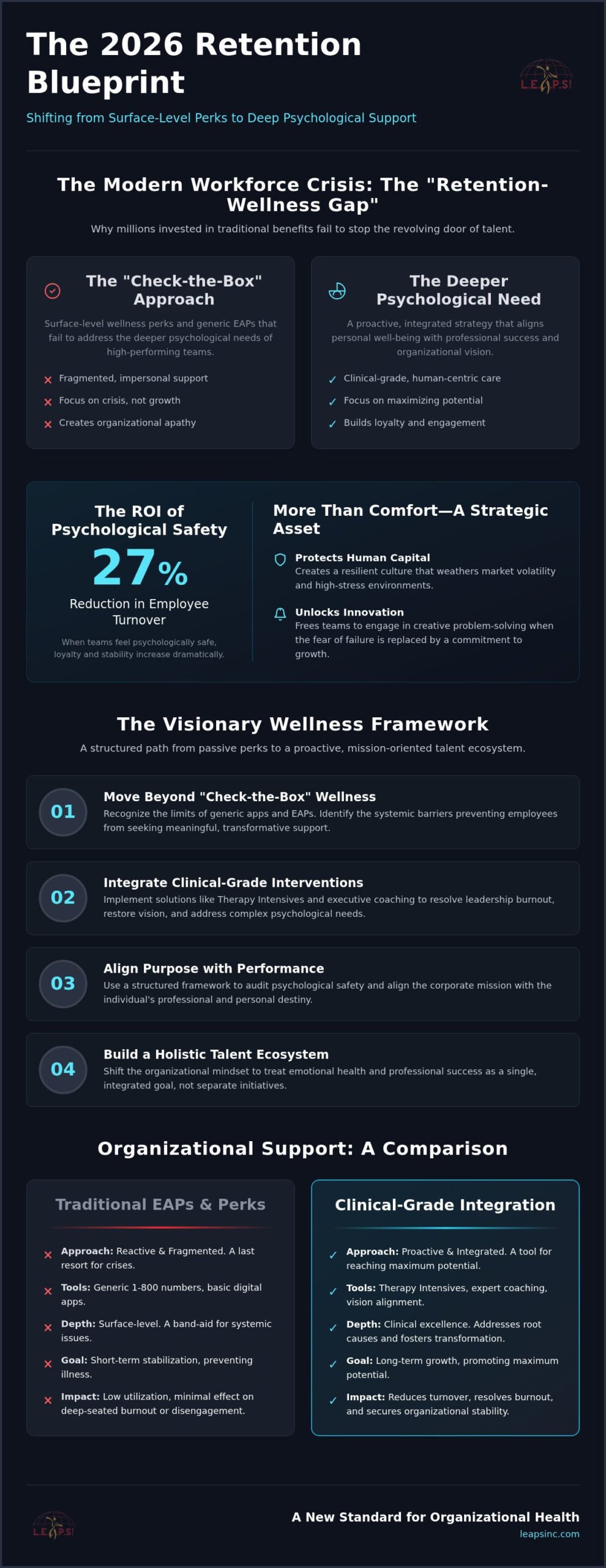
Industry data suggests that establishing a secure psychological environment can reduce turnover by as much as 27%. This isn’t just about comfort; it’s about the freedom to innovate. When teams feel safe enough to express emotional vulnerability, they unlock a level of creative problem-solving that remains dormant in high-stress cultures. Historically, Workplace wellness programs focused primarily on physical health, but the modern mandate is psychological. Psychological safety is a strategic business asset that protects your human capital from the volatility of the external market. This foundation allows for a culture where innovation thrives because the fear of failure is replaced by a shared commitment to growth.
Identifying the ‘Burnout Threshold’
Identifying the “Burnout Threshold” requires more than just tracking attendance or productivity metrics. Early warning signs often manifest as a subtle shift in tone, a decline in collaborative energy, or a loss of alignment with the company’s future. Traditional exit interviews rarely capture the true psychological “why” because the damage is often done months before the official resignation. Integrating Corporate Visioning into your retention strategy allows employees to see their personal destiny woven into the organization’s mission. By the time an executive reaches their threshold, a standard Employee Assistance Program might be too late to bridge the gap. True retention requires a structured framework that identifies these internal shifts before they lead to disengagement.
The Psychology of Disengagement: Why Traditional EAPs Fall Short
Many organizations believe they’ve solved the wellness equation by offering a generic app or a 1-800 number. This “check-the-box” approach often ignores the reality of deep-seated trauma or complex psychological needs that high-performing professionals face. When a leader is navigating a crisis of purpose, an automated notification or a distant voice on a phone line isn’t enough. Fragmented support systems that only offer surface-level solutions create a sense of organizational apathy. If your goal is to strengthen the link between mental health and employee retention, your strategy must move beyond basic crisis intervention toward sustained clinical depth.
Aligning with the Surgeon General’s Framework for Workplace Mental Health requires looking at the work environment as a foundational element of well-being. Traditional EAPs often act as a band-aid for systemic issues. They prioritize short-term stabilization over long-term transformation. This creates a barrier to utilization; employees often view these programs as a last resort rather than a tool for reaching their maximum potential.
The Limits of Digital-Only Solutions
Digital wellness tools offer accessibility but lack the human-centric clinical depth that high-achievers require. While an app might provide a breathing exercise, it cannot facilitate the Individual Therapy necessary for true personal-professional alignment. High-level leaders need a partner who understands the nuances of their role. Comparing app-based coaching to professional Executive Coaching reveals a stark difference in impact. One offers a generic script, while the other provides a visionary roadmap for internal growth and professional mastery.
The Perception Gap: HR vs. The Front Line
A significant perception gap exists between the boardroom and the front line. Research indicates that while roughly 65% of employers believe their mental health offerings are sufficient, a majority of employees feel unsupported. Bridging this trust gap requires more than new software. It demands a leadership team that embodies a clear Therapeutic Philosophy within the corporate culture. Transparent communication about mental health reduces the stigma of seeking help and fosters a culture of genuine belonging. When leaders prioritize their own mental health and employee retention through visible, clinical-grade support, they set a new standard for the entire firm.
Moving toward a more integrated model ensures your talent feels seen and valued at a core level. Organizations ready to evolve their approach can schedule a consultation to explore more sophisticated frameworks for leadership health.
Clinical Depth vs. Corporate Perks: Building a Resilient Talent Ecosystem
Free snacks and modern office aesthetics are pleasant, but they’re ultimately insufficient for repairing a fractured organizational worldview. When an employee’s internal life is in turmoil, a stocked breakroom feels like a shallow distraction rather than a meaningful benefit. Organizations that successfully master mental health and employee retention recognize that true resilience is built through clinical-grade intervention. By moving beyond commodities and perks, firms create a sophisticated ecosystem where talent feels professionally valued and personally seen. This shift from amenities to depth is what distinguishes a visionary firm from its competitors.
Therapy Intensives as a Strategic Intervention
Leadership burnout often requires a more profound intervention than a standard weekly check-in. Therapy Intensives serve as a strategic reset for executives who’ve reached their psychological limit. These sessions allow for an immersive deep-dive into the specific barriers hindering both performance and purpose. By condensing months of traditional work into a focused, high-impact period, intensives significantly accelerate the healing process and provide immediate clarity for the path forward. Reclaiming personal power through this level of clinical depth ensures that high-value leaders stay anchored to the firm’s long-term future.
Holistic Support: Family and Couples Dynamics
The home-to-work spillover effect is a psychological reality that visionary CEOs can’t afford to ignore. When a leader’s personal life is unstable, their professional focus and decision-making inevitably fracture. Integrating Family Therapy or couples support into your corporate wellness umbrella isn’t an overreach; it’s a protective measure for your most valuable assets. Supporting the individual’s sense of destiny means acknowledging their entire life context. This comprehensive approach reduces absenteeism and builds a deep, emotional loyalty that simple salary increases can’t replicate.
Community is the final, vital piece of a resilient talent ecosystem. Group Therapy models can foster a sense of shared experience and mutual support within high-stakes teams. It effectively breaks down the isolation often felt at the top levels of an organization. When mental health and employee retention are treated as a collective mission rather than an individual problem, the organization becomes more than just a place of employment. It transforms into a sanctuary for professional excellence and personal growth, making it nearly impossible for competitors to poach your top talent.
The Visionary Wellness Template: Designing a Program for Maximum Potential
A visionary framework requires moving beyond reactive fixes. To truly master mental health and employee retention, you must follow a structured, proactive path that treats your team as a collection of individuals with unique destinies. This process starts with an honest audit of your organizational worldview. You must determine if your culture currently views employees as mere resources or as vital partners in a shared mission. This initial assessment uncovers the hidden barriers to psychological safety that often lead to talent flight.
Alignment is the second critical step. When you bridge the gap between high-level goals and individual aspirations, you give your team a reason to stay that transcends their paycheck. This leads into the implementation of a bespoke Employee Assistance Program. Unlike the generic, low-utilization models of the past, a boutique EAP provides the clinical depth necessary for high-stakes professionals. Finally, you must redefine your metrics. Success shouldn’t be measured by how many people call a hotline, but by ‘Destiny Fulfillment’ and genuine engagement. You’re looking for signs that your people are reaching their peak state within your firm. For a comprehensive approach to measuring EAP effectiveness through a lens of actual return on investment, explore the frameworks that connect clinical support directly to strategic growth.
Aligning Culture and Strategy
True transformation begins at the leadership level. Utilizing Corporate Visioning allows leaders to articulate a purpose that resonates at a deep, personal level with every team member. This isn’t just cultural architecture; it’s a strategic necessity. Through Leadership Impact Intensives, executives can refine their own internal health to set a powerful tone for the entire firm. For ongoing resources on building a purpose-driven culture, you can explore the LEAPS Inc. Blogs.
The Multi-Disciplinary Implementation Team
A robust strategy requires a diverse set of seasoned experts. You don’t just need clinical therapists to handle emotional vulnerability; you need business coaches who understand the specific pressures of the C-suite. This multi-disciplinary network ensures that support is both therapeutically sound and professionally relevant. Integrating Business Development with your mental health strategy ensures that organizational growth and individual well-being move in tandem. This holistic approach treats executive success and emotional health as two sides of the same coin, creating an environment where high-performers can finally fulfill their maximum potential.
Ready to build your organization’s visionary template? Schedule an appointment with LEAPS Inc. today to begin your transformation.
LEAPS Inc.: Integrating Clinical Excellence with Organizational Strategy
LEAPS Inc. occupies the vital intersection where clinical authority meets high-level organizational strategy. We don’t merely provide a service; we act as a visionary mentor for firms that refuse to settle for the status quo. By aligning deep psychological insights with strategic business objectives, we redefine the standard for mental health and employee retention in high-stakes environments. Our approach is designed for the C-suite, the entrepreneur, and the visionary leader who understands that their internal health is the ultimate driver of their external success.
The synergy we create between clinical expertise and aspirational growth allows your organization to move beyond traditional barriers. Through our Corporate Consulting Intensive, we facilitate a comprehensive reset of your organizational health. This isn’t a surface-level workshop. It’s a deep-dive intervention that identifies systemic fractures and provides a structured framework for long-term transformation. We empower, develop, and transform your leadership team to ensure they’re operating at their peak state.
Boutique EAP and Beyond
Traditional EAPs often fail because they lack the clinical depth and executive relevance required by modern professionals. LEAPS Inc. offers a boutique alternative that prioritizes confidentiality, elite expertise, and direct access to seasoned clinical practitioners. We provide more than just crisis management; we offer a pathway to professional mastery through specialized Entrepreneurship Coaching and individual support. Traditional call centers offer scripts, but we offer a mission-oriented partnership.
Our clients benefit from the visionary insights of Dr. John E. N. Daniel, whose multidisciplinary background bridges the gap between therapeutic psychology and brand development. This unique perspective ensures that every intervention is tailored to the specific pressures of your industry. You aren’t just getting a therapist; you’re gaining a strategic partner dedicated to your organization’s destiny. This level of support ensures that your talent feels seen and valued at a core, psychological level.
Your Next Step Toward Organizational Transformation
The transition from survival to maximum potential requires a courageous commitment to change. It’s time to stop reacting to turnover and start building a culture where your most valuable assets feel truly secure. We invite you to move toward a more sophisticated framework for mental health and employee retention that secures your talent by securing their future. Your people are your greatest asset, and their psychological well-being is your greatest competitive advantage.
True transformation starts with a single, strategic conversation. You can schedule an appointment for a consultation to discuss how LEAPS Inc. can align your corporate vision with clinical excellence. Let’s unlock the latent abilities of your leadership team and ensure your organization thrives through 2026 and beyond. Secure your destiny by investing in the internal depth of your workforce today.
Secure Your Organizational Destiny
The landscape of 2026 demands a departure from shallow wellness perks toward a profound integration of clinical depth and corporate strategy. You’ve discovered that mastering mental health and employee retention isn’t about checking boxes; it’s about aligning an individual’s internal sense of purpose with the organization’s visionary goals. By moving beyond generic EAPs and embracing intensive, expert-led support, you protect your most valuable talent from the quiet erosion of burnout. This strategic shift transforms your firm into a sanctuary for high-performers who are ready to fulfill their destiny.
LEAPS Inc., led by Dr. John E. N. Daniel, provides the multidisciplinary expertise required to bridge the gap between emotional health and executive success. Our framework integrates clinical therapy with elite business coaching to facilitate both professional and personal transformation. We focus on the maximum potential of your team, challenging every leader to reach their peak state. It’s time to move from a state of survival to one of visionary growth. You can Design Your Visionary Mental Health Strategy with LEAPS Inc. today. Your organization’s future depends on the psychological resilience you build right now.
Frequently Asked Questions
How does mental health directly affect employee retention rates?
Psychological distress is a primary driver of high turnover and the quiet erosion of talent. When an organization prioritizes the link between mental health and employee retention, it creates a culture of psychological safety where individuals feel seen and valued. Research suggests that employees who feel supported in their well-being are significantly more likely to stay, reducing the astronomical costs associated with talent acquisition and C-suite burnout.
What is the difference between a traditional EAP and a visionary mental health program?
Traditional EAPs often function as reactive, low-utilization band-aids that focus on basic crisis intervention through distant phone lines. A visionary program provides boutique clinical depth and proactive corporate visioning designed to unlock an individual’s maximum potential. These sophisticated frameworks move beyond preventing illness to facilitate peak performance, offering direct access to seasoned experts who understand the unique pressures of high-stakes professional environments.
Can executive coaching help reduce turnover in the C-suite?
Executive coaching stabilizes leadership teams by providing a secure space to align personal destiny with organizational mission. Turnover in the C-suite is frequently driven by isolation and a lack of internal depth rather than a deficit in skill. By integrating strategic development with emotional resilience, coaching prevents the quiet exodus of top-tier talent. This structured intervention ensures your most valuable assets remain energized and committed.
Why are therapy intensives more effective for high-achieving professionals?
Therapy intensives offer a deep-dive clinical reset that condensed months of traditional weekly work into a few high-impact days. For high-achieving professionals with demanding schedules, this immersive format respects their time while facilitating rapid psychological transformation. These sessions allow for the immediate resolution of deep-seated barriers, enabling a faster return to visionary leadership and peak professional performance compared to standard therapy models.
What are the common risks to mental health in a corporate environment?
High-stakes environments often foster chronic burnout and a dangerous lack of psychological safety. Organizations frequently neglect the home-to-work spillover effect, where personal stressors degrade professional decision-making. Other common risks include:
- A fractured organizational worldview that leads to systemic disengagement.
- Performance-only metrics that ignore the internal depth of the individual.
- Fragmented support systems that create a sense of organizational apathy and distrust.
How do I measure the ROI of a corporate mental health program?
ROI is measured by tracking metrics such as retention longevity, reduced absenteeism, and increased team innovation. Successful programs demonstrate a clear connection between mental health and employee retention through lower turnover costs and improved engagement scores. You should also evaluate “Destiny Fulfillment,” which assesses how effectively your leaders are reaching their maximum potential. For a structured approach to measuring EAP effectiveness and ROI in 2026, explore frameworks that go beyond basic utilization rates to capture true strategic impact. These indicators provide a comprehensive view of the program’s strategic impact.
Is family therapy relevant to an employee’s professional performance?
Family therapy is essential because a leader’s internal life and professional performance are two sides of the same coin. When an executive faces instability at home, their focus and strategic clarity inevitably suffer. By providing holistic support that addresses family dynamics, an organization protects its leaders from the distractions of personal crisis. This comprehensive approach fosters deep emotional loyalty and ensures sustained professional excellence.
How can an organization start a workplace wellness program in 2026?
Starting a program in 2026 begins with an honest audit of your organizational worldview and psychological safety. Move away from generic perks and toward a multidisciplinary team that includes clinical therapists and business coaches.
- Align corporate visioning with individual career coaching goals.
- Implement a boutique EAP that offers genuine clinical depth.
- Partner with visionary mentors to design a framework focused on maximum potential.