

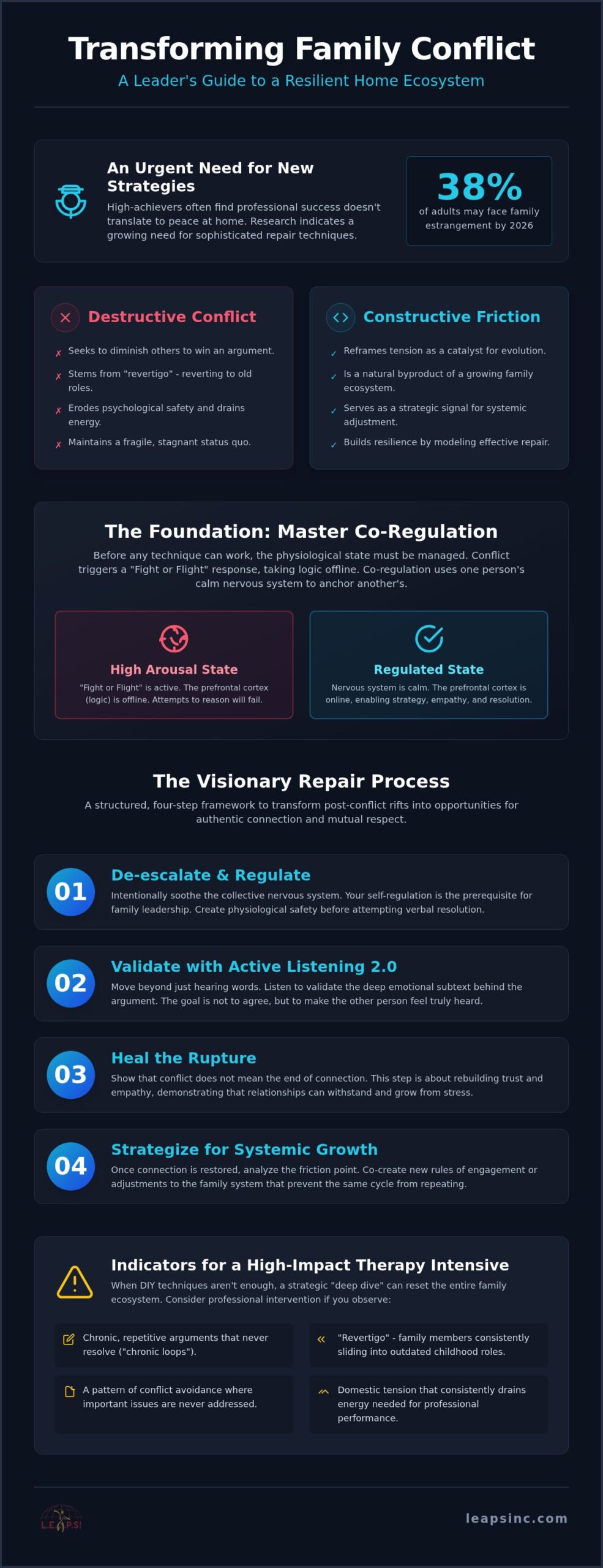
What if the recurring friction in your home isn’t a sign of a failing family, but a raw, untapped catalyst for your collective evolution? Many high-achieving leaders feel a profound sense of defeat when their strategic success doesn’t translate to peace at the dinner table. It’s exhausting to loop through circular arguments while fearing the impact on your children, yet mastering professional family conflict resolution techniques can shift this trajectory. You’re part of a growing demographic seeking deeper connection; by 2026, research indicates that up to 38% of adults face family estrangement, highlighting the urgent need for sophisticated repair strategies.
You deserve a household environment that mirrors your professional excellence and personal values. This guide promises to equip you with the clinical strategies required to transform domestic tension into a foundation for long-term resilience by identifying, de-escalating, and healing broken connections. We’ll move beyond basic communication tips into a visionary framework for Authoritative 2.0 dynamics and structured emotional repair. This article provides a clear roadmap to resolve friction in real-time, ensuring your family ecosystem becomes a powerful launchpad for each member’s peak potential and future destiny.
Key Takeaways
- Reframe domestic friction as a natural byproduct of a growing family ecosystem rather than a sign of failure or instability.
- Master the science of co-regulation to soothe the collective nervous system and bypass the physiological “fight or flight” response that stalls progress.
- Implement sophisticated family conflict resolution techniques, including Active Listening 2.0, to validate the deep emotional subtext behind every argument.
- Execute a structured, four-step visionary repair process to transform post-conflict rifts into opportunities for authentic connection and mutual respect.
- Identify the critical indicators that suggest your family dynamics require the strategic depth of a high-impact Therapy Intensive to unlock long-term resilience.
Understanding the Family Ecosystem: Why Conflict is Normal
A family isn’t just a collection of individuals living under one roof; it’s a dynamic, interconnected ecosystem. This web of emotional needs and responses ensures that when one person shifts, the entire structure feels the vibration. We often view friction as a sign of dysfunction, but in a visionary framework, conflict is actually a natural byproduct of growth. As children mature and parents evolve, their individual identities inevitably press against the existing family boundaries. This pressure creates the heat necessary for transformation. Without it, the system remains stagnant, unable to adapt to the new “destiny” each member is pursuing.
The distinction between destructive conflict and constructive friction lies in the intent and the outcome. Destructive conflict seeks to diminish the other person to maintain a fragile status quo. Constructive friction, however, serves as a strategic signal for necessary systemic adjustment. While formal Conflict resolution theories are often discussed in corporate boardrooms, applying these high-level concepts to your home requires a shift in perspective. You aren’t just trying to stop a fight; you’re optimizing a system. Utilizing professional family conflict resolution techniques allows you to interpret these signals and recalibrate your family ecosystem for peak performance.
Identifying Destructive Cycles and Patterns
Repetitive arguments often stem from “revertigo,” a psychological phenomenon where individuals slide back into outdated childhood roles during moments of high stress. Even a high-powered CEO might find themselves reacting like a defensive teenager when triggered by a spouse or parent. These cycles are fueled by unmet emotional needs that haven’t been articulated. When the goal becomes “winning” the argument, the family unit suffers a net loss. Power struggles erode the psychological safety required for a family to thrive, turning your sanctuary into a source of exhaustion. Recognizing these patterns is the first step toward the deep work found in a Family Therapy setting.
The Positive Value of Resolution
Mastering the art of repair provides your children with a masterclass in emotional resilience. They don’t need a conflict-free life; they need to see that ruptures can be healed through structure and empathy. There’s also a direct, undeniable link between domestic harmony and your professional executive performance. A fractured home life drains the mental energy required for visionary leadership and strategic decision-making. By implementing advanced family conflict resolution techniques, you secure your foundation. Resolution is not the absence of conflict, but the presence of a superior repair strategy. For families stuck in chronic loops, a Therapy Intensive can provide the strategic “deep dive” needed to reset the entire ecosystem.
The Core of Co-Regulation: Pre-Technique Preparation
Before you can deploy sophisticated family conflict resolution techniques, you must first master the internal state from which they are delivered. Co-regulation is the physiological process where one person’s regulated nervous system serves as an anchor for another’s. In the heat of domestic friction, the “Flight or Fight” response often takes the wheel, causing the prefrontal cortex, the seat of logic and strategy, to go offline. When a family member is in a state of high arousal, attempting to use reason is like trying to install software on a computer that is currently rebooting. Our therapeutic philosophy emphasizes that emotional depth and resolution require a stable physiological foundation before any verbal intervention can succeed.
Self-regulation is the prerequisite for leadership within the home. If you enter a conversation with your own nervous system in a state of high alert, you inadvertently signal a threat to others. This isn’t a failure of character; it’s a biological reality. Strategic preparation involves recognizing your own physiological triggers and intentionally returning to a baseline of calm. By doing so, you create the necessary space for repair to occur. If you’re struggling to find this baseline, you can schedule an assessment to explore personalized regulation strategies.
The Biological Basis of Family Tension
The amygdala hijack is a survival mechanism that prioritizes speed over accuracy, often leading to defensive or aggressive communication. During this state, rational problem-solving is biologically impossible. Your family members also possess “mirror neurons,” which means they’ll unconsciously reflect the emotional state you project. To counteract this, utilize immediate self-soothing techniques:
- Box Breathing: Inhale, hold, exhale, and hold for four seconds each to reset the vagus nerve.
- 5-4-3-2-1 Grounding: Identify five things you see, four you can touch, three you hear, two you smell, and one you can taste to pull your brain out of a spiral.
Establishing “Family Ground Rules”
A visionary family unit operates with clear, strategic boundaries that protect vulnerability. Establishing “Family Ground Rules” ensures that even during intense disagreements, the dignity of each individual remains intact. This includes a strict “Time-Out” rule, which allows any member to pause an argument if they feel their nervous system escalating. Unlike abandonment, a strategic pause includes a commitment to return to the conversation once everyone is regulated. Unchecked escalation that bypasses these boundaries can lead to severe outcomes, including Family Conflict & Violence, making these structural safeguards essential for long-term safety and connection. By setting non-negotiable standards for respectful communication, you ensure that family conflict resolution techniques are applied within a secure, high-trust environment.
Master Checklist: 7 Essential Family Conflict Resolution Techniques
Once you’ve anchored your nervous system through co-regulation, you can move into the tactical application of family conflict resolution techniques. These strategies aren’t merely about ending a dispute; they’re designed to restructure the way your family processes emotional data. By shifting from reactive defense to proactive engagement, you transform a standard argument into a strategic opportunity for systemic growth. The following checklist provides a high-level framework for navigating even the most entrenched domestic friction.
- Active Listening 2.0: Move beyond simply hearing words to validating the emotional subtext. This involves identifying the “yearning” behind a complaint. If a spouse complains about chores, they may actually be expressing a need for partnership and visibility.
- The “I” Statement Framework: Use a structured formula to own your internal experience: “I feel [emotion] when [specific event] because I need [core value].” This prevents the other person’s amygdala from triggering a defensive response.
- The Softened Start-Up: Clinical research suggests the first three minutes of a conversation determine its trajectory. Start with a gentle tone and a focus on your own feelings rather than a list of the other person’s failures.
- The “Third-Party” Perspective: Reframe the conflict as “Us vs. The Problem” rather than “Me vs. You.” This psychological shift allows you to view the friction as an external challenge that requires a collaborative solution.
Advanced Communication Strategies
Reflective listening is a cornerstone of deep emotional repair. Before you state your own perspective, you must summarize the other person’s point to their satisfaction. This ensures they feel seen and heard, which naturally lowers their defensive guard. For high-tension topics, utilize the “Speaker-Listener Card” technique. Only the person holding the metaphorical card may speak, while the other focuses entirely on understanding. This structure prevents the circular interruptions that often characterize family arguments. By identifying “The Conflict Under the Conflict,” you can address root causes like fear of abandonment or lack of autonomy, rather than bickering over surface-level symptoms. If your family struggles to implement these tools, a Family Therapy session can provide the necessary expert mediation.
Conflict De-escalation Checklist
Maintaining a peaceful household requires real-time de-escalation skills. Lower your vocal volume and maintain open body language to signal safety to the other person’s nervous system. Validation is your most powerful tool; find at least one point the other person made that you can agree with, even if you disagree with their overall conclusion. This creates a bridge for reconciliation. Most importantly, you must vigilantly avoid “The Four Horsemen” of relational decay: Criticism, Contempt, Defensiveness, and Stonewalling. These behaviors are toxic to the family ecosystem and require immediate intervention. For families in crisis, a Therapy Intensive offers a strategic “deep dive” to purge these patterns and install a superior repair strategy.
The Visionary Repair Process: Four Steps to Authentic Connection
Repair is not merely the cessation of hostilities; it’s the intentional restoration of the family’s emotional signal. A visionary approach treats every argument as a strategic data point for systemic evolution. To truly master family conflict resolution techniques, you must follow a structured repair process that moves beyond a simple “truce” into the realm of authentic re-integration. This process ensures that the rift doesn’t just close, but heals into a stronger bond than existed before the friction.
First, you must explicitly acknowledge the rift. High-performing families often fall into the trap of “sweeping it under the rug,” which creates emotional debt that eventually bankrupts the relationship. Stating, “I recognize we’ve had a significant disconnection today,” honors the reality of the ecosystem. This acknowledgement provides the necessary psychological safety to move into the next phase: the apology. Without this foundational step, any attempt at problem-solving will feel hollow and premature.
What Makes an Effective Apology?
A high-level, clinical apology requires three non-negotiable components: Regret, Responsibility, and Remedy. You must express genuine regret for the pain caused, take full responsibility for your specific actions without “buts” or excuses, and propose a remedy to make things right. Phrases like “I’m sorry you feel that way” are strategic failures. This type of non-apology shifts the burden back to the other person and causes more harm by invalidating their experience. When you model radical accountability, you teach your children that vulnerability is a cornerstone of visionary leadership.
The third step involves collaborative problem solving. In an executive context, this is a post-mortem; in a family, it’s designing a “Strategic Plan” to prevent the same friction from recurring. Finally, you must re-establish intimacy through a deliberate act of connection. Whether it’s a shared activity or a brief moment of physical affection, this signals to the nervous system that the repair is complete and the sanctuary of the home has been restored.
Designing Your Family Growth Plan
Use the data gathered during conflict to update your family “Standard Operating Procedures.” If a specific transition time or topic consistently triggers arguments, the system requires a strategic adjustment. Establishing a “Family Meeting” ritual provides a proactive space for alignment before conflict arises, allowing the unit to discuss goals, needs, and boundaries. For families seeking guided systemic repair, professional Family Therapy provides the neutral expertise required to navigate deep-seated patterns and unlock your collective potential.
If you’re ready to transform your domestic friction into a catalyst for growth and resilience, you can schedule an appointment with our visionary team today. We specialize in helping families move from repetitive cycles into a state of peak emotional performance.
When to Seek Professional Intervention: Scaling Your Family Capacity
High-achieving individuals understand that complex systems eventually require external optimization to reach their maximum potential. When circular arguments persist despite your best efforts to apply advanced family conflict resolution techniques, it’s often a signal that the family’s internal capacity has been reached. Deep-seated patterns, often rooted in generational “revertigo,” act as invisible friction that prevents even the most well-meaning units from evolving. Recognizing these clinical thresholds isn’t a sign of failure; it’s a strategic decision to scale your family’s emotional intelligence through expert intervention. Professional support provides the objective lens needed to identify systemic blind spots that are impossible to see from within the fray.
The synergy between professional coaching and clinical therapy is what unlocks a family’s true destiny. While coaching focuses on strategic advancement and future goals, therapy addresses the internal depth and emotional vulnerabilities that may be stalling progress. By treating these as two sides of the same coin, you ensure that every member of the family ecosystem is empowered to fulfill their individual purpose while remaining deeply connected to the whole. This holistic approach transforms domestic stress into a structured roadmap for visionary harmony.
The Power of the Therapy Intensive
Traditional “one hour a week” models can sometimes feel like trying to steer a ship with a toothpick when the ecosystem is in crisis. For families facing significant rifts or stagnant growth, a Therapy Intensive provides a high-impact environment for deep transformation. This focused, multi-day intervention allows for a comprehensive “deep dive” into systemic issues, bypassing the slow pace of standard sessions to achieve breakthroughs in days rather than months. For those seeking to heal collective wounds in a supportive, high-energy setting, a Group Therapy Intensive offers the structured intervention required to reset the family’s trajectory and restore its core resilience.
Aligning Personal Purpose with Family Health
Your domestic environment is the primary launchpad for your professional and personal legacy. Individual growth fuels family resilience, creating a feedback loop of success and well-being. As a Visionary Mentor, our approach ensures that your individual peak performance doesn’t come at the cost of your home life. Your family unit is your most important organization. Treating its development with the same strategic rigor you apply to your career is the ultimate path to long-term success. If you’re ready to transition from repetitive conflict toward your collective destiny, schedule an appointment to begin your transformation today.
Architecting a Legacy of Emotional Resilience
Mastering sophisticated family conflict resolution techniques is more than a strategy for peace; it’s a commitment to your family’s long-term destiny. You’ve learned that friction is a vital signal for systemic adjustment, requiring the physiological anchor of co-regulation and the structured integrity of authentic repair. By shifting from reactive defense to proactive alignment, you ensure your home remains a high-performance sanctuary for every member’s growth. Healthy conflict resolution doesn’t just solve today’s argument; it builds the emotional infrastructure for tomorrow’s success.
When domestic patterns feel too entrenched for individual effort, scaling your family’s capacity requires an integrative approach. Our clinical expertise, led by Dr. John E. N. Daniel, merges mental health with strategic growth to facilitate deep transformation. Whether you require a focused deep-dive through our specialized Family Therapy Intensives or ongoing guidance, we’re here to help you unlock your collective potential. Ready to transform your family ecosystem? Schedule a consultation with our visionary clinical team today. Your family’s most vibrant chapter is waiting to be written.
Frequently Asked Questions
How do I start a conversation when everyone is already angry?
Start by implementing a strategic pause to allow for physiological de-escalation across the family unit. You cannot resolve conflict when the amygdala is in control of the conversation. Use a neutral, authoritative statement to acknowledge the high emotional state and propose a specific time to reconvene. This demonstrates leadership and protects the family ecosystem from further damage while ensuring the eventual interaction is productive rather than destructive.
What is the most effective way to resolve sibling rivalry?
Focus on individual validation and the elimination of comparative labels within the home environment. Sibling friction often signals a perceived scarcity of parental attention or autonomy. By treating each child as a unique entity with distinct needs, you reduce the drive for competition. Implementing 1-on-1 time and teaching them collaborative family conflict resolution techniques empowers siblings to view each other as teammates rather than opponents in a zero-sum game.
Is it healthy for children to see their parents argue?
It’s healthy for children to witness constructive friction provided they also witness a complete and authentic repair process. Exposure to unresolved, high-conflict arguments can lead to emotional instability; however, seeing parents use respectful communication to navigate differences builds resilience. When children observe the visionary repair process in action, they learn that relationships can survive ruptures, which is a foundational skill for their own future personal and professional success.
How can I stop my family from sliding into the same old arguments?
Identify the “conflict under the conflict” by analyzing the repetitive emotional data points within your home. These circular arguments usually indicate an unmet core need, such as a desire for respect or safety, rather than the surface-level topic. Updating your family’s “Standard Operating Procedures” through a proactive Family Meeting ritual allows you to address these root causes strategically. This systemic adjustment prevents the “revertigo” effect that pulls members back into old roles.
What is the “Softened Start-Up” and how does it work?
The “Softened Start-Up” is a communication strategy where you initiate a difficult conversation without using criticism or contempt. You state your feelings and a specific, positive need rather than pointing out a family member’s flaws. Since the first three minutes essentially dictate the outcome of any interaction, starting gently prevents an amygdala hijack in the other person. This strategic opening keeps the prefrontal cortex online, allowing for rational problem-solving and deeper connection.
When is family conflict a sign that we need professional therapy?
Professional intervention is necessary when the family unit experiences chronic stonewalling, physical aggression, or a persistent sense of hopelessness. If your internal family conflict resolution techniques consistently fail to produce repair, you’ve reached a capacity threshold. In 2026, many high-performing families utilize a Therapy Intensive to break through deep-seated patterns quickly. Seeking expert guidance is a visionary move to protect your most important organization from long-term systemic decay.
How do I handle a family member who refuses to communicate?
Respect the need for a pause while maintaining an open invitation for future connection. Withdrawal is often a defense mechanism against emotional overwhelm or a perceived threat to their autonomy. Instead of demanding immediate engagement, which can increase their flight response, focus on your own co-regulation. State clearly that you’re ready to listen whenever they feel safe to share. This creates a secure environment that eventually makes communication feel more attractive than isolation.
Can executive coaching techniques be applied to family conflict?
Yes, executive coaching frameworks like corporate visioning and strategic goal-setting are highly effective in a domestic context. Families are complex organizations that thrive on clear missions, defined boundaries, and structured feedback loops. Applying high-level leadership principles to your home life facilitates a Visionary Mentor dynamic. This integration allows you to manage family friction with the same clinical authority and strategic rigor you bring to the boardroom, ensuring holistic success.