

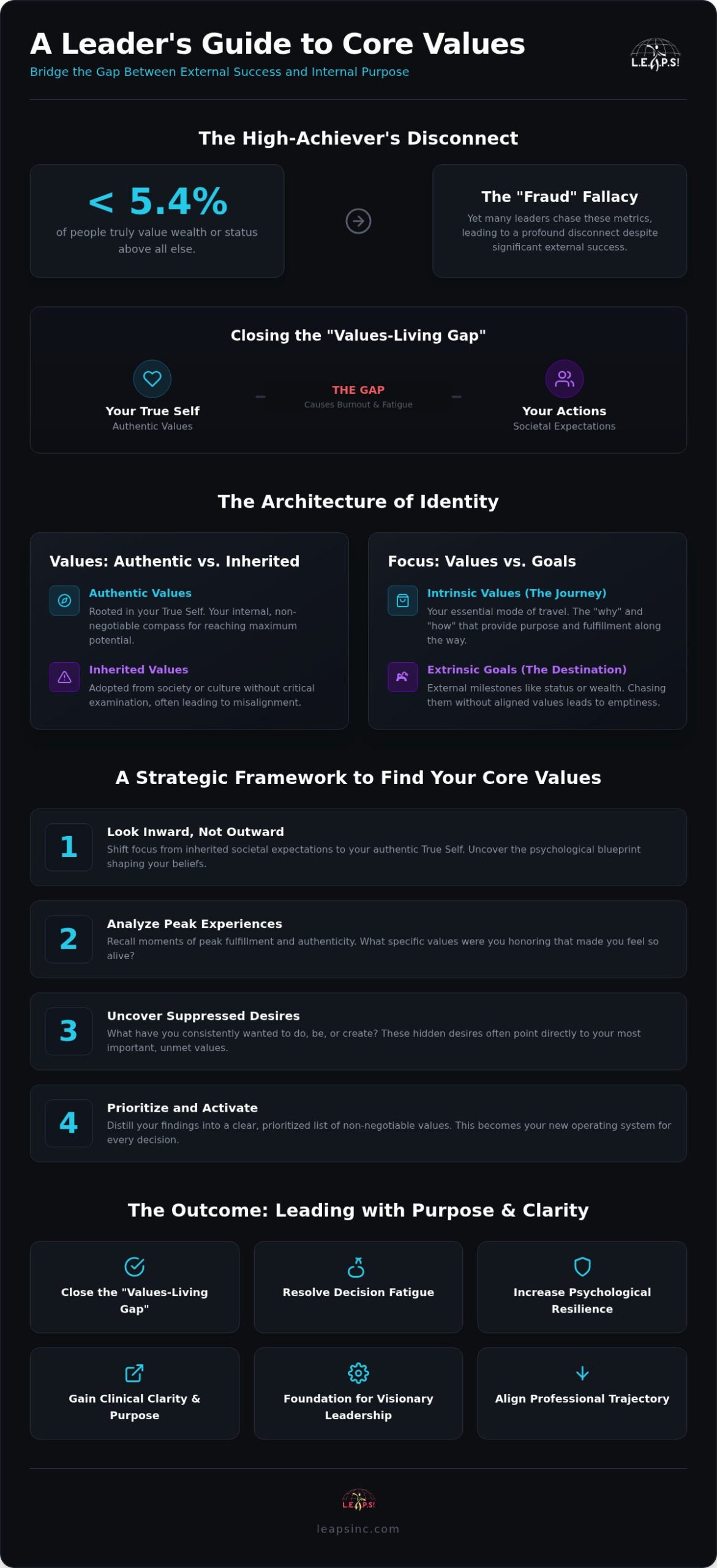
What if the prestigious career you’ve built is actually a blueprint designed for someone else? While research shows fewer than 5.4% of people truly value wealth or status above all else, many leaders spend decades chasing these metrics at the expense of their well-being. This disconnect often leads to feeling like a “fraud” despite significant external success. Learning how to find your core values is not merely a self-discovery exercise. It’s a strategic necessity to bridge the gap between your psychological identity and your visionary destiny.
It’s natural to feel drained by decision fatigue when your internal compass is missing. You deserve a framework that integrates your personal well-being with your professional leadership. This guide offers a clinically-informed approach to identify the core values that define your true self and drive your future success. We’ll examine the “Values-Living Gap” and provide a structured method to prioritize what matters most. By the end, you’ll have a clear, prioritized list of values and a strategic framework for making decisions that align with your highest potential. You’ll move from chasing hollow milestones to leading a life of profound purpose and clinical clarity.
Key Takeaways
- Identify the critical distinction between inherited societal expectations and the authentic values rooted in your True Self.
- Discover a strategic, clinically-informed framework on how to find your core values by analyzing peak experiences and suppressed desires.
- Reframe your approach to success by distinguishing between extrinsic goals as mere destinations and intrinsic values as your essential mode of travel.
- Leverage your core values as the foundational architecture for corporate visioning and high-level executive coaching.
- Close the “Values-Living Gap” to resolve decision fatigue and align your professional trajectory with your psychological identity.
The Architecture of Identity: What Are Core Values?
Core values represent the fundamental beliefs that govern your internal landscape and external actions. They aren’t merely ethical preferences or social pleasantries. Instead, they serve as the bedrock of your identity. To understand What Are Core Values?, you must view them as the non-negotiable requirements for reaching your maximum potential. They function as the operating system for both visionary leadership and personal peace, determining how you allocate your most precious resources: time, energy, and attention.
When you begin the journey of how to find your core values, you’re essentially mapping the clinical and strategic architecture of your life. This process requires a shift from looking outward at societal expectations to looking inward at your True Self. Authentic values are those that resonate with your deepest essence, while inherited values are often those we’ve adopted from family or culture without critical examination. True transformation occurs when you identify and activate the former, allowing your destiny to unfold with clarity and conviction.
To better understand this concept, watch this helpful video walkthrough:
- Internal Governance: Values act as the silent filters for every decision you make.
- External Impact: They dictate the quality of your leadership and the legacy you leave behind.
- Psychological Stability: Alignment with core values reduces cognitive dissonance and increases resilience.
Beyond the Buzzwords: Why Definitions Matter
Many leaders struggle because they confuse ethical standards or personality traits with actual core values. Ethics are the rules we follow to remain socialized; personality traits are the “how” of our behavior. In contrast, core values are the “why.” Vague definitions often result in “aspirational values”—lofty concepts that look good on a corporate wall but don’t actually drive daily behavior. Core values are the clinical and strategic architecture of a person’s life.
The Consequences of Value Misalignment
We often witness the “burnout of the successful,” where individuals reach the peak of their careers only to feel a profound sense of emptiness. This occurs when you achieve goals that contradict your inner compass. This psychological friction creates a persistent state of exhaustion and resentment. If you’re developing a strategy for how to find your core values, it’s often because you feel like a stranger in your own success. Resolving this deep-seated misalignment frequently requires the structured support of individual therapy to rediscover your original purpose.
The Psychological Blueprint: How Your Worldview Shapes Your Values
Your worldview is the comprehensive lens through which you perceive, interpret, and interact with reality. It acts as the foundational “soil” from which your core values grow. Identifying this lens is a critical step in understanding how to find your core values, as your values are essentially the fruit of your underlying beliefs about the world. Many high-achievers suffer from a “split worldview,” where they maintain one set of operating principles for professional competition and an entirely different set for their personal lives. This fragmentation creates a persistent internal friction that drains energy and clouds vision. By defining your worldview through a clinical lens, you can begin to unify these disparate parts of your identity into a singular, powerful force.
The Clinical Context of Value Formation
Early life experiences and “seasoned” wisdom coalesce to form your current value set. Clinical therapy plays a vital role in unearthing these origins, helping you distinguish between trauma-informed values, which are born from survival and fear, and growth-informed values, which are born from your highest potential. For those seeking Christian counseling, this process often involves integrating faith-based convictions with psychological insights to create a cohesive internal compass. This deep work ensures your values aren’t just reactions to past pain, but proactive choices for your future destiny.
Worldview as a Strategic Advantage
For entrepreneurs and C-suite leaders, a clear worldview simplifies complex decision-making by providing a consistent filter for every opportunity. It removes the paralyzing ambiguity of “what should I do?” and replaces it with the clarity of “what aligns with who I am?” This is exactly why corporate visioning must always begin with the founder’s personal worldview. When your business strategy is an extension of your internal blueprint, you achieve a level of authenticity that competitors cannot replicate. Integrating your inner life with your professional objectives is the core of effective executive coaching. Research into Living Your Values in Leadership confirms that leaders who operate from a grounded worldview possess greater resilience and influence.
If you find yourself struggling to reconcile your professional success with your internal sense of well-being, it may be time to speak with a visionary mentor who can help you bridge that gap and unlock your maximum potential.
Intrinsic vs. Extrinsic: Distinguishing Values from Goals
To master the process of how to find your core values, you must first distinguish between the destinations you seek and the mode of travel you employ. Goals are specific, extrinsic targets. They are the “destinations” like a revenue milestone, a title, or a specific acquisition. While hitting a goal provides a temporary surge of satisfaction, that feeling is often fleeting. Values, however, are intrinsic. They represent your “mode of travel.” They are the consistent principles that guide your behavior regardless of whether you’ve reached a specific finish line. Living a value provides sustained fulfillment because it’s available to you in every moment, not just at the end of a long journey.
High-performers often resist value-work because they fear it’s “unproductive” or too abstract for the boardroom. This is a strategic misunderstanding. Values actually enhance long-term performance by reducing the friction of internal conflict. When your actions align with your internal architecture, you move with greater speed and conviction. This alignment is the “why” behind the “what” of any successful career coaching journey. Without a value-based foundation, professional advancement is merely a treadmill of escalating demands without a corresponding increase in meaning.
The Trap of Aspirational Values
Many leaders fall into the trap of claiming “aspirational values.” These are socially acceptable traits like “integrity” or “innovation” that people claim because they want to want them, not because they actually drive their behavior. Identifying your True Self requires the emotional vulnerability to admit what you actually prioritize, even if those values feel less “prestigious.” If you value “autonomy” more than “collaboration,” acknowledging that truth is the only way to build a life that doesn’t feel like a performance. True values are revealed by where you spend your money, time, and emotional energy when no one is watching.
Values as a Decision-Making Filter
Once identified, your core values serve as a rigorous filter for every opportunity. They provide the clinical clarity needed to say “no” to lucrative deals or prestigious roles that don’t align with your destiny. This strategic filtering prevents the “burnout of the successful” by ensuring your external growth doesn’t outpace your internal well-being. This same framework is essential in couples therapy, where conflict often arises not from personality clashes, but from competing worldviews. By understanding how to find your core values, you gain a tool that resolves conflict and streamlines leadership. This deep alignment is the primary focus of value-driven individual therapy, transforming your inner life into a strategic advantage.
A Strategic Methodology: How to Find Your Core Values
Identifying the architecture of your identity is an intensive process that defies the convenience of a surface-level online quiz. True discovery requires a methodical excavation of your psychological history and your future aspirations. This framework moves beyond inherited social norms to reveal the authentic drivers of your True Self. To understand how to find your core values, you must engage with these five strategic steps:
- Step 1: Peak Experience Analysis. Identify moments of maximum fulfillment in your life. Strip away the external accolades to find the underlying drivers that made those moments feel right.
- Step 2: The “Suppressed Desire” Audit. Examine what you envy in others. Envy is often a shadow compass; it points directly to a value you aren’t currently honoring in your own life.
- Step 3: The Visionary Goal Reverse-Engineer. Take your most ambitious goal and ask “why” five times. This helps you peel back layers of ego to find the intrinsic value fueling the ambition.
- Step 4: The “Destiny” Filter. Prioritize values that align with your long-term legacy rather than immediate gratification.
- Step 5: Clinical Validation. Work through individual therapy to stress-test these values against your history, ensuring they aren’t merely trauma-based reactions.
The “Wise Mentor” Exercise
Engage in a guided visualization where you consult your future self, a version of you who has already achieved your maximum potential. Ask this seasoned perspective what truly mattered when the pressure of immediate anxiety was removed. This exercise creates a vital connection between your current strategic actions and your ultimate Life Purpose. It allows you to lead from a place of destiny rather than desperation, providing a clear path forward when the way seems clouded.
Narrowing the Focus: The Core Five
A list of twenty values is functionally useless because it provides no hierarchy for decision-making. You must group similar concepts into “Value Buckets” to find the primary essence of your identity. To reach your final list, apply the “Sacrifice Test.” Ask yourself which value you’d keep if it cost you all the others. Narrowing your focus to a Core Five provides the clinical clarity needed to navigate complex leadership challenges with ease and confidence.
Discovering your internal blueprint is the first step toward visionary leadership and personal peace. If you’re ready to align your success with your True Self, schedule a consultation with a Visionary Mentor today.
From Discovery to Destiny: Living Your Values in Leadership
Mastering how to find your core values serves as the blueprint for your entire professional trajectory. It’s the catalyst that turns personal clarity into organizational excellence. By translating your True Self into a clear corporate visioning strategy, you build a structure that remains authentic under pressure. Value-aligned leadership is the only sustainable way to scale a business without compromising your integrity. It ensures your core remains unshakable even as your market reach expands. Your leadership becomes a reflection of your internal architecture rather than a reaction to external demands.
High-level executive coaching focuses on this precise integration. When your internal compass is calibrated, your leadership impact naturally amplifies. You lead with a clinical authority that inspires trust and reduces operational friction. Extending this value-centric approach to your team through Employee Assistance Programs (EAP) fosters a resilient culture. It acknowledges that individual psychological health is the primary engine of collective success. Scaling becomes an expansion of your mission rather than just a race for revenue.
Values in the Boardroom
In high-stakes environments, values act as the final arbiter for talent acquisition and retention. You must hire and fire based on value alignment to protect your organizational culture. A high-performer whose worldview contradicts your core five is a strategic liability. Communicating your “Visionary Lens” to stakeholders creates a unified front that simplifies complex negotiations. This level of authenticity provides a significant ROI in business development. Partners and clients are drawn to leaders who possess a transparent and principled identity.
Sustaining the Transformation
Maintaining this level of alignment requires ongoing psychological maintenance. Many leaders find that a “Deep Dive” is most effective through therapy intensives. These sessions provide the concentrated time needed to resolve hidden misalignments and trauma-informed reactions. Regular “Value Check-ins” keep your strategic marketing and brand development grounded in reality. As you transition to a mission-oriented life, professional success becomes a byproduct of your internal health. You aren’t just managing a company; you are fulfilling the destiny you architected when you first learned how to find your core values.
Unlocking Your Visionary Destiny
Discovering how to find your core values is a profound act of leadership that bridges the gap between psychological well-being and professional destiny. You’ve explored how your worldview acts as the soil for your identity and how distinguishing intrinsic values from extrinsic goals prevents the burnout of the successful. By applying a strategic methodology, you transition from reactive survival to proactive vision. This alignment ensures that every decision you make in the boardroom or at home resonates with your True Self.
LEAPS Inc., led by Dr. John E. N. Daniel, offers a sophisticated integration of clinical therapy and executive coaching. Our expertise in high-level leadership and personal transformation provides the structured environment you need to stress-test your values and scale your impact. Your future success depends on the clarity of your internal compass. It’s time to stop performing for others and start leading from your own core.
Begin your journey toward visionary alignment; schedule a consultation with LEAPS Inc. today.
The path to your destiny is now clear. Step forward with the confidence that your life and leadership are finally in harmony.
Frequently Asked Questions
What is the difference between core values and beliefs?
Beliefs are the cognitive convictions you hold about yourself and the world; core values are the prioritized principles that drive your behavior. You might believe that hard work leads to success, but you value family above achievement. Values act as the strategic filters for your actions. While beliefs can be passive, values are inherently active and directive. They serve as the non-negotiable architecture of your daily life and professional leadership.
Can my core values change over time as I grow?
Your core values are not static; they often evolve as you gain seasoned experience and navigate major life transitions. While your True Self remains a constant anchor, the prioritization of your values may shift. For instance, a young entrepreneur might prioritize autonomy, whereas a legacy-minded leader might shift toward contribution. Understanding how to find your core values during different life stages ensures that your current lifestyle remains aligned with your evolving visionary destiny.
How many core values should a person realistically have?
Realistically, you should focus on a “Core Five” set of values to maintain clinical clarity and strategic focus. Having a list of twenty values is functionally equivalent to having none; it creates decision-making paralysis. By narrowing your focus, you ensure that your values are specific enough to act as a rigorous filter for high-stakes opportunities. This prioritization allows you to move with greater speed and conviction toward your maximum potential.
What happens if my core values conflict with my partner’s values?
Value conflict in relationships often stems from divergent worldviews rather than personality clashes. When your non-negotiable principles conflict with your partner’s, it creates persistent psychological friction. Resolving this requires a structured approach to identify where your paths diverge and where they can be integrated. Couples therapy provides a secure environment to negotiate these differences, helping both individuals honor their True Self while building a unified visionary future together.
How do I know if a value is truly mine or just something I was taught?
Distinguishing between inherited values and authentic values requires deep introspective work. Inherited values often feel like a “should” or a performance for external approval. Authentic values, however, generate a sense of internal peace and vitality when honored. If you feel like a “fraud” despite success, you are likely living by someone else’s blueprint. Therapy helps you peel back these socialized layers to reveal the original architecture of your identity.
How can identifying my values help with my career anxiety?
Career anxiety often results from a lack of a clear internal compass, leading to chronic decision fatigue. When you master how to find your core values, you gain a strategic filter that simplifies complex professional choices. Anxiety drops significantly when purpose clarity rises. By aligning your career trajectory with your True Self, you replace the fear of the unknown with the certainty of purpose and clinical clarity.
Is it possible to have different values for my personal life and my business?
While the application of values may look different in various contexts, having a “split worldview” between your personal and professional lives is psychologically unsustainable. This fragmentation causes internal friction and eventually leads to the burnout of the successful. True visionary leadership requires the holistic integration of your identity. Your core values should act as a singular operating system that governs your behavior in both the boardroom and the living room.
How does therapy help in identifying core values more than a quiz?
Quizzes provide surface-level results that are often easily discarded. Therapy offers a clinically-informed framework to stress-test your values against your psychological history and future potential. A Visionary Mentor helps you unearth trauma-informed reactions and distinguish them from growth-oriented drivers. This deep dive ensures that your values are not just aspirational labels but are the grounded, strategic architecture of your life, enabling you to fulfill your maximum potential.