

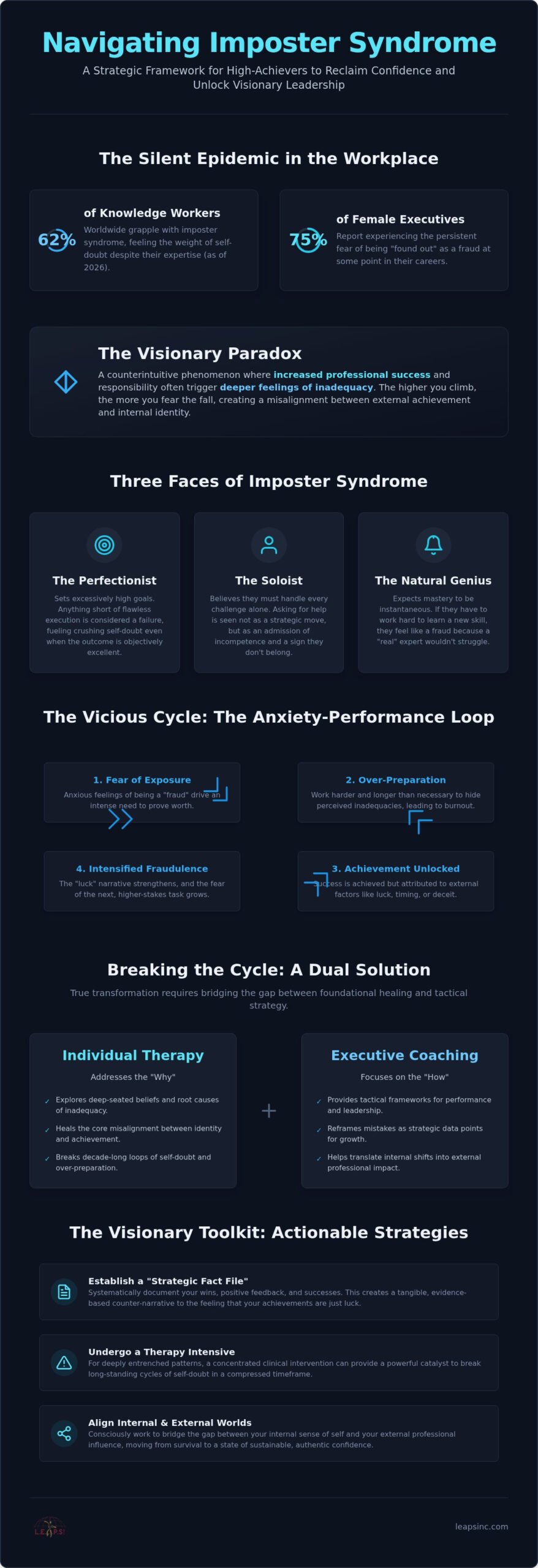
Did you know that as of 2026, 62% of knowledge workers worldwide are currently grappling with the silent weight of imposter syndrome? Even among the most accomplished circles, 75% of female executives report that they have faced the persistent fear of being “found out.” Learning how to deal with imposter syndrome at work isn’t just about managing a temporary dip in confidence; it’s about reclaiming your professional destiny. You likely know the exhaustion of over-preparing until you reach the edge of burnout, or the hollow feeling of attributing your greatest milestones to mere luck rather than hard-earned skill.
It’s a heavy burden that tethers your performance to your anxiety, but it doesn’t have to define your career trajectory. This article provides the clinical and strategic frameworks you need to transform that internal friction into a catalyst for visionary leadership. We’ll explore how integrating Individual Therapy with high-level Executive Coaching can dissolve the “fraud” narrative and unlock your maximum potential. By aligning your internal identity with your external impact, you can move beyond mere survival toward a state of sustainable confidence and executive excellence.
Key Takeaways
- Decode the “Visionary Paradox” to understand why increased professional success often triggers deeper feelings of inadequacy rather than resolving them.
- Learn how to deal with imposter syndrome at work by bridging the gap between the tactical focus of Executive Coaching and the foundational healing found in Individual Therapy.
- Establish a “Strategic Fact File” to document your wins, effectively dismantling the persistent narrative that your achievements are merely the result of luck.
- Discover how a Therapy Intensive can provide the concentrated clinical intervention needed to break decade-long loops of self-doubt and over-preparation.
- Align your internal sense of self with your external professional influence to reach a peak state of visionary leadership and mental freedom.
The Architecture of Imposter Syndrome: Why High-Achievers Feel Like Frauds
Impostor syndrome is often dismissed as a mere lack of confidence, but for the high-achiever, it’s a complex clinical architecture of self-doubt. It’s defined as a persistent inability to internalize success, where every accolade feels like a temporary reprieve before an inevitable exposure. This isn’t just feeling nervous. It’s a fundamental misalignment between your external achievements and your internal identity. When you search for how to deal with imposter syndrome at work, you’re often looking for a strategic fix to a psychological barrier that prevents you from fulfilling your destiny.
This leads to what we call the Visionary Paradox. As you ascend the corporate or entrepreneurial ladder, the feelings of fraudulence often intensify rather than dissipate. Greater success creates a larger platform; a platform that feels like a higher pedestal from which to fall. This clinical intersection of high-performance standards and anxiety creates a loop where success is attributed to luck, timing, or deceit. It’s a symptom of a misaligned professional worldview that prioritizes perfection over progress.
The Five Competence Types and Their Triggers
High-achievers typically fall into specific psychological profiles that dictate their response to pressure. Understanding these is the first step in learning how to deal with imposter syndrome at work effectively:
- The Perfectionist: For the visionary, “good” is never enough. They set excessively high goals and experience crushing self-doubt when they fail to reach them, even if the outcome was objectively excellent.
- The Soloist: These individuals believe they must handle every challenge alone. To the soloist, asking for help isn’t a strategic move; it’s an admission of incompetence and a sign that they don’t belong in their role.
- The Natural Genius: This type expects mastery to be instantaneous. When they have to work hard to learn a new skill, their internal narrative tells them they’re a fraud because a “real” expert wouldn’t struggle.
The Cost of the ‘Fraud’ Narrative
The “fraud” narrative carries a heavy price that extends beyond the boardroom. It leads to strategic paralysis, where leaders avoid bold moves or new opportunities because they fear increased scrutiny. This emotional toll frequently leaks into family dynamics and personal well-being, creating a state of perpetual exhaustion and burnout. To break this cycle, many professionals turn to Individual Therapy. This clinical approach addresses deep-seated feelings of inadequacy, allowing you to bridge the gap between your inner life and your professional executive success.
The Root Causes: Worldview, Values, and the Performance Loop
Many high-achievers trace their current professional self-doubt back to early academic “labeling.” When you’re labeled as “gifted” or “talented” as a child, your identity often becomes tied to effortless mastery. This creates a fragile professional foundation where mistakes aren’t seen as part of a learning curve, but as a loss of self. Understanding this history is a vital part of learning how to deal with imposter syndrome at work. When your identity is built on being “naturally” superior, any struggle feels like evidence that the label was a mistake.
This fragility fuels the Anxiety-Performance Loop. Unlike traditional anxiety that might hinder performance, this loop uses success as fuel for more fear. You work harder to hide the perceived “fraud,” which leads to more success, which then raises the stakes for the next project. A leader’s fundamental worldview acts as the lens that either filters professional feedback as constructive growth or distorts it into a verdict of personal fraudulence. Without intervention, this cycle continues until it reaches the point of burnout or strategic paralysis.
Internalized Standards vs. Realistic Excellence
There’s a thin line between healthy striving and neurotic perfectionism. Healthy striving focuses on the process and the joy of mastery, whereas neurotic perfectionism acts as a shield against the pain of perceived inadequacy. Reframing these expectations requires a “Visionary Mentor” perspective that views mistakes as strategic data points rather than character flaws. One of the most effective ways to stabilize your professional identity is by identifying your core values, ensuring your daily output aligns with your internal “why.” When your work matches your deepest values, the external noise of doubt begins to fade, allowing your maximum potential to surface.
The Impact of Corporate Culture
Corporate culture often exacerbates these internal battles, especially in the high-pressure environment of the C-suite. A lack of psychological safety makes vulnerability feel like a liability, forcing leaders to wear a mask of constant certainty. This is where Corporate Visioning becomes essential. It aligns the individual’s professional path with the company’s trajectory, creating a shared sense of purpose that transcends individual ego. You must engage in an internal PR battle, choosing to trust the data of your achievements over the whispers of doubt. Taking Practical Steps to Boost Career Confidence involves shifting your focus from “proving” yourself to “improving” the organization. If you find that these patterns are preventing you from reaching your destiny, it might be time to consult with a professional who understands the unique pressures of high-level leadership.
Strategic Reframing: Therapy vs. Coaching for Imposter Syndrome
Choosing the right intervention is a strategic decision that dictates the speed of your professional transformation. While many resources offer general advice on how to deal with imposter syndrome at work, high-achievers require a more nuanced distinction between clinical healing and tactical development. Understanding the nuances of therapy vs coaching allows you to address the root causes of self-doubt while simultaneously sharpening your leadership edge. For many, an Employee Assistance Program (EAP) serves as the initial gateway to these resources, providing a confidential first line of defense against the erosion of professional confidence.
An integrated approach represents a significant strategic advantage. It treats your emotional well-being and executive performance as two sides of the same coin. By addressing the psychological underpinnings of the “fraud” narrative through therapy and then operationalizing that newfound confidence through coaching, you create a resilient professional identity. This synergy ensures you aren’t just managing symptoms but are actively evolving into the leader you were destined to be.
When to Seek Clinical Individual Therapy
Clinical intervention becomes necessary when professional self-doubt begins to bleed into your foundational mental health. If your fear of failure has crossed into persistent anxiety, sleep disturbances, or depressive episodes, it’s a sign that the “imposter” has taken deep root. Individual Therapy focuses on processing the inner life, uncovering the childhood patterns or traumatic professional events that created a fragile sense of self. It is the work of rebuilding self-efficacy from the ground up, ensuring that you’re emotionally equipped to fulfill your professional destiny without the weight of constant inadequacy.
When Executive Coaching is the Catalyst
If you possess a relatively stable foundation but struggle to project authority or make bold decisions, Executive Coaching is the ideal catalyst. Coaching is inherently forward-facing; it focuses on mastering internal narratives to build a commanding executive presence. Leaders use this tool to operationalize confidence in the boardroom, turning strategic insights into decisive action. Overcoming workplace imposter syndrome requires more than just mindset shifts. It demands the development of specific behavioral frameworks that align your performance with your visionary goals. Developing these skills is a practical way to learn how to deal with imposter syndrome at work while maintaining a high-stakes career. For entrepreneurs and C-suite leaders, this strategic performance enhancement is what separates those who merely occupy a role from those who truly lead it.
The Visionary Toolkit: How to Deal with Imposter Syndrome at Work
Moving from a state of silent anxiety to one of visionary leadership requires a tactical shift in how you process your professional existence. Learning how to deal with imposter syndrome at work isn’t about positive thinking; it’s about deploying a structured toolkit that aligns your internal reality with your external success. This process involves five critical steps: fact-checking your personal narrative, externalizing the voice of doubt, reframing setbacks as strategic data, practicing radical transparency, and engaging in specialized mentorship. These aren’t just coping mechanisms. They are growth protocols designed to unlock your maximum potential and help you fulfill your professional destiny.
- Fact-Check the Narrative: Maintain a “Strategic Fact File” that documents every win, testimonial, and solved problem to ground your identity in evidence.
- Externalize the Imposter: Give the voice of doubt a name to create psychological distance between your identity and your temporary feelings of inadequacy.
- Reframe Failure: View every setback as “Strategic Data” rather than a personal indictment of your abilities or your future potential.
- Radical Transparency: Share your challenges with trusted peers to kill the “fraud” narrative through authentic connection and collective honesty.
- Specialized Mentorship: Seek guidance from those who have already navigated the complexities of high-level leadership to move from isolation to growth.
Building Your Fact File
Tracking your impact requires looking beyond standard KPIs. While revenue and growth metrics are important, you must also document your influence on company culture, the development of your team, and the complex problems you’ve navigated. Fact-checking is a cognitive tool for high-achievers that anchors professional identity in verifiable data rather than emotional fluctuations. When self-doubt rises, your Fact File serves as a strategic resource to recalibrate your internal compass and remind you of your hard-earned credibility. Seeking external validation from a seasoned mentor can further solidify this file, providing an objective perspective on your contributions that you might otherwise overlook in moments of doubt.
The Power of Vulnerability in Leadership
The most effective leaders in 2026 are those who possess the courage to admit what they don’t know. This radical transparency builds deep trust within an organization and effectively dismantles the fear of being “found out.” By moving from the pressure of being “perfect” to the freedom of being “known,” you transform your leadership style into something far more resilient and inspirational. Leveraging leadership coaching can help you master this authentic communication, allowing you to turn vulnerability into a strategic asset. When you’re ready to transcend the “fraud” narrative and step into your professional destiny, you can schedule a strategic consultation to begin your transformation into a more confident, visionary leader.
Accelerating Transformation: The Role of Therapy Intensives
Standard therapeutic models often operate on a slow, incremental timeline that doesn’t always align with the high-velocity world of executive leadership. If you’re a high-achiever, you don’t have years to wait for a breakthrough. A Therapy Intensive serves as a deep-dive clinical intervention, compressing months of traditional work into a single weekend or a few concentrated days. This format is uniquely equipped to break decade-long imposter loops by providing the space and depth necessary for profound psychological shifts. It’s a high-impact solution for those who possess a burning desire to align their internal identity with their external success.
The synergy of clinical depth and professional visioning in an intensive format creates a catalyst for rapid growth. At LEAPS Inc., we understand that high-stakes leaders require more than just symptom management; they need a comprehensive overhaul of their internal narrative. By dedicating focused time to this process, you can bypass the surface-level distractions of daily work life and engage in the deep work required to fulfill your professional destiny. This isn’t just about feeling better. It’s about reaching a peak state where your visionary energy is no longer drained by the friction of self-doubt.
The Intensive Methodology
The true power of this format lies in moving beyond the limits of the traditional 50-minute hour. During an intensive, we utilize a structured categorization of emotional barriers to systematically dismantle the “fraud” narrative. We identify the specific triggers, whether they’re rooted in early academic labeling or the “Visionary Paradox,” and process them in real-time. This immersive approach allows for the holistic integration of emotional well-being and professional performance. For busy leaders, the long-term ROI of this short-term clinical investment is unparalleled. It provides a definitive answer for how to deal with imposter syndrome at work by offering a clear, methodical path toward mental freedom.
Taking the LEAPS Toward Your Destiny
Your journey from the “shadow” of persistent self-doubt to the state of a visionary leader is a strategic evolution. It’s a process of reclaiming your professional destiny and unlocking the latent abilities that have been suppressed by the fear of failure. The final reframing is simple: imposter syndrome isn’t a sign of weakness, but the threshold to your maximum potential. It’s an invitation to step into a higher state of consciousness and professional impact. At LEAPS Inc., we facilitate this transformation by treating your inner life and your executive career as a single, unified mission. If you’re ready to leave the fraud narrative behind and embrace your true purpose, you can schedule an appointment to begin your transformation today.
Step Into Your Professional Destiny
Transcending the “fraud” narrative is not just a personal victory; it’s a strategic necessity for high-level leadership. You’ve explored the complex architecture of self-doubt and learned how to deal with imposter syndrome at work by aligning your internal identity with your external impact. By integrating clinical Individual Therapy with high-energy Executive Coaching, you can finally bridge the gap between your emotional well-being and your professional performance. This holistic approach ensures that your success is no longer a source of anxiety, but a foundation for visionary influence.
Founded on the expertise of Dr. John E. N. Daniel, LEAPS Inc. specializes in facilitating this transformation through unique interventions like our high-impact Therapy Intensive. We don’t just help you manage symptoms; we challenge you to unlock your maximum potential and fulfill your life’s purpose. It’s time to stop over-preparing and start leading with sustainable confidence and internal freedom. Ready to transcend self-doubt? Schedule your consultation with LEAPS Inc. today. Your destiny is waiting for you to claim it with clarity and power.
Frequently Asked Questions
Is imposter syndrome a recognized mental health condition?
Imposter syndrome is not a formal mental health diagnosis but a persistent psychological pattern of self-doubt. While it’s not listed in the DSM-5, it often acts as a clinical precursor to anxiety or professional burnout. High-achievers frequently experience this internal friction when their external success outpaces their internal sense of worth. Addressing these feelings through Individual Therapy can help prevent them from evolving into more severe challenges that hinder your professional destiny.
Can imposter syndrome actually be a good thing for my career?
While some argue that a small amount of self-doubt keeps you humble or driven, chronic imposter syndrome is generally detrimental to visionary leadership. It creates a state of neurotic perfectionism where you’re fueled by fear rather than purpose. Instead of viewing it as a “good thing,” see it as an invitation to align your internal identity with your external impact. Transforming this doubt into sustainable confidence is the true catalyst for reaching your maximum potential.
How do I know if I need therapy or coaching for my self-doubt?
Determining how to deal with imposter syndrome at work often depends on the depth of the issue. If your self-doubt is rooted in childhood patterns or leads to clinical anxiety, Individual Therapy is the appropriate foundation. However, if you’re looking to operationalize confidence in the boardroom or sharpen your executive presence, Executive Coaching is the ideal catalyst. Many leaders find that a holistic integration of both services provides the most comprehensive strategic advantage.
What happens if I ignore imposter syndrome at work?
Ignoring these feelings often leads to strategic paralysis and professional burnout. When you don’t address the “fraud” narrative, you may find yourself over-preparing to the point of exhaustion or avoiding high-stakes opportunities that could advance your career. The long-term cost includes a significant toll on your emotional well-being and family dynamics. Proactive intervention, such as a Therapy Intensive, can break this cycle before it permanently limits your professional trajectory and visionary impact.
How can I help an employee who is struggling with feeling like a fraud?
Supporting an employee requires fostering a culture of psychological safety where vulnerability isn’t viewed as a liability. Provide objective, data-driven feedback that helps them internalize their successes rather than attributing them to luck. Encouraging them to utilize the company’s Employee Assistance Program (EAP) can also provide a confidential first line of defense. By modeling authentic leadership, you help them move beyond the “fraud” narrative and toward their maximum professional potential and growth.
Can imposter syndrome return after I’ve successfully dealt with it?
It’s common for imposter syndrome to resurface during significant professional transitions or when you reach a new level of influence. This is known as the “Visionary Paradox,” where greater success creates a larger platform for potential scrutiny. The goal isn’t necessarily to eliminate the feeling forever but to develop the clinical and strategic frameworks to navigate it. Mastering how to deal with imposter syndrome at work involves building a resilient identity that remains stable despite external pressure.
What is the fastest way to overcome imposter syndrome during a promotion?
The most efficient way to navigate intense self-doubt during a promotion is through a Therapy Intensive. This deep-dive clinical intervention compresses months of traditional work into a few focused days, allowing you to quickly process emotional barriers. By dedicating concentrated time to your internal narrative, you can enter your new role with a stabilized sense of self-efficacy. This rapid transformation ensures that your promotion becomes a milestone of growth rather than a source of persistent anxiety.
Is imposter syndrome more common in certain industries or roles?
Verified data from 2026 shows that 62% of knowledge workers experience these feelings, but it’s particularly prevalent in high-stakes environments like the C-suite. A KPMG survey found that 75% of female executives have dealt with imposter syndrome at some point in their careers. Roles that require constant innovation or public-facing leadership often trigger specific competence types. Regardless of the industry, the phenomenon disproportionately affects those striving for visionary excellence and high-level professional achievement.