

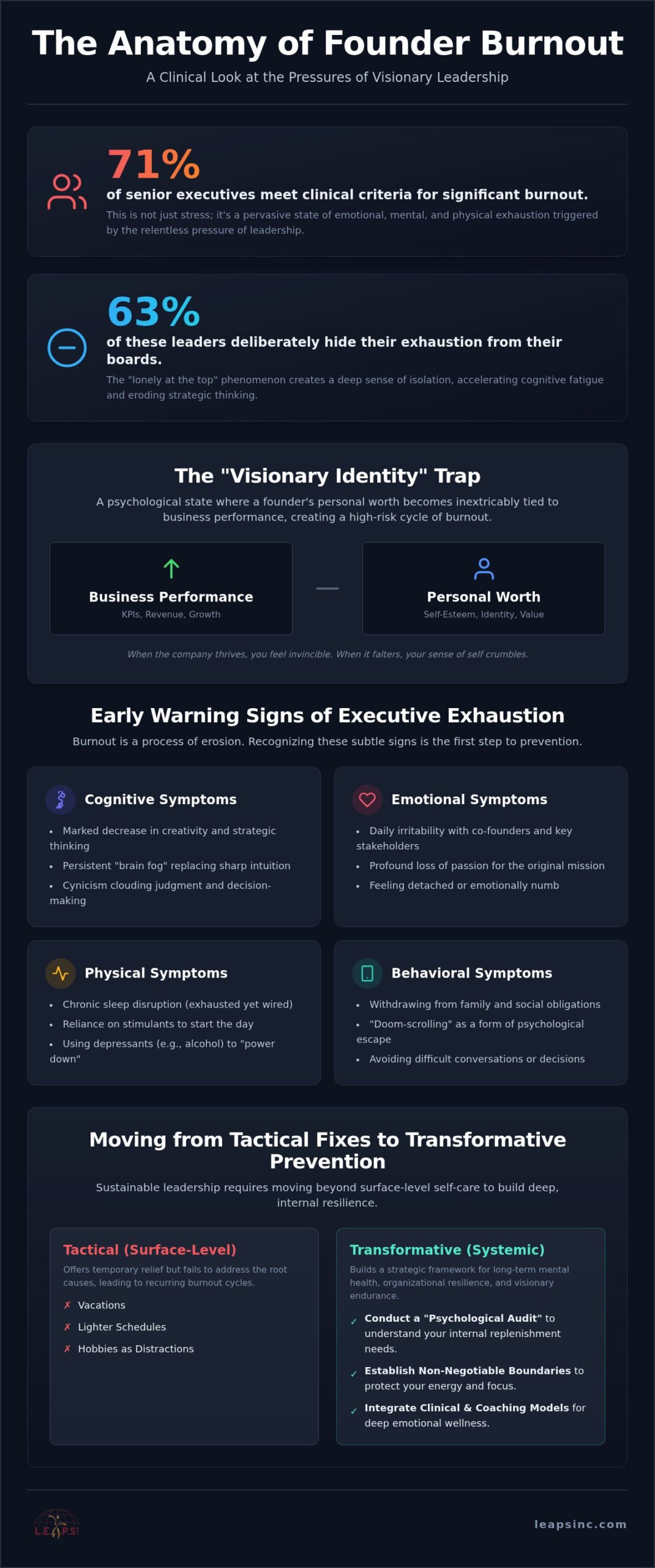
Did you know that 71% of senior executives and CEOs in 2026 meet the structured clinical criteria for significant burnout? Even more alarming, 63% of those leaders are deliberately hiding the depth of their exhaustion from their boards. You likely understand the weight of this heavy silence. You’ve built a visionary business, but the blurring of your personal identity with your company’s success has left you feeling isolated despite being surrounded by a team. Chronic decision fatigue isn’t just a byproduct of growth; it’s a signal that your internal replenishment has fallen out of alignment with your professional output.
Understanding how to prevent founder burnout requires more than just a temporary vacation or a lighter schedule. Discover a clinical and strategic framework designed to safeguard your mental health while you continue to scale your visionary business. We’ll explore how to reclaim your personal power and joy by building organizational resilience that doesn’t depend on your depletion. It’s time to move toward your maximum potential without sacrificing the very life you’re working to build.
Key Takeaways
- Understand how the “Visionary Identity” creates a psychological trap where your personal worth becomes inextricably linked to business performance.
- Identify the subtle cognitive and emotional warning signs of executive exhaustion that often precede a full leadership collapse.
- Discover a strategic framework for how to prevent founder burnout by moving beyond surface-level self-care toward transformative growth.
- Learn to conduct a comprehensive “Psychological Audit” to establish non-negotiable boundaries for your internal replenishment.
- Explore the benefits of an integrated clinical-coaching model that merges professional expertise with deep emotional wellness.
The Psychology of the Founder: Why High-Achievers are Wired for Burnout
Founder burnout is more than a bad week; it’s a pervasive state of emotional, mental, and physical exhaustion triggered by the relentless pressure of leadership. A 2026 clinical review of senior executives and CEOs by CEREVITY found that 71% met the structured clinical criteria for significant Occupational burnout. For the high-achiever, this often stems from the “Visionary Identity,” a psychological state where your personal worth is inextricably tied to business KPIs. When the company thrives, you feel invincible; when it falters, your sense of self crumbles.
Understanding how to prevent founder burnout requires looking at the engine of your success: high-functioning anxiety. While this trait often drives early-stage breakthroughs, it eventually leads to long-term depletion. You’re constantly operating through a visionary lens, focusing on the future state of your empire while neglecting the physiological and emotional needs of your present self. Learning how to prevent founder burnout is not about working less, but about leading with a sustainable internal structure.
The Interplay of Ambition and Vulnerability
Many founders view emotional vulnerability as a strategic liability. They believe that showing a crack in the armor will demoralize the team or spook investors. However, clinical reality shows that workaholism is frequently a defense mechanism against unaddressed trauma or deep-seated imposter syndrome. By staying perpetually busy, you successfully avoid the discomfort of your internal depth. This avoidance creates a temporary sense of safety but ultimately hollows out your leadership capacity. Visionary Burnout is a misalignment of purpose and pace.
The Isolation of the C-Suite
Leadership is inherently isolating. The “lonely at the top” phenomenon isn’t just a cliché; it’s a significant barrier to effective emotional regulation. Data shows that 63% of executives experiencing burnout deliberately hide the severity from their boards, further deepening this sense of solitude. When you have no one to share the burden of high-stakes decisions, your brain remains in a state of hyper-vigilance. This lack of a peer-level support system to mirror your experiences accelerates cognitive fatigue and erodes your ability to think strategically.
Establishing a confidential space for unfiltered expression is essential for long-term sustainability. Engaging in Individual Therapy allows you to untangle your identity from your balance sheet, ensuring you lead from a place of wholeness rather than deficit. This strategic intervention helps you reclaim your personal power and fulfill your ultimate destiny as a leader.
Identifying the Early Warning Signs of Executive Exhaustion
Burnout is not a sudden event; it’s a process of erosion. For the visionary leader, recognizing the onset of this decline is the most critical step in learning how to prevent founder burnout. When you’re operating at the edge of your capacity, the signs are often subtle, masquerading as mere “startup stress” until they settle into your neurological and emotional foundations. Ignoring these markers doesn’t make you stronger; it simply increases the “interest rate” on the emotional debt you’re accruing.
- Cognitive Symptoms: You experience a marked decrease in creativity, finding yourself stuck in repetitive “loops” during strategic planning. Cynicism begins to cloud your judgment, and a persistent “brain fog” replaces your once-sharp intuition.
- Emotional Symptoms: Irritability with co-founders or key stakeholders becomes a daily occurrence. You feel a profound loss of passion for the mission that once fueled your visionary energy.
- Physical Symptoms: Chronic sleep disruption leaves you exhausted yet wired. You may find yourself relying on stimulants to start the day and alcohol to dissociate or “power down” at night.
- Behavioral Shifts: You withdraw from family obligations and find yourself “doom-scrolling” as a form of psychological escape from the pressure of the C-suite.
The Subtle Shift from “Grind” to “Grit”
Startup culture often glorifies the “hero complex,” the belief that a founder’s suffering is a necessary tax on success. However, there’s a clinical distinction between healthy high-performance and pathological overextension. Grit is the capacity to endure toward a goal while maintaining your internal depth. Burnout is the moment work stops being a passion and starts being a prison. When your identity is solely defined by your output, you lose the ability to see when your “grind” has become a destructive cycle. Learning how to prevent founder burnout requires the courage to dismantle this hero narrative.
Measuring the “Steep Bill of Self-Denial”
Ignoring internal signals creates an emotional debt that eventually demands payment. This exhaustion doesn’t just affect your health; it permeates your entire organization. A burnt-out leader often struggles with Strategic Marketing and brand development, as the visionary energy required to project a compelling brand image is depleted. This stress trickles down, often leading to increased Employee Assistance Program (EAP) utilization across the team as the organizational resilience begins to fracture.
Reclaiming your leadership requires a structured, confidential intervention. If you recognize these signs in yourself, it’s time to speak with a seasoned mentor to begin your restoration and protect your company’s future.
Tactical vs. Transformative Prevention: Moving Beyond Surface-Level Self-Care
A week in the tropics won’t solve a crisis of identity. Tactical solutions like wellness apps or a brief vacation often fail because they treat the symptoms of exhaustion rather than the source. For a visionary leader, burnout is rarely just about the volume of work. It’s about the emotional tax of carrying the business’s entire future. True strategies for how to prevent founder burnout must move beyond surface-level relief. While tactical delegation might clear your inbox, only transformative growth through identity work can clear the cognitive fog that prevents high-level strategic thinking.
The research is clear: the median time from recognizing burnout to seeking a clinical session is 19 months. By the time most founders seek help, tactical rest is no longer enough. Integrating a worldview that prioritizes long-term impact over daily fire-fighting is essential. This requires a shift from being the operator to being the visionary. Utilizing Executive Coaching provides the mirror necessary to redefine your leadership style. It allows you to scale without self-immolation. It’s about moving from a state of reactive survival to a proactive pursuit of your maximum potential.
Reframing Boundaries as Strategic Assets
Personal time is not an indulgence or a sign of weakness. Instead, it’s visionary maintenance. Clinical research highlights the necessity of psychological detachment after hours to maintain neuroplasticity. Without this detachment, your brain remains in a loop of hyper-vigilance, destroying the very creativity your business requires. To understand the intersection of performance and mental health, explore The Founder’s Edge: Coaching for Scale and Sanity. You don’t just need a break; you need a boundary that functions as a strategic asset.
The Power of the Therapy Intensive
Standard weekly sessions often feel too slow for the fast-paced life of an entrepreneur. A Therapy Intensive offers a deep-dive intervention that can bypass months of traditional talk therapy in just a few days. This structured, high-impact format allows for a total reset of your destiny path. It addresses the core psychological drivers of your behavior, ensuring that when you learn how to prevent founder burnout, the changes are permanent rather than temporary. You deserve a recovery process that matches the intensity of your ambition.
Building a Resilience Framework: Strategic Boundaries for the Modern Founder
Constructing a resilience framework requires moving beyond abstract intentions into a structured, strategic architecture. When considering how to prevent founder burnout, you must treat your internal replenishment with the same rigor you apply to your quarterly revenue targets. Resilience isn’t a passive trait you possess; it’s an active system you build. This framework ensures that your visionary output remains consistent and sustainable as you scale toward your destiny.
- Step 1: Conduct a Psychological Audit. Review your weekly calendar to identify “energy leaks.” Differentiate between high-leverage strategic work and low-value tasks that contribute to chronic decision fatigue.
- Step 2: Establish Non-Negotiable Zones. Designate specific blocks of time for deep emotional replenishment. These zones are sacred and must be protected from the intrusion of digital notifications or fire-fighting.
- Step 3: Implement a Visionary Council. Surround yourself with an objective support system, including clinical therapists and executive coaches, who provide the unbiased feedback necessary for accurate self-reflection.
- Step 4: Align Organizational Culture. Extend your resilience model to your team by implementing Workplace Wellness Programs. A healthy organizational ecosystem prevents the founder from becoming the sole shock absorber for the company’s stress.
Integrating Individual Therapy and Professional Coaching
The most successful leaders recognize that internal healing and strategic advancement are two sides of the same coin. While Entrepreneurship Coaching focuses on the tactical pressures of scaling and market positioning, individual therapy addresses the psychological roots of your leadership style. This synergy allows you to dismantle the “identity trap” while simultaneously refining your business acumen. Strength starts with the courage to seek professional counsel.
The Role of Family and Couples Counseling
Burnout rarely stays confined to the office. It often results in significant collateral damage to personal relationships, leading to a sense of isolation even at home. Utilizing Couples Therapy provides a foundation of support, ensuring your partnership becomes a source of strength rather than another site of conflict. For a deeper look at maintaining intimacy while leading, read Modern Connection: The Visionary Guide to Couples Counseling. Safeguarding your home life is a critical component of how to prevent founder burnout.
Your destiny as a leader depends on your longevity. Schedule an appointment today to begin architecting your personalized resilience framework and reclaiming your personal power.
The LEAPS Approach: Merging Clinical Authority with Visionary Leadership
The LEAPS approach represents a sophisticated synthesis of clinical psychology and executive strategy. At LEAPS Inc., we facilitate your maximum potential by moving beyond the silos of traditional professional development. Most leaders are forced to choose between a therapist who doesn’t understand venture capital or a coach who isn’t trained to handle deep-seated emotional trauma. Our model bridges this divide. By working with a seasoned mentor who understands both the diagnostic complexities of the DSM-5 and the strategic pressures of a P&L statement, you gain a partner who sees the whole person. This integration is the definitive answer to how to prevent founder burnout while pursuing a legacy of impact.
Destiny and life purpose are not abstract concepts; they are the ultimate antidotes to the exhaustion described in previous sections. When your leadership is anchored in a defined sense of purpose, you move from a state of reactive survival to a state of visionary thriving. This shift allows you to view your business not as a burden to be managed, but as a vehicle for your life’s work. Understanding how to prevent founder burnout is ultimately about aligning your daily pace with your eternal purpose.
Our Multi-Disciplinary Intervention
Our intervention model seamlessly blends Business Coaching with Individual Therapy to address the multifaceted nature of leadership. This multi-disciplinary approach ensures that your strategic advancement is mirrored by internal growth. We maintain the highest standards of professionalism and confidentiality, providing a secure environment where you can explore your vulnerabilities without compromising your professional standing. It’s time to reclaim your power through a professional partnership that values your mental health as much as your market share.
Corporate Visioning for Sustainable Growth
Sustainable leadership requires a resilient organizational ecosystem. Through Corporate Visioning, we help you align your team culture with your personal well-being. By building a structure that supports collective resilience, you reduce the heavy burden of being the sole visionary shock absorber for the company. This strategic alignment ensures that the business can scale without requiring your total depletion. You’ve spent years building your business; now it’s time to build a life that can sustain it. To begin your transformation and secure your future, Schedule a Consultation today.
Architecting Your Visionary Legacy
Sustainable leadership requires more than grit; it demands a profound alignment between your internal depth and your professional ambition. We’ve explored how true transformation occurs when you move beyond surface-level self-care to address the core psychological drivers of your exhaustion. By establishing a resilience framework and integrating clinical authority with strategic advancement, you protect both your mental health and your company’s future. Mastering the art of how to prevent founder burnout is the first step toward fulfilling your ultimate destiny as a leader.
LEAPS Inc., led by Dr. John E. N. Daniel, offers a national reach with specialized therapy intensives and an integrated approach that combines clinical therapy with high-level business coaching. This multi-disciplinary support ensures you don’t have to choose between your well-being and your visionary success. You possess the capacity for extraordinary growth. With the right professional partnership, your potential is limitless.
Begin your journey toward visionary resilience; Schedule your consultation with LEAPS Inc. today.
Frequently Asked Questions
How do I know if I am just stressed or actually experiencing founder burnout?
Stress is typically a reaction to immediate pressures that subsides once a deadline passes. Burnout is a persistent state of emotional and physical exhaustion where you feel a profound sense of detachment from your vision. If you find yourself consistently irritable, cynical, or unable to find joy in your milestones, you’ve moved past simple stress into a clinical burnout state. Recognizing this shift is vital for understanding how to prevent founder burnout before it causes permanent damage.
Can I prevent burnout without stepping away from my CEO role?
You don’t always need to resign to recover; instead, you must redesign your leadership framework. This involves shifting from an operator mindset to a visionary role by establishing non-negotiable boundaries and delegating low-leverage tasks. By integrating strategic interventions like individual therapy, you can rebuild your resilience while remaining at the helm. Recovery is about changing how you lead, not necessarily leaving the position you’ve spent years building.
What is the difference between executive coaching and individual therapy for founders?
Executive coaching focuses on tactical performance, leadership skills, and strategic business outcomes. Individual therapy addresses the internal psychological roots, such as imposter syndrome, identity fusion, or unaddressed trauma that drives workaholism. While coaching helps you scale your company, therapy helps you scale your capacity for emotional regulation. At LEAPS Inc., we often integrate both to ensure your professional advancement is supported by a stable and secure internal foundation.
How does founder burnout affect the rest of the team and company culture?
A burnt-out founder often becomes a bottleneck, causing organizational paralysis through indecision or irritability. This emotional state trickles down, eroding trust and psychological safety within the team. When leadership is depleted, Employee Assistance Program (EAP) utilization often spikes as staff mirror the founder’s stress. Building a resilient culture starts with a leader who models sustainable practices and emotional wellness, ensuring the entire ecosystem remains productive and visionary.
Why are therapy intensives recommended for busy entrepreneurs?
Therapy intensives are designed for leaders who require rapid, deep-seated transformation that standard weekly sessions cannot provide. These multi-day interventions bypass months of traditional talk therapy by focusing intensely on the core psychological drivers of your behavior. For a busy entrepreneur, this high-impact format respects your schedule while facilitating the profound identity reset necessary to sustain a high-growth business and reclaim your life purpose and destiny.
Is founder burnout more common in the early stages or during scaling?
Burnout occurs at every stage, but the nature of the exhaustion shifts. Early-stage founders often face survival burnout from sheer physical overextension and resource scarcity. During scaling, leaders experience complexity burnout caused by isolation, high-stakes decision fatigue, and the blurring of personal identity with business KPIs. Research indicates that 71% of senior executives meet clinical burnout criteria, suggesting that the pressures of growth are often more psychologically taxing than the initial launch.
How can a workplace wellness program help prevent leadership burnout?
An Employee Assistance Program (EAP) serves as a vital tool for organizational wellness by redistributing the emotional load across the company. By providing professional support for the entire team, you reduce the burden on yourself as the sole problem-solver. These programs foster a culture of resilience, making it easier for everyone to maintain peak performance. Learning how to prevent founder burnout often involves leveraging these institutional frameworks to safeguard your own visionary energy.
What are the first steps to take once I realize I am burnt out?
Your first priority is to stop the energy leak by conducting a psychological audit of your current obligations. You should immediately follow these steps:
- Establish a non-negotiable zone for daily replenishment.
- Communicate your needs with a trusted co-founder or board member.
- Seek professional counsel through individual therapy or executive coaching.
Taking these actions allows you to regain a sense of agency and begin the journey toward fulfilling your maximum potential as a leader.