

Change is situational, but transition is fundamentally psychological. When a career pivot, relational shift, or sudden crossroads strips away the roles that once anchored you, the disruption rarely stays confined to your calendar. Seeking out dedicated therapy for life transitions bridges the gap between clinical depth and visionary purpose, ensuring you don’t merely survive the turbulence, but transform it into a catalyst for profound personal renewal.
You already know how exhausting it is to project effortless confidence while privately wrestling with decision paralysis, role disorientation, and acute anticipatory anxiety. It’s an isolating burden to bear alone. Discover how specialized therapeutic frameworks restore your psychological equilibrium, replace chronic self-doubt with reliable emotional regulation, and align your next chapter with your deepest values.
Ahead, we explore the clinical mechanics of identity shifts, structured modalities for sustainable inner stability, and actionable strategies to design an intentional, meaningful path forward.
Key Takeaways
- Distinguish between external events and internal psychological adaptation to understand how specialized therapy for life transitions turns disruptive upheaval into purposeful evolution.
- Unpack the neurobiology of uncertainty and William Bridges’ transition stages, discovering how to maintain stability inside the ambiguous “neutral zone.”
- Explore why multi-domain life shifts demand integrated, multi-modal clinical strategies rather than singular, surface-level coping mechanisms.
- Evaluate the strategic trade-offs between weekly individual sessions and accelerated therapy intensives to match your personal timeline and depth of need.
- Identify the core clinical credentials, verified licensure, and philosophical alignment required to partner with a practitioner who supports your long-term vision.
What Is Therapy for Life Transitions and Why Does It Matter?
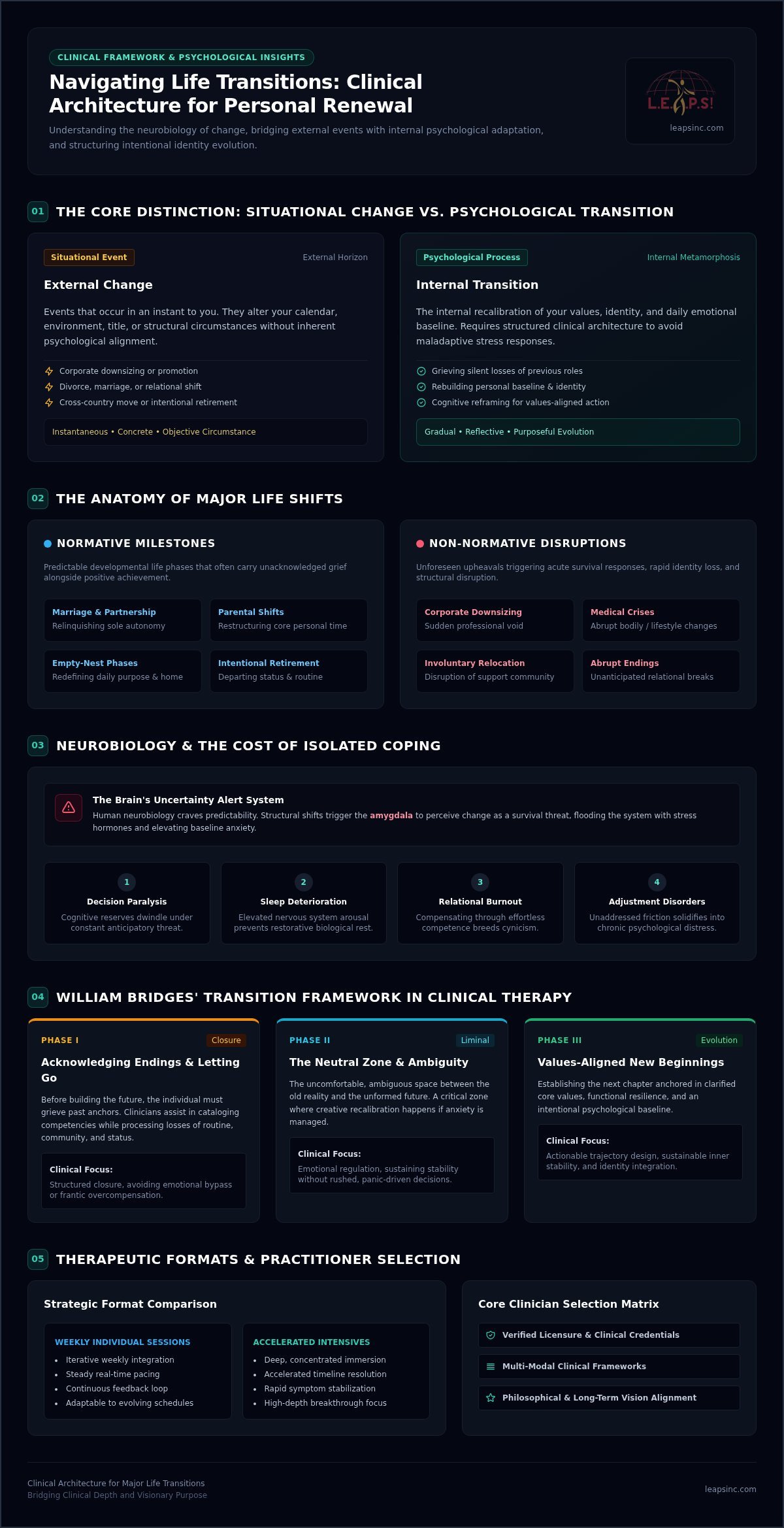
External change happens to you; internal transition happens within you. Situational events like a promotion, divorce, retirement, or cross-country move occur in an instant. The psychological transition, however, requires recalibrating your values, identity, and daily emotional baseline. Specialized therapy for life transitions provides clinical architecture for this internal metamorphosis. Without structured processing, acute upheaval often solidifies into a maladaptive response to a psychosocial stressor, causing functional paralysis, unaddressed grief, and chronic nervous system activation.
To better understand this specialized approach, watch this overview of how clinical guidance supports pivotal shifts:
Clinical intervention acts as an anchor. It transforms chaotic changes into structured platforms for intentional evolution, preventing short-term friction from morphing into long-term despair.
The Anatomy of Major Life Shifts
Life transitions generally split into two distinct categories, each requiring tailored clinical sensitivity:
- Normative milestones: Predictable developmental steps, including marriage, parental shifts, empty-nest phases, and intentional retirement.
- Non-normative disruptions: Unforeseen upheavals such as sudden corporate downsizing, medical crises, involuntary relocation, or abrupt relationship endings.
Even positive achievements carry hidden grief. Stepping into an executive role or getting married means saying goodbye to past freedoms and established identities. Therapy honors that silent loss without diminishing your excitement for the road ahead.
The Psychological Cost of Navigating Transitions in Isolation
High achievers routinely mask acute transitional distress behind relentless competence. Outwardly, projects cross the finish line and calendars remain pristine. Inwardly, decision fatigue compounds, sleep deteriorates, and cognitive reserves dwindle.
Suppressing identity disorientation breeds cynicism and relational burnout. Enlisting dedicated individual therapy breaks this private isolation, equipping you with concrete cognitive reframing tools to regain your emotional center and lead your life with clear purpose.
The Psychology of Change: Navigating the Stages of Personal Transition
Human neurobiology craves predictability. Your brain interprets sudden structural shifts as survival threats, lighting up the amygdala and flooding your system with stress hormones. When an established career path, long-standing relationship, or familiar lifestyle ends, your psychological baseline shatters. This is why William Bridges’ seminal transition model remains essential: real evolution doesn’t happen overnight. It unfolds methodically across three distinct phases that require intentional navigation rather than rushed solutions.
Specialized therapy for life transitions provides the clinical scaffolding to guide you through these stages without allowing acute anxiety to dictate your future.
Phase 1: Acknowledging Endings and Processing Letting Go
Every transformation begins with an ending. Before you can build what comes next, you have to grieve what you left behind. High performers frequently bypass this phase through aggressive overcompensation, frantic planning, or emotional numbing. Unprocessed endings, however, simply drag old baggage into new chapters.
Therapy introduces structured closure. Clinicians help you acknowledge the tangible losses of routine, community, and status while cataloging the competencies you will carry forward.
Phase 2: Mastering the Neutral Zone and Creative Ambiguity
The neutral zone is the uncomfortable, liminal space between the old reality and the unformed future. In this middle ground, old habits no longer work, yet the new identity hasn’t solidified. Feelings of emptiness, low motivation, and disorientation are completely natural here.
Rather than treating this phase as a void to escape, exploring diverse types of therapy reframes it as fertile ground. You learn to tolerate ambiguity, test fresh ideas, and recalibrate your internal compass without the pressure of immediate perfection.
Phase 3: The New Beginning and Reconstructing Core Identity
A true new beginning isn’t merely a change in scenery; it’s a profound identity reconstruction. Here, you release reliance on external titles and ground your self-worth in internal values. You step into your next chapter with calibrated purpose, establishing clear boundaries, realistic behavioral routines, and a renewed sense of personal agency.
When you’re ready to bridge the gap between where you are and where you are meant to be, schedule an appointment with a seasoned clinician who understands the psychological architecture of change.
Common Life Transitions and How Tailored Clinical Modalities Help
Major life shifts rarely stay confined to a single lane. When your career pivots, your marriage feels the reverberation. When your children leave home, your core sense of purpose demands an audit. Relying on a rigid, single-modality approach often falls short because life disruptions are systemic. Comprehensive therapy for life transitions evaluates the entire human ecosystem, marrying psychological depth with strategic action to create lasting personal transformation.
The matrix below highlights how specialized clinical modalities target specific transitional disruptions:
- Executive elevation & exits: Addressed via Cognitive Behavioral Therapy (CBT) and leadership psychology to resolve imposter fears and existential vacuums.
- Relational reorganizations: Resolved through systemic family therapy and attachment-focused work to rebuild interpersonal safety.
- Midlife identity pivots: Supported by Acceptance and Commitment Therapy (ACT) and values-based exploration to unlock intrinsic motivation.
Career Evolution, Executive Elevation, and Retirement
Rapid professional promotions often trigger acute imposter phenomenon. Executives suddenly find themselves leading wider initiatives while silently fearing exposure. Conversely, founders navigating an acquisition or leaders entering retirement frequently face a vacuum of significance. Without daily operational demands, their core purpose feels unanchored. Therapy builds ironclad internal boundaries, decoupling your intrinsic self-worth from external milestones while refining your leadership presence.
Relational Reconfigurations: Marriage, Divorce, and Family Realignment
Blending families, recalibrating after divorce, or welcoming a first child stretches relational dynamics to their breaking points. Unspoken resentments and competing loyalties quickly create emotional distance within homes.
Utilizing dedicated family therapy restores emotional co-regulation and diffuses systemic domestic tension. This approach provides structured protocols to protect dependents from adult conflict, creating a unified environment where every member feels validated and secure.
Midlife Recalibration and Existential Awakening
Midlife frequently arrives with a quiet reckoning. The external signposts of achievement, such as titles, income, and status, suddenly feel insufficient. Many individuals confront acute dread over unfulfilled callings and perceived time constraints.
Clinical work guides you away from chasing outside approval and points you toward authentic self-actualization. By mastering strategic introspection, you can clarify your personal philosophy and discover actionable therapeutic insights that turn existential uncertainty into a grounded, values-aligned trajectory for the second half of your life.
Therapy Formats for Navigating Change: Traditional Sessions vs. Intensives
Timing dictates clinical strategy. When you embark on specialized therapy for life transitions, the structure of your care matters just as much as the modality itself. Some crossroads require patient, iterative reflection spread across months; others present immediate, high-stakes inflection points demanding rapid resolution. Choosing between weekly clinical sessions and concentrated deep dives hinges on your emotional bandwidth, current schedule flexibility, and the velocity of the changes around you.
Consider this practical framework to evaluate your clinical pacing needs:
- Weekly cadence: Best for unfolding developmental stages where small behavioral shifts require real-time testing between appointments.
- Intensive format: Ideal for urgent, high-stakes crossroads where standard 50-minute blocks break concentration before meaningful resolution occurs.
When Traditional Ongoing Therapy Is the Optimal Path
Weekly 50-minute clinical sessions provide a steady, predictable holding environment. This cadence shines when you’re managing multi-month evolutions, such as adjusting to a gradual organizational restructuring, adapting to an evolving family role, or working through prolonged lifestyle realignments.
The primary advantage lies in iterative integration. You explore a cognitive barrier on Tuesday, test a new boundary on Thursday, and unpack the emotional feedback loop the following week. Over time, these small adjustments rewire baseline behavioral responses and anchor enduring self-efficacy.
The Power of Accelerated Therapy Intensives for Rapid Breakthroughs
Certain junctures cannot wait for months of weekly scheduling. Multi-day therapeutic engagements remove the friction of weekly warm-ups and premature session closures. By stepping completely outside daily operational demands, you grant your nervous system the prolonged focus needed to untangle deeply rooted impasses.
Opting for a focused therapy intensive condenses months of traditional clinical work into an immersive, multi-day engagement. These uninterrupted blocks allow clinicians to pinpoint core cognitive roadblocks, process systemic emotional fatigue, and formulate concrete roadmaps without the constant interruption of everyday fires.
Whether you need consistent weekly alignment or an accelerated clinical breakthrough to master your next chapter, you can schedule an appointment today to partner with a seasoned specialist dedicated to your personal and professional evolution.
Reclaiming Your Trajectory: How to Select the Right Transition Therapist
Selecting a clinical partner during a life crossroads involves far more than filtering an insurance directory. The quality of your outcome depends on finding a practitioner who bridges deep clinical mastery with high-level forward momentum. Rigorous therapy for life transitions demands advanced training, active engagement, and an unwavering respect for your broader life purpose. Instead of settling for a passive sounding board, look for a clinician who actively helps you deconstruct old limitations and build an intentional future.
When vetting prospective practitioners, evaluate these critical markers:
- Verified clinical licensure: Confirm active credentials (such as LPC, LCSW, LMFT, PhD, or PsyD) and post-graduate hours via your state licensing board database.
- Multi-systemic expertise: Ensure they understand how emotional turbulence directly intersects with leadership obligations and family systems.
- Methodological alignment: Clarify whether their modalities balance past emotional processing with proactive behavioral architecture.
Key Criteria: Clinical Authority and Aspirational Vision
Effective transition clinicians avoid treating you like an isolated set of symptoms. They view your current friction as the raw material for your next evolution. Ask prospective providers directly: “How do you integrate emotional stabilization with future goal alignment?”
This dynamic partnership defines the philosophy at LEAPS Inc., guided by Dr. John E. N. Daniel. By uniting seasoned clinical interventions with executive-level strategic insight, their practice helps individuals nationwide turn complex personal shifts into enduring professional and relational strength. To understand this philosophy more deeply, explore their therapeutic philosophy.
Actionable Steps to Begin Your Therapeutic Journey
Beginning treatment starts with a comprehensive clinical intake. In this initial phase, your clinician maps the root stressors, uncovers underlying belief patterns, and evaluates systemic pressures across your personal and professional spheres.
From there, you establish clear baseline metrics to track your progress: reduced emotional reactivity, faster decision recovery, and authentic role clarity. If you’re ready to move through your current crossroads with absolute confidence, take the first step and submit a new client intake form to partner with clinicians dedicated to your long-term renewal.
Step Boldly Into Your Next Horizon
Pivotal crossroads will test your baseline, but they don’t have to derail your momentum. True transformation occurs when you stop treating upheaval as a crisis to endure and begin viewing it as an invitation to evolve. Dedicated therapy for life transitions provides the clinical architecture to dismantle outdated identities, master ambiguous thresholds, and anchor your decisions in enduring personal values.
Led by seasoned clinical experts with a national reach, LEAPS Inc. uniquely bridges diagnostic psychological depth with executive leadership acumen. Whether you need the steady cadence of weekly sessions or an accelerated therapy intensive for rapid breakthrough, our unified model equips you to thrive across every personal and professional dimension. Your next level of impact begins within. Begin your purposeful new chapter with LEAPS Inc. today and turn transitional friction into your ultimate catalyst for renewal.
Frequently Asked Questions
What is therapy for life transitions, and how does it differ from general counseling?
Specialized therapy for life transitions targets the psychological disruption caused by major milestones rather than general pathology. While general counseling often focuses on broad symptom management, transition therapy concentrates on identity reconfiguration, ambiguous loss, and strategic values alignment. It blends diagnostic emotional stabilization with proactive frameworks to help you turn situational disruption into intentional personal renewal.
How do I know if I need professional therapy for a life transition instead of just coping on my own?
You should consider professional care when decision paralysis, functional anxiety, or sleep disturbances persist beyond several weeks. High performers frequently mask acute transitional stress behind professional competence until cognitive exhaustion sets in. Clinical support intervenes before routine milestone stress evolves into chronic nervous system dysregulation, providing structured clarity when coping strategies fail.
What are the most common life transitions addressed in clinical therapy?
Therapy frequently addresses both developmental milestones and unforeseen disruptions. These include executive elevations, career exits, retirement, and founder divestments. Relational shifts like divorce, empty nesting, and blending households are equally prevalent. Clinical intervention also resolves the existential disorientation that often emerges during midlife recalibration.
How long does transition counseling usually take to produce tangible results?
Tangible clarity often develops within six to twelve structured sessions. Initial appointments focus on immediate nervous system stabilization and mapping root stressors. Subsequent sessions deconstruct obsolete identities and implement sustainable behavioral frameworks. The total duration depends on whether you navigate an isolated operational shift or a multi-systemic identity overhaul.
Can couples or families attend transition therapy together?
Yes, relational partners and families frequently participate together. Structural shifts rarely affect one person in isolation; a career pivot or household relocation shifts systemic balances across the entire family. Systemic clinical interventions restore emotional co-regulation, establish healthy communication boundaries, and protect dependents from systemic household conflict.
What is the difference between a life transitions coach and a licensed therapist?
Licensed therapists possess accredited graduate training and state-regulated credentials to treat underlying anxiety, trauma, and psychological grief. Executive or life coaches focus predominantly on future performance and goal setting. Choosing a comprehensive practice that unites clinical psychotherapy depth with executive leadership acumen ensures your past identity wounds are healed while your visionary goals are achieved.
How do therapy intensives help individuals facing immediate, high-stakes life crossroads?
Therapy intensives compress months of traditional 50-minute clinical sessions into focused, multi-day interventions. By eliminating the week-to-week warm-up periods and everyday distractions, intensives allow deep, uninterrupted cognitive processing. They provide immediate breakthroughs, rapid emotional stabilization, and concrete strategic trajectories for leaders and individuals facing critical inflection points.