

What if protecting your personal life didn’t mean letting your business down? For founders, work rarely stays within the boundaries of a calendar. Decisions follow you into the evening, urgent tasks land on your desk, and stepping away can feel risky. The answer isn’t another productivity hack. Effective work-life balance strategies for founders create a more sustainable way to operate, so the business can keep moving without depending on you for every decision.
You may already know that clearer boundaries and more delegation could help. The challenge is making those changes when entrepreneurship brings shifting priorities and real responsibility. This article shows you how to establish a workable rhythm, protect time for recovery and relationships, and create systems that reduce unnecessary founder dependency. You’ll also learn how to align your priorities, leadership habits, and business goals so personal well-being isn’t treated as expendable. Balance isn’t a finish line. It’s an operating system you can refine as your business and life evolve.
Key Takeaways
- Assess a representative week to spot after-hours work, repeated interruptions, and decisions that don’t need to stay with you.
- Choose work-life balance strategies for founders based on the actual pressure point, whether it calls for clearer boundaries, delegation, decision rules, or recovery habits.
- Test one manageable change this month, explain it clearly, and review what changes in your work and personal time.
- Build a weekly calendar around focused work, personal commitments, and recovery instead of expecting every day to divide evenly.
- Consider business coaching for leadership and business goals, or therapy for emotional well-being, based on the support you’re seeking.
Why work-life balance strategies for founders must fit the business
A founder’s workday rarely follows the boundaries of a conventional role. A product launch, customer issue, or unresolved decision can pull your attention into the evening, while personal commitments still matter. That tension doesn’t mean ambition and well-being are incompatible. It means balance has to reflect the real demands of leading a business, rather than a generic formula for dividing every day evenly.
For a founder, sustainable work-life balance is the ongoing alignment of business demands, personal priorities, and recovery, without requiring constant availability. The broader concept has several perspectives and a long history, as outlined in this Work-life balance overview. For founders, the practical measure is whether the way you work supports both the business you’re building and the life you want to lead. LEAPS Inc. also shares a wider perspective on life and personal well-being.
For a related perspective on managing internal pressure, watch this video:
What does work-life balance mean for a founder?
It doesn’t mean matching work hours to personal hours or keeping a perfect schedule. Priorities can shift during a launch, settle during a quieter period, or change when family and personal responsibilities need attention. The goal is agency: choosing what deserves your focus, setting boundaries where possible, and making room for recovery. Rest and meaningful commitments aren’t evidence of weak ambition. They help make leadership sustainable over time.
Why can founder responsibilities make balance difficult?
Founders often carry decision-making responsibility while working amid uncertainty. If routine choices still require your approval, or delegation feels difficult, work can spill beyond planned hours. Home can become an extension of the office, and each notification can seem to demand an immediate response. Yet not every pressing task is truly urgent, and a demanding period isn’t automatically burnout. Distinguishing business-critical needs from habits that keep you constantly reachable is an important first step.
Generic advice to “switch off” can miss the underlying issue: the business may rely on your attention to keep ordinary work moving. That’s why work-life balance strategies for founders need to account for decision ownership, operating patterns, and personal priorities, not just calendar discipline. You can remain responsible while making your availability more intentional.
Find the operating patterns that keep founders permanently switched on
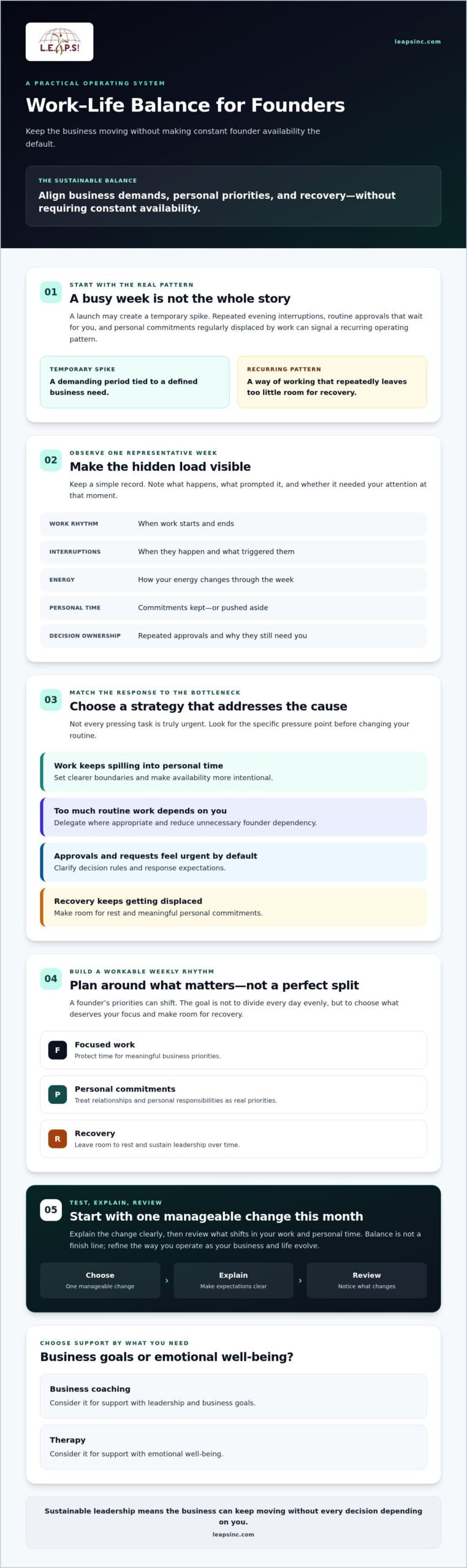
A full calendar doesn’t show what’s draining your attention. The pattern behind the calendar does. A week of late work during a launch may be a temporary response to a defined business need. Repeated evening interruptions, routine approvals that always wait for you, and personal commitments regularly displaced by work may point to an operating pattern that needs attention.
A demanding week is a temporary spike; an unsustainable pattern is a recurring way of working that leaves too little room for recovery. This distinction helps you examine what’s happening without treating every intense period as burnout or assuming that constant pressure is simply part of being a founder.
How can founders identify their biggest sources of overload?
For one representative week, keep a simple record. You don’t need a complex tracking system. Note when work starts and ends, when interruptions happen, how your energy changes, and whether personal commitments were kept or pushed aside. Add a brief note about what prompted each interruption and whether it needed your attention at that moment.
- Track repeated approvals: Which decisions keep returning to you, and is there a clear reason you need to own them?
- Sort urgent from habitual: Was a request time-sensitive, or did it feel urgent because no response expectation or process was established?
- Assess the value of tasks: Which activities move a meaningful goal forward, and which mainly keep you occupied or compensate for unclear ownership?
Look for clusters, not isolated incidents. If a customer question repeatedly interrupts focused work because no one else knows how to respond, the issue may be less about your schedule than about ownership, guidance, or access to information. Until the team has a reliable way to handle that situation, stepping away can feel unsafe. The audit helps you see where a process or decision boundary may matter more than blocking another hour on your calendar.
Is founder burnout the same as having a demanding week?
No. One difficult week doesn’t establish burnout or a clinical condition. Pay attention to whether exhaustion, detachment, or difficulty functioning continues beyond a short-lived surge. These experiences can have different causes, and an article can’t diagnose what’s happening. If distress persists or interferes with daily life, consider speaking with a qualified professional.
Use what you learn as a starting point, not a verdict on your ambition or capacity. If it’s difficult to interpret the pattern or decide what support fits, you can explore options through a conversation about available support. A clearer picture of the pressure points can help you choose changes that address the cause, not just the visible symptom.
Which work-life balance strategies for founders address the real bottleneck?
The right strategy depends on what keeps you switched on. A calendar boundary may protect focus, but it won’t fix a process that sends every decision back to you. Delegation won’t create personal time if you still check every detail. Match the change to the source of pressure, then test whether it addresses the cause.
Stepping back doesn’t mean abandoning responsibility. Clear ownership, decision limits, and agreed escalation points let others act while you retain appropriate oversight. These work-life balance strategies for founders work best as a coordinated approach to how the business operates, not as isolated productivity tricks.
| Strategy | Best-fit pressure point | First experiment | Limitation |
|---|---|---|---|
| Time boundaries | After-hours messages or meetings without a clear purpose | Set a focus or offline window and communicate how urgent issues should be raised | Doesn’t remove work that depends on your decisions |
| Delegation | Repeatable tasks or outcomes that someone else can own | Assign one defined outcome with the authority and guidance to deliver it | Requires clear expectations and follow-up |
| Decision rules | Routine approvals that repeatedly interrupt you | Document what a team member can decide independently and when to escalate | Rules need review as circumstances change |
| Recovery habits | Little space to reset between work demands | Protect a realistic recovery period and treat it as a scheduled commitment | Can’t resolve an excessive or poorly structured workload alone |
When do boundaries help more than another productivity tool?
Use boundaries when interruptions, rather than task volume, fragment your attention. For example, set expectations about response times, reserve meeting-free focus periods, or clarify which channel is appropriate for time-sensitive issues. Tell relevant colleagues and stakeholders what to expect. Agree on genuine exceptions so “urgent” doesn’t become the default label for every request.
When should founders delegate or redesign a process?
Delegate when another person can own a defined outcome and has authority to make related decisions. Before transferring a recurring responsibility, document the relevant standards, decision criteria, and escalation points. Then agree on a proportionate check-in. Handing off a task without context or follow-up can leave you carrying the mental load, even if someone else does the work.
No single tactic is a universal fix. A boundary can protect time, a decision rule can reduce avoidable approvals, and recovery can support steadier leadership. Recurring operational bottlenecks may need a process redesign. If you’d value structured help clarifying leadership priorities and business goals, explore available support options.
Build a founder work-life balance plan you can test this month
A sustainable rhythm comes from deliberate adjustments, not a complete life overhaul. Treat the next month as a practical experiment: identify one pressure point, make one manageable change, communicate it, and review what happens. This keeps your plan responsive to both business needs and your well-being.
- Choose one pressure point. Select a recurring issue you can influence, such as evening messages interrupting family time or meetings breaking up focused work.
- Set a small change. Try one protected personal block, a meeting-free period, or a specific time to review non-urgent requests.
- Communicate the expectation. Tell relevant colleagues and stakeholders what’s changing, who can handle coverage, and how a genuinely urgent issue should be escalated.
- Review and adjust. At the end of the trial, assess whether the change supported your personal priorities without disrupting essential work. Keep it, refine it, or test another approach.
Put focused work, personal commitments, and recovery time on a realistic weekly calendar. Leave room for the unexpected instead of planning every hour as if business demands never shift. The aim isn’t a flawless schedule. It’s a structure that makes your priorities visible and gives you a basis for deciding what can move when circumstances change.
How can founders set boundaries without disrupting the business?
Begin with one predictable boundary, not a sweeping rule that leaves people unsure what to do. For example, protect a regular personal block and arrange who can respond to routine issues during that time. Clarify which situations warrant interrupting you and which can wait. Share the expectation in advance, then revisit it after a defined trial period to address gaps in coverage or communication.
What should founders review at the end of each week?
Use a brief review to guide your next adjustment. Ask:
- Which tasks truly required my involvement, and which need a clearer owner or process?
- Did I protect my planned personal commitments? If not, what interrupted them?
- Did the change support my energy and allow essential business work to continue?
- Could I sustain this approach, or should I make it smaller or more specific?
Choose one adjustment for the coming week instead of rebuilding your entire routine. A launch, a customer need, or a change in personal responsibilities may call for a different arrangement. Work-life balance strategies for founders should be adaptable: review what’s working, respond to changing needs, and keep refining your rhythm.
If you’d like structured support clarifying business priorities and leadership habits, schedule a conversation about your goals.
When coaching or therapy can support a founder’s next steps
Putting a new operating rhythm into practice can raise questions that are difficult to resolve alone. Perhaps you know what needs to change but struggle to make decisions stick, or business pressure is affecting your emotional well-being. Professional support may offer a structured place to examine what’s getting in the way. The right fit depends on whether your primary goals concern the business, your personal well-being, or both.
Could entrepreneurship coaching help with founder work-life balance?
Entrepreneurship coaching may suit founders who want to clarify business priorities, leadership patterns, or development goals. Sessions can provide space to examine where your attention is going, identify decisions that could be handled differently, and consider how your leadership habits align with the business you’re building. LEAPS Inc. offers entrepreneurship coaching as a potential source of structured support. Coaching isn’t a guaranteed solution; its value depends on your needs and the work you’re prepared to do.
When might therapy be a more appropriate form of support?
Therapy may be relevant when emotional distress, persistent strain, or personal concerns need clinical attention. You don’t need to diagnose yourself before seeking guidance. Consider what you want help addressing, and look for a qualified professional whose scope fits that need. Coaching and therapy serve different goals. Business planning alone may not address emotional concerns, and therapy shouldn’t be presented as a substitute for business strategy.
Some founders may need to focus first on business decisions; others may want support with the personal impact of ongoing demands. Your needs may also change over time. The work-life balance strategies for founders in this article can help you name a pressure point, but you don’t have to navigate every challenge without support. A thoughtful next step is to identify the specific question you want help working through, then choose a support option aligned with that goal.
If you’d like to explore whether support may fit your priorities, schedule an appointment to explore support for your goals. It’s an opportunity to consider what you’re seeking and whether the available services align with your needs, without assuming a particular outcome.
Build a Business That Makes Room for Your Life
A sustainable founder rhythm doesn’t require equal hours for work and personal life. It asks you to notice where your attention is going, distinguish real urgency from habits that keep you constantly available, and choose changes that fit the business you’re building.
The most useful work-life balance strategies for founders address the actual pressure point. Protect a boundary when interruptions are the issue; clarify ownership or decision rules when routine work depends too heavily on you. Test one adjustment, then review whether it supports your well-being and allows essential business work to continue. Your plan can evolve as your responsibilities change.
If self-directed changes are difficult to sustain, LEAPS Inc. offers entrepreneurship, business, and executive coaching for business and leadership goals, as well as individual therapy for emotional well-being. The right support depends on what you want help addressing, and no approach can promise a particular outcome.
Schedule an appointment to explore support for your goals. You can pursue meaningful business growth without treating your well-being as expendable. Start with one intentional change, and keep building a way of working that supports both your vision and your life.
Frequently Asked Questions
What are the best work-life balance strategies for founders?
The best work-life balance strategies for founders address the recurring pressure point instead of defaulting to another productivity tool. If messages interrupt evenings, set clearer availability expectations. If every decision waits for you, document decision rules or delegate defined responsibilities. Protect recovery time as part of a sustainable work rhythm. Test one change at a time, then review whether it supports your personal priorities and business continuity.
How can a founder create boundaries without hurting the business?
A founder can set boundaries more confidently by planning coverage before changing availability. Start with one predictable limit, such as a protected personal block, and decide who can handle routine issues while you’re unavailable. Define what truly needs escalation and how others should raise it. Communicate these expectations clearly, then review how the arrangement worked. Boundaries are more practical when people know who owns decisions and what process to follow.
Can a founder take time off without the business falling behind?
It depends on the work, decision-making responsibilities, and coverage available in your business. Before stepping away, identify which tasks only you can handle and which repeatable processes another person could own with suitable guidance. Document key steps, clarify escalation for genuine exceptions, and plan the timing realistically. A prepared absence can reveal where systems need strengthening, but it doesn’t prove that every business can operate without its founder.
How do founders know when work-life imbalance has become a serious concern?
Pay attention if work regularly displaces sleep, relationships, recovery, or activities that matter to you, especially if the pattern affects daily functioning. A demanding season or difficult week alone doesn’t establish burnout or a mental health condition. Consider how long the strain has continued and whether it feels manageable. If distress persists or interferes with daily life, speak with a qualified mental health professional who can assess your individual circumstances.
Is coaching or therapy better for a founder who feels overwhelmed?
The better fit depends on what you want support with. Business, executive, or entrepreneurship coaching can help clarify leadership and business-related goals. Therapy may be appropriate for emotional well-being and personal concerns. They serve different purposes, and neither guarantees a particular outcome. LEAPS Inc. offers entrepreneurship, business, and executive coaching, as well as individual therapy. Consider your needs and seek qualified clinical support for mental health concerns.
What is one work-life balance change a founder can make this week?
Choose one recurring source of pressure and make a specific, manageable change. You might set a communication window, protect a personal commitment on your calendar, or document a decision another person can own. Tell anyone affected what’s changing and how urgent matters should be handled. At the end of the week, ask whether the change protected your priority, supported essential business work, and felt realistic enough to continue or adjust.