

What if hearing how someone else meets a familiar struggle could help you see your own choices more clearly? It’s natural to feel cautious about sharing personal experiences with a group, or to wonder whether a therapist can give you enough individual attention. Yet the benefits of group therapy can include more than feeling understood: a structured group offers opportunities to reflect, connect, and practice new ways of relating with others.
Group therapy isn’t simply a roomful of people exchanging advice, and it isn’t the same as individual therapy. A therapist guides the process, while participants’ perspectives can bring fresh insight and a chance to learn through real interactions. The experience varies by group and person, so it may not be the right fit for every goal.
This article explores the emotional, relational, and practical benefits of group therapy, how the process generally works, and what it can and cannot provide. You’ll also find ways to consider whether group or individual therapy may better support your needs, so you can choose a thoughtful next step without pressure.
Key Takeaways
- Group therapy is clinician-guided work with multiple participants, and its potential value depends on your goals, the group’s structure, and your participation.
- The benefits of group therapy may include noticing personal patterns and considering new perspectives through shared discussion.
- Feeling vulnerable in a group is understandable; clear expectations about confidentiality and its limits can help you make an informed choice.
- Reflect on what you want from therapy, how comfortable you feel discussing experiences with others, and whether shared learning fits your aims.
- Group therapy can offer a setting for connection and intentional practice, but it isn’t a guaranteed solution or the right fit for every goal.
What Are the Benefits of Group Therapy?
Group therapy is clinician-guided therapeutic work involving multiple participants who meet with a shared focus. Its potential benefits vary with each person’s goals and circumstances, as well as the group’s structure and the participant’s involvement. Connection, fresh perspectives, thoughtful feedback, and opportunities to practice relating to others may all support personal growth, though no single experience or outcome is universal.
A therapy group is a clinician-guided space for shared reflection and intentional interpersonal learning, not simply an informal gathering where peers exchange support. The therapist helps keep the work connected to participants’ therapeutic aims. For a foundational overview of its history, principles, and formats, see Group psychotherapy.
To hear more about what participation may involve, watch this video:
How does group therapy differ from individual therapy?
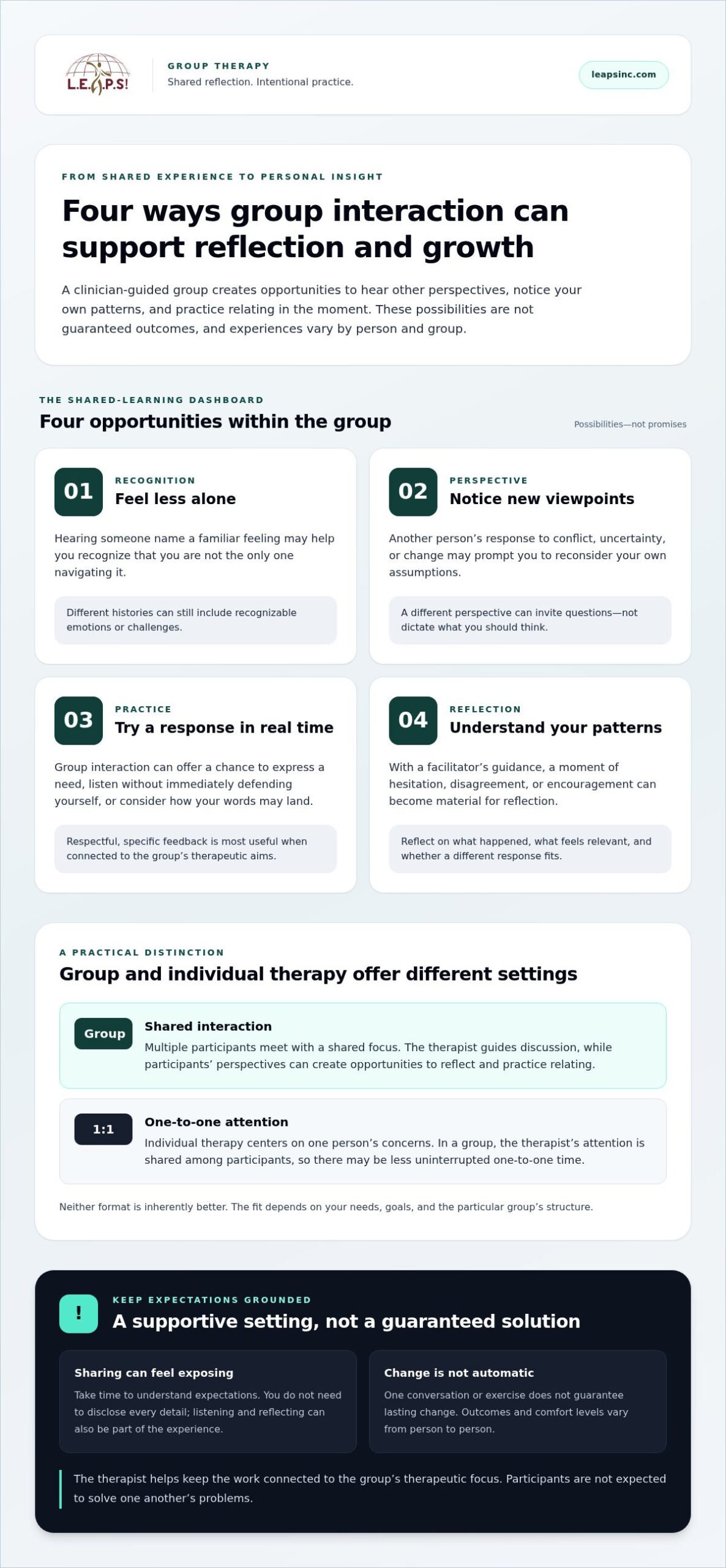
Individual therapy centers on one person’s concerns in a one-to-one therapeutic setting. A group adds interaction with other participants, creating opportunities to notice how you respond in relationships, hear perspectives you may not have considered, and practice expressing yourself. Neither format is inherently better; the right fit depends on your needs and goals. LEAPS Inc. also offers individual therapy support for people seeking one-to-one attention.
In a group, a moment of disagreement, hesitation, or encouragement may help bring a relational pattern into view. With the therapist’s guidance, participants can reflect on what happened and consider different responses. These experiences can complement other forms of care, but they don’t guarantee change.
What makes a therapy group a therapeutic setting?
The clinician guides discussion, maintains appropriate boundaries, and helps connect what happens in the group to its therapeutic focus. Participants aren’t expected to solve one another’s problems; their observations and responses can instead become material for reflection and learning.
Groups can differ in their goals, structure, and methods, so there isn’t one format that describes every experience. Exploring the different types of therapy can help clarify how approaches vary. The benefits of group therapy are most thoughtfully considered in relation to the particular group, its therapeutic focus, and your aims.
How Group Therapy Can Turn Shared Experience Into Personal Insight
Shared experience can create a useful pause between feeling something and deciding what it means. As participants describe how they respond to conflict, uncertainty, or change, you may hear an approach that differs from your own. That contrast can prompt questions: Am I assuming others will reject me? Do I tend to stay quiet when I need support? These possibilities, not guaranteed outcomes, are among the benefits of group therapy.
The value isn’t that everyone has the same story. Different histories can still contain recognizable emotions or challenges. The American Psychological Association’s overview of Benefits of group therapy describes how therapeutic groups can offer support and connection in a structured setting. Feeling understood may ease isolation for some people, but it doesn’t promise that distress will resolve or that every participant will relate to the group in the same way.
Why can shared experiences reduce a sense of isolation?
It can be grounding to hear someone name a feeling you thought you had to manage alone. For instance, a participant who feels overwhelmed by setting boundaries might hear others describe similar hesitation, even if their relationships and circumstances are quite different. That recognition may make room for curiosity and self-compassion. It doesn’t erase the challenge, and no one needs to disclose more than feels appropriate to benefit from listening and reflecting.
How can group feedback and practice support growth?
Group interaction can offer a chance to try a different response in the moment: express a need clearly, listen without immediately defending yourself, or consider how your words may land with someone else. Feedback can provide another perspective, but it is most useful when respectful, specific, and connected to the group’s therapeutic aims. A facilitator can help keep the exchange constructive, rather than letting advice or judgment take over.
Repeated interpersonal practice can create opportunities to notice your reactions, understand your patterns, and choose how you want to respond. One conversation or exercise alone doesn’t guarantee lasting change. Insight may grow as you reflect on what happened, decide what feels relevant, and consider whether to practice a different response beyond the group.
If you’re curious about whether this kind of shared reflection fits your goals, a scheduled appointment can be a thoughtful way to explore your therapy needs.
Group Therapy Benefits and Concerns: What It Can and Cannot Offer
Sharing personal experiences in front of others can feel exposing, especially if you’re unsure how your words will be received. You can take time to understand the group’s expectations and decide what you feel ready to share. Participation doesn’t require disclosing every detail of your life; listening and reflecting may also be part of the experience.
Group therapy also has practical limits. The therapist’s attention is shared among participants, so you may have less uninterrupted one-to-one time than in individual sessions. The American Psychological Association’s overview of group therapy describes its potential for support and learning, but the format won’t meet every need. It isn’t emergency or crisis support; if you or someone else is in immediate danger, seek emergency assistance rather than waiting for a group session.
Is group therapy confidential?
Privacy is an important expectation in a therapeutic group, but it shouldn’t be treated as an absolute guarantee about what other participants may share outside the setting. The clinician should explain confidentiality expectations and applicable professional limits. Before sharing sensitive details, take time to understand how privacy is addressed, what boundaries participants are expected to follow, and what circumstances may affect confidentiality.
These conversations can help you make an informed choice about what to disclose and when. Feeling cautious doesn’t mean you can’t participate; it can be part of deciding what feels appropriate for you.
When might individual therapy also be worth considering?
One-to-one attention may be useful if you want sustained focus on a personal concern, prefer to speak without a group present, or have goals that need more space than a shared session allows. This isn’t a diagnosis or a judgment about which format is better. Group and individual therapy can serve different purposes, and some people may find that the formats complement one another.
LEAPS Inc. offers individual therapy as another setting for exploring personal goals. Considering what you need most right now, shared reflection or focused attention, can help you think through which approach feels aligned with your aims.
The benefits of group therapy should be weighed alongside these boundaries: it offers a guided setting for shared work, not unlimited individual attention or a guarantee of privacy from other participants. If you’re weighing the format against your goals, a scheduled appointment to discuss your therapy goals can help you consider a thoughtful next step.
How to Decide Whether Group Therapy Fits Your Goals
You don’t need complete certainty before considering a group. Start with what you hope will change, what kind of support feels useful, and how shared discussion sits with you right now. The benefits of group therapy are most relevant when the opportunity to learn with others connects to your therapeutic aims. Your circumstances and needs matter, too.
What goals may align with a group setting?
A group may be worth exploring if you want to practice communicating, hear different perspectives, or become more aware of patterns in how you relate to others. These are possible areas of focus, not promised results or a description of every group. The fit depends on what you’re working toward and whether the group’s focus and structure support that work.
Consider which of these intentions feels closest to your needs:
- Practice: I want to express my needs or listen with greater care.
- Perspective: I want to consider how others understand a shared challenge.
- Awareness: I want to notice patterns in how I respond or connect.
If one stands out, you have a starting point for a conversation about whether a shared therapeutic setting may be appropriate.
What questions can help clarify your readiness?
Uncertainty is reasonable. Rather than treating readiness as a yes-or-no test, name what you hope for, what concerns you, and what boundaries would help you feel more comfortable. You might ask yourself whether you’re open to listening even when you’re not ready to speak, and what main concern you would want a therapy conversation to address.
- What would I like support with at this point in my life?
- What feels challenging about sharing space with other participants?
- Would listening, speaking, or a combination feel manageable?
- What expectations about privacy or participation do I want to understand?
Writing down your answers can help turn a broad question into a clearer discussion. LEAPS Inc.’s group therapy service is one therapeutic option for people considering shared reflection and learning.
Your next step doesn’t have to be a firm commitment. You can begin by identifying your priorities and discussing how they relate to group participation. Schedule an appointment to explore your therapy goals and consider which form of support may align with them.
Explore Group Therapy as a Step Toward Lasting Growth
Group therapy can be one setting for reflection, connection, and intentional practice. Its value isn’t measured by a single conversation or a promise of change. The benefits of group therapy depend on how your goals align with the group’s structure, your experience of participating, and the therapeutic fit. It may be one part of a wider process of understanding yourself and choosing how you want to relate to others.
What can someone expect when exploring group therapy?
A first step can be a conversation about what you hope to work on, what questions you have, and what concerns you’re carrying. You can use that discussion to clarify what matters to you and consider how shared therapeutic work might relate to those aims. You don’t need to arrive with a perfect explanation or a firm decision. Naming what you’re unsure about is useful, too.
It can help to bring a few points to that conversation:
- The concern or pattern you most want to understand.
- What you hope to gain from learning alongside others.
- Any boundaries or privacy questions you want to discuss.
This gives the conversation a starting point without requiring you to share more than feels appropriate. Exploring the group therapy service can also help you reflect on whether this format connects with your goals.
How can group work connect with a wider growth journey?
Insight can create a foundation for practice: noticing a familiar reaction, considering another perspective, and choosing a response that better reflects your values. Group work may provide opportunities to explore those steps with others, while growth beyond the group remains personal and gradual. Therapy can support reflection and development, but it can’t guarantee a particular emotional, relational, or professional outcome.
People seek therapy for different reasons and at different points in life. If you’re reflecting on why people go to therapy, consider what you want support to make possible for you, rather than assuming one format is right for everyone. A thoughtful next step is simply to bring your goals and questions into a therapeutic conversation.
Schedule an appointment to explore your goals and consider whether group therapy may align with the growth you’re seeking.
Choose a Supportive Path for Your Growth
The benefits of group therapy may come from hearing different perspectives, reflecting on familiar patterns, and practicing new ways of relating in a clinician-guided setting. Those possibilities aren’t guarantees: fit depends on your goals, circumstances, participation, and the group’s structure. If you’re uncertain, naming your questions and the kind of support you hope for can be a meaningful first step.
LEAPS Inc. offers group therapy alongside individual, couple, and family therapy. Each format offers a different setting for therapeutic work, and the right conversation starts with what matters to you now. You don’t need to have every answer before exploring your options.
Schedule an appointment to explore your goals and consider what kind of support may align with them. Thoughtful growth begins with a next step that feels right for you.
Frequently Asked Questions
What are the main benefits of group therapy?
Potential benefits include connection, exposure to different perspectives, supportive feedback, and opportunities to practice communication in a clinician-guided setting. Hearing others describe challenges may help you reflect on your own assumptions or patterns. These experiences don’t guarantee a particular outcome, and what you gain can depend on your goals, participation, the group’s structure, and how well the setting fits your needs.
Is group therapy as effective as individual therapy?
Group therapy can be effective for a range of concerns, but neither format is universally more effective. Group sessions create opportunities to learn through shared discussion and interaction; individual therapy offers more focused one-to-one attention. The right approach depends on your goals, circumstances, and therapeutic fit. A clinician can help you consider whether one format, or a combination, aligns with the support you’re seeking.
Can group therapy help with social anxiety?
Group therapy may offer a supported setting to explore social concerns and practice participating with others, depending on the group’s focus and approach. You might begin by listening, then decide whether and when you feel ready to contribute. This isn’t a guaranteed treatment or a reason to push past your boundaries. Discuss your goals and concerns with a clinician to consider whether a group setting feels appropriate for you.
How does group therapy help people feel less alone?
Hearing others speak about emotions or challenges that resonate with your own may help you feel understood and less isolated. Participants don’t need identical experiences to find points of connection; different perspectives can also broaden understanding. Feeling less alone doesn’t mean distress will automatically resolve, and each person’s experience differs. Listening and reflecting can be meaningful forms of participation, even before you’re ready to share much yourself.
What happens if I feel uncomfortable sharing in group therapy?
You can acknowledge that you feel uncomfortable without forcing yourself to disclose more than you’re ready to share. Depending on the group and its structure, listening quietly or sharing a smaller concern may feel more manageable. You can also raise your discomfort with the clinician, who can help you reflect on it and consider next steps. Feeling uncertain doesn’t mean you’ve failed or that the group cannot be useful.
Can group therapy be combined with individual therapy?
Yes. Group and individual therapy can address different needs and may complement one another, depending on your goals and circumstances. A group may provide shared discussion and interpersonal practice, while individual sessions offer focused time for personal concerns. LEAPS Inc. provides both formats, along with couple and family therapy. A clinician can help you explore whether combining approaches makes sense for the support you’re seeking.