

What if the right couples therapist isn’t the one with the most polished profile, but the one who helps both of you feel heard and gives your conversations a clear direction? Searching for support can bring up its own concerns: whether therapy fits what you’re facing, whether one partner will feel blamed, and how to tell a strong therapeutic fit from persuasive marketing.
Those questions deserve careful consideration. Couples therapy can offer a structured setting to understand recurring relationship patterns, talk through challenges, and clarify what each partner hopes will change. The process isn’t about deciding who’s at fault. It’s about making room for both perspectives and identifying practical next steps together.
This guide will help you understand what couples therapy may address, assess a therapist’s approach and fit, and prepare for an initial conversation with greater confidence. You’ll learn what to look for in the therapist’s approach, how to discuss shared goals, and which questions can bring clarity to the process, so you and your partner can begin with a clearer sense of direction.
Key Takeaways
- Notice recurring conflict, emotional distance, or difficulty repairing disagreements as patterns you can explore, not proof that one partner is to blame.
- Understand how a couples therapist can guide conversation and help you work toward shared goals without taking sides.
- Look for signs of a thoughtful fit, including balanced participation, clear goals, and space for both partners’ perspectives.
- Prepare for an initial conversation by naming your concerns, hopes, and questions, and describing specific moments rather than building a case against your partner.
- Explore how couple therapy at LEAPS Inc. can provide a structured place to discuss relationship concerns and clarify possible next steps.
When Should You Consider a Couples Therapist? Start With the Pattern, Not the Blame
Seeking support doesn’t mean a relationship has failed. It can be a deliberate way to understand how you relate, what keeps getting stuck, and what you both want to build next. You don’t need a single dramatic event to consider therapy. A concern that keeps resurfacing or a desire to communicate more effectively can be reason enough to start a conversation.
Couples therapy is professional support for understanding relationship dynamics and working toward shared goals. A couples therapist can help partners examine their interactions and concerns without treating one disagreement as proof that something is fundamentally wrong. For a broader overview of its purpose and approaches, see Couples therapy. You can also explore our guide to couples counseling for more context on the process.
Which relationship patterns might couples therapy help you explore?
Look at what repeats rather than trying to decide who started it. Perhaps the same argument returns without resolution, conversations quickly become defensive, or an important concern stays unspoken until it surfaces in another disagreement. You might also find it hard to reconnect after conflict, even when both of you want to move forward.
These are prompts for reflection, not clinical criteria or proof that a relationship is unhealthy. A useful starting point is for each partner to describe what they hope will feel different. Try specific, non-blaming language: “I’d like us to talk about decisions without shutting down,” rather than “You never listen.” Naming the moment and its impact can open a more constructive conversation than building a case against one another.
Do you need to wait until the relationship is in crisis?
No. Couples may seek support for concerns that keep resurfacing or to strengthen communication before difficulties feel overwhelming. Seeking help earlier is an option, not a requirement, and it doesn’t determine whether a relationship will continue or change in a particular way.
Start by asking whether there’s a shared question worth exploring: What happens when we disagree? What feels difficult to say? What would help us feel more understood? You don’t need identical answers or complete certainty before considering therapy. Even recognizing that each of you sees the pattern differently can give you a clearer place to begin.
What Does a Couples Therapist Do? Understand the Process Before You Begin
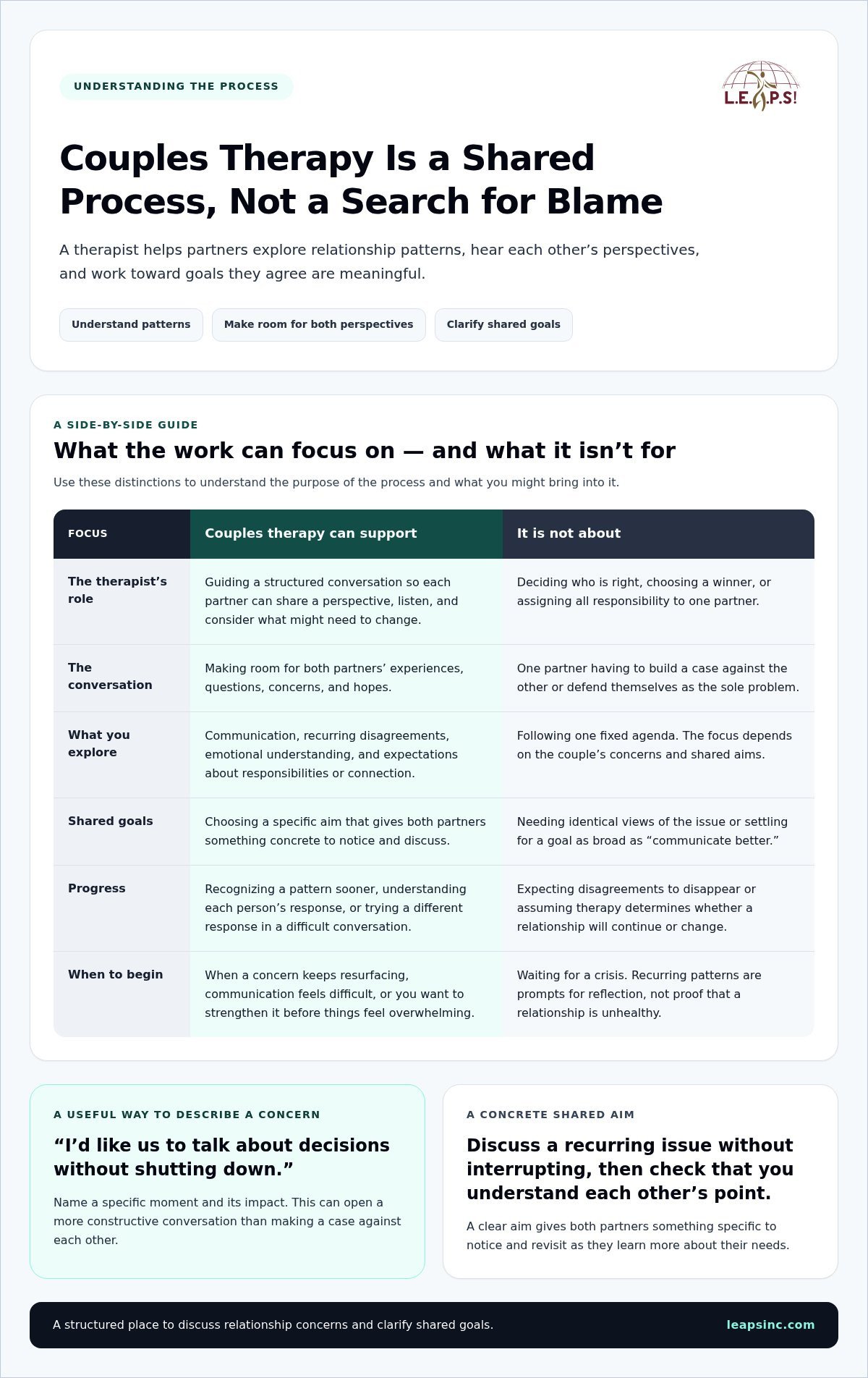
A couples therapist helps partners examine relationship concerns and work toward goals they agree are meaningful. Rather than deciding who is right, the therapist guides a structured conversation so each person can share their perspective, listen, and consider what might need to change. The work is collaborative: the therapist supports the process, while the partners bring their experiences, questions, and hopes.
Couples therapy focuses on relationship patterns and communication, not assigning one partner all the blame. That distinction can matter if either person worries they’ll be criticized or expected to defend themselves. The aim is to understand how interactions unfold and identify useful ways to address concerns, not to declare a winner.
What might couples work on with a therapist?
The focus depends on the couple’s concerns and shared aims. Possible areas to explore include communication, recurring disagreements, emotional understanding, and expectations about responsibilities or connection. Partners don’t have to see an issue in the same way to decide it’s worth addressing together.
For example, one partner may experience a conversation as an attempt to solve a problem, while the other feels rushed or unheard. Exploring that difference can clarify what each person needs from the exchange. These examples aren’t a fixed agenda, and therapists may use different approaches. LEAPS Inc. provides couple therapy as a professional setting to discuss relationship concerns and clarify shared goals.
How can goals and progress be discussed?
Make goals specific enough to guide reflection. Instead of “We need to communicate better,” try, “We want to discuss this recurring issue without interrupting, then make sure we understand each other’s point.” A clear aim gives both partners something concrete to notice and discuss.
Progress doesn’t have to mean disagreements disappear. It may involve recognizing a pattern sooner, understanding what each person is responding to, or trying a different response during a difficult conversation. As partners learn more about their needs, they can revisit goals and refine what they’re working toward.
For additional questions to consider as you evaluate therapeutic support, The Gottman Institute offers guidance on how to find a competent couples therapist. If you’re ready to explore a purposeful next step, you can schedule an appointment with LEAPS Inc.
How to Assess a Couples Therapist’s Fit When You Have Concerns
Considering therapy can bring up a central fear: “Will the therapist take my partner’s side?” A thoughtful process shouldn’t be about choosing a winner or assigning all responsibility to one person. Fit is less about whether every conversation feels easy and more about whether both partners have room to speak, understand the purpose of the work, and raise concerns about how it’s going.
Use early conversations to notice how the process is explained and how your questions are received. These signs can help you assess fit without expecting a therapist to agree with everything either partner says.
| Helpful sign | What to notice |
|---|---|
| Balanced participation | Each partner has opportunities to speak, and the conversation isn’t consistently dominated by one person. |
| Clear goals | You can discuss what you hope to address and how those aims might be revisited. |
| Room for differences | Partners can describe different perspectives without being pressured to agree immediately. |
| Openness to feedback | You can say when the pace feels difficult, you feel misunderstood, or participation feels uneven. |
| Clear privacy expectations | The therapist explains applicable confidentiality practices, records, and limits in understandable terms. |
How can both partners feel heard without erasing differences?
Balanced facilitation doesn’t mean treating every account as identical or requiring agreement on every issue. It means making space for each person’s perspective and helping the couple explore what they want to understand together. Since an article can’t establish what’s happening in your relationship, avoid assuming one partner is the problem based on a single point of view.
A challenging conversation may involve discomfort; persistent dismissal is different. If you feel unheard, say so directly: “I’m having trouble explaining my perspective,” or “Could we slow down so I can respond?” How that concern is addressed can tell you something important about whether the process feels workable.
What questions clarify expectations and boundaries?
Ask how goals are established and revisited, how each partner can raise concerns about the process, and what privacy practices apply. Before sharing sensitive information, request a clear explanation of confidentiality, records, and any applicable limits. These details depend on the circumstances and practice, so don’t assume privacy is absolute or identical everywhere.
You can also reframe a stuck question. Instead of “Who is right?” try, “What pattern do we want to understand?” That shift doesn’t erase accountability; it creates a shared focus for inquiry. A couples therapist should be able to explain the process without promising neutrality, complete confidentiality, or a particular outcome.
How to Prepare for Couples Therapy and Make the First Conversation Useful
A little preparation can help you use the first conversation with a couples therapist to explain what matters, rather than trying to settle every disagreement at once. Each partner can reflect separately, then compare notes if that feels constructive. The aim isn’t to arrive with a perfect account; it’s to bring honest concerns, hopes, and questions into the discussion.
What should each partner reflect on beforehand?
Start with a simple sequence: identify a concern, name a hope, consider readiness, and write down questions. Each partner might note one recurring difficulty and one relationship strength they want to preserve. This keeps the conversation grounded in both what feels challenging and what remains meaningful.
Next, describe what improvement could look like in an ordinary interaction. For example, would you like to discuss plans with less tension, or feel that both perspectives are considered before a decision is made? Focus on a specific moment and its impact rather than assembling examples to prove your partner is at fault. Questions about shared goals, participation, and expectations can also help you enter the conversation with curiosity.
- Concern: What situation keeps bringing you back to the same difficulty?
- Strength: What do you value in the relationship and hope to protect?
- Hope: What would you notice in everyday life if things were improving?
- Question: What would you like to understand about the therapy process?
LEAPS Inc.’s therapeutic philosophy offers further context for considering the principles that can shape a purposeful conversation about care.
What if one partner is hesitant about therapy?
Hesitation is information to understand, not a reason to pressure or shame a partner. Ask what feels concerning. They may fear being blamed, misunderstood, or expected to make an immediate decision about the relationship. Listening to the specific worry can make it easier to discuss what each person needs before taking a next step.
You don’t have to force agreement or pretend both partners feel equally ready. A first conversation can be a chance to clarify questions and concerns, not a commitment to a particular outcome. You might say, “I’m not asking us to decide everything now. I’d like to understand what feels difficult about exploring support.”
When you’re ready to talk through your concerns and possible goals, schedule an appointment to discuss your next step.
Explore Couples Therapy at LEAPS Inc. and Choose a Clear Next Step
Once you’ve considered what you hope to understand and what would help both partners participate, the next step can be a conversation about care. LEAPS Inc. provides couple therapy as a professional setting to explore relationship concerns and clarify goals. Beginning that conversation doesn’t promise a particular outcome for the relationship. It gives you an opportunity to bring questions into a purposeful discussion and consider what direction feels right.
What can you bring into a first conversation?
You don’t need a polished summary or complete agreement before you begin. Bring the concerns each partner wants to understand, the changes you hope to work toward, and questions about the process. You might jot down a few prompts in advance:
- What relationship concern feels most important to discuss?
- What would you hope to experience differently in everyday interactions?
- What questions do you have about goals, participation, or expectations?
Keep the focus on what you want to explore, rather than preparing a case for why one person is right. If you and your partner describe the concern differently, that difference can be part of the conversation. You can bring uncertainty, too. Not knowing exactly what you want to change doesn’t mean you have nothing useful to discuss.
How can you decide whether to take the next step?
Consider whether you’re ready to explore relationship concerns in a structured professional setting, even if you aren’t sure what the outcome should be. You might ask yourselves whether there’s a pattern you want to understand, a shared goal you’d like to clarify, or a question you’d value discussing with a couples therapist. Readiness can begin with curiosity, not certainty.
Scheduling an appointment is a concrete step toward a conversation, not a commitment to a predetermined result. You and your partner retain agency as you consider your needs and what you learn through the process. LEAPS Inc. offers couple therapy as a place to begin that discussion with intention and care.
If you’re ready to take that first step, Schedule an appointment with LEAPS Inc.
Take the Next Step Toward a More Purposeful Conversation
Choosing a couples therapist starts with noticing the patterns you want to understand, then looking for a process where both partners can express their perspectives and clarify shared goals. You don’t need to agree on every detail or arrive with a perfect plan. Bringing honest questions and a willingness to explore can be a meaningful beginning.
LEAPS Inc. provides couple therapy alongside individual, family, and group therapy. Founded and led by Dr. John E. N. Daniel, the practice offers a place to begin discussing relationship concerns and possible next steps without promising a predetermined outcome.
If you and your partner are ready to explore what support could look like, schedule an appointment to explore couples therapy. You can begin with one clear conversation and decide what comes next with greater understanding and intention.
Frequently Asked Questions
How do I know if we need a couples therapist?
You might consider a couples therapist if the same concerns keep returning, conversations regularly become difficult, or you’re struggling to repair disagreements. You don’t need to be in crisis or agree on every detail before exploring support. Ask yourselves what you’d like to understand or experience differently together. These patterns aren’t a diagnosis or proof that a relationship is unhealthy; they can simply help you decide whether a structured conversation could be useful.
Can couples therapy help if only one partner wants to go?
One partner’s interest can begin an honest conversation, even if the other feels uncertain. Rather than pressuring them, ask what gives them pause. They may worry about being blamed, misunderstood, or pushed toward a decision. Share what you hope therapy could help you explore, and invite them to voice their concerns. Couples therapy involves working with relationship concerns together, so discussing readiness and expectations can help clarify whether both partners are willing to take part.
What happens in couples therapy?
Couples therapy provides professional support for examining relationship concerns and working toward agreed goals. A therapist guides conversation so partners can describe their perspectives, explore how interactions unfold, and consider what they want to address. The focus may include communication, recurring disagreements, emotional understanding, or clarifying expectations. The specific process can vary. Partners can ask how goals will be set and revisited, and share what would make participation feel constructive for each of them.
Will a couples therapist take sides?
A couples therapist’s role is to guide exploration of the relationship, not simply declare one partner right and the other wrong. That doesn’t mean every account will be treated as identical or that challenging topics will be avoided. Notice whether both perspectives can be expressed and whether you can raise concerns about feeling misunderstood or overlooked. If the process feels persistently dismissive, name that concern and discuss what would help you participate more meaningfully.
How should we prepare for couples therapy?
Each partner can identify one concern they want to explore, one relationship strength they hope to preserve, and one change they’d like to see in everyday interactions. Bring questions about goals, participation, and what to expect. Describe specific moments and how they affected you rather than rehearsing accusations. You don’t need a polished history or a complete solution before beginning. Different perspectives can be useful material for a thoughtful conversation.
Is couples therapy confidential?
Privacy practices and their limits depend on the applicable setting and circumstances, so don’t assume confidentiality is absolute or identical across practices. Before sharing sensitive information, ask the therapist to explain how privacy is handled, what records are kept, and what exceptions or limits may apply. A clear, accurate explanation can help both partners make informed choices about what to discuss and understand the boundaries of the therapeutic conversation.
How long does couples therapy take?
There isn’t one set timeline for couples therapy. The length of the work can depend on the concerns you bring, the goals you establish, and how those goals evolve as you learn more about your relationship. Rather than relying on a fixed number of sessions, ask how progress can be discussed and when goals might be revisited. Progress may include greater understanding or new responses to difficult moments, not only fewer disagreements.