

What if the most effective way to prevent burnout isn’t asking employees to become more resilient, but changing the conditions they work in? If you’re asking how to prevent employee burnout, start by looking for patterns. Persistent exhaustion, growing detachment, or difficulty keeping up may signal that workplace stress needs attention. These signs aren’t a reason to diagnose an employee. They’re a prompt to listen and take a closer look at how work is structured.
It’s understandable to feel that workload and staffing pressures leave little room to act. Yet wellness perks alone can’t offset unclear priorities, limited autonomy, inadequate support, or expectations that make it hard to disconnect. Sustainable prevention starts with practical changes to the work itself, even when you can’t remove every pressure at once.
This guide explains how to recognize risks early, have supportive conversations, and identify realistic ways to improve workload, autonomy, and manager support. You’ll also learn how to build a prevention plan that addresses organizational causes while making room for professional support, including Employee Assistance Program resources and therapy when appropriate. Both can help, but individual support should complement, not replace, healthier workplace conditions.
Key Takeaways
- Recognize persistent exhaustion, detachment, and reduced effectiveness as signals to explore workplace pressures, not as grounds to diagnose an employee.
- Review workload, staffing, priorities, and employee control to identify conditions that may be making work unsustainable.
- Learn how to prevent employee burnout by listening to employees, agreeing on practical changes, and following up to see whether those changes help.
- Equip managers to clarify priorities and reconsider lower-priority work when demands exceed available time and capacity.
- Use feedback and workplace patterns to guide ongoing improvements, while treating individual support as a complement to organizational change.
How to prevent employee burnout starts with understanding what it is
Persistent work stress can affect an employee’s wellbeing and make it harder for a team to sustain its work. If you’re considering how to prevent employee burnout, start by understanding the pattern: burnout is connected to chronic workplace stress that hasn’t been successfully managed, not simply to a demanding day or a busy season.
Featured-snippet definition: The World Health Organization (WHO) describes occupational burnout as a syndrome resulting from chronic workplace stress that hasn’t been successfully managed. It involves exhaustion, increased mental distance or cynicism toward work, and reduced professional efficacy. WHO classifies it as an occupational phenomenon, not a medical condition. Occupational burnout offers further background on the concept.
For a brief overview of workplace causes and prevention, watch this video:
These dimensions are signals to pay attention to, not a checklist for managers to diagnose employees. A person may feel tired or frustrated after a difficult shift without experiencing an ongoing pattern. Pay closer attention when strain persists, recovery feels insufficient, and work starts to feel increasingly distant or harder to do effectively.
How is burnout different from everyday work stress?
Temporary pressure may ease when a demanding project ends, priorities settle, or an employee has time to recover. Burnout risk deserves closer attention when exhaustion, cynicism, or a sense of reduced effectiveness continues over time. One difficult day, a missed deadline, or a single sign alone doesn’t establish burnout. Look for patterns and ask what conditions may be contributing.
Why should employers address burnout early?
Unaddressed strain can affect wellbeing, work quality, attendance, and an employee’s desire to stay. Early, respectful conversations give managers a chance to understand pressures and review whether workload, priorities, or support need to change. Employees shouldn’t be left to solve organizational problems through personal resilience alone. Workplace improvements and individual support can work together. An Employee Assistance Program can be one part of that broader approach.
Identify workplace conditions that can raise employee burnout risk
Workplace risk often appears in the way work is organized, not in one employee’s ability to cope. Review whether people have enough time, staffing, authority, and support to meet expectations. A workload may look manageable on paper but become unsustainable when priorities conflict, urgent requests repeatedly interrupt focused work, or employees are accountable for outcomes they can’t control.
Assess the conditions surrounding the work. Are expectations clear? Does treatment feel fair? Can employees raise concerns without fear, and do managers respond when support is needed? Gallup’s research on preventing employee burnout also highlights the role workplace experiences and management practices can play. These factors offer leaders a practical starting point for how to prevent employee burnout: examine what employees encounter day to day, then identify what can change.
Which work patterns should managers review?
Look for repeated patterns, not one unusually busy week. Consider whether employees regularly work excessive hours, miss breaks, receive unpredictable schedules, or operate in a state of constant urgency. Check whether responsibilities exceed available staffing, decision-making authority, or tools. Compare experiences across teams to identify pressure points, while recognizing that different roles may have different demands and constraints.
Employee control matters, too. Do people have reasonable input into how tasks are completed, how schedules are managed, or how decisions affecting their work are made? Limited flexibility can be especially difficult when expectations are high but employees lack the authority or resources to meet them. Use these questions to guide a review, not as a diagnostic scorecard.
How can leaders hear concerns without making employees feel exposed?
Offer more than one confidential way to share feedback, such as a private manager conversation and an anonymous survey. Explain who will see responses, how information will be used, and what confidentiality can and cannot mean in your workplace. Ask open questions about work rather than pressing for personal details:
- Which priorities are hardest to balance?
- What gets in the way of completing work during scheduled hours?
- Where would more clarity, control, or manager support help?
Review feedback alongside work-pattern information, such as scheduling, overtime, missed breaks, and changes in absence trends. Use aggregate data responsibly. Don’t monitor private communications or treat any single measure as proof that an employee is experiencing burnout. Share what you heard, describe the steps you’ll take, and report back when changes are made. If you’d value support as you reflect on workplace pressures, you can schedule an appointment.
Why burnout prevention needs more than resilience training or wellness perks
Resilience skills can help employees respond to stress, recover after demanding periods, and ask for support. But they can’t make an unmanageable workload manageable. If a team is consistently short-staffed, receives conflicting deadlines, or lacks authority to set priorities, a mindfulness session won’t remove those pressures. Treating burnout prevention as an individual responsibility can leave the conditions driving strain untouched.
This doesn’t mean personal resources have no value. Coaching, therapy, peer connection, and practical recovery strategies may support wellbeing. The key is to pair them with visible changes to how work is designed and managed. As you consider how to prevent employee burnout, ask whether wellness efforts are helping employees cope while leaders also act to reduce avoidable pressure.
What can resilience programs do, and what can they not do?
Programs that build coping skills can help employees notice stress, set boundaries where possible, and access support. They work best as part of a broader approach, not as a remedy for persistently excessive demands. For example, encouraging employees to take breaks has limited impact if staffing levels or workload make breaks difficult to take. Pair individual resources with practical changes to expectations, capacity, and decision-making.
That balance also avoids assigning blame. Wellbeing is shaped by work and by factors beyond the workplace, and no single initiative can promise to prevent burnout. Leaders can focus on what they can influence: clarify roles, review staffing and priorities, and give employees appropriate input into how work gets done.
How can organizations move beyond surface-level wellness?
Evaluate whether existing initiatives are easy to access, communicated clearly, and designed to respect employees’ privacy. Then look beyond participation numbers. A well-attended workshop doesn’t show whether workload has become more manageable or whether employees feel safe raising concerns. Gather feedback about what is useful, identify recurring obstacles, and share what the organization will change in response.
- Address causes: Revisit workloads, staffing, role clarity, and employee influence over work.
- Keep support accessible: Make it clear how employees can seek help and what confidentiality means.
- Follow through: Communicate decisions and check whether workplace changes ease the pressures employees identified.
Individual support can complement organizational action. For employees who want help with personal distress, Employee Assistance Program support can be part of a wider prevention approach. It should sit alongside leadership’s responsibility to examine and improve workplace conditions, not take the place of that work.
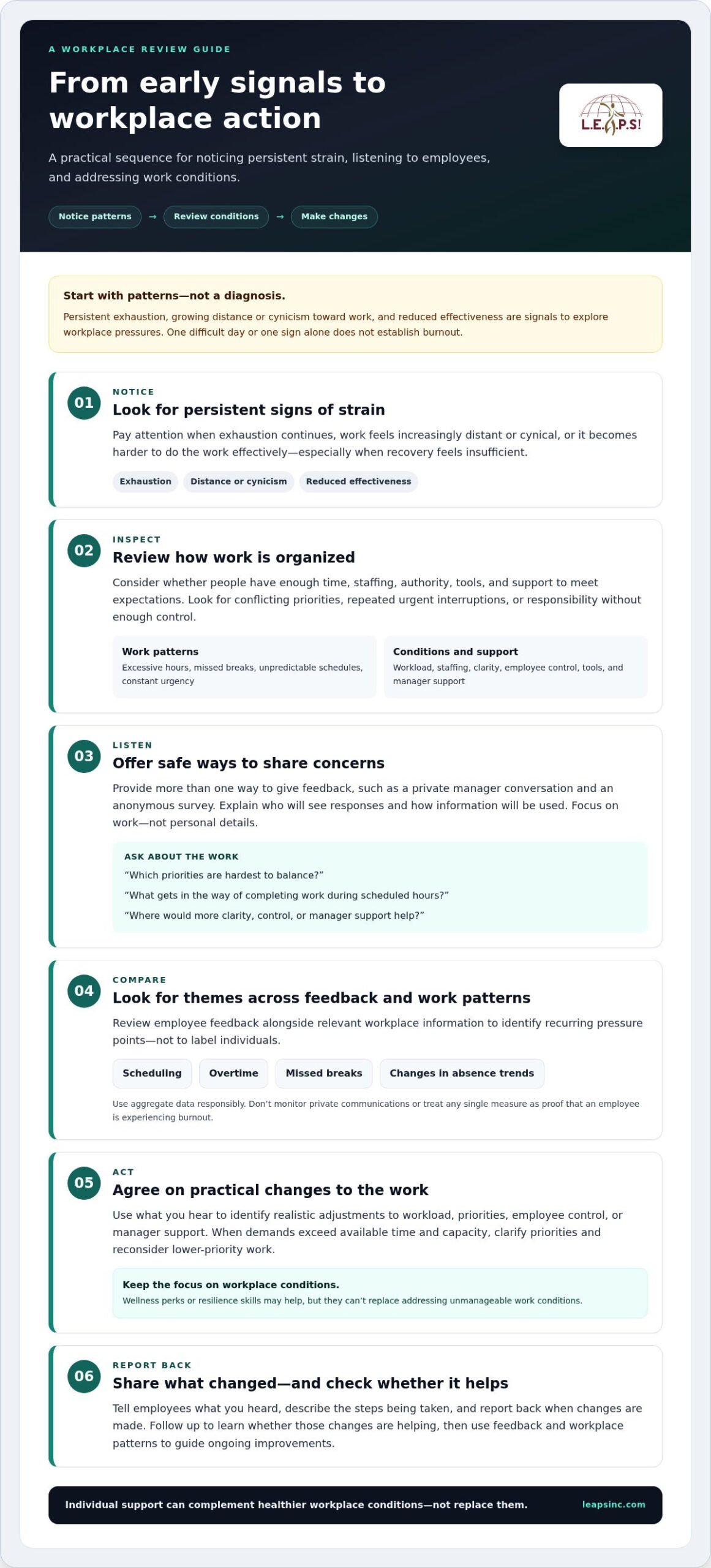
How to prevent employee burnout with practical manager actions
Managers can turn concern into meaningful action by following a repeatable process. The aim isn’t to label an employee or solve every workplace pressure in one conversation. It’s to listen, identify what can change, and make follow-through visible. This is a practical way to approach how to prevent employee burnout while respecting each person’s privacy and agency.
- Listen. Make space for the employee to describe what’s difficult without interrupting or rushing to reassure.
- Identify work pressures. Explore workload, competing priorities, unclear expectations, coverage, and barriers to taking breaks.
- Agree on changes. Choose specific steps, name who will take them, and clarify what can be adjusted now.
- Follow up. Set a respectful date to ask whether the changes helped or need revision.
- Review patterns. Look across the team for recurring workload or scheduling issues, while keeping personal conversations confidential.
How should a manager start a conversation about burnout concerns?
Choose a private setting and describe observable work-related changes without diagnosing: “I’ve noticed you’ve had several urgent deadlines at once. How is the workload feeling?” Then listen. Ask what feels most difficult and what would make work more manageable. Before ending, agree on an immediate next step, who owns it, and a date to revisit progress. Don’t promise confidentiality beyond what you can honor.
Which practical changes can a team test first?
Start with changes that address the pressures employees identify. Clarify which deadlines matter most, and pause or reassign lower-priority work where feasible. Review meeting demands, workload distribution, coverage, and schedule predictability. Set boundaries around expected availability, protect breaks and recovery time where operations allow, and communicate schedule changes as early as possible.
Make the action measurable at the team level. For example, track whether priority work is clearly assigned, meeting time has been reduced, or schedules are shared more predictably. Review these indicators alongside employee feedback. Don’t use them to infer an individual’s mental health. If a change isn’t helping, adjust it with the people affected.
Managers may benefit from structured support as they navigate complex team needs. Executive coaching can help leaders strengthen their approach to communication and decision-making. To explore support for your leadership development, schedule an appointment.
Build lasting burnout prevention with organizational support and clear next steps
Prevention becomes sustainable when leaders treat it as an ongoing organizational practice, not a one-time initiative. Set regular points to review employee feedback, workloads, absence patterns, and whether agreed workplace changes were completed. The purpose isn’t to identify or diagnose individuals. It’s to understand whether work is becoming more manageable and where pressures may still need attention.
How can leaders tell whether prevention efforts are helping?
Measure follow-through as well as participation. If a team agreed to clarify priorities, adjust coverage, or protect time for focused work, check whether those actions happened. Invite employees to share whether workload, recovery, manager support, and role clarity have improved. Look at trends over time and across teams, but protect privacy and avoid treating any single measure, including absence, as proof of burnout.
Use a simple review cycle: record the action, the person responsible, and when the team will revisit it. At the next review, ask what changed, what remains difficult, and whether the response needs adjustment. Share themes and decisions without exposing individual feedback. If pressure persists, revise the plan rather than assuming employees need to adapt to conditions that haven’t changed.
Organizations can also strengthen their approach through corporate consultation and organizational development. Initiatives should respond to employee feedback and address working conditions, not rely solely on program attendance or other surface-level indicators.
When may professional support be useful?
Workplace improvements and personal support serve different, complementary purposes. When an employee is experiencing persistent distress, support from a qualified professional may help them explore what they’re going through and consider their needs. Employee Assistance Program resources can provide a workplace support pathway, while individual therapy offers a dedicated setting to work through personal concerns. Coaching can also support leaders as they develop their capacity to guide teams through change.
These options don’t transfer responsibility for workplace conditions to employees. A sustainable plan pairs access to support with continued attention to workload, roles, management practices, and the actions employees have identified as important. That balanced approach is central to how to prevent employee burnout over time: listen, act, review, and refine.
If you’re seeking personal support, schedule an appointment to explore the next step that fits your needs.
Make burnout prevention part of how work gets done
Learning how to prevent employee burnout means looking beyond individual coping strategies. Notice persistent patterns, listen to employees’ experiences, and address work conditions such as competing priorities, unclear roles, and limited support. Then make practical changes, follow up, and refine your approach based on feedback.
Prevention is an ongoing commitment, not a single program or conversation. Leaders can review whether agreed actions are happening and whether employees have the clarity, capacity, and support to do their work. Professional help can complement these workplace changes when someone is experiencing ongoing distress. LEAPS Inc. provides individual therapy, Employee Assistance Program support, and organizational support as parts of a broader approach to wellbeing.
If you’re seeking personal support, schedule an appointment to explore your needs. Thoughtful action can help create healthier conditions for employees and a more sustainable future for your workplace.
Frequently Asked Questions
What is the most effective way to prevent employee burnout?
The most effective approach is to address work conditions that create persistent strain while making support available to employees. Review workload, staffing, conflicting priorities, role clarity, and employees’ ability to influence how work gets done. Then agree on practical changes and check whether they help. Resilience resources may support wellbeing, but they can’t replace manageable expectations and responsive management. This combined approach is central to how to prevent employee burnout sustainably.
Can managers prevent burnout without changing company policies?
Managers can often make useful changes within their team’s authority, even if they can’t revise company-wide policies. They may clarify priorities, redistribute tasks, reduce avoidable meetings, or provide more predictable schedules. If a recurring problem requires policy, staffing, or budget changes, document its impact and raise it with the appropriate decision-makers. Local adjustments can help, but lasting improvement may depend on addressing broader organizational barriers too.
How can you recognize early signs of employee burnout?
Look for persistent patterns rather than relying on a single behavior or difficult day. An employee may describe ongoing exhaustion, growing distance or cynicism toward work, or difficulty feeling effective. Changes in engagement, work quality, or attendance can prompt a supportive check-in, but none proves burnout on its own. Ask open questions about work pressures and support, and avoid diagnosing employees or treating observations as a clinical assessment.
Do wellness programs prevent employee burnout?
Wellness programs can offer useful resources, such as opportunities to build coping skills or seek support, but they aren’t sufficient on their own. Their value is limited if employees still face chronic excessive demands, unclear priorities, or inadequate staffing. Assess whether initiatives are accessible and responsive to employee feedback, then pair them with changes to workload, role clarity, and management practices. Participation alone doesn’t show whether underlying workplace pressures have improved.
What should an employer do if an employee says they feel burned out?
Listen without dismissing the concern or applying a diagnosis. Meet privately, ask what feels most difficult at work, and explore what changes might make the workload more manageable. Agree on a practical next step, who will take responsibility, and when you’ll follow up. Respect the employee’s privacy, explain how any information will be handled, and address workplace contributors rather than placing the burden of change on the employee alone.
Can an Employee Assistance Program help prevent burnout?
An Employee Assistance Program can connect employees with support and may help them respond to distress, but it doesn’t remove workplace conditions that contribute to strain. Treat EAP access as one part of a broader approach that also reviews workload, priorities, management support, and role clarity. Employers should explain how employees can access the program and what confidentiality means. LEAPS Inc. provides Employee Assistance Program support alongside organizational services.
How often should an organization review its burnout prevention plan?
Review the plan at regular intervals and after meaningful changes to workloads, staffing, schedules, or team responsibilities. There’s no single review schedule that fits every organization. Check whether agreed actions were completed, invite feedback on workload and support, and look for patterns in aggregate information. Protect individual privacy, avoid treating any one measure as proof of burnout, and revise the plan if employees continue to report pressure.