

What if the first step after infidelity isn’t deciding whether to stay or leave, but making space to understand what happened? Counseling for cheating can help partners face betrayal, anger, grief, or uncertainty without requiring an immediate answer. If you worry that counseling will assign blame or pressure you toward a particular choice, bring that concern into the conversation, too.
When trust has been shaken, even honest communication can feel difficult, especially when partners want different futures. Support can help you process the impact of infidelity, clarify what you need, and consider your options with care. This article explains how couples therapy can support shared conversations and how individual therapy can offer space to work through your own emotions and decisions. Counseling cannot guarantee reconciliation, forgiveness, or a specific outcome. Its purpose is to help you take a thoughtful next step, whether you’re working toward repair or seeking clarity about a different path.
Key Takeaways
- Learn how counseling for cheating can help partners process infidelity and consider what comes next without assigning blame or dictating an outcome.
- Explore a flexible way to address immediate concerns before turning to broader questions about the relationship.
- Compare individual and couples therapy to decide which kind of support may better fit your current needs.
- Prepare for a session by noting your concerns, hopes, boundaries, and questions, without trying to script the conversation.
- Use therapy to clarify what matters to you and consider intentional next steps, whether you’re exploring repair or another path forward.
Counseling for Cheating: What It Can Address After Infidelity
Discovering infidelity can bring shock, grief, anger, shame, and uncertainty into a relationship at once. You may not know what to ask, what to believe, or whether you want to stay. Counseling for cheating offers a structured space to understand how the betrayal has affected each person and consider possible next steps, without presuming who should be blamed or what the relationship must become.
Understanding what happened is not the same as excusing it. Context may help partners examine choices, unmet needs, or relationship patterns, but it doesn’t erase the breach of trust or minimize its impact. The general overview of Infidelity describes a range of behaviors and meanings. In counseling, partners can discuss what the experience means to them instead of assuming they share the same definition or expectations.
Honest disclosure can be difficult to discuss. This video explores why lying may continue after infidelity is discovered:
Why infidelity can affect both partners differently
The betrayed partner may experience a loss of trust, security, or emotional steadiness. Everyday moments can prompt questions or intensify uncertainty. The unfaithful partner may feel guilt or shame, or respond defensively when faced with the impact of their actions. These are possibilities, not rules. Reactions can shift over time, and neither partner should be reduced to a single feeling or role.
A therapist can help partners name these different experiences and listen without turning the conversation into a contest over whose pain matters more. That doesn’t mean treating actions as equivalent. It creates room to understand what each person needs now, including boundaries, truthful communication, or time to reflect before making decisions.
What counseling can, and cannot, promise
In individual or couples therapy, a therapist can support reflection, help partners communicate more clearly, and make space to identify needs and concerns. Couples who want faith to be part of their relationship conversations can also explore Christian marriage counseling.
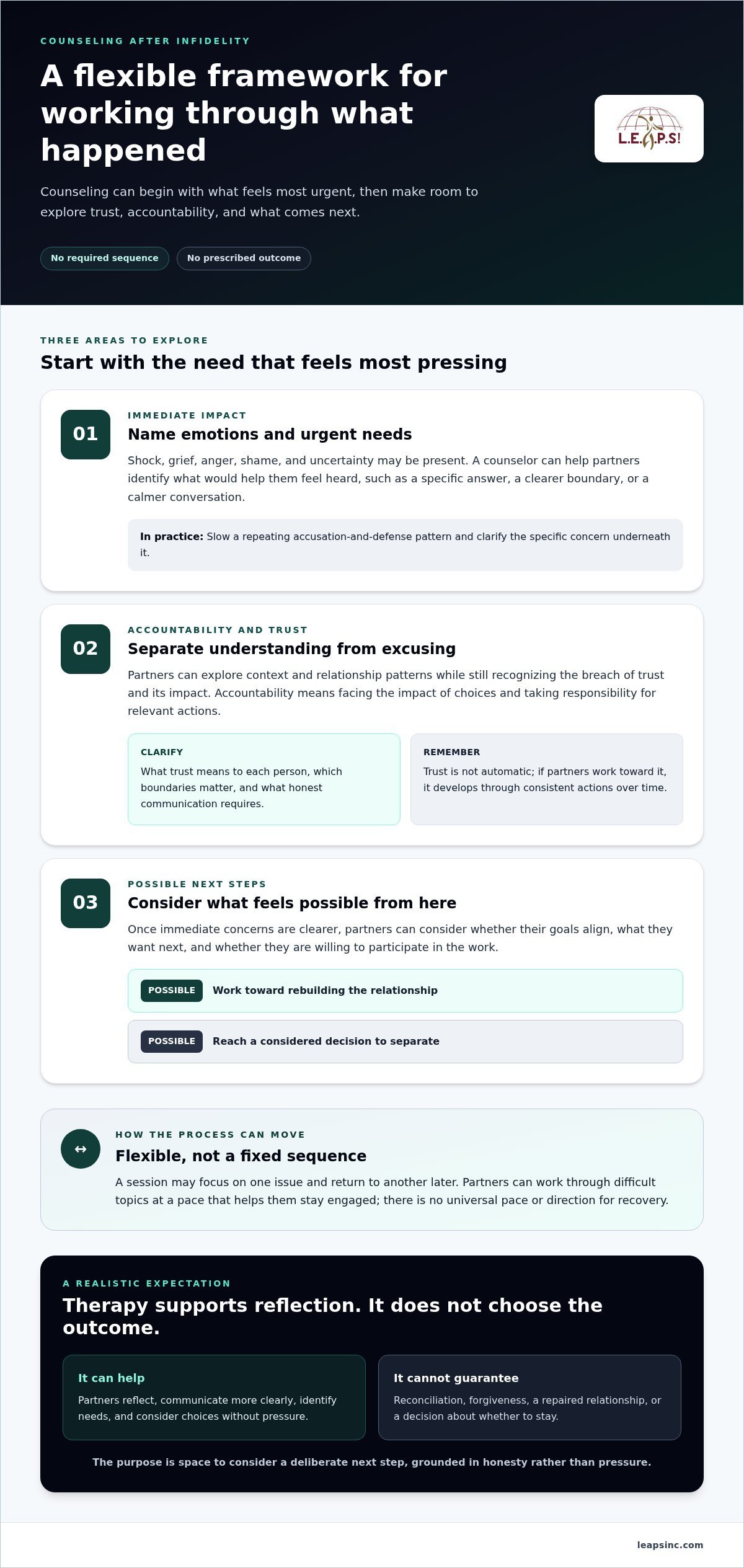
Therapy can help you face the truth and consider your choices; it cannot guarantee that a relationship will be repaired or decide whether you should stay. Some partners may work toward rebuilding their relationship; others may reach a considered decision to separate. Counseling doesn’t erase what happened or require either outcome. Its value is in creating space to examine what feels possible and make a deliberate choice, grounded in honesty rather than pressure.
How Counseling for Cheating Can Help Partners Process What Happened
There isn’t one required sequence for working through infidelity in therapy. Counseling for cheating can begin with what feels most urgent, such as managing a painful argument, clarifying a boundary, or finding a way to talk without escalating. Once immediate concerns are clearer, partners may have more room to consider broader questions about the relationship and what they want next.
This is a flexible framework, not a standard protocol or a promise that every conversation will feel orderly. A session might focus on one issue and return to another later. The American Psychological Association’s discussion of how psychologists help patients heal from infidelity also reflects the complexity of this work and the importance of attending to individual as well as relationship needs.
Beginning with emotional impact and immediate needs
At first, partners may need help naming what they’re feeling before they can make sense of the relationship as a whole. One person might say, “I need you to answer my question without changing the subject,” while the other may need to explain what makes that conversation difficult. A counselor can help each person identify what would help them feel heard, without requiring agreement on every interpretation.
When an argument repeats the same accusation and defense, a therapist may slow the exchange and help turn broad statements into specific concerns. “You never tell me the truth” might lead to a discussion of a particular unanswered question or a need for clearer communication. This doesn’t dictate what must be disclosed or in what order. Partners can work through difficult topics at a pace that allows them to stay engaged.
Exploring accountability, trust, and possible next steps
Accountability means facing the impact of choices and taking responsibility for relevant actions. It isn’t the same as reducing therapy to blame, and discussing relationship context doesn’t excuse infidelity. Partners can distinguish explanation from responsibility: they may explore what was happening while still recognizing the harm and the need for honest communication.
Trust, if partners choose to work toward it, develops through consistent actions over time. Counseling can help clarify what each person means by trust, which boundaries matter, and what behaviors might support greater confidence. These discussions don’t make trust automatic. They help partners consider whether actions and words align and whether both people are willing to participate in the work.
From there, partners can explore whether their goals align or whether they need to consider separate paths. Couples therapy can offer a structured setting for that reflection without positioning reconciliation as the required destination. Recovery has no universal pace or direction; each person and couple moves through it in their own way.
If structured support feels like a useful next step, you can schedule an appointment to begin considering what you need from the process.
Individual or Couples Counseling for Cheating: Which Fits Your Situation?
Choosing a format doesn’t require deciding whether the relationship will continue. A more useful question may be: do you need space to understand your own experience first, or are you ready to work on shared conversations together? Counseling for cheating can involve individual therapy, couples therapy, or a shift between these forms of support as needs change.
| Format | Focus | Who attends | May suit situations where |
|---|---|---|---|
| Individual therapy | Personal feelings, boundaries, and choices | One partner | You need room to process distress or think through a decision, whether or not your partner is ready to attend |
| Couples therapy | Shared communication, relationship patterns, and joint decisions | Both partners | You want support discussing the impact of infidelity and considering the relationship’s future together |
These formats serve different purposes; neither is a test of commitment or a vote for staying together. You can begin individually, then decide with your partner whether shared sessions fit your needs. A useful starting point is the format that makes room for honest reflection and meaningful participation.
When individual therapy may be a useful starting point
If you’re feeling overwhelmed, unsure which boundaries you need, or caught between competing choices, individual therapy can offer focused space to examine your priorities. You might want to clarify what you need before discussing the relationship, or consider what staying or leaving could mean for you. You can seek individual support even if your partner isn’t ready to attend.
The focus is your experience and well-being, not persuading you toward one relationship outcome. You can explore difficult emotions, identify questions you want to address, and consider which next step feels aligned with your needs.
When couples counseling may help create a shared conversation
Couples sessions bring both partners into a facilitated conversation about communication, relationship patterns, and decisions that affect them together. For example, one person may want to discuss what transparency should look like, while the other wants to explain what they’re prepared to change. A therapist can help keep both concerns in view without requiring partners to reach agreement immediately. Couples therapy offers a setting for shared support as partners consider relationship questions.
Joint sessions may fit when both people are willing to participate, even if they’re not equally certain about the future. Attending together doesn’t guarantee reconciliation or restored trust. It can give partners a structured setting to clarify their goals, assess whether those goals align, and consider repair or separation with greater intention.
As you weigh the options, notice what feels most urgent: personal clarity, a shared discussion, or both. Your choice can remain open as your needs become clearer.
How to Prepare for Counseling After Cheating
You don’t need a complete account of what happened or a final decision about the relationship before beginning counseling. A little preparation can help you use the first conversation to identify what feels most pressing and what support you’re seeking. Treat your notes as a guide, not a script. The conversation can take a different direction as your needs become clearer.
Before the session, take a few minutes to consider four areas:
- Concerns: What is weighing on you most right now?
- Hopes: What would you like counseling to help clarify, even if you don’t yet know the answer?
- Boundaries: What feels important to communicate about pace, privacy, or difficult topics?
- Questions: What do you find hard to raise in everyday conversations?
Questions to reflect on before the first session
Try writing down one or two priorities in your own words. For example, you might want to understand why conversations keep turning into arguments, or figure out what you need before making a decision about the relationship. If you’re attending with a partner, each of you can reflect separately first. Your personal needs may differ from shared relationship goals, and both are useful to name.
Notes can help you stay oriented if emotions rise, but they don’t need to cover every detail or dictate the session. A first conversation can help clarify what support you need and which questions deserve attention. It may also establish a starting point without requiring a fixed plan or timeline for therapy.
Setting realistic expectations for difficult conversations
Talking about betrayal can bring up sadness, anger, shame, or defensiveness. Feeling distressed doesn’t mean counseling is failing; it may simply mean the subject is painful. Try to listen for what the other person is communicating while stating your own needs clearly. You can ask to pause or slow down rather than push yourself into a conversation you’re not ready to have.
Forgiveness doesn’t need to be demanded as proof of progress. Instead, consider what boundaries would make discussion feel more manageable, such as focusing on one concern at a time or agreeing to take a break when either person feels overwhelmed. If faith is central to your relationship, you may want to explore faith-based couples therapy as part of your reflection.
Preparation isn’t about controlling what a counselor will say or ensuring a particular outcome. It can help you arrive with a clearer sense of what matters while leaving room for insight you may not have anticipated. If you’re ready to begin that conversation, you can schedule an appointment and take a considered first step.
Move Forward with Counseling for Cheating at LEAPS Inc.
After infidelity, the next step doesn’t have to settle the future of your relationship. It can simply be a decision to make room for reflection, understand what you need, and approach difficult choices with greater intention. At LEAPS Inc., individual and couples therapy offer different forms of support for processing emotions and considering what comes next. Neither guarantees a particular solution or requires a promise to reconcile.
Individual therapy may be a helpful starting point if you want space to sort through your feelings, identify personal boundaries, or consider a decision before discussing it with your partner. Couples therapy may fit when both people want to take part in shared conversations about the relationship and its future. These options meet different needs; choosing one doesn’t define the final outcome.
Choose a next step that reflects your needs
If you’re not ready to speak together, beginning individually can still be a meaningful step. You can use that time to clarify your priorities and what you want support with, without deciding whether to stay or leave. If you and your partner are ready to talk together, couples therapy provides a setting for shared support as you consider relationship questions.
Your needs may change. You might begin with individual support and later decide that joint sessions would be useful, or conclude that you need to continue working through your own concerns first. Your decision can reflect where you are now, not a permanent commitment to one path. Seeking support doesn’t declare that the relationship must be saved or ended.
Begin a conversation about support
Therapy can help you clarify what feels most important, process difficult emotions, and identify thoughtful next steps. The work may bring greater understanding, but it cannot promise forgiveness, restored trust, reconciliation, or a particular relationship decision. Your choices remain yours.
If you’re ready to discuss what support could look like for you, schedule an appointment with LEAPS Inc. You can begin with the questions you have today and take the conversation one step at a time. A considered future doesn’t require certainty now; it begins with choosing a next step that reflects your needs, values, and capacity for honesty.
Choose a Next Step That Honors Your Needs
The future of a relationship may not be clear today. You can still approach it with intention: make room for what you’re feeling, identify what matters most, and decide what support could help you think clearly. Counseling for cheating isn’t a commitment to stay or leave. It’s an opportunity to move toward a choice grounded in honesty and self-understanding.
LEAPS Inc. offers individual and couples therapy, as well as therapy intensives. The right starting point depends on the support you’re seeking, not on a promise of reconciliation or a prescribed destination. You remain the decision-maker throughout the process.
If you’re ready to explore support, schedule an appointment to discuss your next step. You don’t need to have every answer before beginning. One considered choice can open space for greater clarity and a future shaped by your values.
Frequently Asked Questions
Can counseling for cheating help if we are not sure we want to stay together?
Yes, counseling for cheating can support partners who are uncertain about continuing their relationship. You don’t need to arrive with a shared decision. One partner may want to understand what would need to change, while the other is still weighing whether to participate. Counseling can help make those differences clearer and give you space to consider possible paths without treating uncertainty as a failure.
Can one partner start counseling after cheating if the other partner refuses?
Yes, one partner can seek individual support even if the other isn’t willing to attend. You might use sessions to sort through your reactions, decide which boundaries matter to you, or prepare for a conversation you’ve been avoiding. Individual support can focus on your well-being and choices; it doesn’t require your partner’s participation or mean you’ve decided what should happen to the relationship.
Is counseling for cheating only for married couples?
No, relationship counseling isn’t limited to married couples. Partners who are dating, engaged, or in another committed relationship may also want help addressing infidelity and its effects. The agreements and expectations in a relationship can shape what each person wants to discuss. A counselor can help partners clarify those expectations and consider their concerns without treating marriage as a prerequisite for support.
How long does counseling for cheating take?
There’s no set duration that applies to every person or couple. The amount of time can depend on what you want to address, whether you attend individually or together, and how your needs evolve. An initial conversation can help clarify your priorities and what support could involve. You can revisit your goals as you go; don’t assume a particular timeline or relationship outcome in advance.
Should partners discuss every detail of an affair in counseling?
No, you don’t have to prepare a complete account or share every detail at once. It may help to identify which unanswered questions affect your decisions, boundaries, or understanding of what happened. Some details may feel relevant; others may not help you move forward. You can tell the counselor what you’re hoping to understand and discuss how to approach sensitive questions without rushing into disclosures you’re not ready to make.
Can counseling help when the affair is still ongoing?
Yes, counseling can provide space to address the situation as it is, including what each partner understands, needs, and is willing to consider. An ongoing affair may make it harder to discuss trust or possible repair, but sessions can still help clarify boundaries and relationship choices. Counseling doesn’t require you to make a decision on the spot or guarantee that the affair will end or the relationship will continue.
Does counseling for cheating mean the betrayed partner has to forgive?
No, attending counseling doesn’t obligate the betrayed partner to forgive. Sessions can focus on understanding the impact, expressing what feels unresolved, and deciding which boundaries or next steps are right for that person. Forgiveness is personal, and it isn’t the same as staying in the relationship or accepting ongoing behavior that causes harm. Each partner can take time to determine what healing and honesty mean for them.