

What if the problem isn’t your logo, but the gap between what your organization stands for and what customers experience? When leadership’s vision and customer-facing messages don’t align, even polished branding can feel unclear. Brand development consulting can help connect your purpose and strategy with the way your organization shows up, so you can explain what makes it meaningfully different.
When your brand no longer feels right, visible change can seem like the natural first step. But changing colors or language without a strategic foundation may leave more important questions unanswered: Who are you here to serve? What impact do you intend to make? How should that purpose shape the customer experience?
This article explains what brand development consulting involves and when it may be useful. You’ll find a practical framework for evaluating brand decisions, learn how brand development can work alongside corporate visioning, business development, and strategic marketing, and identify a next step for connecting your organization’s direction with the way your brand shows up.
Key Takeaways
- Brand development consulting can connect an organization’s purpose and direction with the identity customers experience.
- Evaluate brand decisions through five lenses: organizational direction, audience understanding, meaningful difference, consistent expression, and ongoing learning.
- Distinguish strategic brand development from visual redesign and ongoing marketing execution to clarify what your organization needs.
- Document your intended audience, purpose, differentiators, and communication principles to turn insight into practical brand decisions.
- LEAPS Inc. offers brand development alongside corporate visioning, business development, and strategic marketing consultation, tailored to organizational priorities.
What Brand Development Consulting Does Beyond a New Logo
A new logo can make an organization look different without helping it communicate what makes it distinct. Brand development consulting takes a wider view. It examines the organization’s purpose, direction, audience, and intended impact, then considers how those foundations should shape what people see, hear, and experience. The goal is not change for its own sake. It is to bring the organization’s internal direction and external expression into clearer alignment.
Brand identity is the meaning and character an organization intends to convey. Visual assets, such as a logo, colors, and typography, express that identity, but they are not the identity itself. Messaging and customer interactions also shape how the organization comes across. A useful starting point is the broader idea of What is a Brand?, which extends beyond a single visual mark to include how an organization is recognized and understood.
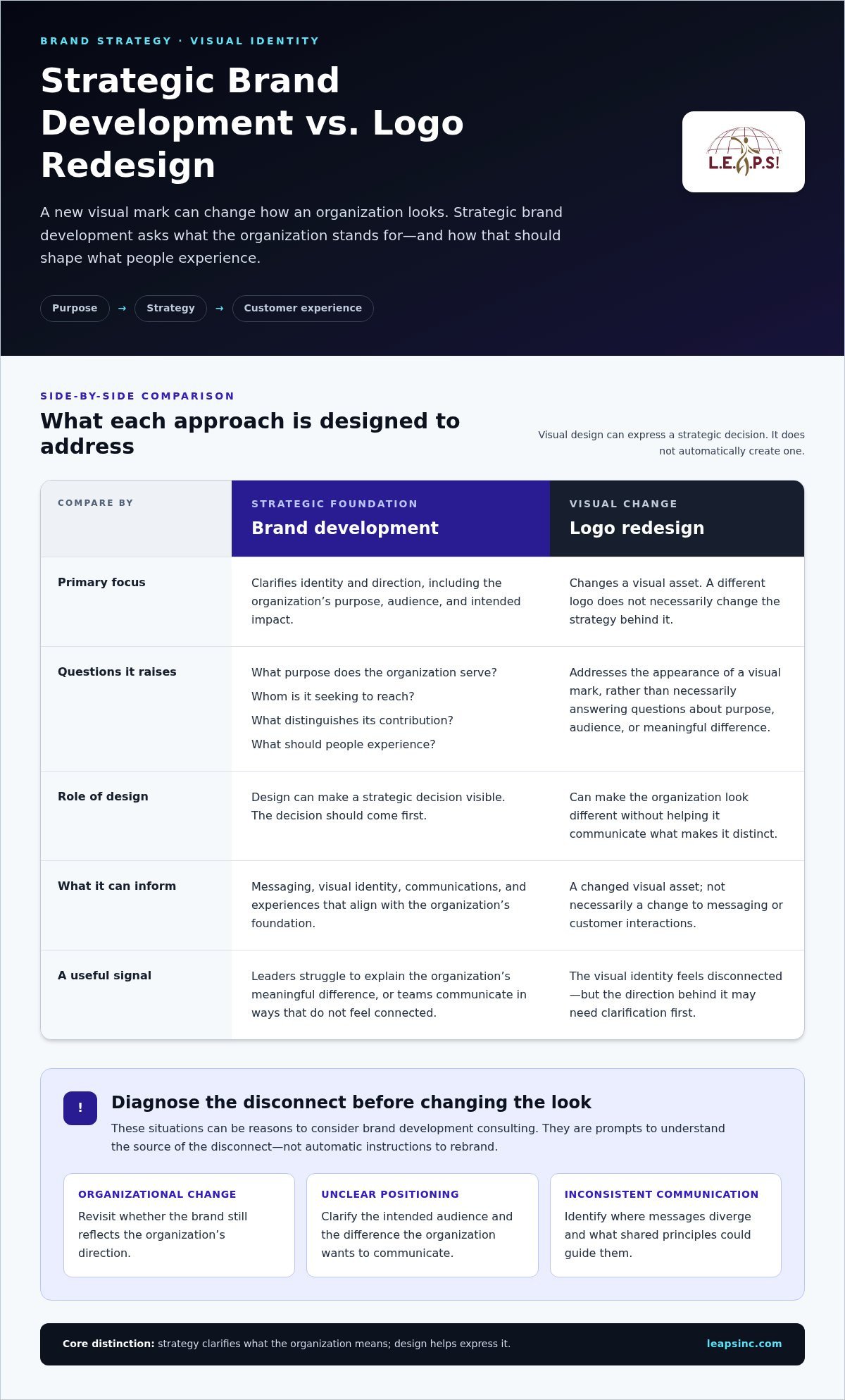
Brand development is the strategic work of clarifying an organization’s identity and direction, then aligning its communications and experiences with that foundation. A logo redesign changes a visual asset, but not necessarily the strategy behind it. Design can make a strategic decision visible, but the decision should come first. If audiences receive conflicting messages or leaders struggle to explain the organization’s meaningful difference, the issue may be alignment rather than aesthetics.
What does a brand development consultant help clarify?
A consultant helps an organization examine the questions that guide brand decisions: What purpose does the organization serve? Whom is it seeking to reach? What distinguishes its contribution? What should people experience when they encounter it? Answers can inform deliverables such as messaging or visual identity, but the questions are not deliverables in themselves. The scope depends on organizational needs and priorities. LEAPS Inc. offers brand development consultation as a strategic conversation about identity, direction, and intended impact.
Separating the questions from the outputs helps leaders make deliberate choices. If a message sounds generic, for example, the organization may need to articulate its differentiators before rewriting its website. If the visual identity feels disconnected from the organization’s direction, clarify that direction before commissioning new design. Not every project requires a full strategic review. The important thing is for each output to have a clear reason grounded in the organization’s purpose and priorities.
When is brand development consulting worth considering?
Consider brand development consulting when a meaningful organizational change makes existing language feel outdated, leaders can’t describe the organization’s position clearly, or teams communicate in ways that don’t feel connected. These are prompts to diagnose the source of the disconnect, not automatic instructions to rebrand. A focused conversation can help distinguish a strategic issue from a narrower need, such as updating a specific message or visual element.
- Organizational change: Revisit whether the brand still reflects the organization’s direction.
- Unclear positioning: Clarify the audience and difference the organization intends to communicate.
- Inconsistent communication: Identify where messages diverge and what shared principles could guide them.
Brand development can create a more considered foundation for decisions, but it doesn’t guarantee growth, revenue, or market share. Its value starts with clarity: leaders can better assess what the organization stands for and how to express that purpose. That gives design and communication choices a strategic basis instead of making a new look the starting point.
How Brand Strategy Connects Organizational Vision to Customer Experience
A vision gives an organization a sense of direction; brand strategy translates that direction into choices people can recognize. Customers don’t encounter a vision statement in isolation. They experience its effects through an organization’s words, decisions, services, and interactions. Brand development consulting can help leaders move from broad intent to a coherent expression that matters both inside and outside the organization.
Brand alignment exists when the identity an organization intends to express is reflected in the experience people actually have with it. Use this five-step sequence to make that alignment practical:
- Clarify direction. Describe the organization’s purpose, priorities, and intended impact in language leaders can use to guide decisions. Clear direction helps teams distinguish core commitments from short-term preferences.
- Understand audiences. Consider whom the organization serves, what those people need, and how they currently perceive the organization. Customer insight can show where internal assumptions match, or differ from, people’s experiences.
- Define difference. Identify what the organization can credibly offer that matters to its audience. A distinction is strongest when it reflects real organizational strengths, not simply a claim leaders hope will sound compelling.
- Align expression. Translate strategic choices into messages, visual cues, and interaction principles. For example, a commitment to thoughtful guidance should come through not only in a tagline but also in how information and support are delivered.
- Review learning. Observe how the brand is understood and experienced, then revisit decisions as the organization and its audiences evolve. Treat feedback as a prompt for considered refinement, not an automatic reason to change direction.
How does organizational vision shape a brand?
Vision helps leaders set a shared destination and make consistent choices about priorities, communication, and the experience they intend to create. If leaders interpret that destination differently, one team may emphasize innovation while another communicates stability, leaving audiences with mixed signals. Corporate visioning can help clarify organizational direction; brand development translates that direction into an identity people can encounter.
How do customer insights inform brand positioning?
Leadership insight and customer research answer different questions. Leaders can articulate the organization’s purpose, ambitions, and capabilities. Audience insight can illuminate what people value, understand, and experience. Both matter. A positioning claim based only on internal conviction may overlook what customers recognize, while feedback alone may not express the organization’s future direction. Separate observed evidence from assumptions, then use both perspectives to shape a credible position.
Once direction is clear, it can guide more than a campaign. It can help teams choose which messages to prioritize, how to describe the organization’s contribution, and what qualities should remain consistent across customer interactions. It also gives leaders a practical test for proposed decisions: does this reinforce the intended identity and serve the organization’s priorities? If your leadership team is working through these questions, you can schedule a conversation about your organizational goals.
How to Evaluate Brand Development Consulting for Your Organization
The right scope of brand development consulting depends on the decision your organization needs to make. Before considering activities or deliverables, name the challenge. Is the organization unclear about its position, dissatisfied with its visual identity, or looking for consistent execution of an established strategy? These needs can overlap, but they call for different work. Distinguishing them helps prevent an attractive deliverable from standing in for a more important decision.
Brand development consulting vs. a visual rebrand
A visual rebrand changes how an organization looks; strategic work examines what it needs to communicate and why. Changing a logo or color palette may be appropriate, but it won’t by itself resolve unclear positioning or differences in how teams describe the organization. Conversely, an organization may need to establish strategic direction without an immediate visual overhaul. Treat design as one possible expression of clear decisions, not a substitute for making them.
What makes recommendations relevant to business priorities?
Useful recommendations connect to the organization’s stated goals, audience, and operating context. Their reasoning should be clear: which priority does a recommendation serve, whom is it for, and what decision or action does it inform? If leaders want to communicate a more focused purpose, for example, proposed messaging should help express that purpose rather than add broad claims that don’t guide choices.
Brand work can feel abstract if discussion never leads to decisions. Keep it grounded by defining the questions the work should answer and the practical choices those answers will support. These might include which audiences to prioritize, what message to lead with, or what principles should shape customer interactions. Business development consultation relates to wider organizational direction, while brand development focuses on how identity and expression support that direction. This work can inform choices, but shouldn’t be treated as a guarantee of financial performance.
Before agreeing on a scope, consider whether it is clear, connected to organizational priorities, informed by relevant evidence, and useful for implementation. Choose ways to assess the work based on its objectives. Depending on those objectives, leaders might consider whether teams can apply shared communication principles or whether intended audiences understand the organization’s central message. If you’re ready to discuss your organization’s priorities, schedule a conversation.
A Practical Brand Development Framework for Turning Insight into Action
Insight becomes useful when it helps leaders make and apply decisions. A practical framework keeps brand work connected to the organizational challenge that prompted it, rather than allowing findings to remain abstract. Brand development consulting can help clarify what matters, decide what to prioritize, and give teams guidance they can use across relevant communications and customer interactions.
What should leaders clarify before brand work begins?
Begin with the decision or organizational change that brought the brand into focus. Gather leadership perspectives and examples of current customer-facing communication, such as website copy, presentations, or service descriptions. Look for places where intended messages feel unclear or inconsistent. Then state what the organization wants its brand to help clarify or express. This preparation gives the work a defined purpose without presuming that a visual overhaul is necessary.
Use the following sequence to move from diagnosis to action:
- Frame the challenge. Write a concise statement of the issue and the decision the organization needs to make. A leadership transition, for example, may raise questions about which parts of the organization’s identity should remain constant and what needs to be communicated differently.
- Record the foundation. Document the intended audience, organizational purpose, meaningful differentiators, and communication principles. Make each statement specific enough to guide a choice, rather than relying on broad aspirations alone.
- Set priorities. Identify which questions need resolution first. If teams disagree about the organization’s core message, establish that before refining secondary language or visual details.
- Translate decisions into guidance. Define how the agreed direction should shape relevant touchpoints, such as introductory messaging, service descriptions, presentations, or customer interactions. The aim is consistent expression, not identical wording everywhere.
- Review and refine. Consider whether the guidance is clear and practical in use. Gather relevant feedback, note where interpretations differ, and refine the direction when learning or organizational priorities warrant it.
How can a brand strategy guide implementation?
Translate each strategic choice into a usable principle. If the organization wants to communicate a clear, supportive experience, specify what that means for tone, explanations, and follow-through. Teams can then apply the principle in their own contexts while keeping the underlying identity coherent. This allows thoughtful adaptation without losing direction.
Brand direction can also inform broader marketing priorities. When an organization needs to connect its identity with audience-focused planning and communications, strategic marketing planning can complement brand development. Keep the roles distinct: brand direction clarifies what the organization stands for and how it should be expressed; marketing planning applies that direction to communication priorities.
Review is a discipline of learning, not a guaranteed performance formula. Agree on what the organization will assess, such as whether teams can apply the principles consistently or whether communications express the intended direction. To discuss how these decisions relate to your organization’s priorities, discuss your organization’s brand direction.
How LEAPS Inc. Approaches Brand Development Consulting
Brand decisions are strongest when they reflect where an organization intends to go, not only how it wants to look. LEAPS Inc. offers brand development alongside strategic marketing, business development, and corporate visioning consultation. These areas can inform one another while addressing different questions: brand development considers identity and expression, strategic marketing focuses on marketing direction, business development considers organizational development, and corporate visioning addresses the direction an organization wants to pursue.
How can brand development connect with wider organizational goals?
For leaders, the value of brand development consultation lies in its connection to organizational priorities. A brand’s identity can be considered alongside the organization’s intended impact and direction, helping leaders think through how to express that direction to the people they serve. Corporate visioning can help frame where the organization is headed; brand development considers how its identity communicates that direction; strategic marketing applies the resulting clarity to marketing choices. The disciplines are related, but not interchangeable.
Keeping these distinctions clear helps prevent a broad organizational challenge from being reduced to a design task or marketing campaign. If leaders are still working to articulate their future direction, that question deserves attention in its own right. If direction is clear but the organization’s identity feels difficult to express, brand development may be the more relevant focus. When marketing priorities need attention, strategic marketing can complement the conversation without replacing brand strategy.
LEAPS Inc.’s consulting work is tailored to organizational priorities. The conversation can begin with the question leaders need to resolve, then consider how brand development relates to other organizational goals. The purpose isn’t to prescribe a predetermined package or promise a particular business result. It is to support clear thinking about identity, direction, and how to express the organization’s intended impact.
What is a useful first conversation about brand direction?
A useful starting point is a concise account of what prompted the discussion. Leaders can describe the current challenge, the audience they intend to reach, and the direction they hope to express. It can also help to identify where the brand feels disconnected from organizational priorities, such as inconsistent descriptions across teams or uncertainty about what distinguishes the organization. These details give the discussion a meaningful focus without requiring every answer to be settled in advance.
LEAPS Inc. was founded and is led by Dr. John E. N. Daniel. Leaders, entrepreneurs, and organizations can use an initial conversation to explore how brand development relates to their goals and whether consultation in strategic marketing, business development, or corporate visioning is also relevant. Bring the question you’re working through and the future you’re trying to clarify.
Schedule an appointment to discuss your goals.
Give Your Brand Direction a Clear Next Step
Your organization’s next chapter deserves an identity that can move with purpose. Rather than starting with what to change, begin with what you want people to understand, experience, and remember. That intention can guide upcoming decisions and help your team choose which questions deserve attention first.
Brand development consulting offers a way to explore that direction in relation to your organization’s priorities. LEAPS Inc. provides brand development consultation, with strategic marketing, business development, and corporate visioning available as related areas of organizational consultation. Each addresses a different dimension of direction and expression. The right starting point is the challenge your organization is ready to address.
You don’t need every answer before starting a conversation. Bring the question that feels most important, the audience you hope to reach, and the future you’re working toward. From there, you can begin shaping a more intentional path for your organization.
Schedule an appointment to discuss your brand goals and take a considered next step toward expressing your organization’s purpose with greater clarity.
Frequently Asked Questions
What is brand development consulting?
Brand development consulting is strategic guidance that helps an organization clarify its identity, audience, differentiation, and how these are expressed. It looks beyond a logo to the meaning and experience the organization intends to communicate. Scope depends on organizational priorities: one organization may need sharper positioning, while another is preparing to explain a new service. The work can support clearer decisions, but it can’t guarantee a particular business result.
Is brand development consulting only for large companies?
No. Organizations of different sizes can face questions about positioning, identity, or change. A small organization introducing a new service may need to explain its value clearly, while a larger one may be working through inconsistent messaging across teams. Company size alone doesn’t determine whether consulting is useful. Consider how important and complex the current challenge is, and whether clearer brand direction could help leaders make the decisions in front of them.
Can brand development consulting help when a company is changing direction?
Yes. Strategic brand work can help leaders examine how the organization’s identity and communication relate to a new direction. A shift in the audience an organization serves, for instance, may raise questions about which messages still fit and what needs clarification. Start with the organization’s specific goals and context. Consulting can guide that consideration, but it can’t guarantee customer acceptance, growth, or a successful transition.
How is brand development different from strategic marketing consulting?
Brand development focuses on what an organization stands for, how it is positioned, and the experience it intends to convey. Strategic marketing considers how the organization approaches its market and communicates its offer. Brand direction can help clarify the meaning behind a new service, for example, while marketing planning can shape how that service is presented to its intended audience. The disciplines can inform each other, but they aren’t interchangeable.
What should I prepare before a brand development consultation?
Bring the organizational challenge, goals, assumptions about the intended audience, and examples of current messaging. It can also help to identify a specific moment when the brand felt unclear, such as when teams described the organization differently in separate presentations. You don’t need a polished brief or complete answers. A few clear questions and relevant examples give the initial discussion useful context and help focus attention on the decisions that matter.
How can an organization tell whether its brand messaging is inconsistent?
Possible signs include teams describing the organization in different ways, difficulty explaining what distinguishes it, or customer-facing messages that don’t reflect leadership’s intent. Treat these as clues to investigate, not proof of a single cause. A change in the market, operations, or audience may also explain the disconnect. Compare messages across contexts, note where meanings diverge, and explore what has changed before deciding what needs attention.
How much does brand development consulting cost?
The cost depends on the organization’s goals and the scope of work involved, so a useful discussion starts with the specific challenge rather than a generic estimate. Consider whether you need help clarifying direction, addressing a defined brand question, or connecting identity with wider organizational priorities. To discuss your needs, schedule an appointment. The conversation can focus on your situation without assuming a particular scope or outcome.