

The most important premarital counseling questions to ask aren’t necessarily the ones with matching answers. They’re the ones that help you understand each other’s expectations and make decisions together. Before marriage, it’s natural to focus on shared hopes. Yet expectations about money, family, conflict, intimacy, and daily life can remain unspoken, especially when a subject feels difficult to raise.
You don’t need identical perspectives to build a strong marriage. Different answers can show where you’ll need curiosity, clear communication, and a plan to keep talking. Use this guide to explore meaningful questions, understand what your responses may reveal, and prioritize the conversations that matter instead of treating a long checklist as a test.
You’ll also find ways to approach difficult topics without turning differences into automatic deal-breakers, and to revisit conversations as your plans change. If you want a supportive space to explore expectations and relationship patterns, couple therapy can offer guidance as you prepare for the life you intend to build together.
Key Takeaways
- Use premarital counseling questions to ask about the future you want to build, not just the wedding you’re planning.
- Explore how your values, commitment, and emotional needs shape the partnership you hope to create.
- Discuss practical expectations around money, parenting, family boundaries, work, and household responsibilities.
- Choose one or two questions at a time, listen with curiosity, and agree on when to continue the conversation.
- Consider guided couples therapy when a topic feels difficult to discuss or revisit together.
Why Premarital Counseling Questions Matter Before Marriage
Preparing for marriage isn’t about predicting a perfect future. It’s about approaching that future with curiosity: learning how each of you thinks, what you value, and how you want to make decisions together. A thoughtful conversation can uncover assumptions that might otherwise stay hidden simply because neither person thought to ask.
Premarital counseling questions are prompts that help partners explore expectations, values, relationship patterns, and shared decisions so they can understand one another and plan their life together with greater clarity. The purpose isn’t to produce identical answers or pass a compatibility test. It’s to speak honestly, listen respectfully, and notice where your perspectives align or call for more discussion.
For example, both partners may want a close family life but picture different boundaries with relatives. One may see a career move as an exciting opportunity while the other worries about its effect on daily routines. Naming the expectation behind each response helps you discuss what matters rather than assume you already agree. The premarital counseling questions to ask are most useful when they open a conversation, not when they demand a perfect answer.
What Can Premarital Questions Help Couples Understand?
Questions can bring unspoken expectations into view: what commitment looks like day to day, how each person responds under stress, and what support feels meaningful during a difficult season. You may discover shared priorities, such as wanting to make major decisions jointly, alongside areas that need clarification, such as how much time to spend with extended family.
Different answers are information, not a verdict. They don’t predict whether a marriage will succeed or determine whether you should marry. Instead, they can prompt useful follow-ups: “What led you to that view?” or “How might we handle this if our circumstances change?” Those questions turn a difference into a chance to understand each other’s reasoning and identify a possible way forward.
Do Strong Couples Still Need Premarital Conversations?
Premarital conversations aren’t only for couples in serious conflict. A strong connection can be a valuable starting point for discussing new responsibilities, changing routines, and decisions that affect you both. Talking early gives you room to practice hearing each other before pressure makes it harder to slow down and respond thoughtfully.
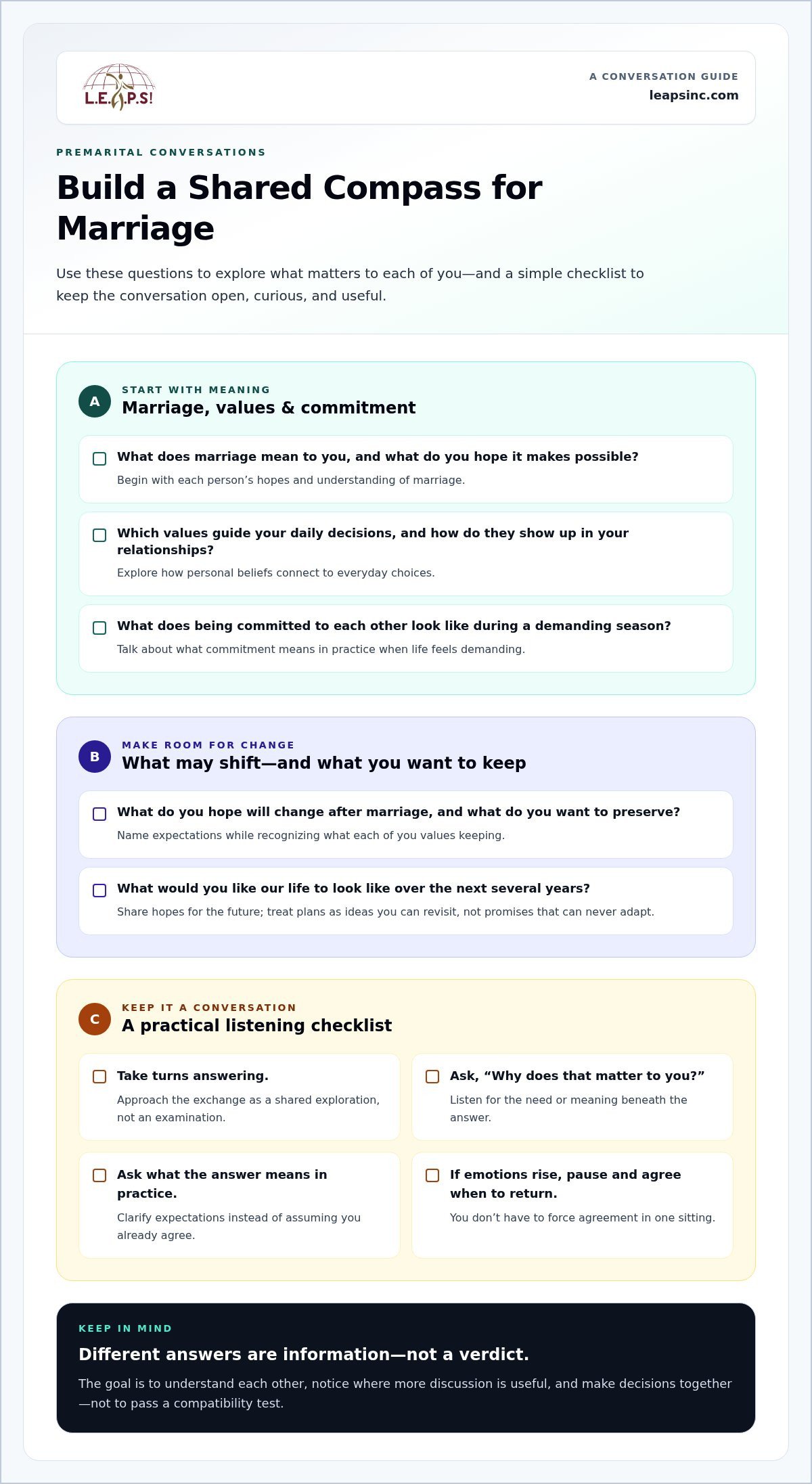
Approach the exchange as a shared exploration, not an examination. Take turns answering, ask what a response means in practice, and acknowledge what you appreciate in your partner’s perspective. If a topic feels emotionally charged, pause and agree when to return to it rather than forcing agreement in one sitting. The aim is to build a respectful way to continue the conversation.
For partners who want support connecting shared beliefs with expectations for marriage, Christian marriage counseling can offer a setting for guided discussion. More broadly, couples therapy can help partners examine relationship patterns and strengthen communication as they prepare for the life they hope to build. Asking meaningful questions is a beginning; learning how to stay engaged with the answers gives those conversations lasting value.
Premarital Counseling Questions About Values, Commitment, and Connection
The most useful conversations move from personal beliefs toward a shared vision. Start with what each of you brings to the relationship: the experiences, values, and hopes that influence how you define marriage. Then explore how those ideas might shape your life together. You don’t need to agree on every detail. Focus on understanding what sits beneath each answer.
Shared values don’t require identical personalities or histories. They give partners a common compass for making choices while honoring their differences.
Questions About Marriage, Values, and the Future
Begin with meaning before logistics. Ask what commitment looks like in everyday behavior, then connect broad beliefs to real choices. These prompts can help you move beyond “I believe in honesty” to what honesty means when a conversation feels uncomfortable.
- What does marriage mean to you, and what do you hope it makes possible?
- Which values guide your daily decisions, and how do they show up in your relationships?
- What does being committed to each other look like during a demanding season?
- What do you hope will change after marriage, and what do you want to preserve?
- What would you like our life to look like over the next several years?
After each answer, ask, “Why does that matter to you?” A partner who values regular time together may be expressing a need for connection, not a fixed schedule. Treat future plans as hopes you can revisit, rather than promises that can never adapt. Psych Central’s overview of the benefits of premarital counseling also discusses how guided conversations can help couples explore expectations and prepare for marriage.
Questions About Trust, Emotional Needs, and Intimacy
Connection is shaped by small, repeated interactions as well as moments of vulnerability. Talk about what helps each of you feel understood, how you repair trust after a disappointment, and how you’ll communicate when emotional or physical needs shift. Different ways of expressing care don’t necessarily mean different levels of commitment.
- What helps you feel heard when something is weighing on you?
- What builds trust for you, and what can weaken it?
- How do you prefer to receive affection, and how can we talk about intimacy comfortably?
- What helps you feel emotionally safe enough to share something difficult?
- How should we let each other know when our needs or boundaries change?
Listen for the meaning behind each preference. One person may need quiet time to process, while the other feels close through talking right away. Understanding those responses can help you find a way to reconnect that respects both partners. If you want support strengthening communication and relationship connection, explore LEAPS couples therapy. You can also schedule an appointment to begin a guided conversation.
Questions About Conflict, Money, Family, and Everyday Life
Practical expectations often become clearest in ordinary situations: deciding how to spend, responding to stress, or dividing weekly responsibilities. Rather than working through an exhaustive checklist, choose questions connected to decisions you’ll actually face. The table pairs each topic with a prompt and the expectation it can help you explore.
| Topic | Sample question | Expectation to explore |
|---|---|---|
| Money | What do saving, spending, and financial security mean to each of us? | Priorities, habits, and how to make major financial decisions together. |
| Children and parenting | Do we each want children, and how do we imagine sharing caregiving? | Whether your hopes align and what parenting responsibilities might involve. |
| Extended family | How involved do we want relatives to be in our lives and decisions? | Boundaries, traditions, and expectations for offering or receiving support. |
| Conflict | What do we tend to do under stress, and what helps us return to a hard conversation? | Ways to pause, communicate, and work toward repair. |
| Household and work | How should we divide home responsibilities when work demands change? | Fairness, flexibility, career priorities, and leisure time. |
Questions About Money, Children, and Family Boundaries
Money discussions involve more than whether you combine accounts. Explore what each of you considers necessary, how you approach saving and discretionary spending, and how you want to weigh major purchases. If your habits differ, ask what those habits represent: security, independence, generosity, or another priority. You can also talk about how you’d approach a financial decision when you disagree, such as setting a time to review the options together before committing.
Be direct about whether you want children. If you do, discuss how you picture sharing parenting. If you don’t, make room to understand what that choice means to each of you. Family traditions and obligations deserve the same care. For couples whose faith is central to these conversations, Christian marriage counseling can provide a faith-informed setting to explore expectations.
Questions About Conflict and Shared Responsibilities
Ask what each person tends to do when overwhelmed: seek an immediate discussion, withdraw to think, or focus on solving the practical problem. Then explore what makes it easier to return and listen. The aim isn’t to label one response right or wrong. It’s to learn how your different reactions affect the conversation and what helps both of you stay engaged.
Daily life also calls for explicit agreements. Discuss how you’ll divide cooking, cleaning, caregiving, and planning, while recognizing that responsibilities may shift with work or health. Talk about how much time you want together and what independence looks like for each of you. A difference in preference is a starting point for context and negotiation, not an automatic judgment about compatibility. These premarital counseling questions to ask can help turn broad hopes into practical agreements you can revisit.
How to Ask Premarital Questions Without Turning Them Into a Test
A thoughtful question can still feel like pressure if it comes up during an argument, demands an immediate answer, or seems designed to prove a point. Treat these conversations as collaborative work, not a pass-or-fail interview. Choose one or two meaningful premarital counseling questions to ask, give each person room to think, and prioritize understanding over speed.
A simple structure can help you stay engaged, especially when the topic is sensitive. Agree to pause if either partner feels overwhelmed, and decide when you’ll return to the subject so that a break doesn’t become avoidance.
A Simple Process for Discussing Sensitive Topics
- Choose a topic. Pick one area that matters to your shared life, such as financial decisions or family boundaries. Avoid stacking several difficult questions into one conversation.
- Take turns answering. One partner responds while the other listens without interrupting or preparing a rebuttal. Then switch roles so both perspectives receive equal attention.
- Reflect what you heard. Summarize your partner’s point in your own words and ask whether you understood it accurately before sharing your response.
- Clarify with curiosity. Ask, “What shaped that belief?” or “What kind of support would feel helpful?” These questions invite context instead of putting a partner on the defensive.
- Agree on what comes next. Record any decision you’ve reached separately from subjects that need more thought. Set a time to revisit open questions rather than expecting every issue to be resolved at once.
What to Do When Your Answers Differ
A difference isn’t automatically evidence of failure or incompatibility. One partner may want to decide quickly, while the other needs time to reflect. Pause to consider the reason beneath each position: is it connected to a need for security, a fear of being unheard, a deeply held value, or a past experience? Understanding that context makes it easier to explore options without dismissing either person.
A useful difference invites understanding and negotiation; an unresolved communication pattern keeps the same concern returning without either partner feeling heard. Notice whether you can discuss the gap, ask sincere follow-up questions, and identify a next step. If the exchange becomes tense, name what is happening without blame: “I want to keep talking, but I need a short break. Can we return to this tomorrow?” A pause works best when both people know the conversation still matters.
Reflective, growth-oriented support can help couples recognize recurring patterns and approach them with greater intention. LEAPS’ therapeutic philosophy emphasizes a purposeful approach to personal and relational growth. If you’d like support practicing these conversations together, schedule an appointment to explore your relationship patterns and communication.
When Premarital Counseling Can Help You Build a Shared Foundation
Some conversations flow easily at home. Others circle back without resolution, become emotionally charged, or disappear because neither partner knows how to reopen them. Guided premarital conversations can offer structure when you want to understand each other but feel stuck in the same exchange. Counseling isn’t a requirement for every engaged couple, and seeking support doesn’t mean your relationship is failing. It can be a proactive way to prepare for shared decisions.
In couple therapy, partners can examine how they communicate, what patterns emerge around sensitive subjects, and how their expectations shape the relationship. The focus is on the questions and goals you bring, not on diagnosing either person or deciding who is right. A therapist can help slow a conversation down, make room for both perspectives, and identify what you want to keep exploring together.
Signs a Guided Conversation May Be Useful
Consider added support if the same disagreement resurfaces without new understanding, an important subject keeps getting avoided, or you’re uncertain how to make a decision that affects you both. You might know that a topic matters yet struggle to discuss it without becoming defensive or withdrawing. These moments can point to an opportunity to build communication skills, not proof of incompatibility.
Guidance may also help when one partner feels ready to decide and the other needs more time. Rather than treating that difference as a problem to overcome, explore what each person needs to feel included in the decision. There’s no need to wait for a crisis to have a more intentional conversation.
Taking the Next Step Together
Begin by naming one conversation you’d like to approach with greater clarity. It could concern a shared decision, an expectation you haven’t discussed, or a recurring interaction you want to understand. Each partner can describe what they hope to gain from discussing it. A specific starting point makes the work manageable without reducing the relationship to a checklist.
Couple therapy can provide a supportive setting to explore expectations, relationship patterns, and future intentions with care. Bring questions you’ve struggled to revisit, consider what matters beneath each perspective, and practice communicating in ways that help both partners feel heard. The aim isn’t to force agreement. It’s to create space for honest reflection and shared growth as you prepare for marriage.
If you’re ready to explore your relationship goals together, schedule an appointment with LEAPS and take a purposeful step toward building your shared foundation.
Build the Marriage You Intend to Create
Your next step doesn’t have to be a complete plan for every season of marriage. Choose one question that feels important, make space for each person’s honest answer, and stay open to what you learn. The premarital counseling questions to ask can help you begin, but your willingness to keep listening will shape how those conversations develop.
If you’d value support turning a difficult or important topic into a more constructive conversation, LEAPS Inc. offers couple therapy alongside individual, family, and group therapy. Together, you can explore your relationship goals and consider how to move forward with intention.
Schedule an appointment to explore your next steps together, and take this opportunity to build a marriage grounded in understanding, care, and shared purpose.
Frequently Asked Questions
What questions are asked in premarital counseling?
Premarital counseling questions often explore expectations for marriage, personal values, communication, conflict, finances, family, children, intimacy, and shared responsibilities. The premarital counseling questions to ask depend on what matters most to you as a couple. If one partner expects to support aging relatives, for example, talk about what that support could involve. Don’t look for one correct response. Ask what shaped each answer and what it means in daily life.
Is premarital counseling only for couples having problems?
No. Couples may choose counseling as preparation even when they feel close and secure. It can give partners dedicated time to discuss expectations, practice communication, and understand how they approach decisions before new responsibilities arise. For example, you might explore how you’ll make room for both careers during a demanding period. Counseling isn’t necessary for every couple, and attending can’t guarantee a particular outcome. It’s one way to prepare thoughtfully.
How early should we start premarital counseling?
There’s no universal timeline. You can begin when you want structured space for important conversations. Starting before a topic becomes urgent may leave more room to reflect, gather context, and return to complex questions. If wedding planning is already demanding, choose a pace that lets you focus instead of treating discussions as a final task to complete. The right time is one that gives both partners space to participate openly.
Can premarital counseling questions reveal whether we are compatible?
No set of questions can produce a definitive compatibility score. Your answers may illuminate shared priorities, different expectations, and subjects that deserve further exploration, but one response isn’t a verdict on the relationship. Pay attention to the process, too: can you stay curious, explain your reasoning, and consider each other’s perspective? Disagreement about a tradition, for example, may lead to a conversation about its meaning and how you want to honor it together.
What happens if we disagree on an important premarital question?
Slow the conversation down and explore what each answer represents before trying to settle the issue. Ask whether the difference reflects a preference, a core value, or a decision with practical consequences. Different views on living near relatives, for example, may connect to family support, independence, or cultural expectations. You may need more than one conversation to understand those factors. You don’t have to force agreement, and disagreement alone doesn’t determine your future.
Can we use premarital counseling questions without a therapist?
Yes, you can begin with a few open questions at home. Take turns answering, listen to understand rather than persuade, and ask a follow-up before offering your own solution. If the conversation becomes unproductive, pause and agree on when to return to it. A therapist can offer additional structure when a subject repeatedly feels hard to discuss or the same pattern gets in the way. Self-guided questions can start reflection, but they aren’t a substitute for professional support when you want it.