

A leadership plan can feel like extra paperwork when it does not connect to a manager’s real meetings, decisions, conversations, and priorities. We recommend building the plan around one visible challenge, one observable behavior, weekly practice, specific feedback, and a review process that helps the manager adjust without shame or guesswork.
What problem should a manager’s leadership development plan solve first?
Start with the leadership problem that is creating the clearest cost for the manager, team, or organization. Many managers understand leadership principles but struggle to apply them during difficult conversations, delegation, meetings, changing priorities, or organizational change. A useful plan focuses on one defined challenge instead of asking someone to become a “better leader” in general.
Start with a visible leadership challenge
Choose a challenge that people can observe, such as unclear accountability, inconsistent feedback, slow decisions, weak communication across teams, or difficulty guiding change. Ask where the problem appears, who experiences it, and what the manager currently does when it happens. Planning usually takes about 30 to 60 minutes, followed by a review cadence that gives the manager enough weekly opportunities to practice.
Set prerequisites, time expectations, and success signals
A workable plan needs a willing manager, a specific team or business context, access to feedback, a weekly practice window, and a sponsor who can review progress. Define a baseline using observable actions, such as whether meetings end with clear owners and deadlines, then review the evidence weekly and make a fuller adjustment every few weeks. The goal is steady application, not a perfect performance review.
How do you turn a leadership problem into one behavior a manager can practice?
Turn the broad problem into one repeatable action that a manager can perform in a real work situation. For example, “communication is unclear” can become “ask two clarifying questions before offering a solution,” while “meetings lack accountability” can become “end every meeting by naming an owner and deadline.”
Next, identify the capability underneath the behavior: communication, decision-making, strategic planning, conflict resolution, delegation, coaching, or change leadership. Connect that capability to the organization’s vision, mission, core values, team performance, or a current business opportunity. A short worksheet can ask: What is my current behavior? What behavior do I want instead? Where will I practice it? Who will be affected? What evidence will show improvement?
Define the behavior in observable terms
Write the behavior so another person could recognize it without guessing about the manager’s intentions. “Listen better” is too broad; “summarize the employee’s concern before responding in each weekly one-to-one” is testable. The manager should also identify the trigger, the setting, and the point at which the behavior is complete, so practice can happen during normal work rather than in an abstract training exercise.
Connect the behavior to team and organizational goals
Link the practice to a result the team already cares about, such as faster decisions, clearer project ownership, stronger collaboration, or more consistent execution of a strategic plan. This connection helps the manager see why the behavior matters and helps a sponsor assess progress. It also keeps a leadership development plan from becoming a private exercise disconnected from organizational priorities.
What should managers do each week to turn leadership training into practice?
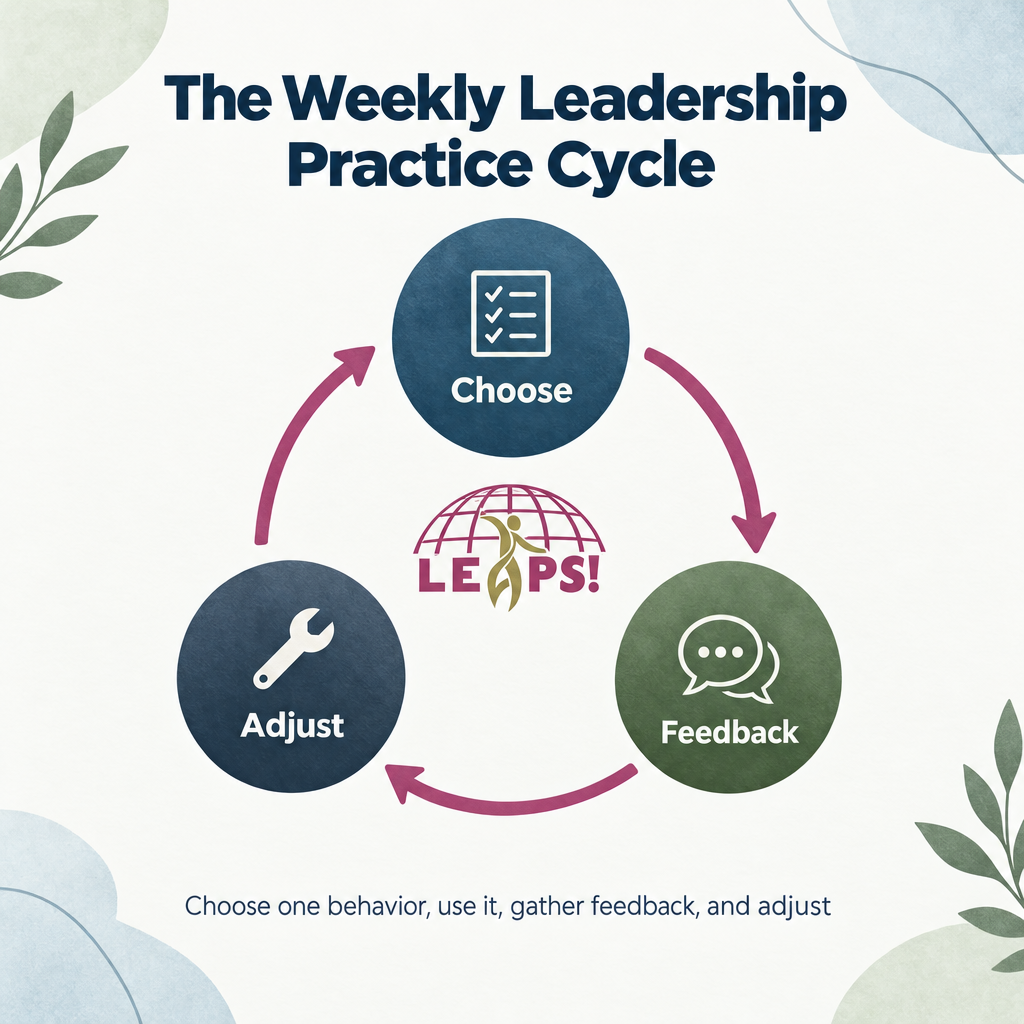
Managers should use a repeatable cycle that places leadership practice inside staff meetings, one-to-ones, performance conversations, project decisions, and change-management updates. Attendance at a leadership development program is only a starting point; the workplace behavior is where learning becomes usable.
A repeatable weekly practice cycle
Use the following six-step cycle once each week, keeping the behavior narrow enough to practice and review. Each step should produce a small checkpoint that the manager or sponsor can inspect.
- Choose one situation: Select a scheduled meeting, conversation, decision, or change update where the behavior fits. Checkpoint: write down the situation and its purpose.
- Plan the behavior: Decide what the manager will say or do. Checkpoint: record a conversation goal, question, or decision standard.
- Practice it: Use the behavior during normal work. Checkpoint: note the owner, deadline, question asked, or summary delivered.
- Collect feedback: Ask a named colleague for feedback about that specific action. Checkpoint: capture the person’s observation, not a general opinion about leadership.
- Review the result: Compare the intended behavior with the response it produced. Checkpoint: record what changed, what remained unclear, and what felt difficult.
- Select the next adjustment: Keep, simplify, or modify the behavior for the next situation. Checkpoint: schedule the next practice opportunity.
How to know the behavior is becoming usable
A behavior is becoming usable when the manager can apply it during pressure, not only when reminded in a classroom. Look for repeated evidence across more than one setting, such as clearer ownership in meetings and better follow-through in one-to-ones. Avoid practicing too many behaviors at once, choosing abstract goals, treating attendance as progress, or skipping reflection after an uncomfortable interaction.
How can feedback and accountability keep the plan from fading after training?
Specific feedback keeps a leadership plan grounded in what other people actually experience. Instead of asking, “How am I doing as a leader?” ask, “Was my decision clear?” “Did I listen before responding?” “Did the conversation end with an agreed next step?” or “What made my follow-through easier or harder to understand?”
Direct reports may describe clarity and psychological safety, peers may notice collaboration, supervisors may assess judgment and priorities, and project partners may see decision quality across teams. Self-reflection adds context, but it should not replace other perspectives. Confidentiality matters, especially when feedback could affect trust or a formal performance process.
Choose useful feedback sources
Choose feedback sources based on where the behavior occurs, then explain that the purpose is development rather than surveillance. A direct report may be the best observer of listening, while a supervisor may be better positioned to assess strategic planning. Ask for one observed strength, one point of confusion, and one suggestion for the next experiment.
Build accountability into existing routines
Use a short weekly review that records the situation, action taken, response observed, lesson learned, and next experiment. A coach, executive sponsor, or leadership cohort can ask about the evidence and offer support without turning the process into punishment. Accountability works best when the manager can discuss setbacks honestly and still leave with a practical next step.
How should senior leaders evaluate a leadership development program before choosing one?

Senior leaders should choose a program that connects directly to a current leadership challenge and requires application beyond presentations or completion records. Ask whether the program includes experiential learning, collaborative goal-setting, feedback, action planning, and follow-up accountability. The program should help leaders apply concepts to the decisions and relationships that shape team performance.
A strong applied deliverable might be an action plan for a personal leadership challenge or an organizational opportunity. LEAPS Inc. provides leadership development coaching for senior-level business leaders responsible for growing their businesses, teams, and personal leadership capabilities. Its leadership development work addresses leadership styles, strategic plans, vision, mission, core values, and leadership-team performance.
Questions about fit, structure, and application
Ask who the program is designed to serve, how goals are selected, where experiential learning occurs, how feedback is handled, and what support continues after a session. Leaders should also clarify whether the work fits an individual manager, a leadership team, or a wider organizational change effort. These questions reveal whether the program can meet the workplace as it actually operates.
What a practical program should produce
A practical program should produce a specific action plan, defined practice behaviors, feedback points, and a process for reviewing evidence. LEAPS Inc. uses a structured, compassionate approach and its proprietary L.E.A.P.S. coaching model to support guided practice and practical action planning. Its programs are organized into structured nine-session intensive journeys, while workplace practice should continue through regular management routines.
What should managers do when the leadership plan stops working?
When a plan stalls, diagnose the design before blaming the manager. Common barriers include no time to practice, unclear authority, team resistance, conflicting feedback, an overly broad goal, or a workplace change that makes the original challenge irrelevant. The next move may be to simplify the behavior, change the practice setting, ask for clearer sponsorship, gather another perspective, or redefine the evidence of progress.
Diagnose the stalled behavior
First ask whether the manager had a real opportunity to use the behavior and whether the behavior was specific enough to recognize. If authority is unclear, the manager may need a sponsor to clarify decision rights; if feedback conflicts, the manager may need to compare perspectives and return to the intended team goal. Recurring conflict, communication breakdowns, organizational change, or a high-stakes transition may call for structured coaching.
Revise the plan without abandoning the goal
Keep the underlying goal while changing the route. A manager who cannot practice delegation in a current project might practice clarifying ownership in one-to-ones; a broad change-leadership goal might become one weekly update with a clear decision, impact, and next step. Senior leaders in Florida, including Tampa and Orlando, can contact LEAPS Inc. at +18558853277 or info@leapsinc.com to discuss whether leadership development coaching fits their goals.
Frequently Asked Questions
How long should a leadership development plan last?
A plan should last long enough for a manager to practice a defined behavior repeatedly, collect feedback, and review evidence of change. The timeline depends on the challenge, work cycle, and access to practice opportunities. LEAPS Inc. organizes programs into structured nine-session intensive journeys, while workplace practice should continue through regular meetings and reviews.
What should be included in a leadership development plan for managers?
Include one leadership challenge, one measurable behavior, practice situations, feedback sources, an accountability rhythm, evidence of progress, and a revision process. Goals should connect to team performance, communication, decision-making, strategic planning, or organizational priorities rather than remain abstract.
How do I know whether leadership development coaching is right for my organization?
Leadership development coaching may fit organizations that want managers to apply learning to a personal leadership challenge or organizational opportunity with structured feedback and accountability. Ask about coaching structure, practical assignments, confidentiality, business alignment, and progress reviews. LEAPS Inc. serves senior-level business leaders working to grow their businesses, teams, and leadership capabilities.
Does LEAPS Inc. offer leadership development coaching in Tampa and Orlando?
The supplied business information identifies Tampa and Orlando as service areas. Contact LEAPS Inc. at +18558853277 or info@leapsinc.com to confirm current availability, format, and fit for your leadership goals.
How do managers get started with a leadership development plan?
Start by naming one recurring leadership problem, selecting one behavior to practice, and identifying a person who can provide useful feedback. Schedule a weekly review and decide what evidence will show progress. Managers and senior leaders who want guided support can contact LEAPS Inc. to discuss their personal leadership challenge or organizational opportunity.