

You don’t need to wait until anxiety feels unmanageable to consider therapy. If worry, fear, or avoidance is affecting your relationships, work, sleep, or ability to do what matters to you, therapy is a practical option to explore. Knowing how to find a therapist for anxiety starts with identifying what you want help with, then looking for a qualified professional whose experience and approach fit your needs.
It’s understandable if getting started feels difficult. Therapist specialties, credentials, treatment approaches, and session formats can be hard to compare, especially when anxiety makes decisions feel more difficult.
This guide explains how to find a therapist for anxiety, decide whether therapy may be right for you, and assess a therapist’s experience, credentials, and personal fit. You’ll also learn what to consider when comparing individual, group, and virtual care, so you can take a thoughtful next step toward greater understanding and well-being.
Key Takeaways
- Consider therapy if anxiety is affecting your daily life, and clarify what you want support with before you begin.
- Compare therapist credentials, experience with your specific concerns, and treatment approach to find care aligned with your needs.
- Explore in-person, video, group, and workplace counseling options to identify a format that feels accessible and appropriate.
- Use early conversations and sessions to assess trust, communication, boundaries, and shared goals.
- If you’re in crisis in the United States, call or text 988 for the Suicide & Crisis Lifeline, according to the Substance Abuse and Mental Health Services Administration (SAMHSA).
1. How do I know if anxiety therapy is right for me?
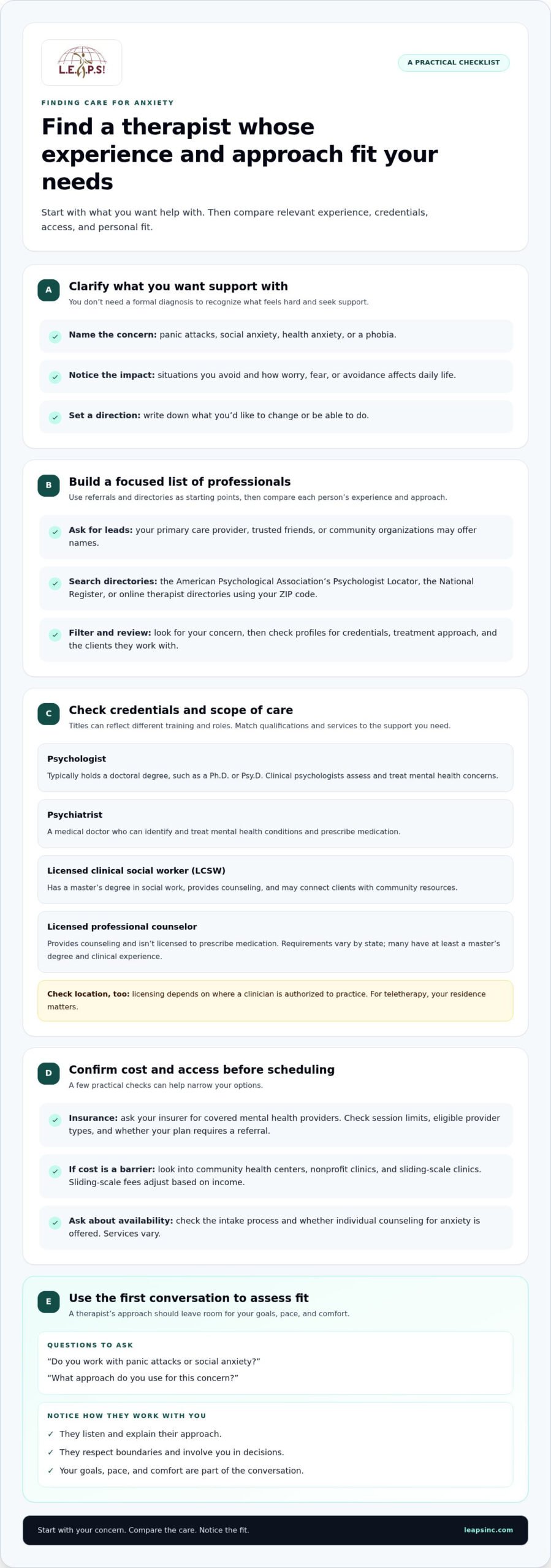
Anxiety therapy may be worth exploring when worry, fear, or avoidance interferes with daily life. Panic symptoms might make errands difficult, social anxiety could strain relationships, or health worries may consume your attention. You don’t need a formal diagnosis to recognize what feels hard and seek support. Start by noting the situations you avoid and what you’d like to change.
To find a therapist for a specific anxiety concern, first name what you’re experiencing. Note whether you’re dealing with panic attacks, social anxiety, health anxiety, or a phobia. Then look for a therapist whose profile or experience addresses that concern. A therapist may have relevant experience without calling themselves an “anxiety specialist,” so focus on the issues they work with and their treatment approach.
Your primary care provider can be a useful starting point. Describe the anxiety symptoms you want help with and ask for a therapist recommendation. You can also ask trusted friends or community organizations for names. Treat referrals as leads, then compare each professional’s experience, treatment approach, session format, and fit with your goals.
To find in-network care, ask your health insurer for its list of covered mental health providers. Search for therapists who work with your concern, then check whether your policy limits covered sessions or coverage to certain provider types. If your plan requires a referral, ask your primary care provider how to obtain one. Confirming these details can narrow your options before you schedule.
If cost is a barrier, look for community health centers, nonprofit clinics, and sliding-scale clinics. These organizations may offer affordable therapy, and sliding-scale clinics adjust fees based on income. Ask about the intake process and whether individual counseling for anxiety is available. Services vary, so identify the kind of care you need before reaching out.
Consider credentials alongside experience. Therapists are generally licensed and may include psychologists, clinical social workers, or professional counselors. Review the professional’s stated qualifications. A licensed clinical social worker has a master’s degree in social work. Requirements for professional counselors and similar titles vary by state; many have at least a master’s degree and clinical experience.
As you compare therapists, prepare a few direct questions: “Do you work with panic attacks or social anxiety?” and “What approach do you use for this concern?” In an initial conversation or session, notice whether the therapist listens, explains their approach, respects boundaries, and involves you in decisions. Therapy should make room for your goals, pace, and comfort.
2. Exploring other licensed-therapist directories
Choose a professional based on the support you need. Psychologists, psychiatrists, counselors, and social workers have different training and roles, so compare their qualifications and services with your goals. If medication is part of your care, a psychiatrist is a physician who can prescribe it. For counseling, consider a therapist whose clinical experience fits your concerns.
Directories can help you build a focused list. The American Psychological Association’s Psychologist Locator and the National Register are options for finding psychologists. In the United States, you can also search online therapist directories using your ZIP code. Filter results by anxiety, panic, or another concern, then review each profile’s credentials, treatment approaches, and client population.
Licensing is tied to where a clinician is authorized to practice. Each U.S. state sets requirements for therapists practicing there, and clinicians cannot serve clients who reside outside the United States. For teletherapy, your residence matters, not simply where you happen to be during a session. Look for a professional whose license applies to your location.
Psychologists typically hold a doctoral degree, such as a Ph.D. or Psy.D. Clinical psychologists assess and treat mental health concerns using approaches that may include cognitive behavioral therapy, which focuses on thought patterns and behaviors, or mindfulness-based methods. A psychiatrist is a medical doctor who can identify and treat mental health conditions and prescribe medication. These roles differ, so match the professional’s scope to your priorities.
A licensed clinical social worker, often listed as an LCSW, has a master’s degree in social work. LCSWs provide counseling and may connect clients with community resources. That combination may suit someone seeking therapy alongside help identifying practical supports. Review whether the clinician’s experience includes your concern, such as social anxiety or phobias, rather than relying on the job title alone.
Licensed professional counselors provide counseling and aren’t licensed to prescribe medication. Requirements for counselors and similar titles vary by state, but many have at least a master’s degree and clinical experience. When comparing profiles, look for a clear license title, relevant training, and an explanation of the counselor’s approach. Ask how they work with anxiety and collaborate with you on therapy goals.
Use directory profiles as a starting point, not the sole measure of fit. Compare the license, education, anxiety experience, and methods listed, then consider whether the clinician’s communication feels clear and respectful. If you’re ready to discuss your next step, you can schedule an appointment.
3. Teletherapy, employee assistance programs, and support groups
Therapy can take place in person, by video, or by phone. Teletherapy may suit someone whose schedule, transportation, or comfort makes office visits difficult. Before choosing it, consider whether you can speak privately and reliably attend sessions from your chosen location. Compare the format with your needs, not just its convenience.
Workplaces may provide confidential counseling through an Employee Assistance Program (EAP). If your employer offers an EAP, find out how to access counseling and whether it addresses your concern. For example, explain that anxiety is affecting sleep or concentration and ask what support the program provides. An EAP can be a starting point for counseling, while ongoing care may require a separate arrangement.
Group therapy offers peer support and shared experiences in a guided setting. Listening to others describe anxiety can help you recognize patterns and practice expressing your needs. Consider whether you’d feel comfortable speaking in a group, and ask how sessions are structured. If anxiety overlaps with eating concerns or substance use, include those issues when describing the support you’re seeking.
Support between sessions can help you apply ideas in everyday situations. Some therapists provide worksheets, journaling prompts, or exercises to practice at home. For example, you might record situations that trigger anxiety and note the thoughts or behaviors that follow. Ask how communication between sessions works, including whether the therapist responds to messages or offers check-ins. Clear expectations help you understand what support is available outside appointments.
Before beginning teletherapy or group care, consider what helps you participate openly. A private room, headphones, and a stable connection can make a video session easier to focus on. For group therapy, reflect on whether shared discussion feels useful or overwhelming. You can also clarify confidentiality, session format, and how the therapist handles questions between meetings.
Therapy is not a crisis response service. If you’re in crisis in the United States, call or text 988 for the Suicide & Crisis Lifeline, according to the Substance Abuse and Mental Health Services Administration (SAMHSA). Keep this resource distinct from routine therapy planning. If you’re comparing care formats during a difficult period, prioritize immediate safety and use crisis support when needed.
To choose a format, write down your practical needs and therapy goals. For example, note whether you prefer video or in-person sessions, want peer connection, or need workplace counseling as a starting point. Then compare those preferences with the options available to you. The right format should make it possible to participate consistently and work toward meaningful change.
4. Therapist specialties and relevant experience
Approaches used for anxiety can include cognitive behavioral therapy (CBT), exposure therapy, acceptance and commitment therapy (ACT), and mindfulness-based stress reduction (MBSR). Evidence-based treatments have been scientifically tested. Which approach fits depends on your symptoms, preferences, and goals, so ask how the therapist connects their method to your concern.
CBT focuses on identifying and changing unhelpful thoughts and behaviors. For example, someone who avoids work presentations might examine predictions about embarrassment and practice new responses. Exposure therapy can involve gradually entering situations avoided because of fear or anxiety. Ask how the therapist plans each step and adapts the pace to your comfort.
ACT and MBSR offer other ways to address anxiety. ACT helps people respond differently to difficult thoughts while taking action guided by personal values. MBSR uses mindfulness practices to build awareness of present experiences. Ask what sessions involve, what you may practice between them, and how the clinician will discuss progress toward your goals.
Match experience to your concern, not just the word “anxiety” in a profile. Panic attacks, social anxiety, health anxiety, and phobias can involve different triggers and patterns. A therapist may have experience with a particular concern or group without calling themselves an anxiety specialist. Describe the situations affecting you and ask about the clinician’s experience treating similar concerns.
Age and life context matter, too. Therapists may specialize in working with children, families, adults, or older adults. Marriage and family therapists focus on relationship dynamics that may affect mental health. If anxiety is creating tension with a partner or family member, clarify whether you want individual support or help addressing relationship patterns.
Ask specific questions before choosing a therapist: “What approaches do you use for this concern?” and “How do we track whether therapy is helping?” You can also ask how goals are set and what support between sessions looks like. The answers can show whether the clinician explains their process clearly and collaborates with you, rather than relying on a specialty label alone.
Consider the level of training your situation calls for. More severe symptoms or a complex diagnosis may call for a provider with relevant expertise and training. A clinical psychologist assesses and treats mental health concerns using evidence-based approaches. Compare that background with the clinician’s experience, proposed approach, and ability to explain how it relates to your symptoms.
Use the first session to assess fit as well as expertise. Notice whether the therapist listens, explains their reasoning, and respects your boundaries. You can ask to adjust the pace, question an interpretation, or say when an exercise feels unhelpful. A productive therapeutic relationship develops through shared goals, agreed-upon steps, and trust built over time.
5. Checking therapist credentials
A profile’s specialty is only one part of choosing a therapist. Compare the person’s education, license, clinical experience, and ability to explain their approach. Many mental health providers have at least a master’s degree, while psychologists typically hold a doctoral degree, such as a Ph.D. or Psy.D. These credentials describe training, but don’t by themselves show whether the therapist’s experience fits your concerns.
Start with the exact professional title. Psychologists typically provide assessment and therapy, and most psychologists in the United States aren’t licensed to prescribe medication. A psychiatrist is a medical doctor who can prescribe medication and provide therapy. If you want counseling and medication management, you may need more than one provider, with each role contributing to your care.
Advanced-practice psychiatric mental health nurses have at least a master’s degree in psychiatric mental health nursing. Whether they can prescribe medication depends on state law. Their education and prescribing role differ from a psychologist’s, so identify the support you’re seeking before comparing profiles. If medication is a priority, clarify the provider’s role in your care plan.
Marriage and family therapists have at least a master’s degree; license and certificate requirements vary by state. Their focus on relationship dynamics may be relevant when anxiety affects a partnership or family. For example, you might seek individual support for panic symptoms or relationship-focused care when worry fuels recurring conflict. Your setting and goals help determine which professional background is most relevant.
Consider credentials alongside experience with anxiety, depression, or trauma. During an initial conversation, ask what concerns the therapist works with and how their training informs their approach. A clear answer should connect their approach to your symptoms, rather than rely only on broad claims of expertise. You can also ask how they collaborate on goals and discuss progress.
Look for consistency across the therapist’s profile and conversation. Their degree, license title, and stated specialty should be clear. Ask what a credential or certification means and how it relates to the care they provide. A therapist’s stated specialty is one consideration; their qualifications and the way they engage with you matter, too.
Notice how the therapist responds when you ask about boundaries, pacing, or an interpretation that doesn’t fit. You can say you’re not ready to discuss trauma, ask for an explanation, or identify an exercise that isn’t helping. A sound working relationship includes shared goals and agreed steps, while allowing you to retain control over what you discuss.
Use credentials to make an informed comparison, then weigh training against the person’s experience and communication. If you’re ready to explore whether individual therapy fits your needs, schedule an appointment.
LEAPS: Individual Therapy
LEAPS offers Individual Therapy for people seeking a dedicated space to explore anxiety and its effects on daily life. You can discuss concerns such as persistent worry, avoidance, or strain in relationships, then work toward goals that reflect what you want to change. This may be a natural next step if you’re ready to move from comparing therapists to discussing your own experiences in therapy.
If anxiety is also affecting a partnership, Couple Therapy may provide a setting to address shared relationship concerns. Group Therapy offers another format, with guided discussion among participants. The right option depends on the support you’re seeking and the goals you want to pursue.
To learn more about Individual Therapy, visit leapsinc.com.
Choose a Next Step That Supports Your Growth
Beginning therapy doesn’t require having every answer. It can start with one clear intention: understanding what you want to change, what you hope to reclaim, or how you want to show up in daily life. Let that intention guide your first conversation and give your care a direction that feels meaningful to you.
If you’re considering how to find a therapist for anxiety, choose a next step that lets you discuss your needs openly. LEAPS offers Individual Therapy, Therapy Intensive, and Couple Therapy. Each offers a different way to address personal or relationship concerns, depending on the support you’re seeking.
You can take time to reflect, or begin a conversation about your options. Contact LEAPS to explore your options and consider what kind of support aligns with your goals. A thoughtful first step can create space for greater clarity and a more intentional path forward.
Frequently Asked Questions
How do I know if anxiety therapy is right for me?
Therapy may be worth considering if anxiety is shaping choices you’d rather make differently. You might turn down a promotion because presentations feel overwhelming or avoid a medical appointment because of fear. Write down one situation you want to handle differently and what gets in the way. That specific example can help you explain your concerns and decide whether professional support fits your goals.
What types of anxiety do you treat?
Anxiety can involve panic attacks, social fears, health worries, or specific phobias. LEAPS offers Individual Therapy focused on emotional well-being, where you can discuss the concerns affecting your life and the goals you want to pursue. LEAPS uses CBT, Emotionally Focused Therapy and Mindfulness. Share what troubles you, such as avoiding social events or persistent worry, to help frame a conversation about care.
What credentials and specialties should I look for in an anxiety therapist?
Look for a clearly stated professional degree and license, then consider whether the therapist’s experience matches your concern. Psychologists typically have a Ph.D. or Psy.D.; counselors and social workers have distinct training and roles. Ask how the therapist works with anxiety and what their approach involves. If anxiety occurs alongside depression or trauma, mention both so the clinician understands the full context.
How much does anxiety therapy cost without insurance in the United States?
Costs vary by therapist, location, credentials, session format, and practice policies, so there isn’t one national fee to rely on. Before starting, ask about the therapist’s fee, payment expectations, cancellation policy, and any charges for missed sessions. If the cost doesn’t fit your budget, explore community health centers, nonprofit clinics, or sliding-scale clinics, which adjust fees based on income.
Does health insurance cover therapy for anxiety and how do I verify benefits?
Health insurance may cover therapy, but benefits can depend on provider type, plan rules, and session limits. Start with your insurer’s mental health provider list and review your policy’s behavioral health benefits. Ask whether the plan requires a referral, limits covered visits, or applies different costs to in-network and out-of-network care. Keep the answers and the representative’s reference details for your records.
How do I find a therapist who offers a sliding scale or accepts Medicaid?
Search for therapists and clinics that identify sliding-scale fees, then ask how income affects the amount charged and what documents are needed. For Medicaid, begin with your state Medicaid plan’s behavioral health provider directory or member services. Check that the therapist’s provider type and services are covered under your plan. Community clinics can also explain their intake process and payment options.
How do I find an anxiety therapist through telehealth?
Search a therapist directory for telehealth and anxiety experience, then narrow results by your state of residence and preferred video or phone format. Before booking, consider whether you can speak privately and reliably from your chosen setting. Ask how sessions are conducted, what happens if there’s a technical interruption, and what communication is available between appointments. These practical details can help you decide whether remote care suits your routine.
How to find a therapist quickly if anxiety is severe or urgent
For severe symptoms, look for a mental health provider with greater expertise and training. You can ask your primary care provider for a referral or contact your insurer for covered providers. If you’re in crisis in the United States, call or text 988.