

What if the next strategic plan isn’t the first step toward alignment? A corporate visioning workshop helps leaders agree on the future they’re working toward before they commit to priorities, timelines, and measures of success. Without shared meaning, even a compelling vision can remain too abstract to guide everyday decisions.
Leadership perspectives may differ, or your team may use visioning as another name for routine strategic planning. The two are connected, but serve different purposes: visioning clarifies where the organization is going and why, while strategic planning maps how to get there. One gives choices direction; the other turns that direction into action.
In this article, you’ll learn how to shape a clear future direction, connect organizational purpose and culture with strategic choices, and turn the conversation into practical priorities with clear ownership. We’ll explore key workshop elements and how LEAPS Inc.’s corporate visioning service supports organizations in aligning their people, purpose, and direction.
Key Takeaways
- Set a clear boundary for the workshop: focus on the future the organization wants to create, rather than trying to resolve every operational challenge.
- Prepare a corporate visioning workshop by defining the decision at hand, including relevant perspectives, gathering context, and agreeing on respectful discussion norms.
- Use visioning to define the destination, then strategic planning to assess choices, routes, and practical commitments.
- Shape an agenda that moves from shared context to future possibilities, emerging themes, alignment, and decisions for later planning.
- LEAPS Inc.’s corporate visioning service can support organizational growth alongside its business development, strategic marketing, and brand development services.
What Is a Corporate Visioning Workshop, and What Should It Clarify?
A corporate visioning workshop is a facilitated conversation in which an organization defines the future it wants to create and builds shared understanding of what that direction means. Its purpose isn’t to resolve every operational problem or produce a complete strategic plan. Instead, it gives leaders and participants room to surface assumptions, consider possibilities, and find common ground about the organization’s long-term direction.
That distinction matters. Planning meetings often focus on immediate decisions, projects, resources, and measures of progress. Visioning looks beyond the next task to ask what kind of organization the group intends to become and why that future is worth pursuing. The aim isn’t instant agreement on every detail. It’s a clearer shared reference point for the choices that follow.
A useful workshop brings unspoken assumptions into the open. One leader may see growth as reaching new audiences; another may define it as deepening the organization’s impact. If both use the same words but mean different things, teams can leave with conflicting interpretations. Ask participants to explain what key terms such as “growth,” “impact,” or “access” mean to them. Naming differences helps the group build shared language before turning direction into action.
To see how a facilitator can structure a collaborative session, watch this workshop guide:
What does a corporate vision describe?
A vision describes an ambitious but intelligible future state that can inform organizational choices. It should be specific enough to help people recognize the direction, yet broad enough to guide more than one project or annual target. A vision statement puts that future into words. A mission describes the organization’s purpose, while values express the principles that guide conduct along the way.
For example, a hypothetical education organization might envision a future where learners can access meaningful support throughout their lives. Its mission could explain why it exists, while values such as accessibility and respect guide how it serves people. The vision becomes useful when leaders can connect it to choices, such as which programs to develop or what experiences to prioritize.
When is a visioning workshop useful?
A workshop can be valuable during a leadership transition, a period of growth, a strategic shift, or when disagreement about direction starts to surface. These moments often prompt different interpretations of what should come next. The goal isn’t to force consensus or promise that every tension will disappear. It’s to understand the differences and clarify what the group can align around.
When assumptions remain unspoken, departments may set priorities that compete rather than reinforce one another. A shared direction gives teams a common lens for weighing opportunities and discussing trade-offs. LEAPS Inc.’s corporate visioning consultation helps organizations connect direction with people and purpose.
How to Prepare a Corporate Visioning Workshop Around Purpose and Culture
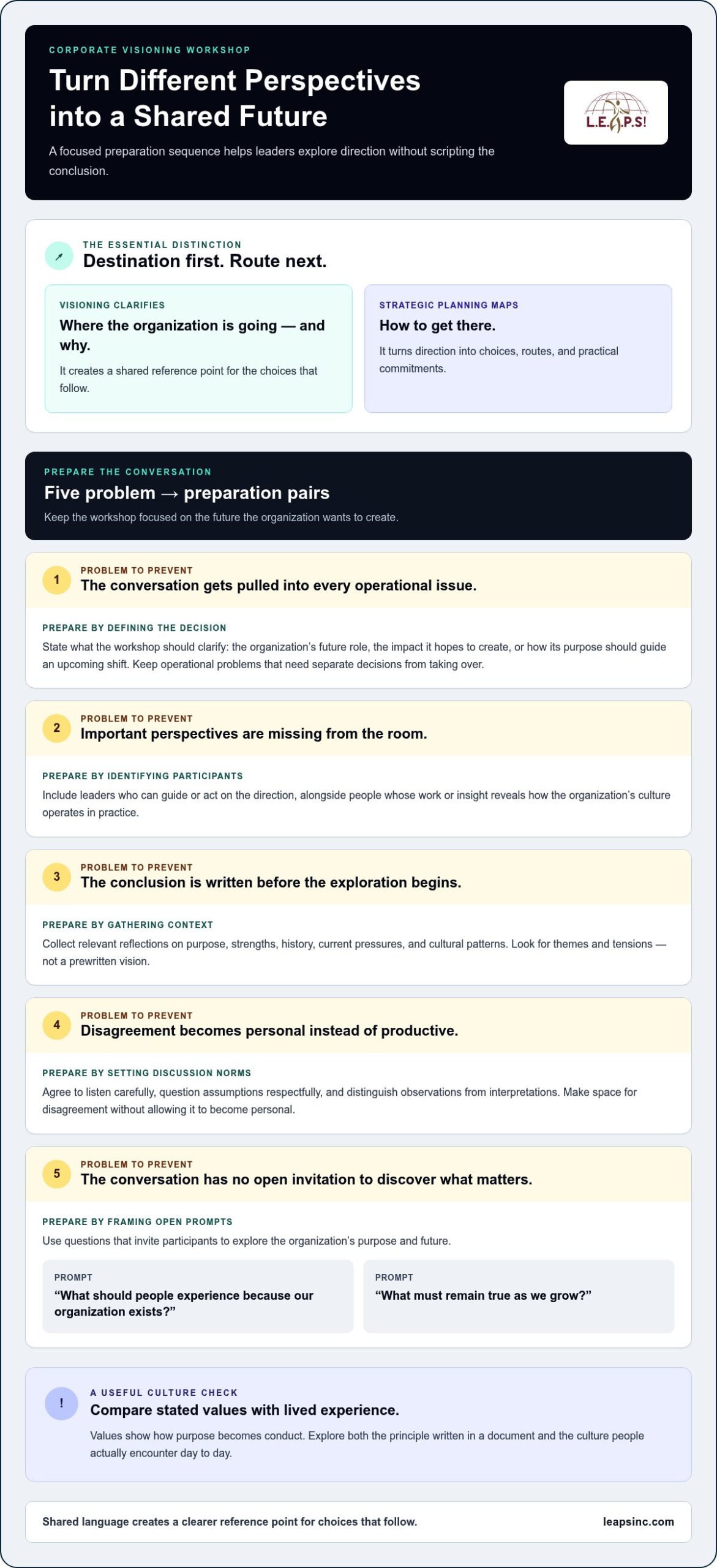
Strong preparation makes room for honest exploration without scripting the conclusion. Before a corporate visioning workshop, clarify what the group needs to understand or decide, whose perspective is essential, and what organizational realities should inform the conversation. Preparation should help participants arrive ready to think, not steer them toward a statement leaders have already chosen.
Use this sequence to create a focused foundation:
- Define the decision. State what the workshop should clarify, such as the organization’s future role, the impact it hopes to create, or how its purpose should guide an upcoming shift. Keep operational problems that require separate decisions from taking over the session.
- Identify participants. Include leaders who can guide or act on the direction, along with people whose work or insight reveals how the organization’s culture operates in practice.
- Gather context. Collect relevant reflections on organizational purpose, strengths, history, current pressures, and cultural patterns. Look for themes and tensions, not a prewritten vision.
- Set discussion norms. Agree to listen carefully, question assumptions respectfully, and distinguish observations from interpretations. Make space for disagreement without allowing it to become personal.
- Frame open prompts. Ask questions that invite discovery, such as “What should people experience because our organization exists?” or “What must remain true as we grow?”
Values are useful preparation because they show how purpose becomes conduct. A value written in a document may differ from what employees experience day to day, so explore both the intended principle and the culture people actually encounter. Jim Collins and Jerry Porras’s framework for core ideology and envisioned future can help distinguish enduring purpose and values from the future the organization seeks to create.
Who should participate in corporate visioning?
Choose participants according to the workshop’s scope. An organization-wide direction-setting conversation may need executive sponsors and perspectives from functions or groups affected by future choices. A narrower discussion may call for a smaller set of decision-makers and subject-matter voices. The essential test is whether the room includes both authority to carry direction forward and knowledge to understand its cultural implications.
Executive sponsorship matters, but it shouldn’t crowd out meaningful input. Leaders can explain strategic context; other participants can illuminate how policies, communication, and everyday practices shape people’s experience. This balance helps the group see where stated purpose and lived culture align, and where they diverge.
What should participants bring into the room?
Invite participants to reflect in advance on what gives the organization meaning, what it does well, what cultural realities should be acknowledged, and what impact they hope it will have in the future. Encourage specific observations rather than polished slogans. For example, ask for a moment when the organization’s values were visible in action, as well as a situation where its actions felt inconsistent with those values.
These reflections create richer discussion without dictating an answer. LEAPS Inc.’s corporate visioning service supports leaders working to align purpose, culture, and future direction. You can schedule a conversation about corporate visioning.
Corporate Visioning vs. Strategic Planning: How the Two Work Together
Visioning and strategic planning answer different questions, even when an organization connects them in one process. A corporate visioning workshop clarifies the future the organization wants to create and the meaning behind that aspiration. Strategic planning examines the choices, resources, and coordinated steps that can move the organization toward it. Keeping the distinction clear prevents either conversation from being expected to resolve questions it was not designed to answer.
The boundary is useful, not rigid. An organization might identify themes for future planning during a visioning session, then explore feasibility and trade-offs in a separate planning conversation. MIT Sloan Management Review examines how leaders make strategic choices to achieve a desired future, underscoring the bridge between aspiration and execution.
What belongs in visioning, and what belongs in planning?
Visioning should establish purpose, shared meaning, and a compelling picture of the future. It can reveal what the organization hopes to contribute and what principles should inform its direction. Detailed objectives, initiatives, budget choices, timelines, and sequencing belong in strategic planning, where leaders can assess constraints and decide how to act.
Some organizations link the conversations closely; others allow time between them. Either approach can work if participants know which decisions are being made now and which require further analysis. Without that clarity, the group may mistake an aspiration for an approved initiative or expect a visioning session to settle resource questions it was not designed to resolve.
How does culture shape a credible corporate vision?
A vision gains credibility when it accounts for how people experience the organization, not only how leaders describe it. Compare stated aspirations with everyday behaviors, decision patterns, and working realities. If collaboration is named as a priority but decisions are consistently made without input, that tension deserves attention before the organization builds plans around the ideal.
Acknowledging a gap doesn’t invalidate the aspiration. It helps leaders distinguish the future they seek from current conditions and consider what must change for the vision to feel authentic. LEAPS Inc.’s corporate visioning service supports reflection on the relationship between organizational direction, culture, and strategic choices.
A Corporate Visioning Workshop Agenda: From Future Picture to Follow-Through
A useful agenda creates a progression, not a rigid script. The group needs time to understand the present, imagine a future, identify shared themes, and distinguish agreement from questions that require further work. Adapt the sequence to the purpose of the session, the people in the room, and the decisions leaders need to make afterward.
A corporate visioning workshop can move through these stages:
- Establish shared context. Revisit the purpose of the session, relevant organizational realities, and the discussion norms. Invite participants to name what they believe is changing or needs attention.
- Imagine future possibilities. Use a prompt that gives people room to think beyond immediate constraints. For example, ask participants to write a headline they hope could describe the organization’s impact in the future, or a letter from that future describing what has changed.
- Surface perspectives before synthesis. Give participants quiet reflection time, then invite them to share in pairs or small groups before discussing ideas together. This can help prevent the first or most senior voice from defining the whole conversation.
- Identify themes and test alignment. Group related ideas, notice meaningful differences, and discuss which aspirations feel compelling and connected to the organization’s purpose. Record areas of agreement and unresolved tensions separately.
- Define the handoff. Name which questions need strategic planning, what information is still needed, and who will carry each item forward. Avoid treating an initial theme as a fully approved initiative.
Which activities help teams imagine a shared future?
A future headline can help a group express the impact it hopes to create in a concise form. A letter from the future invites participants to describe what the organization has become and what made that change possible. Neither exercise produces a vision by itself. Their value lies in surfacing different assumptions and language that the facilitator can help the group explore and synthesize.
Choose activities based on group size, trust, available time, and the decision at hand. A group that needs space to build confidence may benefit from individual writing before open discussion. A group with established trust may be ready to compare ideas directly. In either case, make room for quieter perspectives and ask follow-up questions before rushing toward consensus.
How can leaders sustain alignment after the workshop?
Capture the conversation in a record participants can use: agreed themes, unresolved questions, planning decisions still required, and an owner for each follow-up. Then translate the themes into questions for planning and clear messages leaders can share with the wider organization. Set a review point to assess whether emerging decisions still reflect the agreed direction, and revisit the vision if circumstances materially change.
A vision becomes useful when its shared themes connect to named priorities, decision owners, and accountable next steps. LEAPS Inc. also offers executive coaching to support leadership development and performance. You can schedule a conversation with LEAPS Inc. about aligning organizational direction and action.
How LEAPS Inc. Supports Corporate Visioning and Organizational Growth
A workshop framework can help leaders prepare for a meaningful conversation. The next step is creating space to examine how organizational purpose, people, and future direction fit together. LEAPS Inc. provides corporate visioning consultation for organizations seeking to explore that alignment and consider how it can inform their growth.
With over 25 years guiding relationships, individuals, and organizations toward lasting transformation, LEAPS Inc. brings a people-centered perspective to organizational development. The work can begin with the questions leaders are carrying: What future are we trying to create? Which parts of our purpose should guide that future? Where do perspectives differ, and what needs further discussion?
What can organizations explore through corporate visioning?
A corporate visioning conversation can help leaders clarify the direction they hope to pursue and consider how purpose and culture relate to that ambition. It can also surface questions about alignment: whether organizational choices reflect stated intentions, how leadership perspectives connect, and what the desired future may mean for the organization’s development.
The right areas of focus depend on the organization’s goals. LEAPS Inc. also offers business development, strategic marketing, and brand development services. These can connect with corporate visioning when leaders are considering how organizational direction relates to growth, communication, and how the organization presents itself. For example, leaders exploring a shift in direction can discuss how it aligns with their approach to business development or brand development. Each organization’s goals shape which questions are relevant to explore.
LEAPS Inc.’s corporate visioning service is a consultation that helps leaders examine organizational purpose, culture, and direction.
What is a useful next step for organizational leaders?
Before starting a conversation, identify the decision or alignment challenge your organization is facing. You might be entering a new phase of growth, reconsidering how purpose informs business choices, or noticing that leaders describe the future differently. A concise statement of the challenge can help focus an initial discussion without requiring you to arrive with a finished vision.
From there, leaders can discuss the organization’s goals and what support would be useful. LEAPS Inc. offers a free 15-minute consultation as an opportunity to begin that conversation. Share what your organization is working through and explore how corporate visioning can support its direction.
To take that step, schedule an appointment with your organizational goals in mind. A clear account of the challenge, the perspectives that need alignment, and the future you hope to shape can provide a grounded starting point for the discussion.
Give Your Organization a Direction Worth Moving Toward
A shared future becomes meaningful when leaders return to it as they make choices, communicate change, and decide what deserves attention. The work of a corporate visioning workshop doesn’t end when the conversation closes; its deeper value emerges as people use the direction to shape what comes next.
If your organization is facing a pivotal decision or differing views about its future, begin with the question that matters most and a willingness to consider what your organization can become. LEAPS Inc. brings over 25 years of experience guiding relationships, individuals, and organizations toward lasting transformation, with services spanning corporate visioning, business development, strategic marketing, and brand development.
Take a considered first step toward aligning your organization’s purpose and direction. Schedule an appointment to discuss your organization’s vision and explore a path forward that reflects the future you want to create.
Frequently Asked Questions
What is a corporate visioning workshop?
A corporate visioning workshop is a facilitated working session that helps an organization articulate the future it wants to create. It can help leaders test whether their language is clear enough to guide real choices. For instance, if a vision emphasizes accessibility, participants can discuss what that aspiration might mean for services, communication, or future investments, while leaving detailed commitments for planning.
Who should attend a corporate visioning workshop?
Invite people whose perspectives can illuminate the organization’s future and whose roles connect to decisions that follow. For example, a leadership group exploring a major shift might include executives who set direction and stakeholders who understand how that shift could affect employees or customers. Keep the group purposeful: participants should contribute insight, help interpret differing views, or have a clear role in carrying the discussion into later decisions.
How long should a corporate visioning workshop last?
There’s no universal duration; the time needed depends on the work the group must do. A session exploring one focused question may need less discussion than a conversation involving several competing assumptions, extensive stakeholder input, or a complex organizational shift. Plan backward from the outcomes you need: allow enough room for reflection, discussion, and clarification, and consider whether preparation or a later follow-up conversation is also needed.
What should participants prepare before a visioning workshop?
Participants can arrive with brief, concrete observations rather than a polished vision statement. Ask them to note an example of the organization at its best, a strength it should preserve, and a change they hope its future will make possible. Leaders can also share relevant background or questions in advance. This preparation gives the group a common reference point while leaving the eventual direction open to examination.
Can a corporate visioning workshop replace strategic planning?
No. A visioning session doesn’t replace the analysis and decisions needed to plan execution. After the workshop, leaders may need to assess the feasibility of potential initiatives, compare resource demands, and decide what to prioritize. A useful handoff is to identify which themes require planning, what information is missing, and who will bring those questions to the next decision-making process.
How do you keep a corporate vision relevant after the workshop?
Give the vision a practical review rhythm. At an existing leadership or planning review, ask whether current priorities still reflect the direction and whether new circumstances require a fresh discussion. Teams can also use the vision as a prompt when assessing proposals: does this opportunity advance the future the organization intends to create, or is another consideration more important? These conversations keep the vision connected to evolving choices.
What happens if leaders disagree about the organization’s vision?
Disagreement gives leaders information to examine, not a reason to rush into consensus. Ask each person to explain the concern behind their position, then distinguish differences in evidence from differences in values or desired outcomes. For example, leaders may agree that growth matters but disagree about what responsible growth means. Recording what is settled, what remains contested, and who will address open questions makes the next discussion more focused.