
Table of Contents
- Why Senior Leaders Face Unique Infidelity Challenges
- The Hidden Cost of Unaddressed Relationship Trauma in Leadership
- How Our 6-Module Program Restores Both Personal Integrity and Professional Performance
- Module 1: Immediate Stabilization and Crisis Management
- Module 2: Understanding the Root Causes and Attachment Patterns
- Module 3: Rebuilding Trust and Emotional Safety
- Module 4: Reconnecting Purpose with Leadership Identity
- Module 5: Implementing Sustainable Relationship Practices
- Module 6: Long-Term Integration and Organizational Support
- Why Our Trauma-Informed Approach Works for High-Achieving Professionals
- Corporate Implementation: How Organizations Support Executive Recovery
- Getting Started with Our Executive Infidelity Recovery Program
- Frequently Asked Questions (FAQ)
Why Senior Leaders Face Unique Infidelity Challenges
Infidelity strikes at the heart of executive life in ways that outsiders rarely understand. A senior leader may command boardrooms with confidence, yet feel utterly lost when trust fractures in their marriage. The paradox is stark: individuals who excel at solving complex business problems often find themselves paralyzed when facing personal betrayal. We’ve worked with hundreds of executives through this exact terrain, and we know that recovery requires far more than good intentions. It demands a structured, compassionate, and strategically designed approach that honors both the emotional weight of the crisis and the professional responsibilities leaders carry.
At LEAPS Inc., we’ve developed a specialized six-module program specifically for senior leaders navigating infidelity recovery. This isn’t generic therapy adapted for busy professionals. It’s a trauma-informed framework built around the particular vulnerabilities, pressures, and strengths that high-achieving leaders bring to their most intimate relationships.
Senior leaders encounter infidelity within a distinct constellation of stressors. High-pressure roles, travel demands, and boundary-blurred professional relationships create environments where affairs can take root. More significantly, the cognitive patterns that drive executive success often become liabilities in marriage recovery.
Leaders typically compartmentalize. They can suppress difficult emotions during a crisis meeting, then face profound disorientation when that same suppression prevents genuine connection with a partner. Many executives default to problem-solving mode when infidelity emerges, attempting to “fix” the relationship through logic and timelines rather than addressing the emotional rupture underneath.
Additionally, senior leaders often fear visibility. The prospect of seeking help feels risky when reputation and authority are interconnected. Leaders worry that vulnerability signals weakness or that therapy attendance might somehow become known within their professional circles. This isolation intensifies both the personal pain and the risk of poor decision-making.
What to do next: Recognize that these patterns aren’t character flaws; they’re adaptive strategies developed through years of professional success. Recovery begins when leaders acknowledge that the skills that built their careers may actually obstruct their healing.
The Hidden Cost of Unaddressed Relationship Trauma in Leadership
Unresolved infidelity doesn’t stay contained to home life. We observe executives whose decision-making becomes increasingly erratic, whose emotional regulation deteriorates, and whose leadership presence diminishes. Some leaders unconsciously recreate patterns of secrecy and shame in their workplace relationships. Others swing toward hypervigilance, micromanaging teams or overcommitting to projects as a form of escape.
The organizational impact compounds this personal suffering. When a senior leader is emotionally fractured, entire teams absorb that dysregulation. Decision quality suffers. Retention problems emerge among talented staff who sense instability at the top. In worst cases, executives make major strategic errors during the fog of personal crisis, costing organizations millions.
Physical health deteriorates too. We see elevated cortisol, insomnia, immune suppression, and stress-related illness. The body keeps score even when the mind tries to move forward. Left unaddressed, this becomes a cascade: diminished personal well-being leads to diminished leadership capacity, which reinforces shame and isolation.
What to do next: View your relationship recovery as a business imperative, not a personal indulgence. The investment in healing directly supports your organization’s stability and performance.
How Our 6-Module Program Restores Both Personal Integrity and Professional Performance
Our program interweaves clinical best practices with the realities of executive life. Each module builds sequentially, moving from crisis management through sustainable integration. The timeline spans typically four to six months, with flexibility for individual circumstances and organizational constraints.
We work with both partners when both are engaged, though we also support individuals whose partners are not yet ready for joint work. Executive coaching elements run throughout, ensuring that recovery translates into sharpened leadership capacity rather than simply avoiding further harm.
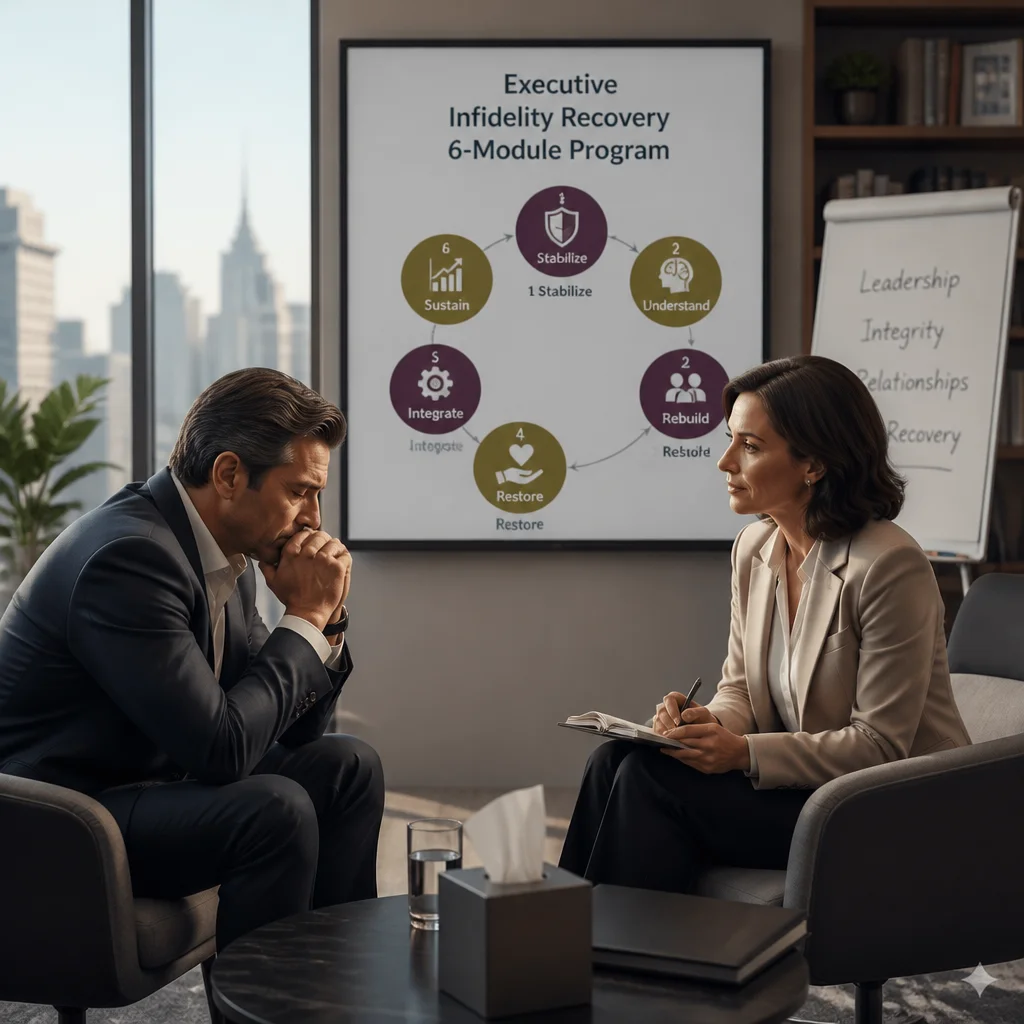
The program balances intensive work with sustainable pacing. We offer individual sessions, couples intensives, and group cohorts so that senior leaders can choose configurations that fit their needs and schedules. Our therapists and coaches hold specialized training in trauma recovery, attachment theory, and executive psychology.
Module 1: Immediate Stabilization and Crisis Management
When infidelity is discovered or disclosed, the immediate weeks are destabilizing for everyone involved. Our first module focuses on creating psychological safety and preventing reactive decisions that escalate harm.
We help leaders name and understand their immediate responses without judgment. Betrayal triggers legitimate pain, rage, and grief. Rather than suppressing these responses or acting on them impulsively, we establish tools for emotional regulation. Couples learn to communicate about the crisis without escalating into destructive patterns. Individual leaders develop capacity to show up at work without projecting their home trauma onto colleagues.
Concrete practices include grounding techniques, structured communication frameworks, and temporary agreements about transparency and boundaries. We also clarify what decisions can wait and which require immediate attention. Financial matters, custody considerations if applicable, and immediate safety form the focus; larger strategic decisions about the relationship’s future are intentionally postponed.
What to do next: Implement a daily grounding practice (five minutes of breath work or body awareness) and identify one trusted colleague or mentor who can provide ongoing support without inserting themselves into your marriage.
Module 2: Understanding the Root Causes and Attachment Patterns
Infidelity rarely emerges in a vacuum. Module 2 guides partners toward understanding the relational and individual factors that created vulnerability. This isn’t about assigning blame; it’s about building the self-knowledge required for genuine change.
We explore attachment styles, relationship history, unmet needs, and the specific vulnerabilities within the partnership that may have preceded the affair. Often executives discover that their relational patterns formed long before their current marriage. A leader whose early relationships centered on achievement and emotional distance may unconsciously recreate that pattern, leaving emotional intimacy unaddressed until a third party fulfills that hunger.
Through structured reflection and therapeutic conversations, couples or individuals begin distinguishing between the affair itself and the conditions that permitted it. This distinction is crucial; it shifts focus from shame-based narratives toward realistic understanding of complex human vulnerability.
What to do next: Write a brief personal history of how you experienced love, loyalty, and intimacy in your family of origin. Notice patterns that may still operate in your current relationship.
Module 3: Rebuilding Trust and Emotional Safety
Trust rebuilds slowly, and only when specific conditions are in place. This module is often the longest because it requires consistent, aligned action from all parties. We establish concrete transparency practices that address the betrayed partner’s legitimate need for reassurance without veering into hypervigilance.
Transparency practices might include shared calendar access, regular check-ins, and honest disclosure about interactions that could trigger concern. Simultaneously, the partner who had the affair demonstrates consistent follow-through, honoring commitments, and gradually rebuilding credibility. We help couples distinguish between healthy accountability and punitive monitoring, as the latter destroys the relationship rather than heals it.
Emotional safety deepens through vulnerability work. Both partners learn to articulate underlying fears and needs. The betrayed partner communicates what reassurance genuinely helps. The partner who strayed expresses remorse not as performance but as authentic acknowledgment of harm caused. Over time, this repeated pattern of honest communication creates new neural pathways; the brain begins to register the other person as trustworthy again.
What to do next: Schedule a weekly “trust conversation” where you share something true that feels vulnerable, then listen to your partner’s perspective without defending. Consistency matters more than perfection.
Module 4: Reconnecting Purpose with Leadership Identity
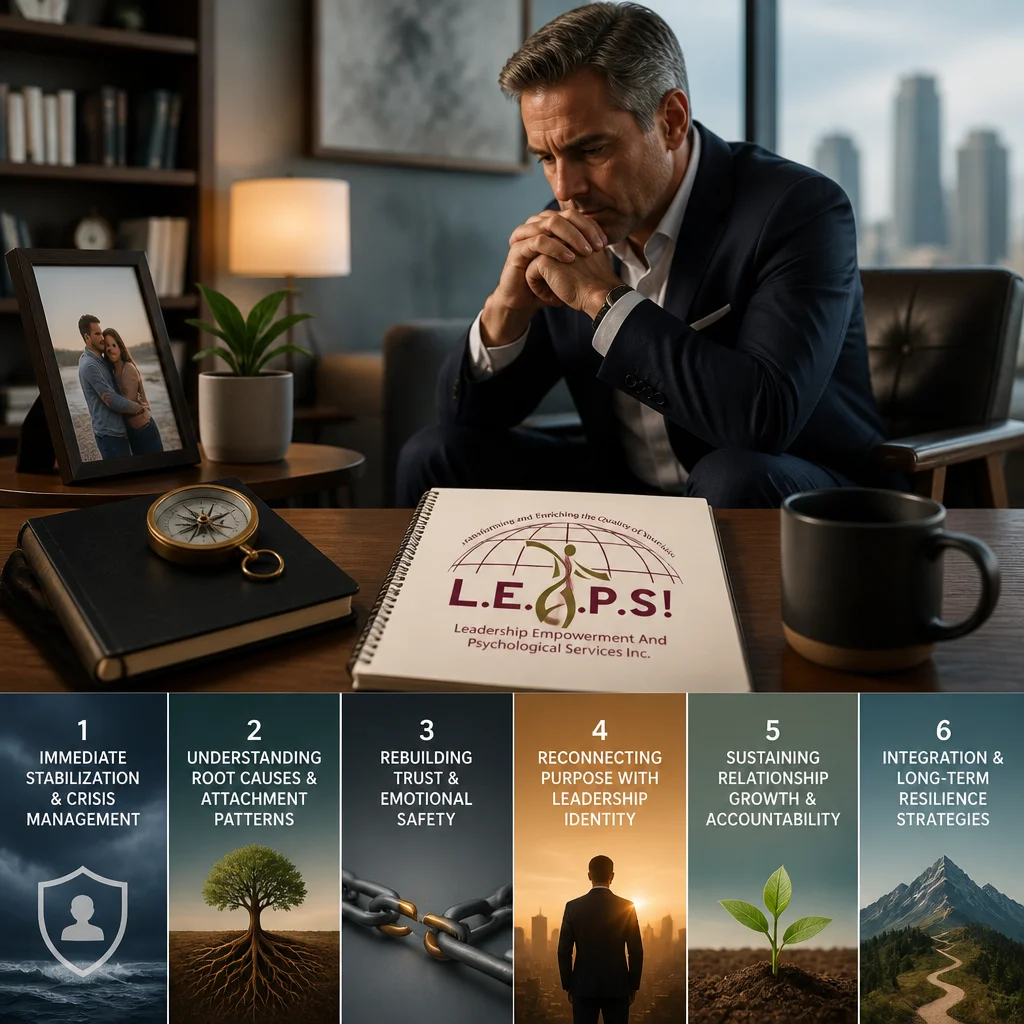
Many executives discover that their marital betrayal connects to a broader loss of purpose or integrity in their professional lives. This module explicitly bridges personal and professional identity work. We help leaders examine whether they’re living aligned with their core values or whether they’ve drifted into roles that don’t reflect who they actually want to be.
Sometimes this exploration reveals that a leader chose a marriage or career path primarily for external validation. Other times, it uncovers aspirations that have been deferred or neglected. By module four, the acute crisis has stabilized, creating space for this deeper work. Leaders emerge with clearer purpose, stronger integrity, and often renewed commitment to their relationships because the commitment stems from authentic choice rather than obligation.
This phase often includes legacy work: What kind of leader and partner do you want to be known as? What principles should guide future decisions? This forward orientation helps executives transcend the shame of infidelity and step into a more intentional life.
What to do next: Define your top three non-negotiable values in both your professional and personal life. Evaluate whether your current commitments align with those values.
Module 5: Implementing Sustainable Relationship Practices
With understanding and trust partially rebuilt, module five focuses on practices that sustain the gains. We teach couples specific communication patterns for ongoing conflict, approaches to recurring triggers, and decision-making frameworks for navigating future challenges without reverting to secrecy or distance.
These aren’t overly complex tools; they’re accessible, repeatable practices that become habitual. Regular date time, monthly relationship reviews, quarterly deeper check-ins, and annual renewal experiences keep the partnership tended. We help couples establish their own rhythm rather than imposing a template.
This module also addresses sexual reconnection if both partners are ready. Infidelity often damages sexual intimacy profoundly. We normalize this, provide permission to move slowly, and offer guidance on rebuilding physical connection with awareness of the trauma involved.
What to do next: Schedule a monthly 90-minute “relationship meeting” where you discuss what’s working, what needs attention, and what you appreciate about each other. Consistency creates safety.
Module 6: Long-Term Integration and Organizational Support
By the final module, executives are reintegrating recovery into their broader lives. We help leaders consider what organizational support might sustain their progress and how to leverage their company’s resources (EAP services, wellness programs, coaching benefits) for ongoing development.
This module also prepares leaders to move forward without our intensive support. We identify warning signs that signal the need for a booster session, outline self-care practices, and help leaders build their own support network of trusted relationships and community.
For organizations, we explore how to acknowledge an executive’s recovery journey in ways that normalize executive wellness rather than stigmatize it. Some leaders benefit from a quiet conversation with their HR partner confirming that privacy is protected and support is available.
What to do next: Create a six-month check-in schedule with your therapist or coach, building in space for ongoing growth without ongoing crisis management.
Why Our Trauma-Informed Approach Works for High-Achieving Professionals
Our team brings clinical expertise in trauma recovery alongside deep understanding of executive psychology. We recognize that leaders require evidence-based approaches, transparency about our methods, and respect for their intelligence and agency. We’re not here to pathologize executives or suggest that success in business correlates with failure in relationships.
Instead, we honor the strengths that leaders bring while addressing the specific ways those strengths can obstruct recovery. Executives’ capacity for discipline, their ability to learn from mistakes, and their commitment to excellence become assets in the healing process when directed thoughtfully.
Our infidelity recovery therapy integrates attachment theory, somatic practices, and narrative work, all adapted for professionals navigating complex life circumstances. We maintain confidentiality absolutely and communicate with clarity about what therapy is, what it can and cannot guarantee, and how it complements the executive’s broader life.
Corporate Implementation: How Organizations Support Executive Recovery
Forward-thinking organizations are increasingly recognizing that executive wellness, including relationship health, directly supports organizational performance. Some companies proactively offer our program as a benefit to senior leaders, normalizing recovery work and reducing the shame that prevents executives from seeking help.
Corporate implementation might include:
- Integrating our program into executive coaching benefits
- Offering executive coaching as a preventative measure alongside relationship work
- Creating space in executive calendars for wellness without stigma
- Partnering with us to offer workshops on relationship resilience for leadership teams
- Establishing confidential referral pathways so executives know how to access support
Organizations that invest in executive relationship recovery see improvements in decision-making quality, leadership presence, and retention among their most valuable talent.
Getting Started with Our Executive Infidelity Recovery Program
If you’re a senior leader navigating infidelity or a company interested in supporting your executives, our first step is a confidential consultation. We assess your specific situation, discuss timeline and format preferences, and outline how our program would work within your life and organization.
Contact us at https://www.leapsinc.com to schedule an initial conversation. We’ll discuss your circumstances with complete confidentiality and clarity about what recovery involves. Our goal is to support you in rebuilding both personal integrity and professional excellence, moving forward with clarity, commitment, and renewed purpose.
Recovery from infidelity is possible. So is becoming a more intentional, integrated leader in the process.
Call us today for a free 15 minute consultation.
Frequently Asked Questions (FAQ)
How does your 6-module infidelity recovery program differ from standard executive coaching?
Our program uniquely combines trauma-informed therapy with leadership development, addressing both the emotional wounds of infidelity and the specific performance challenges executives face. We understand that senior leaders need more than relationship repair—we help you reconnect your personal integrity with your professional identity so you can lead authentically again. Each module builds on the previous one, taking you from crisis stabilization through long-term integration within your organizational context.
Can our company sponsor this program for multiple executives without compromising confidentiality?
Yes, we regularly work with corporations to establish confidential infidelity recovery programs for their leadership teams. We maintain strict confidentiality agreements while providing your HR department with aggregate progress metrics and program completion status. Our corporate sponsorship model allows us to tailor the program timeline and delivery method to fit your organizational needs while keeping individual therapeutic content completely private.
What happens after completing the 6 modules if I need continued support?
We offer flexible follow-up options including monthly integration sessions, quarterly leadership check-ins, and access to our ongoing professional development resources for program graduates. Many of our clients continue working with us on broader leadership challenges or transition into our executive coaching services once they’ve completed the infidelity recovery framework. We believe healing isn’t linear, so we design our aftercare to support your evolving needs as both a leader and a person.