

Therapy can help entrepreneurs address burnout when stress, anxiety, or exhaustion begins to affect daily functioning, decision-making, or relationships. Therapy for entrepreneurs experiencing burnout offers space to understand what is driving the strain, build coping skills, and explore more sustainable ways to work.
When work feels endless, it can be hard to know whether to push harder or make a change. Financial uncertainty, leadership pressure, and the feeling that your business defines your worth can also make it difficult to step back and recognize what you need.
This article explains how therapy can support entrepreneurs facing burnout, financial anxiety, and tension between work and personal life. You’ll learn which signs may suggest that strain is affecting everyday life, how therapy can help, and how to consider support that fits your needs and aspirations.
Key Takeaways
- Therapy can address both work pressures and personal strain by helping you explore boundaries, values, and how you define success.
- Recognizing changes in focus, motivation, sleep, mood, or relationships can help you notice when stress is affecting daily life.
- Financial uncertainty can fuel anxiety; therapeutic tools can help you interrupt spirals and respond more deliberately to business pressures.
- Support can help you identify stress triggers, shift unhelpful thought patterns, and build coping skills that fit your circumstances.
- Individual Therapy may be a useful next step when emotional strain persists or begins affecting your well-being and relationships.
Is this therapy focused more on work or personal life?
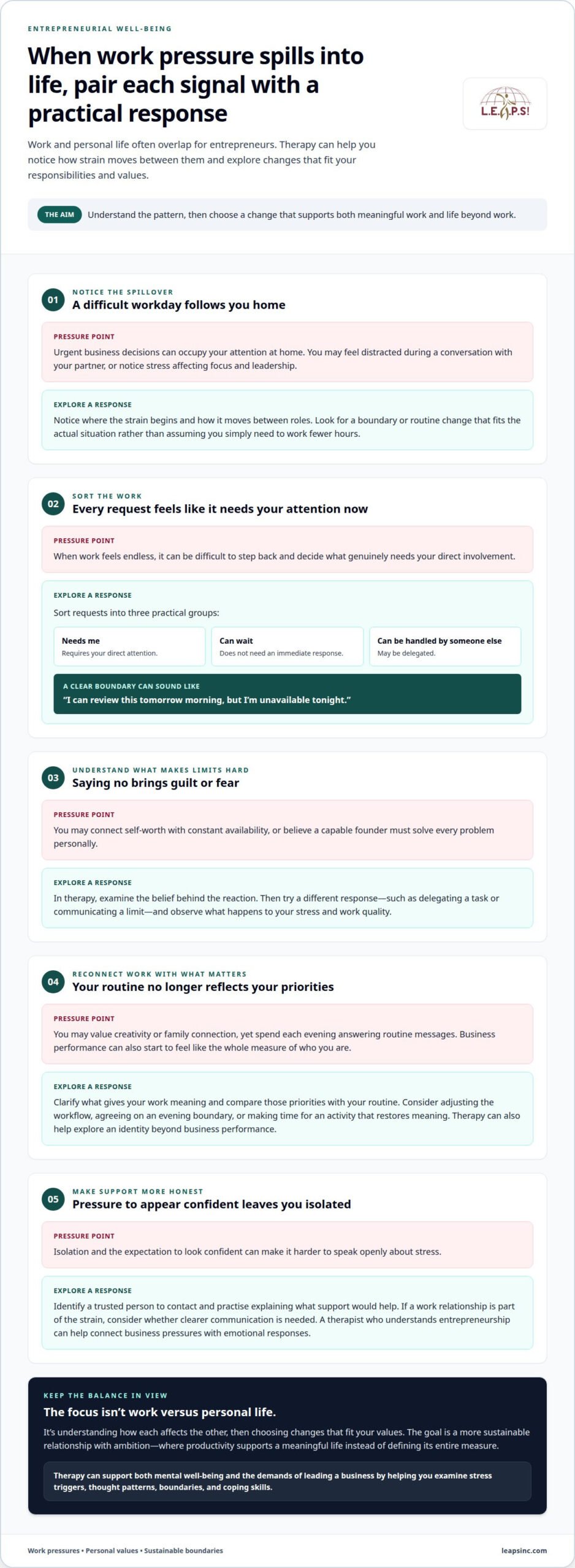
Therapy can address both work and personal life, which often overlap for entrepreneurs. A startup’s urgent decisions may follow its founder home, while personal stress can affect focus and leadership. In therapy, you can explore where strain begins and how it moves between roles. A difficult workday, for example, might leave you distracted during a conversation with your partner. That pattern can point to a boundary or change in routine that may help.
Work boundaries are more practical when they reflect your actual responsibilities and preferences. Identify which requests need your direct attention, which can wait, and which someone else can handle. Then practise stating a clear preference, such as, “I can review this tomorrow morning, but I’m unavailable tonight.” This isn’t about automatically working fewer hours. It’s about reconsidering how work gets done, setting realistic goals, and protecting time for rest and relationships.
Therapy can also help you explore why setting boundaries feels difficult. If saying no brings guilt or fear that productivity will suffer, a therapist can help you examine the beliefs behind that reaction. You may connect self-worth to constant availability or assume that a capable founder must solve every problem personally. Recognizing that belief gives you room to try a different response: delegate a task, communicate a limit, and observe what happens to your stress and work quality.
Personal values matter alongside business goals. A therapist can help you clarify what gives your work meaning and whether your routine reflects those priorities. You may value creativity and family connection, for example, yet spend each evening answering routine messages. Naming that mismatch gives you a place to start: reconsider the workflow, agree on an evening boundary, or make time for an activity that restores meaning. Therapy for entrepreneurs experiencing burnout can also help explore an identity beyond business performance.
Social connection is another part of sustainable work. Isolation and the pressure to appear confident can make it harder to speak honestly about stress. In therapy, you can identify a trusted person to contact and practise explaining what support would help, rather than sharing only polished updates. You can also consider whether a work relationship needs clearer communication. These steps can strengthen resilience without making your business your only source of identity or purpose.
The focus isn’t work versus personal life. It’s understanding how each affects the other and choosing changes that fit your values. A therapist can help you set boundaries, express your work preferences, and reconsider the link between achievement and self-worth. The goal is a more sustainable relationship with ambition, where productivity supports a meaningful life instead of defining its entire measure.
Mental health challenges associated with entrepreneurship
Entrepreneurship can bring sustained responsibility, uncertainty, and personal investment. Recognizing how these pressures affect your mental health can help you seek support before strain disrupts work or home life.
Common Mental Health Symptoms
Notice patterns such as emotional exhaustion, anxiety, low mood, disrupted sleep, or difficulty concentrating. Repeatedly rereading a routine email, for example, may signal that stress is affecting your focus. Changes in motivation, patience, or relationships can also show that pressure is reaching beyond the workday.
Therapy length and session frequency depend on goals, symptoms, progress, and practical needs. Some people notice improvements in clarity and stress levels within a few therapy sessions; longer-term results depend on consistency and individual needs.
Therapists for Entrepreneurial Mental Health
A therapist who understands entrepreneurship can help connect business pressures with emotional responses. In sessions, you might examine a difficult decision, identify its stress triggers, and practise coping strategies for a similar situation. Look for a collaborative approach that considers both mental well-being and the demands of leading a business.
Therapy, coaching, and burnout retreats serve different purposes. Therapy explores emotional distress and thought patterns; coaching focuses on goals and performance, while retreats offer a structured pause from routine.
Does health insurance cover therapy for entrepreneur burnout? Coverage varies by plan, covered services, and provider network. Those terms shape benefits and out-of-pocket responsibility.
How much does therapy for burnout cost in the United States? The price depends on the case and is given after a quote request; factors include session format, frequency, and care needs.
Burnout Prevention and Well-Being
Alongside therapy, practical steps can help reduce strain. Set realistic goals, protect time for rest, and tell a trusted person what support would help. Reassess how work gets done instead of assuming that fewer hours alone will resolve burnout. A brief mindfulness practice can also help you pause and notice rising tension.
What steps can entrepreneurs take to recover from burnout alongside therapy? Prioritize self-care, strengthen social support, and practise boundaries while addressing stress triggers in therapy. Adjust routines and responsibilities as you identify what sustains the pressure.
Mental Health and Business Performance
Emotional strain can affect focus, engagement, motivation, and resilience. A founder who is exhausted may overlook details, delay decisions, or respond sharply during a team discussion. These changes can influence collaboration and the quality of daily work. Therapy can help you recognize patterns and develop coping skills before they become embedded in your leadership. If support feels timely, you can schedule an appointment to discuss your needs.
Financial anxiety and income uncertainty
Uncertain revenue can make ordinary business decisions feel like threats to personal security. A delayed payment, lost contract, or slow sales period may trigger ongoing worries about payroll and household expenses. For some entrepreneurs, business failure could also put personal assets used to start the company at risk. That possibility can make it hard to distinguish a financial problem that needs practical action from anxiety that keeps replaying worst-case outcomes.
Therapy can help entrepreneurs manage stress, anxiety, and depression by identifying triggers and examining the thoughts attached to them. A therapist may help you notice when a forecast starts to feel like a certainty, then consider more balanced interpretations. This work doesn’t resolve cash-flow problems, but it can support clearer emotional responses while you address the business issue through appropriate planning.
Setbacks can heighten uncertainty because entrepreneurs often carry responsibility for employees, customers, and their own livelihoods. After a contract falls through, for instance, you might go from “this project failed” to “the business will never recover.” Cognitive reframing helps you examine that leap, distinguish evidence from prediction, and identify a next step. You might review what changed, decide which conversation needs attention, and delay major decisions until you can think more clearly.
Mindfulness offers another way to interrupt an anxiety spiral. Begin with a brief period of quiet attention to your breath or surroundings each day. When thoughts turn to a future funding gap, gently bring your attention back to the present, then identify the practical question that needs an answer. This creates a pause between feeling alarmed and reacting. It can also help you recognize whether a concern calls for action, discussion, or acknowledgment.
Risk is part of building a company, but constant vigilance can narrow your sense of direction. Therapy can help you distinguish a specific, manageable risk from uncertainty you can’t eliminate, such as a customer changing plans. In a session, you could explore what the setback means to you, how it affects sleep or relationships, and which response aligns with your values. That reflection can make room for resilience without minimizing financial pressure.
To get started, describe one recent money-related worry in concrete terms: what happened, what you fear, and what you know. Practitioners at LEAPS Inc. can help you explore the emotional meaning of the event and practise coping strategies, including mindfulness and cognitive reframing. You can then return to the business question with more clarity, consider your options, and choose a deliberate next step rather than letting anxiety set the direction.
Specialists can use mindfulness-based techniques and cognitive reframing in therapy to help entrepreneurs interrupt anxiety spirals during financial uncertainty.
Signs that strain is affecting daily functioning
Strain deserves attention when it starts changing how you work, care for yourself, or relate to others. A missed deadline alone may reflect a busy week; repeated mistakes alongside disrupted sleep or ongoing conflict can point to a broader pattern.
Look for changes in everyday routines. You may struggle to begin tasks that once felt manageable, lose focus during familiar decisions, or find that small setbacks provoke unusually strong reactions. A delayed client response, for example, might occupy your thoughts all evening, even after you’ve finished work. Changes in sleep or mood can also make uncertainty harder to tolerate the next day.
Entrepreneurial burnout can affect relationships as well as business responsibilities. You might withdraw from friends, become impatient with a partner, or repeatedly cancel plans because work feels impossible to leave. Notice whether these changes are occasional or persistent, and whether they interfere with connection, rest, or daily commitments. A simple record of what changed, when it happens, and what came before it can help clarify patterns.
Work performance offers another useful signal. If routine decisions take much longer, you overlook details, or your motivation has dropped, consider what else has changed. A founder who rereads the same proposal without absorbing it, for instance, may be experiencing reduced concentration, not a lack of capability. When strain affects both responsibilities and personal routines, discussing those changes in therapy can help identify suitable support.
Uncertainty can also intensify reactions to conflict. You may avoid a necessary conversation with a colleague, interpret feedback as personal failure, or respond sharply to a minor disagreement. Track the situation and its effects: did it disrupt sleep, delay a decision, or damage trust? These details give a therapist a clearer picture than the label “burned out” alone.
When should burnout symptoms prompt urgent professional or medical help? Seek urgent help if you feel unable to keep yourself safe, or if a sudden change in your physical or mental state creates immediate danger. For persistent symptoms that affect daily functioning or relationships, arrange professional support promptly rather than waiting for work demands to ease.
A practical next step is to name the change plainly. You might say, “I’ve stopped sleeping well, and I’m avoiding conversations with my team.” Sharing specific effects helps a therapist understand how strain shows up across work and personal life. It also moves the discussion toward useful goals, such as restoring daily routines, addressing conflict, or strengthening coping skills. Seeking support is a deliberate response to a pattern, not a judgment about your ability to lead.
Therapy for entrepreneurial burnout
Therapy can help you understand what is sustaining burnout and develop a more workable response. Instead of treating exhaustion as a personal failure, sessions can explore stress triggers, emotional reactions, and recurring patterns. A founder might notice, for example, that every difficult client conversation leads to rumination long after work ends. Identifying that sequence creates a clearer starting point for change.
The approach should fit the concerns you bring. Cognitive behavioral therapy can help you examine unhelpful thoughts linked to business pressure and practise alternative responses. Interpersonal therapy focuses on communication and relationships, which may help when conflict with a co-founder or partner adds strain. Mindfulness-based and trauma-informed approaches may also be useful areas to explore with a therapist.
Therapy can turn insight into practical steps. You might identify a recurring trigger, notice the belief attached to it, and choose a different response the next time it occurs. If a delayed decision prompts thoughts of failure, for instance, you could examine the evidence, name what remains uncertain, and set a time to revisit the decision. Relaxation strategies and coping skills can support emotional regulation as you practise.
Work-related goals can sit alongside personal ones. A session might focus on how perfectionism shapes delegation, how emotional decision-making affects leadership, or how work pressure influences a close relationship. The aim isn’t to eliminate ambition. It’s to develop sustainable habits, strengthen resilience, and clarify what success means beyond constant output.
Are online therapy options effective for entrepreneurs dealing with burnout? Online therapy is a way to meet, not a separate therapeutic method. Its usefulness depends on whether the format supports focused, consistent sessions and the work you and your therapist undertake together.
Progress can be reviewed through meaningful changes rather than a single measure. You might track whether you recover more quickly after a setback, communicate more directly, or make decisions with greater clarity. Some people notice improvements in clarity and stress levels within a few therapy sessions; longer-term results depend on consistency and individual needs. If emotional, physical, and work-system pressures overlap, therapy may be coordinated with coaching when appropriate.
Therapy can also address burnout’s effects on close relationships without treating those effects as a reason for guilt. You and your therapist can develop an honest plan, for example, to discuss missed time or recurring tension with someone you care about. This makes the work practical: understand the pattern, practise a response, and review what changes.
If you’re ready to explore what is driving your strain, schedule an appointment to begin a focused conversation about your needs and goals.
LEAPS: Individual Therapy
LEAPS offers Individual Therapy for entrepreneurs who want space to address burnout, anxiety, or changes in daily functioning. In therapy, you can explore how business pressures affect your emotional well-being, identify recurring patterns, and develop more sustainable ways to respond. If strain is also affecting a close relationship, Couple Therapy may provide a setting to work through that impact together. A focused Individual Therapy process can help you clarify what you’re experiencing and what you want to change. If you’re ready to discuss support, contact LEAPS to arrange an appointment.
Choose a more sustainable way forward
Your next step doesn’t have to solve every business challenge at once. It can begin with a clearer understanding of what you need to protect, change, or reclaim in your life. Therapy for entrepreneurs experiencing burnout can offer dedicated space to explore that direction, strengthen your capacity to respond, and make choices guided by more than immediate pressure.
Progress may start with one honest conversation about what no longer feels sustainable. From there, you can identify the changes that matter most and move toward them with intention. Seeking support isn’t a rejection of ambition; it’s a way to build a future where your well-being has a place alongside your work.
Contact LEAPS to explore therapy and consider a next step that supports the life and work you want to create.
Frequently Asked Questions
How do I know if therapy is right for me as an entrepreneur?
Therapy may be useful when emotional strain affects decisions, rest, or relationships, even after work ends. You might feel unable to switch off after a routine client meeting or find that worry is shaping every business decision. Therapy for entrepreneurs experiencing burnout can offer a confidential space to explore these patterns and consider changes that may support your well-being.
What are the signs and causes of burnout among entrepreneurs?
Burnout can involve emotional exhaustion, disrupted sleep, reduced concentration, low motivation, or growing irritability. These changes may develop amid sustained workload, responsibility for others, uncertain income, and pressure to keep a business moving. Watch for a shift from occasional tiredness to difficulty managing routine tasks or maintaining connections. The pattern and its effect on daily life matter more than any single difficult day.
What types of therapy help entrepreneurs with burnout?
Approaches may include cognitive behavioral therapy, Emotionally Focused Therapy, and mindfulness, depending on your concerns and therapeutic goals. Cognitive behavioral therapy can help you examine the relationship between thoughts and responses; mindfulness can support awareness of present-moment reactions. Emotionally Focused Therapy may be relevant when emotional patterns affect close relationships. Discussing a specific challenge, such as perfectionism or conflict, can help shape the therapeutic focus.
How do I find a therapist who specializes in entrepreneurs or founders?
Look for a therapist who understands founder-specific pressures, such as carrying responsibility for a team or feeling unable to separate your identity from the company. In an initial conversation, describe a current challenge and notice whether the therapist helps clarify its emotional and practical dimensions. At LEAPS, Dr. John Daniel is a Black African American therapist and a Christian therapist who integrates faith into healing.
What should I look for when choosing a therapist for burnout?
Look for a collaborative approach that gives you room to explain your priorities, values, and concerns without reducing everything to business performance. Ask how therapy might address the issues you want to work on, such as anxiety, relationship strain, or difficulty making decisions. Consider whether the therapist’s approach feels respectful and clear. LEAPS offers evidence-based methods including cognitive behavioral therapy, Emotionally Focused Therapy, and mindfulness.