


Article by
Dr. John E. N. Daniel
Dr. John E. N. Daniel is a visionary with a burning desire to coach, counsel, teach and empower individuals from diverse backgrounds towards the attainment of their maximum potential, life purpose and destiny. He coaches, counsels, consults, mentors, and ministers to the global community through diverse media and environments.
A brand can look polished and still leave people unsure what a business stands for. Effective branding and development go beyond a logo: they shape how a business understands its audience, expresses its purpose, and builds recognition through consistent experiences. The work is strategic, not cosmetic.
It’s reasonable to expect a clear brand to help people understand why a business matters. Building that clarity takes more than choosing colors or writing a tagline. It means aligning the business’s identity with what its audience values and what it can genuinely deliver. This guide explains how to research your audience, define a brand strategy, and develop a mission, vision, values, brand promise, and visual identity. It also shows how to keep these elements coherent as the business grows, so the brand reflects both where it is now and the future it intends to create.
Key Takeaways
- Use audience research to uncover the needs, priorities, and language that should shape your brand’s decisions.
- Align your brand strategy with what the business can genuinely deliver, then track how consistently it is put into practice.
- Build clear guidelines for messaging and visual identity so every interaction expresses a coherent brand.
- Define a mission, vision, values, and promise that give your brand a meaningful direction and a credible foundation.
- When you need structured support to turn your brand direction into a development strategy, LEAPS offers Brand Development.
Finding and understanding a target audience
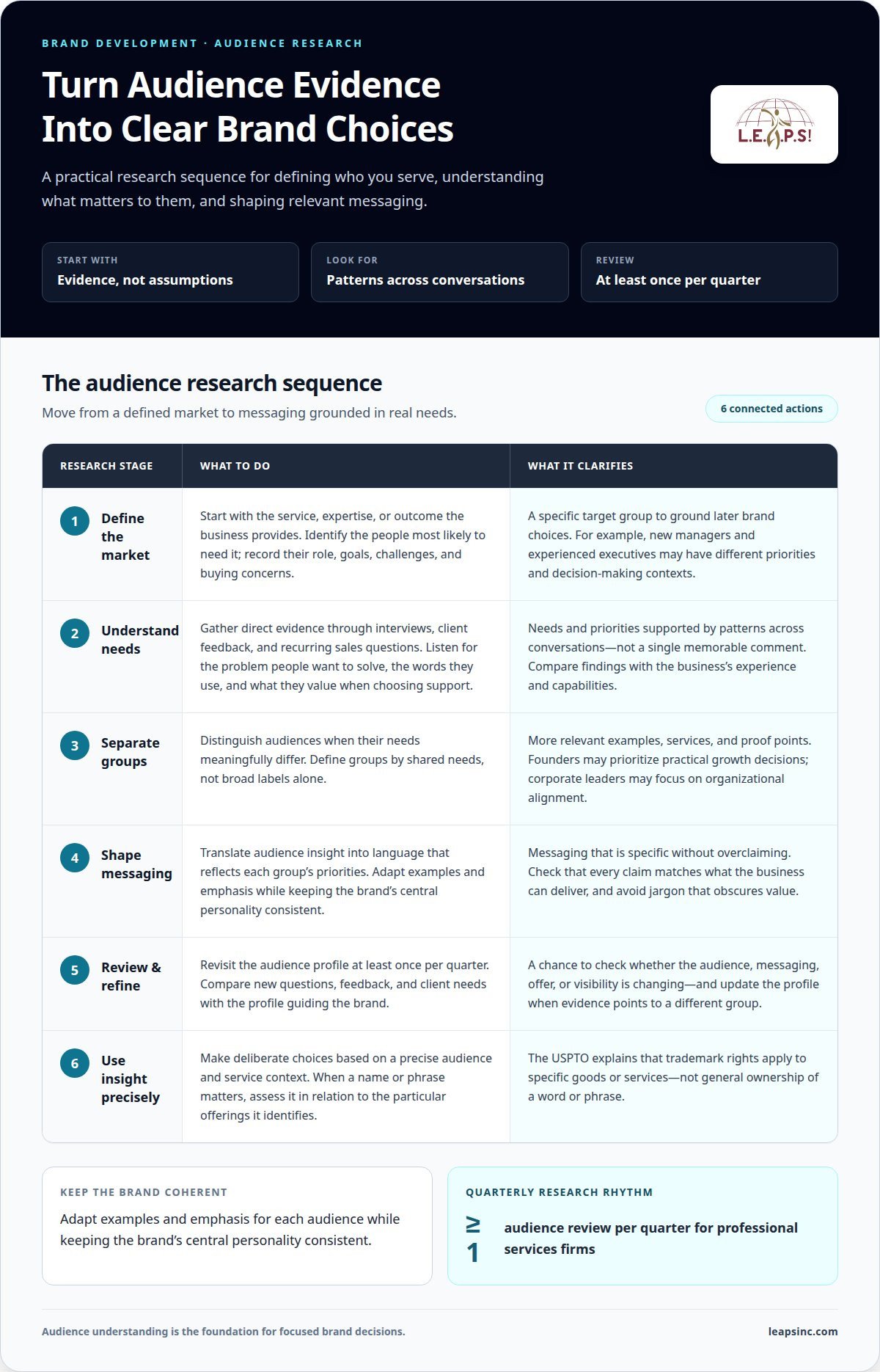
Begin with evidence, not assumptions: professional services firms should research their target client group at least once per quarter. Use each review to refine who the business serves, what those people need, and how the brand can respond.
- Define the market you can serve. Start with the service, expertise, or outcome the business provides, then identify the people most likely to need it. For example, a leadership consultant might distinguish new managers from experienced executives because their priorities and decision-making contexts differ. Record each audience’s role, goals, challenges, and buying concerns. A clear target keeps later brand choices grounded in a real group.
Understand Audience Needs
Gather direct evidence through interviews, client feedback, and recurring questions from sales conversations. Look for the problem people are trying to solve, the words they use to describe it, and the qualities they value when choosing support. Compare those findings with the business’s experience and capabilities. Don’t treat one memorable comment as a universal need. Look for patterns across conversations and feedback.
- Separate audience groups when their needs meaningfully differ. A firm serving founders and corporate leaders, for example, may find that founders prioritize practical growth decisions while corporate leaders focus on organizational alignment. Define each group by shared needs, not broad labels alone. This distinction helps the business choose relevant examples, services, and proof points without diluting its overall positioning.
Shape Audience-Specific Messaging
Translate audience insights into language that reflects each group’s priorities. For founders, explain how the work supports clearer business decisions; for corporate leaders, emphasize alignment and organizational development. Check that every claim reflects what the business can deliver, and avoid jargon that obscures the value. Keep the brand’s central personality consistent while adapting examples and emphasis for each audience.
- Review the evidence and update the audience profile at least once per quarter. Compare new questions, feedback, and client needs with the profile already guiding the brand. If a business repeatedly attracts a different group, examine whether its messaging, offer, or visibility is shaping that response. A focused brand development process can connect audience findings with a coherent market position.
- Use audience insight to make deliberate choices, not to claim ownership over broad language. The United States Patent and Trademark Office explains that trademark rights apply to specific goods or services, not general ownership of a word or phrase. That distinction reinforces the value of defining the precise audience and service context. When a name or phrase matters, assess it in relation to the particular offerings it identifies.
How to Craft Your Brand Strategy?
Build the strategy around business priorities, audience expectations, and what the organization can deliver. Translate that direction into consistent choices, measurable actions, and clear messages.
Align Brand and Business Strategies
Connect the brand’s position to a specific business objective, such as entering a new market or clarifying a specialized service. Make sure the promise reflects the organization’s actual strengths and capacity. A brand strategy can guide marketing, service design, and customer experience, but it shouldn’t claim expertise the business cannot support. Tie every proposed action to a clear business priority.
Choose a Branding and Development Agency
Choose a branding agency by assessing its strategic process, relevant work, communication, and ability to connect brand decisions with business goals. Ask how it will turn audience insights into positioning, messages, and practical materials, then consider whether its approach fits the organization’s needs. For legal risks, the United States Patent and Trademark Office explains that a trademark doesn’t create general ownership of a word or phrase; its rights apply to use with specific goods or services. Keep that distinction in mind when developing a name or identity.
Coordinate Branding and Web Development
Coordinate the brand direction with the website’s structure and content before development begins. The brand defines the voice, visual system, and core messages; the website turns those choices into navigation, page layouts, and useful content for a consumer. For example, a firm positioning itself around clear guidance should use straightforward page labels and explain its process plainly. Avoid designing the site in isolation, since disconnected copy and visuals can weaken the intended impression.
Adapt and Evolve the Brand Strategy
Treat brand development as an ongoing process, not a one-time launch. Track both how the plan is being implemented and the results it produces. Check whether marketing materials use the agreed messages and whether intended audiences respond. Review progress against the business objective, then adjust the plan when customer needs, services, or market conditions change. Keep the core positioning grounded in what the firm can deliver, even as tactics evolve.
- Turn the strategy into an action plan with an owner, a practical task, and a way to evaluate progress for each priority. For example, if a firm wants stronger recognition for a specialist service, align its website copy, presentations, and outreach around that focus. Business development can connect the brand direction with the organization’s wider growth priorities. A business development strategy can help structure that connection. If you want to discuss how strategic priorities relate to brand development, you can schedule an appointment.
What is Brand Development?
For professional services firms, a brand reflects reputation and visibility in the marketplace. Brand development creates and strengthens that brand through clear positioning, messaging, and consistent expression.
Develop the Brand Message
Write a central message that explains what the organization does, whom it serves, and why its work matters. Connect each claim to a real service or client experience. For example, a consulting firm might explain how it helps leaders clarify organizational priorities. Avoid vague promises that could describe any business. Specific, credible language gives the audience something meaningful to remember.
Define Brand Voice and Core Messaging
Choose a voice that reflects the organization’s character, then use it across conversations and materials. A financial advisory firm might adopt a calm, precise voice and explain complex decisions directly. The voice is how the brand sounds; the message is what it communicates. Keep both aligned, and avoid shifting tone between a website, proposal, and client presentation.
Establish Brand Positioning
State what the organization offers, who benefits, and what distinguishes its approach. A professional services firm’s brand positioning statement is typically four to six sentences long. Use those sentences to identify the intended audience, its relevant need, the firm’s response, and its distinguishing strengths. Check every point against the organization’s actual capabilities. Strong positioning guides core messaging without relying on unsupported claims.
Create Brand Guidelines
Document the decisions that help people present the brand consistently. Include approved messaging, voice principles, visual identity elements, and examples of how they should appear in common materials. For instance, show how a logo, heading style, and service description work together in a proposal. Explain what to avoid, such as distorted logo proportions or language that conflicts with the brand promise.
- Apply the guidelines wherever people encounter the brand. Review a website page, proposal, and social post side by side. Each should convey the same positioning, even when format and detail differ. Consistent visuals make the identity recognizable, while consistent messages help the intended audience understand its value. A successful brand isn’t simply uniform: its expression should resonate with people and remain true to the organization.
Hinge describes brand development as creating and strengthening a professional services brand. This approach treats the work as more than a cosmetic exercise: the goal is to give the firm a clear, credible identity and strengthen it as the organization communicates what it offers. Each decision should help people recognize the firm’s purpose and understand the relevance of its work, without promising more than it can deliver.
Leaders can use brand development to guide how the firm presents itself and explains its services. Ask whether each choice supports the intended identity and reflects what the organization can genuinely provide. If an expression feels unclear or overstates the firm’s value, revise it before it reaches an audience. When the brand is grounded in the organization’s real work, people have a clearer basis for understanding what the firm does and whether it may suit their needs. That clarity makes the brand a practical guide for communication, not just a visual signature.
What visual elements should be included in your brand identity?
Build a visual system that helps people recognize the organization and connect its appearance with its purpose. The logo, colors, typography, imagery, and layout should work together across brand materials.
Create a Recognizable Visual Identity
Choose a logo, color palette, typography, and image style that express the organization’s character. For example, a financial advisory firm might use restrained colors and clear typography to communicate steadiness. Don’t select each element in isolation; assess how they work together on a website header, presentation cover, and business card. The identity should feel distinctive without distracting from the service or message.
- Decide what associations each visual choice should create. A children’s learning center might use lively illustrations to suggest discovery, while a legal practice may favor structured layouts and restrained imagery. Record the intended impression beside each design decision. This helps prevent a graphic style from communicating warmth when the organization wants to convey precision, or appearing luxurious when its position emphasizes accessibility.
Build Visual Consistency
Set practical rules for applying visual elements across digital and printed materials. Specify logo placement, color combinations, typography hierarchy, image treatment, and spacing. For example, define how a logo appears on a dark background and how headings differ from body text. Consistency doesn’t require identical layouts. It means each format uses the same recognizable design logic and avoids improvised variations.
Connect Visuals With Brand Recognition
Use a small set of distinctive visual cues repeatedly, so audiences can associate them with the organization. Consumers form a first impression of a logo within 10 seconds, and need 5-7 impressions to remember it. Pair the logo with consistent colors and typography across a presentation, website, and social post. Avoid frequent redesigns that make recognition harder to build.
- Use graphic design to make information easier to understand, not merely more decorative. On a service page, clear headings, relevant imagery, and generous spacing can guide readers through the organization’s offer. Check that each visual supports the intended meaning and remains legible in its actual format. A complex illustration that obscures a key message weakens communication, even if it looks striking.
- Review the identity against audience response and the organization’s desired reputation. Ask whether people connect recurring colors, symbols, and imagery with intended qualities, such as expertise or approachability. Coherent, repeated use builds visual recognition and can reinforce trust and loyalty when the experience matches those signals. If a design element creates the wrong association, revise it deliberately rather than changing the entire identity.
Brand mission, vision, values, and promise
Define the principles that guide your brand, then make them visible in daily decisions. A clear mission, vision, values, and promise give your strategy a coherent foundation.
Define the Brand Mission and Vision
Write a mission statement describing the work your organization does and whom it serves. Then describe the future your vision seeks to create. For example, a community health organization might help families access supportive care while envisioning healthier, more connected communities. Keep the mission grounded in current work, and make the vision aspirational without promising outcomes beyond your influence.
Establish Core Values
Select values that guide real choices, not words chosen only for a presentation. If transparency is a value, show how it shapes pricing explanations, project updates, or service expectations. If collaboration matters, describe how teams involve clients in decisions. A concise set of values is easier to apply across hiring, customer interactions, and marketing than an extensive list without clear behaviors.
Connect Values With Brand Personality
Translate each value into recognizable ways of communicating and acting. For example, a brand that values clarity might use direct language, explain its process, and avoid inflated claims. A value of innovation could support a curious, forward-looking personality, while integrity calls for measured, accountable messaging. Check that social media posts and client conversations express the same character as formal statements.
Identify the Unique Value Proposition
State the specific value customers receive, the need it addresses, and why your organization is suited to provide it. A bookkeeping firm, for example, might emphasize helping independent designers understand cash flow through clear monthly reporting. Compare the statement with your actual capabilities and customer priorities. Avoid generic claims such as “the best service,” which don’t explain a meaningful distinction.
- Bring these elements together in a brand development strategy. Use the mission to define purpose, the vision to set direction, values to guide conduct, and the value proposition to clarify relevance. Build them into the brand development process, from campaign briefs to service decisions. Review a website page and social media post: both should reflect the same promise in language suited to each format.
If you’re ready to bring purpose and strategy into closer alignment, schedule an appointment to discuss your brand direction.
A promise earns credibility when people can recognize it in everyday interactions, not only in polished brand statements. That consistency matters because 86 percent of people name authenticity as a key factor in deciding which brands they like, support, or buy from. Make sure the experience matches the words: explain what customers can expect, follow through on commitments, and acknowledge limitations rather than overstating what you can deliver.
Review the promise whenever services, customer needs, or organizational priorities change. Ask whether staff can describe it clearly and whether customers encounter it consistently across conversations and materials. When the promise reflects real capabilities and values, it gives teams a practical standard for decisions and helps customers understand what makes the relationship worthwhile.
LEAPS: Brand Development
LEAPS offers brand development for businesses seeking a clear, coherent brand strategy. It can be a useful next step when your audience, purpose, and values are defined, but your positioning or brand expression still needs direction. The work can help connect your intended identity with how the business presents itself and supports its growth.
If you’re ready to turn your brand thinking into a deliberate development process, contact LEAPS to discuss your goals and next steps.
Build a Brand That Can Grow With You
Your brand isn’t a fixed declaration. It’s a commitment that should remain meaningful as your organization develops. Let branding and development evolve together, guided by the direction you’re choosing and the experience you want people to have. The next step is to turn that intention into clear decisions and a practical path forward.
LEAPS offers Brand Development, alongside Individual Therapy, Therapy Intensive, and Couple Therapy. If you’re ready to explore how your brand can express your organization’s purpose and support its future, contact LEAPS to discuss your brand. Take the next step with intention, and keep building toward the future you envision.
Frequently Asked Questions
What does “branding and development” mean in business?
Branding and development means shaping how a business is understood and improving that identity as the organization evolves. Branding clarifies what people should associate with the business; development turns that direction into decisions about its services, communications, and customer experience. For example, a growing consultancy might refine its positioning when it begins serving a new client group while keeping its central purpose recognizable.
What are the key elements of a brand identity?
A brand identity combines the name, logo, colors, typography, imagery, voice, and messaging that distinguish a business. These elements should work together in practical settings, not just in a style guide. For example, a proposal cover, email signature, and service page should feel connected while serving different purposes. The identity should also help customers understand what the organization offers and what experience to expect.
What are the steps to develop a brand from scratch?
Start by clarifying the business’s purpose and the people it intends to serve. Next, define its position, promise, and distinguishing value, then translate those decisions into a name, messaging, visual identity, and usage guidance. Test the resulting materials in realistic situations, such as a sales presentation or website page. This sequence helps reveal gaps before the brand appears across customer-facing channels.
How can businesses measure the ROI of branding and website development?
Measure return by connecting brand and website activity to business outcomes, rather than relying on impressions alone. Establish a baseline, then monitor qualified inquiries, conversion rates, repeat business, and revenue associated with relevant campaigns or pages. Compare changes with the resources invested and consider other factors that may affect results, such as service changes or market demand. A clear measurement period and consistent tracking make comparisons more useful.