

Business coaching usually focuses on the organization, its growth, strategic decisions, and performance. Executive coaching focuses more directly on a leader’s judgment, communication, influence, and effectiveness in a management role. The two can overlap when an owner or senior leader is responsible for both business results and team performance.
What problem are you trying to solve: business growth or executive leadership?
Choosing professional support can feel uncertain when your business, role, or leadership responsibilities have become difficult to manage alone. The clearest starting point is to identify whether the central challenge belongs to the enterprise, the leader, or both.
Business coaching generally examines growth priorities, strategic decisions, operations, delegation, organizational performance, and broader business leadership capabilities. Executive coaching generally examines the individual leader’s performance, judgment, communication, relationships, influence, and ability to lead effectively. Neither category is automatically better; the right fit depends on the outcome you need to pursue.
Business coaching for owners, entrepreneurs, and business leaders
Business coaching is usually the better starting point when you need help deciding where the organization should go and how to improve its performance. A business coach may help you clarify growth priorities, examine strategic choices, improve organization, delegate work, and create practical action steps. LEAPS Inc. provides business coaching for entrepreneurs and business leaders focused on growth, strategic decisions, leadership development, and organizational performance.
Executive coaching for managers and senior leaders
Executive coaching is usually the better fit when the primary concern is how you lead, decide, communicate, and influence others. The work may address difficult conversations, leadership presence, delegation, judgment, team relationships, and performance in a management or executive role. Owners often need both perspectives because their personal leadership choices directly affect business results.
How do business coaching and executive coaching differ in scope and accountability?
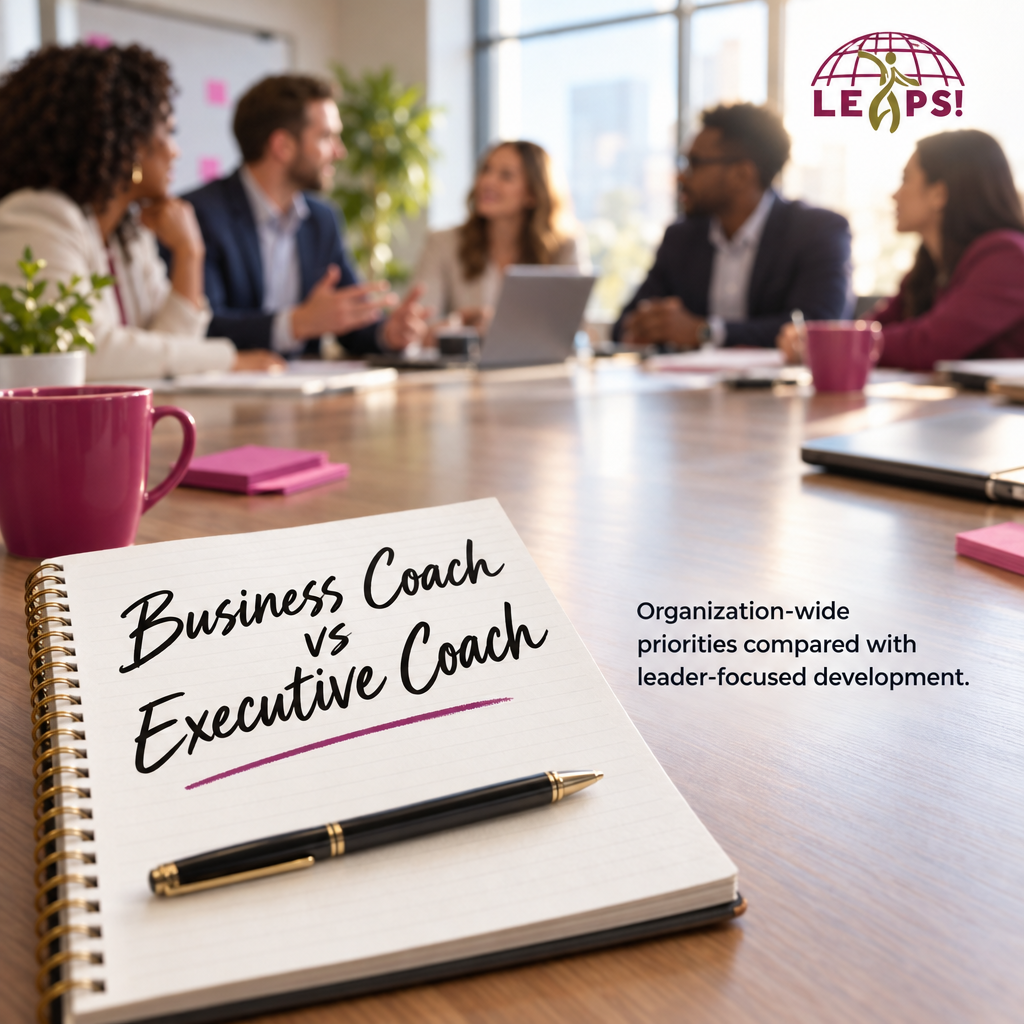
Business coaching may ask, “Which priorities will improve the organization?” Executive coaching may ask, “How is the leader’s behavior affecting decisions, relationships, and results?” In practice, the conversations can include growth, operations, delegation, change management, communication, and leadership development.
Business coaching tends to examine the enterprise and its decisions, while executive coaching tends to examine the leader’s behavior, relationships, judgment, and influence within that enterprise. Accountability should connect to agreed goals, observable actions, follow-up conversations, and realistic time frames rather than vague encouragement.
Questions to clarify before choosing a coach:
- What specific goal should the coaching address?
- Will the scope focus on the business, the leader, or both?
- How often will sessions occur, and what happens between them?
- How will confidentiality be handled, especially if an organization is involved?
- How will progress be reviewed?
- What follow-up is expected from the client and coach?
Typical business coaching questions
Business coaching may help you examine whether to prioritize growth, improve operations, reorganize responsibilities, delegate more effectively, manage change, or strengthen overall business leadership capabilities. The discussion should connect each priority to a practical decision, an action, and a way to review progress rather than leaving you with general motivation.
Typical executive coaching questions
Executive coaching may focus on how you communicate under pressure, decide with incomplete information, influence stakeholders, handle conflict, develop employees, or build trust with a team. The coach may help you observe patterns in your leadership and test specific behaviors between sessions.
What should you ask about a coach’s credentials, method, and structure?
Evaluate a coach by asking about relevant credentials, experience with comparable goals, coaching method, confidentiality, session format, goal-setting, and progress review. A title alone does not show how the engagement will work, so ask what happens between sessions and how the coach responds when progress stalls.
LEAPS Inc. identifies credentials including Board-Certified Business Coach, Board-Certified Executive Coach, Board-Certified Entrepreneurship Coach, Certified Consultant, and Leadership Expert. Its stated approach connects collaborative goal-setting, accountability, positive psychology, experiential learning, and practical action planning. These elements can give a coaching engagement a clear structure without promising a particular outcome.
Credentials that relate to your goals
Choose credentials and experience that match the problem you want to address. If you need enterprise strategy, ask about business coaching experience; if you need leadership behavior and influence, ask about executive coaching experience. For an entrepreneurial transition, an entrepreneurship coaching background may be relevant. Then ask how that experience applies to your specific situation.
What a structured engagement should include
A structured engagement should define goals, responsibilities, session expectations, confidentiality, between-session actions, and review points. LEAPS Inc.’s stated method uses collaborative goals, accountability, positive psychology, experiential learning, and practical action planning, giving clients concrete areas to discuss and practice rather than relying only on conversation.
How can you tell whether coaching or therapy is the better fit?
Coaching usually addresses future-focused goals, performance, decisions, leadership development, organization, and action planning. Therapy may be more appropriate when the main concern involves significant emotional distress, relationship trauma, persistent mental health symptoms, family conflict, or recovery from infidelity.
Business pressure can affect emotional and relational health, so it helps to discuss the distinction rather than assume one service addresses every concern. LEAPS Inc. combines professional coaching with therapy services, including individual, couples, family, and specialized relationship support. Coaching does not replace clinical care when therapy is the appropriate service.
When the primary need is business or leadership performance
Choose coaching when your main need is clearer priorities, better organization, stronger leadership, more effective decisions, or accountability for action. A coaching conversation can help define the outcome and determine whether business coaching, executive coaching, entrepreneurship coaching, or another coaching category best matches the situation.
When emotional or relational health needs professional therapy
Consider therapy when distress, relationship conflict, family tension, trauma, or infidelity recovery is central to the concern. If business stress is contributing to those issues, explain the full context during the initial conversation so the support can be matched to the primary need without treating coaching as a substitute for therapy.
What should you expect from the first conversation and the coaching engagement?
The first conversation should clarify your desired outcome, current challenge, decision-making context, stakeholders, confidentiality, session expectations, communication between sessions, and how success will be assessed. You should leave with a clearer understanding of the scope, method, responsibilities, and next steps.
Coaching may involve a focused set of sessions or ongoing support, depending on your goals and situation. LEAPS Inc. states that business coaching can range from a few sessions for a focused issue to ongoing support lasting six to nine months or longer. Duration describes the possible structure, not a guaranteed result.
Questions to bring to an initial consultation
Ask how the coach would define your main goal, what preparation is expected, how confidential information is handled, and how progress will be reviewed. You can also ask what communication is available between sessions and how the coach will respond if an agreed action becomes difficult to complete.
How engagement length can vary
A focused decision may need only a few sessions, while broader growth, leadership, or organizational goals may call for ongoing support. Discuss milestones and review points instead of assuming a fixed timeline. Proceed when the scope, method, responsibilities, and next steps feel clear enough for you to evaluate the fit.
Which coach should you choose if your role combines ownership, leadership, and personal pressure?
Choose business coaching when enterprise priorities dominate, executive coaching when leadership performance dominates, and therapy when emotional or relational health is the central concern. An owner, founder, or senior manager may reasonably need a blended conversation about strategy, time allocation, organization, communication, and leadership.
LEAPS Inc. offers business, executive, entrepreneurship, career, life, and couples coaching alongside therapy services. That range makes it useful to state the problem plainly and ask which service best fits, rather than choosing based only on a title.
A decision guide for overlapping needs
If you are deciding whether to expand, improve operations, or clarify business priorities, begin with business coaching. If your central concern is how you lead, communicate, delegate, or influence, begin with executive coaching. If pressure is closely tied to distress or relationship conflict, ask whether therapy should be part of the conversation.
A clear next step for Florida readers
Florida readers, including those in the Tampa and Orlando service areas identified by LEAPS Inc., can contact the team at info@leapsinc.com or +18558853277 to discuss fit, scope, goals, and next steps. Describe whether your primary need involves business growth, executive leadership, entrepreneurship, personal development, or emotional and relational health.
Frequently Asked Questions
Is a business coach the same as an executive coach?
No. Business coaching usually centers on business growth, strategic decisions, organizational performance, and leadership capabilities, while executive coaching centers more directly on an individual leader’s performance, communication, judgment, and influence. The services can overlap for owners and senior leaders.
How do I know whether I need a business coach or an executive coach?
Choose based on the main problem you want to address. Business coaching may fit enterprise priorities and growth decisions, while executive coaching may fit leadership behavior, team influence, and role performance. Ask a prospective coach how they would define the scope before committing.
What qualifications should I look for in a business or executive coach?
Look for credentials relevant to your goals, experience with similar challenges, a clearly explained method, confidentiality expectations, and a process for setting and reviewing goals. LEAPS Inc. identifies Board-Certified Business Coach and Board-Certified Executive Coach credentials among its professional qualifications.
Can coaching help if business stress is affecting my relationships or emotional health?
Coaching can address goals, accountability, decisions, organization, and leadership behaviors, but therapy may be the better fit when emotional distress, relationship conflict, trauma, or infidelity recovery is the primary concern. Clarify the main need during the initial conversation.
How long does business or executive coaching take?
The appropriate length depends on the goals and situation. LEAPS Inc. states that business coaching may range from a few sessions for a focused issue to ongoing support lasting six to nine months or longer. Discuss milestones and review points rather than assuming a fixed timeline.