


Article by
Dr. John E. N. Daniel
Dr. John E. N. Daniel is a visionary with a burning desire to coach, counsel, teach and empower individuals from diverse backgrounds towards the attainment of their maximum potential, life purpose and destiny. He coaches, counsels, consults, mentors, and ministers to the global community through diverse media and environments.
The screen itself doesn’t determine whether therapy works. Virtual therapy can produce outcomes comparable to in-person care for anxiety disorders, depression, and PTSD. Whether virtual therapy is as effective as in-person therapy depends on the condition, the treatment approach, and how well the format supports consistent participation and a strong connection with the therapist.
It’s understandable to weigh convenience against the focus and personal connection of meeting in a therapist’s office. Neither format is automatically better; the right fit depends on your needs, circumstances, and the kind of care you’re seeking.
This guide compares virtual and in-person therapy, including video, phone, chat, and messaging. You’ll learn what each option offers, how privacy and technology affect the experience, and how treatment needs can shape your decision. Understanding the trade-offs can help you choose a setting where you can engage with the work and pursue meaningful change.
Key Takeaways
- Compare the practical fit of each format, including travel, scheduling, privacy, and access needs.
- Consider whether your space, internet connection, and device can support focused virtual sessions.
- Match the format to the treatment approach and the kind of support you need; some work may be easier face to face.
- Choose among video, phone, chat, and messaging based on how you communicate and engage in therapy.
- For children and teens, consider how age and the therapy activities may shape the value of meeting in person.
What are the advantages of telehealth therapy?
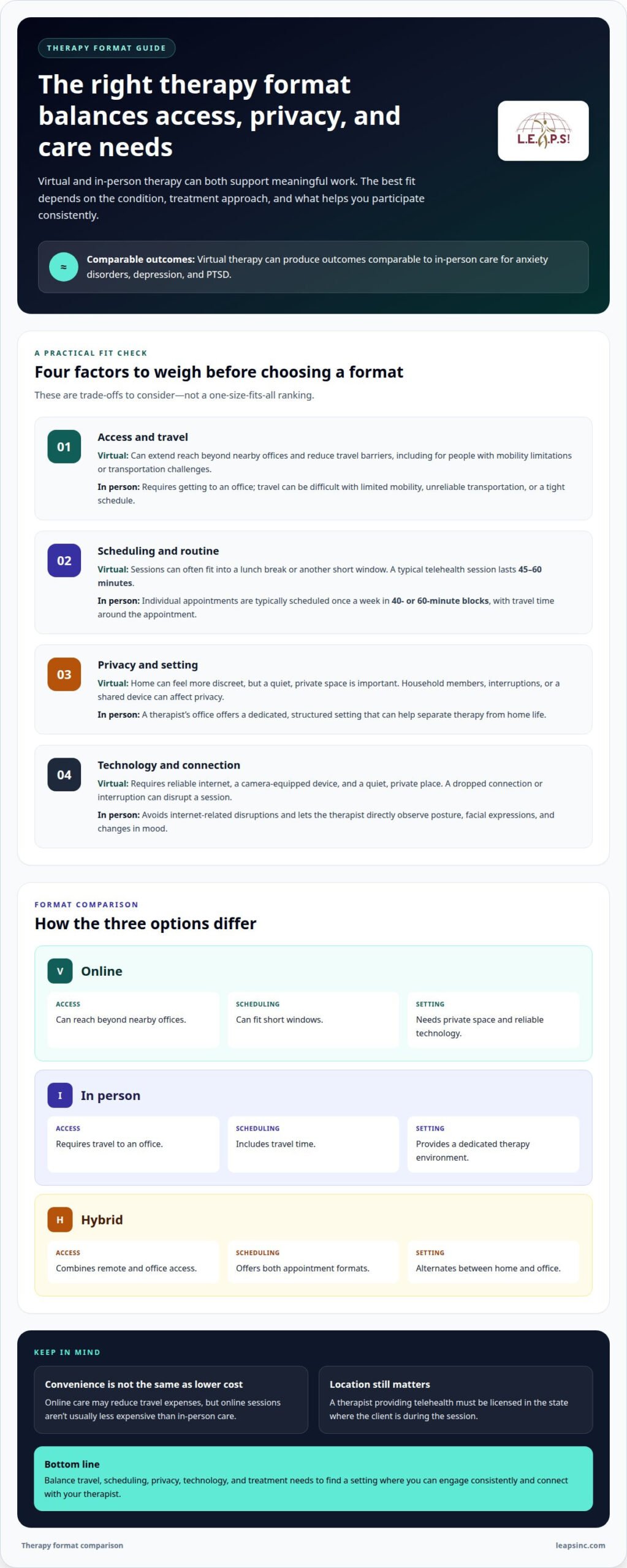
Online therapy can make access easier when travel, mobility, or distance complicates an in-person appointment. A person avoiding a 40-minute commute can use that time to prepare for a therapy session or return to work. Remote care can also reduce travel expenses, though online sessions aren’t usually less expensive than in-person care. The advantage is often logistical, not a lower session price.
For people in rural communities, video appointments can expand access to therapists who specialize in particular mental health concerns. Clients may have more options than the professionals within driving distance. Location still matters: a therapist providing telehealth must be licensed in the state where the client is during the session. Someone crossing state lines for work, for example, needs to be in a state where the therapist can provide care.
Scheduling can also be more adaptable. A typical telehealth session lasts 45-60 minutes, and online sessions can often fit into a lunch break or another short window. That may help someone whose work schedule, caregiving duties, or transportation options make an office visit difficult. Instead of adding travel time before and after an appointment, the person can join from a private location.
Comfort and concerns about stigma can also affect access. Someone worried about being recognized in a waiting room may prefer joining from home. For example, a person in a small community could avoid a public arrival at a local office. Home sessions can feel more discreet, but privacy depends on having a quiet space where household members can’t overhear.
Online care can also reduce physical access barriers for people with mobility limitations or transportation challenges. It requires reliable internet, a camera-equipped device, and a quiet, private place without interruptions. A dropped connection or someone entering the room can disrupt a session, so these practical conditions matter as much as convenience.
| Option | Access | Scheduling | Setting |
|---|---|---|---|
| Online | Can extend reach beyond nearby offices | Can fit short windows | Requires private space and reliable technology |
| In person | Requires travel to an office | Includes travel time | Uses a dedicated therapy setting |
| Hybrid | Combines remote and office access | Offers both appointment formats | Alternates between home and office |
Choose the format that best balances travel, privacy, scheduling, and access to a dependable place to talk.
What Is Traditional In-Person Therapy?
Traditional in-person therapy takes place with the therapist and client together in an office. Individual appointments are typically scheduled once a week in 40- or 60-minute blocks. That routine creates a defined time and place for reflection, without requiring the session to happen through a screen. For someone who finds it difficult to separate home life from emotional work, leaving home can mark a clear transition.
A therapist’s office can provide a structured, neutral environment. Household chores aren’t in view, and family members are less likely to enter unexpectedly. For example, a client sharing a small apartment may find it easier to discuss a sensitive issue in a private office. The setting can support focus as the therapist guides the conversation toward the client’s goals.
In-person sessions avoid interruptions caused by internet or other technology problems. A weak connection can freeze a video call just as someone begins discussing a difficult experience. In an office, there’s no need to restart a router, reposition a camera, or switch to a phone after a dropped call. Face-to-face contact also lets the therapist directly observe posture, facial expressions, and changes in mood.
Home may feel more comfortable, but privacy depends on who else is nearby. A roommate working in the next room, a child opening the door, or a partner overhearing through a thin wall can make honest conversation harder. A parked car may provide more separation, yet outside noise or an approaching passenger could interrupt. These examples show why a private setting matters when choosing online sessions.
Technology can raise other privacy concerns. A shared computer may display appointment reminders, saved passwords, or messages for other household members to see. Headphones can reduce what others hear, but they can’t prevent someone from entering the room. The U.S. Department of Health and Human Services says virtual therapy providers should have infrastructure for HIPAA compliance when offering communication options. A quiet room and careful device use also shape the experience.
In-person care has its own access barriers. Traveling to an office can be difficult for someone with limited mobility, unreliable transportation, or little time between commitments. An appointment may require arranging a ride or finding a private place away from home. When choosing a setting, weigh these logistics against the value of a neutral room, fewer technology disruptions, and direct observation.
If a dedicated office setting could help you speak more openly, schedule an appointment to explore your therapy needs.
Choosing a therapy format based on the condition and treatment type
The best format depends on the condition, therapeutic approach, and what helps someone participate consistently. Telehealth outcomes are generally described as comparable to in-person outcomes for anxiety disorders, depression, and PTSD. For these concerns, the relationship with the therapist, regular attendance, and an approach suited to the person all matter. The decision should focus on fit, not simply whether sessions happen on a screen.
Behavioral work can call for closer consideration of the setting. Exposure therapy, for example, may involve practicing in real-world situations, where face-to-face support can make the work easier to conduct. In-person contact also lets therapists directly observe posture, facial expressions, and changes in mood. These details can help clarify what someone is experiencing, particularly when nonverbal communication matters to the session.
Some situations call for more support than a remote format can provide. People with severe mental health conditions, including schizophrenia or intellectual disabilities, and people at higher risk of suicide need to be seen in person. A virtual appointment isn’t a substitute for urgent crisis support. The setting should allow for the level of observation and care the person’s condition requires.
Dropout rates and patient satisfaction don’t have one result that applies to everyone in either format. A strong therapeutic relationship, consistent attendance, and a suitable treatment approach are key factors associated with similar outcomes across formats. Someone who speaks openly by video may engage well remotely, while another person may feel more present in an office.
In the United States, insurance coverage for virtual therapy depends on the person’s plan and benefits. Out-of-pocket costs vary according to coverage details, such as deductibles and copays; no single amount applies to every plan.
For virtual care, the therapist must be licensed in the state where the client is during the session. A practical first step is to establish the client’s location for appointments, then confirm that the therapist’s license covers that state. Next, discuss whether the therapist’s approach fits the treatment need, such as anxiety-focused work or exposure practice.
A hybrid format can combine office appointments with remote check-ins, offering flexibility while preserving face-to-face contact. Consider whether the work depends on practicing outside sessions, reading nonverbal cues, or having a private setting at home. The question “is virtual therapy as effective as in-person” has no single answer for every treatment. Choose the format that supports the therapeutic approach, safety needs, and consistent participation.
Virtual therapy formats, including messaging, chat, phone, and video
Virtual therapy isn’t one uniform experience. A scheduled video appointment, phone conversation, live text chat, and written messaging each offer a different way to communicate. The best fit depends on whether you need real-time dialogue, visual contact, or time to write your thoughts. A parent arranging childcare, for example, may value avoiding travel and parking while still needing a private place to participate.
Video: A live video session lets clients and therapists see and hear each other. Facial expressions and gestures can contribute to communication, although nonverbal cues may be harder to perceive online than in person. A stable internet connection, working camera, and quiet space help clients stay present. Video is the closest virtual match to face-to-face conversation, but the screen still changes how people interact.
Phone: Phone sessions use voice rather than video. They may suit someone who can speak privately but lacks reliable video access or feels more comfortable without a camera. The therapist can hear tone and pauses but can’t see facial expressions or posture. For example, a client taking a session from a quiet parked car can avoid a crowded home, provided the setting remains private and uninterrupted.
Live chat: Chat allows people to exchange written messages in real time. It can help those who find spoken conversation difficult or prefer to read and compose their responses. However, typing can slow discussion, and short messages may leave nuance unclear. Someone who needs time to put feelings into words may find writing useful, while a person seeking rapid back-and-forth may prefer voice or video.
Asynchronous messaging: Written messages are sent and answered at different times, rather than during a shared appointment. This allows time to reflect before replying, but it isn’t the same as immediate conversation or continuous access to a therapist. Some online subscription services use weekly video calls as their core therapeutic service, with messaging as a separate communication feature. Don’t assume a message will receive an immediate response.
Privacy and platform practices matter across these options. The U.S. Department of Health and Human Services says virtual therapy providers should have infrastructure for HIPAA compliance when offering communication options. Someone using a shared phone, for instance, should consider whether message previews appear on the lock screen. Severe mental health needs may call for in-person care rather than relying on text exchanges alone.
- Choose video for face-to-face conversation when internet and privacy are reliable.
- Choose phone when voice feels comfortable but video isn’t practical.
- Choose chat or messaging when written communication better supports expression.
Choose a format that fits the interaction your care requires, not convenience alone.
Are virtual therapy outcomes different for children, teens, adults, or older adults?
Age alone doesn’t determine whether virtual or in-person therapy is the better fit. The format of the work, a person’s ability to participate, and the session environment all matter. For example, a child who needs hands-on activities may engage differently from an adult who prefers talking from home. Consider how each person communicates, concentrates, and uses support during sessions rather than assuming one format suits an entire age group.
For children, face-to-face sessions can make play-based activities and shared materials easier to use. Child therapy may also involve the child’s surroundings or interaction with a caregiver, which can be simpler to observe in person. Exposure therapy involving practice in real-world situations may also be easier to conduct face to face. A child who struggles to stay engaged on a screen may benefit from an office’s structure, while a child comfortable communicating by video may find remote sessions workable.
Teenagers may weigh privacy and comfort differently. A teen sharing a home could find it difficult to speak freely if family members are nearby, even during a video session. An in-person appointment may provide a separate setting; virtual care may be easier if the teen has a private room and feels comfortable speaking on camera. The practical question is whether the teen can participate openly and focus in the chosen environment.
For adults, the decision may depend on treatment needs and everyday circumstances. Someone working through anxiety may value the convenience of remote sessions, while a person whose therapeutic work involves real-world practice may prefer face-to-face support. Adults should also consider whether they can protect private time at home. A quiet room and uninterrupted session can make virtual participation more feasible.
Older adults can consider the same practical factors, including comfort with video calls, hearing or vision needs, and access to a suitable device. For example, an older person who finds screens tiring may prefer an office conversation. Another may find remote access easier than arranging transportation. These examples describe format considerations, not a rule that outcomes differ by age.
Across age groups, consistency and a strong therapeutic relationship support progress. A hybrid arrangement may suit someone who benefits from office visits but wants remote check-ins between them. Three questions can help guide the decision:
- Can the person communicate comfortably in this format?
- Does the treatment involve activities that are easier to do face to face?
- Is there a private, dependable setting for remote sessions?
Discussing these factors can help align the format with the person’s needs. Schedule an appointment to explore which therapy setting may support your next step.
LEAPS
LEAPS Inc. offers therapy for individuals, couples, and groups, with a Therapy Intensive for those seeking focused support. If you’re weighing virtual and in-person care, the next step is to consider what helps you participate openly, what your treatment needs involve, and which setting supports consistent engagement. These questions can help clarify the kind of therapeutic support that fits your circumstances and personal goals.
Therapy can provide space to explore challenges, strengthen communication, and work toward meaningful change. Whether you’re considering individual, couple, family, or group therapy, LEAPS Inc. offers support to begin that process with intention.
Contact LEAPS Inc. to discuss taking a next step toward therapy.
Choose the setting that supports your next step
Whether virtual therapy is as effective as in-person care is ultimately a personal question: the format should make it possible to engage meaningfully with the work ahead. Consider where you can speak openly, what kind of support you’re seeking, and which setting helps you return to the conversation consistently. The decision isn’t about choosing the most convenient option at any cost. It’s about creating conditions for honest reflection and purposeful progress.
LEAPS offers Individual Therapy, Therapy Intensive, and Couple Therapy to support different therapeutic needs. If you’re ready to explore what kind of care may fit your circumstances, contact LEAPS about therapy options. A thoughtful first conversation can help you identify a meaningful direction and take a considered step toward the future you want to build.
Frequently Asked Questions
What Is Online Therapy?
Online therapy is mental health care delivered remotely through tools such as video calls, phone sessions, live chat, or messaging. For example, a client might discuss stress by video during an appointment or use written messages to reflect between conversations. These formats differ in how quickly people interact and how much they can see or hear. The therapist and client decide how communication supports the therapeutic work.
What are the disadvantages of online counseling?
Online counseling can make body language harder to read, and internet problems may interrupt a conversation. A client using a shared home office, for example, might struggle to speak privately if a family member enters. Remote sessions also rely on suitable technology and a workable setting. Written messages may not convey tone clearly, while phone sessions remove visual cues. These constraints can affect how comfortably someone communicates.
Is virtual therapy as effective as in-person therapy for common mental health conditions?
Virtual therapy is generally described as producing outcomes comparable to in-person therapy for anxiety disorders, depression, and PTSD. The fit also depends on the treatment approach and whether the person can participate consistently. For instance, a client who speaks openly by video may engage well remotely, while someone who needs in-person observation may prefer an office. Consider the condition and therapeutic work together rather than assuming one format works for everyone.
What do clinical studies and meta-analyses say about teletherapy outcomes compared with face-to-face therapy?
Overall, teletherapy outcomes are described as comparable to face-to-face care for anxiety disorders, depression, and PTSD, but that finding shouldn’t be generalized to every condition or treatment. Outcomes also relate to the therapeutic relationship, consistent attendance, and an approach suited to the client. Comparing formats is most useful when you consider what treatment involves, rather than treating all therapy sessions as identical.
Which types of therapy and mental health conditions respond well to virtual therapy?
Virtual therapy is generally described as having comparable outcomes for anxiety disorders, depression, and PTSD. Video or phone conversations can support therapeutic work focused on discussing experiences, feelings, and goals. The fit may differ when treatment involves practicing skills in a specific environment. For example, exposure therapy may be easier face to face when practice takes place in real-world situations. The method and activities matter alongside the diagnosis.
What are the limitations and risks of virtual therapy compared with in-person care?
Remote sessions depend on technology, privacy, and communication through a screen or phone. A weak connection can disrupt an important conversation, and a shared device may expose notifications or messages to others. Therapists may also miss nonverbal cues that are easier to notice in person. These are practical limitations, not proof that virtual therapy can’t help; they matter most when they interfere with focused participation or appropriate care.
Who may benefit more from in-person therapy or need in-person care?
In-person care is needed for people with severe mental health conditions, including schizophrenia or intellectual disabilities, and for people at higher risk of suicide. Face-to-face sessions can also suit children when therapy involves play or exposure work in real-world settings. Someone who finds it difficult to communicate through a screen may benefit from meeting directly. The key question is whether the person’s safety, treatment activities, or communication needs call for in-person support.
What technology, privacy, and safety steps are needed for effective virtual therapy?
Use a device with a camera, reliable internet, and a quiet, private space where others can’t overhear. Headphones can make conversations less audible to people nearby; disabling message previews can help protect privacy on a shared phone. Set up the device before the appointment to reduce avoidable interruptions. LEAPS Inc. guidelines recommend ensuring secure connections to protect patient confidentiality throughout every session.