


Article by
Dr. John E. N. Daniel
Dr. John E. N. Daniel is a visionary with a burning desire to coach, counsel, teach and empower individuals from diverse backgrounds towards the attainment of their maximum potential, life purpose and destiny. He coaches, counsels, consults, mentors, and ministers to the global community through diverse media and environments.
Rebuilding connection after an affair begins with facing what happened, not rushing past it. Affair recovery counseling gives couples a structured space to acknowledge the betrayal, express its impact, and define what safety and trust would need to mean in their relationship.
It makes sense if closeness feels difficult or conversations quickly turn to anger, fear, or defensiveness. Therapy can help partners communicate more openly, work through hurt and resentment, and set boundaries that reflect their needs. The partner who broke trust can work on taking responsibility, while the hurt partner has room to express how the betrayal changed the relationship.
Recovery doesn’t follow a fixed script, and reconnecting doesn’t require pretending the past didn’t happen. This article explains what couples may work on in therapy, how new understandings and boundaries can shape the relationship, and when professional support may help partners decide how to move forward together.
Key Takeaways
- Therapy can create room to acknowledge the impact of betrayal, express difficult emotions, and begin rebuilding communication.
- Clear boundaries are more meaningful when they translate into consistent actions and help both partners understand what safety requires.
- New insights can guide how a couple approaches trust, intimacy, and the future of the relationship without rushing the healing process.
- When both partners feel hurt, a therapist can help each person’s experience be heard while supporting accountability and understanding.
- Couples who are willing to engage openly and work toward the relationship may find professional support useful as they consider their next steps.
Rekindling Connection: What does Affair Recovery look like in Therapy?
Therapy helps partners address infidelity directly, understand its impact, and consider what rebuilding connection requires. Sessions can provide a structured space for difficult conversations, accountability, and clearer relationship boundaries.
Processing Infidelity-Related Pain
A therapist can help partners name the specific harms connected to infidelity rather than reducing the experience to a single argument. One partner may describe humiliation or fear; the other may need to acknowledge the choices that caused that pain. Ask how sessions make room for both perspectives while keeping responsibility clear. Questions about confidentiality and the therapist’s experience with couples can also clarify what to expect.
Emotional Effects of Infidelity
The betrayed partner may feel insecure, ashamed, embarrassed, stressed, anxious about intimacy, or angry. These reactions can affect ordinary moments, such as a delayed reply or a change in routine. Therapy can help partners identify what triggers distress and talk about it without dismissing or escalating the concern. A couples therapist should be able to explain their professional credentials and experience addressing infidelity in relationships.
Addressing Broken Trust and Relapse Fears
Rebuilding trust involves more than a promise. Partners need to discuss boundaries, transparency, and actions that support a sense of safety. Therapy can help the partner who broke trust take responsibility, while the hurt partner explains what would help them feel more secure. Concerns about repeat infidelity can be addressed through ongoing conversations and agreed expectations.
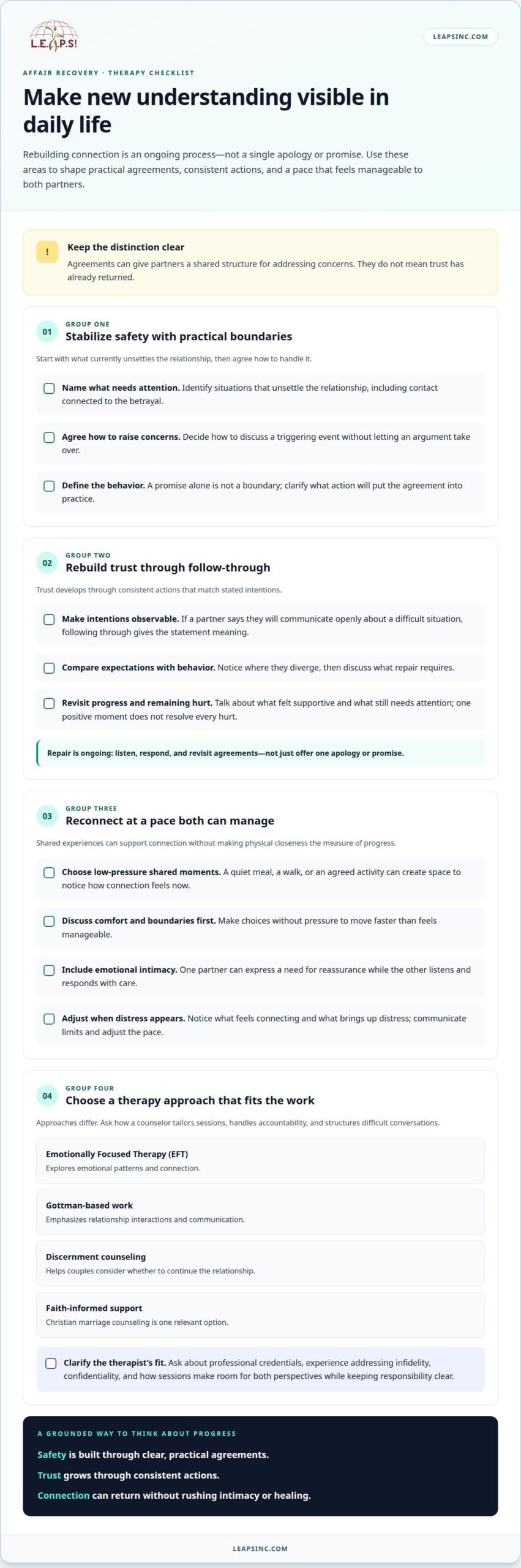
Approaches differ: Emotionally Focused Therapy (EFT) explores emotional patterns and connection; Gottman-based work emphasizes relationship interactions and communication; discernment counseling helps couples consider whether to continue the relationship. Ask a counselor how they tailor their approach, handle accountability, and structure conversations. For faith-informed support, Christian marriage counseling is one relevant option.
Insurance coverage depends on plan benefits and how couples sessions are billed. In the United States, counseling fees depend on factors such as session format and the couple’s needs; the fee is provided after a quote request.
Restoring Intimacy and Connection
Emotional and physical intimacy can return at a pace both partners can manage. Moving too quickly may intensify distress, so therapy can help couples discuss comfort, consent, and boundaries before making changes. A therapist may guide structured conversations about concerns and positive needs, such as asking for reassurance rather than only demanding that a behavior stop. Specific, repeatable actions can help partners build connection.
Rebuilding and integrating new understandings into a relationship
After an affair, rebuilding involves more than discussing what happened. Couples can translate new understandings into boundaries, daily behavior, and shared choices that support a safer relationship moving forward.
Stabilization and Marital Safety
Stabilization begins with identifying what currently unsettles the relationship and agreeing on practical steps. For example, partners might decide how to handle contact connected to the betrayal or how to raise a concern without letting an argument take over. A promise alone doesn’t establish a boundary; the couple needs to define the behavior that will put the agreement into practice.
Therapy can help clarify which boundaries matter now and how each partner will recognize them in practice. One partner may need a clear plan for discussing a triggering event, while the other needs to respond without minimizing its impact. These agreements don’t mean trust has returned. They give partners a shared structure for addressing concerns as they arise.
Rebuilding Trust
Trust develops through consistent actions that match stated intentions. If a partner says they will communicate openly about a difficult situation, following through gives that statement meaning. Therapy can help couples identify where behavior and expectations diverge, then discuss what repair requires. The focus is not on declaring the relationship “normal” again, but on creating more reliable patterns.
Structured conversations can help partners address concerns and notice progress without treating one positive moment as proof that every hurt is resolved. For instance, they can discuss what felt supportive during a difficult week and what still needs attention. Rebuilding is an ongoing process of listening, responding, and revisiting agreements, not a single apology or promise.
Rebuilding Intimacy and Shared Experiences
Shared experiences can help couples reconnect without making physical closeness the measure of progress. A quiet meal, a walk, or an agreed activity can offer space to notice how connection feels now. Partners can discuss comfort and boundaries before choosing what to try, allowing each person to participate without pressure to move faster than feels manageable.
Intimacy can involve emotional openness as well as physical connection. One partner might express a need for reassurance, while the other listens and responds with care. Therapy can help couples notice when an interaction feels connecting and when it brings up distress. This awareness makes it easier to adjust the pace, communicate limits, and build shared moments that feel mutual.
Integrating New Understandings
New understanding becomes useful when it changes how partners respond to familiar situations. If a disagreement once led to silence, the couple might agree to return to the conversation after taking space. If one partner’s behavior caused harm, applying that insight means acknowledging its impact and making different choices. Therapy can help turn reflection into specific agreements.
Partners may also discover that the relationship needs have changed. One may want more direct communication; the other may need clearer ways to discuss concerns. These differences can be explored without assuming that one person’s account erases the other’s. For couples ready to work through these patterns with professional support, schedule a therapy appointment as a next step.
Defining an affair and relationship boundaries
Partners may define “affair” differently, so therapy can help them describe the specific behavior that damaged trust. One person may identify sexual contact as betrayal, while another may also include secret messages or emotional intimacy. Rather than impose a single definition, partners can discuss what happened, what agreements existed, and which actions crossed them.
Boundaries make those understandings practical. A couple might discuss contact with someone involved, private messaging, or what information each partner needs to feel informed. A boundary should describe an action, not only a hope: “We will discuss contact that affects our relationship” is clearer than “Be more trustworthy.” A therapist can help partners express their needs and consider whether each agreement is workable.
After discovery, decisions about the relationship can feel urgent. Therapy can help partners separate immediate questions from longer-term choices, such as whether to stay together, what repair would involve, and what each person needs before deciding. One useful step is to identify the next decision rather than demand a final answer during a painful conversation. The partner who broke trust needs to acknowledge the impact of their actions.
Communication habits also affect whether new agreements hold. Partners can set a regular time to discuss concerns and progress instead of revisiting difficult topics only during conflict. One person might state a need directly, such as asking for a calm discussion after a triggering event. The other can reflect what they heard before responding, helping both people focus on meaning and impact.
Relationship history can provide context without excusing infidelity. A therapist may explore how the couple handled conflict before discovery, whether concerns were discussed openly, and which patterns now need to change. For example, if one person withdrew during disagreements, therapy can examine how that affected communication. Context helps partners understand the relationship’s development; responsibility for the affair remains with the person who chose it.
Rebuilding trust requires actions that match the boundaries partners set. If an agreement concerns openness about contact, the couple can discuss what openness means in practice and how to address a lapse. A promise alone doesn’t establish safety. Consistent behavior and honest conversations give partners something concrete to consider as they work through pain and think about their future.
Not every couple will make the same decision. Some may choose to rebuild, while others may need time to understand what staying together would involve. Therapy can help each person clarify their needs, limits, and hopes without treating forgiveness as an obligation or reconciliation as the only valid outcome. The goal is a considered decision based on what both people are willing to do next.
Healing when both partners have experienced betrayal
When both partners feel hurt, therapy can make room for each person’s experience without treating the harms as identical. The therapist can pace conversations so both feel heard while keeping accountability for infidelity clear.
Support for the Hurt Partner
The hurt partner may need space to describe the betrayal’s impact without pressure to forgive or move forward prematurely. A therapist can help identify what feels most painful, such as secrecy, a broken agreement, or fear about the relationship’s future. These details give the couple a clearer starting point for discussion.
Infidelity is not the betrayed partner’s fault. Therapy can help separate responsibility for the affair from the couple’s broader relationship history. For example, both partners may explore communication difficulties while recognizing that relationship challenges do not make one partner responsible for the other’s choice to betray trust.
Support for the Unfaithful Partner
The partner who had the affair may experience guilt, unease, or shame. Those feelings can be acknowledged, but they don’t replace understanding the impact on their partner. A therapist can guide this person to listen, take responsibility for their choices, and respond to the hurt they caused instead of focusing only on feeling bad.
This work can involve specific conversations. If the hurt partner describes feeling excluded by secret communication, the unfaithful partner can reflect what they heard and recognize why it mattered. The focus is not on defending the action or demanding immediate trust. It is on showing accountability through honest engagement and behavior that aligns with agreed boundaries.
Support for the Involved Partner
If the partner who had the affair also feels betrayed or wounded in the relationship, therapy can make room for those feelings without using them to excuse the affair. The therapist can distinguish that person’s pain from their responsibility for their own actions. This allows both experiences to be examined while staying clear about what happened.
Sessions may include the couple together and each partner individually. A joint conversation can help partners hear one another’s perspectives; an individual session can provide space to explore personal reactions. The therapist can work at a pace that helps both people participate, rather than allowing one person’s distress to silence the other.
Healing can require attention to more than one kind of pain, but that doesn’t mean every hurt carries the same responsibility. A therapist can help partners identify what each needs to feel heard, what accountability looks like, and whether they’re willing to work toward connection. If the affair behavior is continuing, recovery work needs to address it directly. Progress comes through honest reflection and meaningful actions, not simply reaching one shared explanation.
Couples who may benefit from affair recovery
A relationship can recover from infidelity, and less than a third of couples split up after an affair. The path depends on whether the affair behavior has stopped, the unfaithful partner takes responsibility, and both people are willing to engage openly.
Couples who are committed to their relationship and approach therapy with an open mind may be suited to recovery work. Commitment doesn’t mean agreeing about every detail or deciding immediately to stay married. It means being willing to examine what happened, listen to each other, and consider what rebuilding would involve. For example, one partner may want to continue the marriage while the other needs time to decide.
The betrayed partner’s needs deserve attention, but they are not responsible for the affair. The partner who broke trust needs to acknowledge how their actions affected the relationship, rather than focusing only on guilt or shame. A therapist can help keep these responsibilities distinct. Both partners can then discuss what they expect from therapy, such as honest conversation, clearer boundaries, or support in deciding what comes next.
Couples may also benefit when they can make room for painful feelings without demanding a quick return to intimacy. Anger may rise during healing; that doesn’t automatically mean therapy has failed. A structured conversation can help partners identify what triggered the feeling, what needs acknowledgment, and what response would help. This gives the couple a specific issue to work through instead of turning distress into a verdict on the marriage.
Couples therapy is not recommended as a starting point when severe physical or emotional abuse or active drug or alcohol addiction remains unresolved. It may be helpful to address these concerns before beginning affair recovery work. Continuing affair behavior also needs direct attention, because recovery work requires that it stop. A therapist can help establish whether the couple is ready to focus on betrayal and relationship repair.
Another useful sign of readiness is being able to discuss uncertainty without forcing an immediate decision. One partner may be unsure whether they can trust again; the other may want to repair the marriage. Therapy can help each person state their position clearly, hear the other’s perspective, and identify a next step. That may mean working toward reconnection or clarifying whether continuing together is right.
When both partners are prepared to engage, schedule a therapy appointment to begin exploring their needs, boundaries, and direction. The goal is not to guarantee reconciliation. It is to help each person face the reality of the betrayal and make a thoughtful decision about moving forward.
LEAPS
LEAPS offers therapy options for people working through betrayal and considering what comes next. Couple Therapy can give partners a setting to discuss their relationship, clarify their needs, and explore whether rebuilding together is their goal. Individual Therapy can offer space to examine personal feelings and decisions alongside that work. A Therapy Intensive or Group Therapy may also be relevant depending on the support a person is seeking.
Consider professional support when conversations feel stuck, trust remains difficult to address, or either partner needs help clarifying a next step. Therapy can focus on understanding the impact of infidelity and identifying a considered direction, without assuming reconciliation is the only outcome.
To discuss your next step, contact LEAPS.
Choose the Next Step With Intention
The next step doesn’t need to settle your relationship’s entire future. It can begin with identifying what you want professional support to help you understand, express, or decide. You might be ready to talk together, or you may first need space to clarify your own needs. Naming that starting point can make the first conversation more focused.
Affair recovery counseling can support this process by giving difficult questions a deliberate place in the conversation. You can bring uncertainty, conflicting hopes, or concerns about what change would require. The aim isn’t to arrive with every answer, but to engage honestly and consider what a meaningful next step looks like for you.
If you’re ready to explore that step, contact LEAPS to discuss counseling. A thoughtful beginning can help you move toward greater clarity, one decision at a time.
Frequently Asked Questions
Does infidelity pain ever go away?
Pain after infidelity can become less consuming, though reminders may still bring up difficult feelings. Healing doesn’t require forgetting what happened or excusing it. A date, place, or change in routine may stir old distress even after a couple has made progress. Support can help you understand those reactions, respond with care, and decide what role the experience will have in your life going forward.
How can affair recovery counseling help you manage obsessive thoughts about infidelity?
Affair recovery counseling can help you explore recurring thoughts and the feelings or situations connected to them. In therapy, you can notice what prompts a cycle, such as unanswered questions or a partner arriving home late, and identify what needs attention. A therapist can support clearer conversations and help distinguish a present concern from a painful reminder. The aim is to understand the thoughts, not shame yourself for having them.
How long does infidelity trauma last?
There’s no single timeline for distress after infidelity. Its duration can depend on the betrayal’s impact, whether the behavior has stopped, how much support is available, and how partners respond to concerns. A person may feel steadier in some parts of life while still struggling with reminders. If distress continues to interfere with daily routines or relationships, individual therapy can offer space to explore its effects and consider supportive next steps.
How long does it take to get past infidelity?
Getting past infidelity isn’t a fixed-duration process, and partners may define “past it” differently. One person might mean fewer arguments; another might mean feeling able to make plans together. Progress can depend on whether both partners participate, communicate honestly, and follow through on changes. Rather than relying on a deadline, couples can discuss what has shifted, what remains difficult, and which next decision would help them move forward.
Recovery and Healing Broken Trust?
Healing broken trust involves noticing whether everyday actions become more dependable over time. For example, partners might agree to revisit a difficult topic at a planned time, then follow through on that conversation. A missed agreement can be discussed as a sign of what needs attention, rather than ignored or treated as proof that repair is impossible. These observations help each person assess whether the relationship is moving toward the connection they want.
What Defines an Affair?
An affair is understood in relation to the agreements and expectations within a particular relationship. One couple may view secret romantic messages as a breach, while another may define betrayal differently. The label alone doesn’t explain the harm. Partners can clarify what happened, which shared expectations were involved, and what each person considers a violation. That discussion helps make the meaning of the breach clearer without assuming every couple uses the same definition.
What type of therapy is best for infidelity?
The most suitable approach depends on what the couple needs help with. Emotionally Focused Therapy focuses on emotional patterns and connection; Gottman-based work addresses relationship interactions and communication; discernment counseling supports couples who are uncertain about continuing together. A therapist can explain how an approach would address your goals and adapt conversations to the issues you bring. Ask about their experience with relationship betrayal and how progress will be discussed.
Where Can I Learn More About Affair Recovery?
A qualified therapist can offer personalized support for relationship concerns and the emotional effects of betrayal. LEAPS provides Individual Therapy and Couple Therapy for emotional well-being and relationship concerns. Individual support may suit someone seeking space to clarify personal needs; couples work may help partners address shared relationship questions. Learning more can begin by identifying what you want help understanding, then discussing that goal with a professional.