


Article by
Dr. John E. N. Daniel
Dr. John E. N. Daniel is a visionary with a burning desire to coach, counsel, teach and empower individuals from diverse backgrounds towards the attainment of their maximum potential, life purpose and destiny. He coaches, counsels, consults, mentors, and ministers to the global community through diverse media and environments.
Feedback should change what happens next, not diminish the person receiving it. To learn how to give constructive feedback to employees, describe a specific behavior, explain its impact, and agree on a clear next step. Keep the conversation focused on work and growth rather than personal judgment.
It’s understandable to want to balance honesty with encouragement. But praise shouldn’t disguise a difficult message, and criticism alone rarely gives an employee a path forward. Constructive feedback is clear, respectful, and grounded in the belief that people can develop.
This article explains what constructive feedback is and how to make it actionable, from choosing the right moment to inviting an employee’s perspective. You’ll also learn how to recognize strong work, avoid common mistakes, and connect feedback to professional development so employees can turn insight into progress.
Key Takeaways
- Describe observable behavior, explain its impact, and agree on a practical next step.
- Use a live conversation for nuanced feedback with remote and hybrid employees, then make expectations and follow-through clear.
- Address the behavior rather than the employee’s character, and avoid letting frustration accumulate before speaking up.
- Balance recognition with candid guidance, while giving employees space to share their perspective and contribute solutions.
- Connect feedback to future skills and responsibilities; when additional support is needed, LEAPS offers an Employee Assistant Program (EAP).
What is Constructive Feedback?
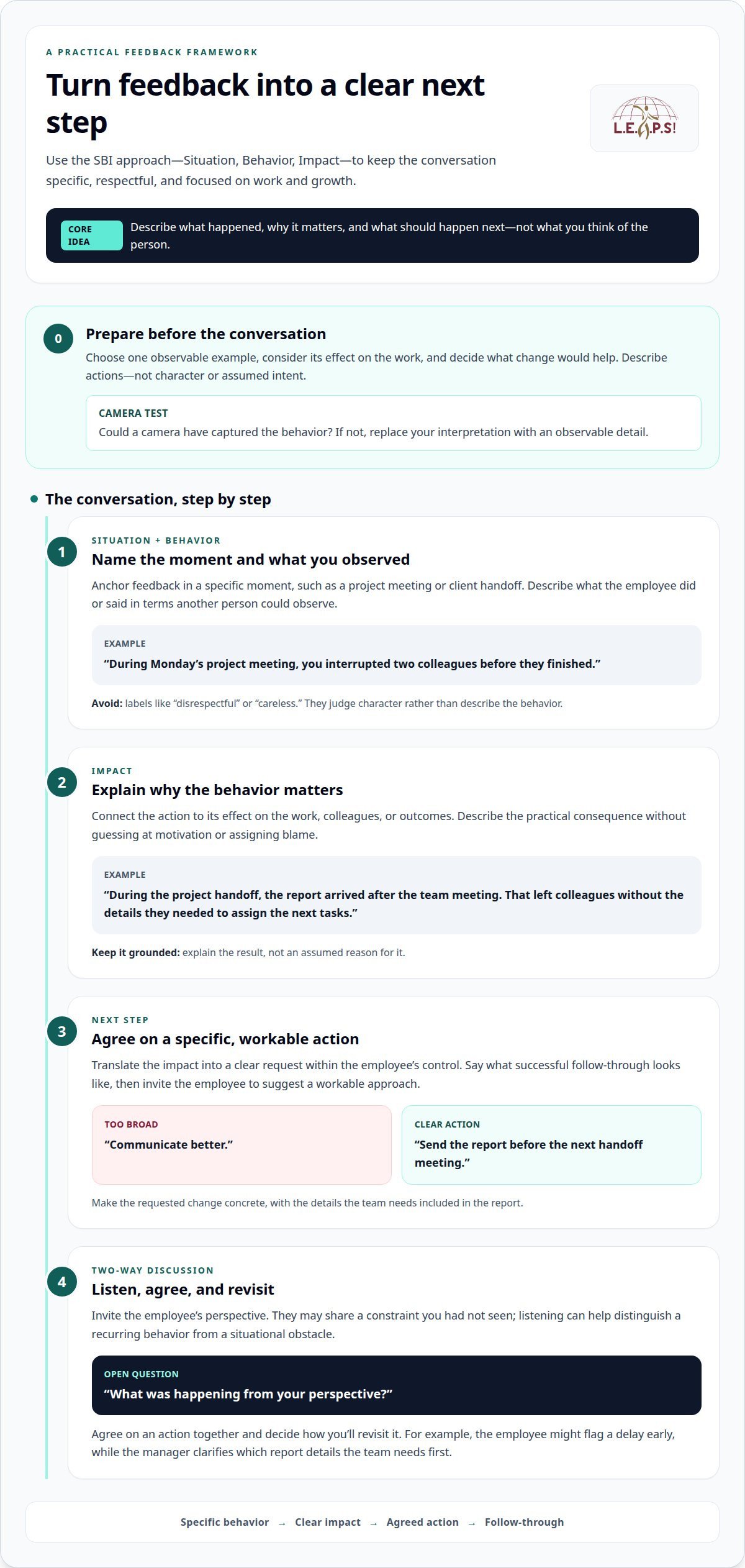
Constructive feedback identifies a work behavior, explains its impact, and points toward a useful next step. Managers can use the SBI model, Situation-Behavior-Impact, to keep feedback specific and focused on development.
Prepare by choosing one observable example, considering its effect on the work, and deciding what change would help. Make sure your wording describes actions, not character or assumed intent. This preparation gives the conversation direction without scripting the employee’s response.
Describe the Situation and Observable Behavior
Anchor your feedback in a specific moment, such as a project meeting or client handoff. Describe what the employee did or said, using details another person could observe. For example, “During Monday’s project meeting, you interrupted two colleagues before they finished.” Avoid labels like “disrespectful” or “careless”; they judge character and make the behavior harder to discuss.
Test your wording with a camera question: could a camera have captured the behavior? If not, replace interpretation with an observable detail. “You missed four team collaboration sessions during the last project” gives the employee something concrete to recognize and discuss.
Explain the Behavior’s Impact
Connect the behavior to its effect on work, colleagues, or outcomes. In SBI, the situation identifies when it happened, behavior describes the action, and impact explains why it matters. For example: “During the project handoff, the report arrived after the team meeting. That left colleagues without the details they needed to assign the next tasks.”
Describe the result without guessing at motivation or assigning blame. Avoid saying, “You don’t care about deadlines.” Instead, explain the practical consequence and invite the employee to add context. An impact statement makes the concern meaningful while keeping the discussion focused on a behavior that can change.
- Translate the impact into a clear next step. If a late report delayed task assignments, agree that the employee will send it before the next handoff meeting. Explain what successful follow-through looks like, such as including the current status and outstanding decisions. The question of how to give constructive feedback to employees becomes easier to answer when the requested action is clear and within the employee’s control.
Avoid broad instructions like “communicate better.” Identify the specific behavior that would improve the outcome, then invite the employee to suggest a workable approach. A clear request sets direction without dictating every detail of how the employee completes the work.
- Make the conversation two-way. After describing the situation, behavior, and impact, ask an open question such as, “What was happening from your perspective?” The employee may explain a constraint you hadn’t seen. Listening helps managers distinguish a recurring behavior from a situational obstacle.
Agree on an action together, then decide how you’ll revisit it. For example, the employee might flag a delay early, while the manager clarifies which report details the team needs first. This makes feedback a focused conversation about progress, not a one-sided verdict.
Giving feedback to remote and hybrid employees
Choose the channel and wording deliberately so distance doesn’t blur the message. Managers can make feedback specific, actionable, and balanced by naming the concern directly, explaining the expected change, and recognizing relevant strengths separately.
Useful phrases include, “In yesterday’s handoff, the update arrived after the team meeting. Please send it beforehand next time so colleagues can prepare.” For positive feedback, try, “Your project summary clarified the decision and helped the team move forward.”
Adapt Feedback for Remote and Hybrid Employees
Move nuanced developmental feedback from text into a live conversation, using video or phone when you can’t meet in person. A short message can invite someone to talk: “Would you have 10 minutes to discuss the client handoff?” Avoid delivering sensitive criticism through chat, where tone and context are easy to misread.
Keep remote check-ins regular so a performance conversation doesn’t feel alarming. If a written follow-up would help, use bullet points to record decisions, deadlines, and agreed actions. This gives the employee a clear reference without making a complex issue depend on a string of messages.
Make Feedback Specific and Actionable
State the issue, the needed change, and the next action. For example: “The weekly status email didn’t include the launch risks. Add risks and owners to Friday’s update so the project team can respond.” That makes the action and its purpose clear, unlike “Be more thorough.”
Check that the request describes an action the employee can take. Agree on what follow-through looks like, such as including a decision and deadline in the next project summary. Then revisit that expectation at your next check-in instead of leaving the employee to guess whether the change helped.
Deliver Negative Feedback Directly
Name the concern at the start of the conversation. For example: “I want to discuss the missed client deadline and how we can prevent another delay.” Don’t cushion the message with unrelated praise first; the employee may miss the point or mistake the conversation for a compliment sandwich.
Keep your tone respectful and your request clear. Explain the impact on the work, then ask what obstacles affected the deadline. If the employee describes a scheduling conflict, discuss a practical way to flag risks earlier. Direct language addresses the issue without turning feedback into a personal attack.
Use Constructive Feedback Phrases
Choose language that is direct about the work and open to discussion. Try, “I recommend adding the key decision to the meeting notes so absent teammates can follow the plan.” Or say, “I noticed the draft arrived after review began. What would help you share it before the next review?”
Use “I recommend” or “I noticed” to keep the focus on your observation, not a character judgment. Invite the employee to explain their perspective, then agree on an action. When written follow-up helps, list the decision and deadline separately so both are easy to find.
If workplace communication concerns are affecting employee well-being beyond a feedback conversation, schedule an appointment to discuss support options.
Avoiding common feedback mistakes
Effective feedback addresses a specific behavior promptly, explains its effect, and agrees on a useful change. In a private meeting, invite the employee’s perspective and keep the discussion focused on learning rather than blame.
- Replace blurry words with examples. Terms such as “careless,” “unprofessional,” or “not committed” leave employees guessing about expectations. Describe what happened instead: “The client summary missed the revised delivery date and owner.” This gives the employee a clear issue to discuss without making a judgment about personality.
Before a meeting, look for words like “always,” “never,” and “poor attitude.” Replace each with an observable example, such as a missed handoff or an unanswered project question. If you can’t identify a specific instance, gather clearer observations before making a broad claim.
- Address the issue before frustration builds. When a manager delays feedback, a later conversation can become an inventory of old grievances. Focus instead on the clearest current pattern. For example, discuss the latest missed deadline and its effect on the team, rather than listing every late task from the quarter.
Keep the discussion tied to expectations that were communicated. If a report lacked required information, identify the missing section and clarify what the next report should include. This turns a general complaint into a practical learning opportunity.
- Separate impact from assumed intent. Saying, “You ignored my request,” assumes what the employee was thinking. Describe the observable sequence instead: “I sent the revised agenda before the meeting, but the earlier version was shared with the group.” Then explain the consequence, such as confusion about which decisions were current.
Ask what happened before deciding how to respond. The employee may explain that they used a saved file or missed the message. Context doesn’t erase the impact, but it helps managers choose an effective next step.
- Don’t use authority to shut down discussion. A command like “Just do it my way” may end the conversation without clarifying the problem. Explain the work requirement, then ask, “What would help you meet this expectation in the next review?” This invites the employee to contribute to a solution.
If the employee becomes defensive, acknowledge their reaction and ask what feels inaccurate. For example, “I can see this is frustrating. Which part of my example doesn’t match your experience?” Listen before restating the expectation or agreeing on an action.
- Pair a concern with support and follow-through. Criticism that identifies a weakness but offers no path to improvement leaves the employee without direction. If a presentation missed key decisions, suggest a summary of decisions and owners, then clarify when it should be ready for the next meeting.
After the conversation, record the behavior discussed, the agreed action, and the follow-up point. A structured note helps managers track whether the issue recurs and recognize progress. Keep the record factual, using examples instead of labels or emotional conclusions.
Balancing positive and negative feedback
In a one-on-one, share one clear concern and its impact on the work, then invite the employee’s perspective. Encourage action by asking what support or next step would help them apply the feedback.
Start with an Ask
Open with a question that lets the employee share their view before hearing yours. For example, ask, “How did the client handoff feel from your perspective?” Listen for context, not just agreement. This helps you understand what the employee noticed and intended.
Then explain why you want to discuss the issue: you believe the employee can grow and want them to succeed. Avoid questions that disguise accusations, such as, “Why did you let the handoff fail?” A neutral opening creates space for a candid exchange.
Balance Candor with Support
State the concern plainly, then connect it to a practical change and the employee’s ability to make that change. For example: “The client update went out without the revised timeline. Please include the latest date next time so the client can plan accurately. I can clarify which milestones need to appear.” This pairs a direct expectation with useful support.
Recognize positive work specifically instead of adding praise to soften criticism. You might say, “Your clear meeting notes helped the team track decisions,” in a separate moment. Praise the behaviors you want repeated; don’t use a compliment as an introduction that obscures the purpose of the conversation.
Tell and Ask in a One-on-One
After hearing the employee’s view, share what you observed and why it matters. Then ask an open question, such as, “What would help you send the revised timeline before the next client update?” This ask-tell-ask sequence invites dialogue while keeping the key points direct and tied to a work outcome.
Give the employee time to respond, especially if the feedback is difficult to hear. If they become defensive, acknowledge their reaction and ask what feels inaccurate. Don’t rush to rebut them; their response may reveal context that changes the next step without erasing the impact.
- Agree on an action the employee can own, then make follow-through visible. For example, decide that the next client update will include the current timeline and milestone owners. Ask the employee to describe their plan in their own words. This confirms shared understanding rather than treating silence as agreement.
Close by deciding how you’ll revisit the action, such as reviewing the next update together. If the employee meets the expectation, recognize that specific behavior. If the issue remains, discuss what got in the way and adjust the support or plan. A balanced conversation pairs candor with an achievable path forward.
Professional development feedback
Use feedback to help employees develop capabilities they can apply in future responsibilities. Connect observed performance to a growth goal, a practical opportunity, and clear follow-up.
- Give feedback close to the work, while its details are fresh. After a project concludes, discuss one effective contribution and one opportunity to improve before the team moves on. Don’t save useful guidance for an annual review; timely conversations help employees connect advice with the decisions they made.
Choose a calm moment, not the peak of frustration. For example, after a client presentation, recognize how the employee handled questions, then discuss one answer that needed clearer evidence. This supports accuracy and gives the employee a concrete learning point.
- Tell the employee why you’re raising the topic. Say, “I’m sharing this because I believe you can strengthen your client presentations, and I want to support that progress.” Naming your intent clarifies the conversation and frames development as a shared investment, not a surprise judgment.
Be direct about the growth area. If a project update omitted risks, explain how that limited planning, then suggest adding risks and owners to future updates. Avoid broad phrases like “be more strategic”; specify the skill and the behavior that demonstrates it.
- Invite the employee to help shape the solution. Ask, “What could make your next update more useful for the decision-makers?” An open-ended question can surface context and encourage the employee to propose an approach they can sustain.
Agree on an action together. For example, the employee might add a brief risk summary to the next update, while the manager clarifies which decisions need attention. This turns feedback into a development plan with clear responsibilities, rather than advice that remains abstract.
- Connect demonstrated strengths to a stretch assignment or future responsibility. An employee who explains complex project choices clearly might lead a planning discussion or present recommendations to a broader group. Match the opportunity to a skill already demonstrated, then identify what new capability the assignment should develop.
Set a meaningful measure of progress, such as whether the employee can explain the recommendation and its supporting evidence. Discuss the result after the assignment. This makes growth visible without treating a single outcome as a complete judgment of the employee’s potential.
- Build regular feedback into the organization’s culture instead of limiting it to formal reviews. After each major project, ask what should continue, change, or be learned. Recognize positive behaviors when employees demonstrate them, and offer developmental guidance while the work is still relevant.
Use follow-up to reinforce progress. If an employee includes stronger evidence in a later recommendation, name that improvement and connect it to the earlier goal. Consistent conversations help employees understand how current skills can support future contributions.
For support in aligning employee growth with broader business goals, schedule an appointment.
LEAPS: Employee Assistant Program (EAP)
An employee assistance program may be an option when workplace concerns call for support beyond a manager’s role. A manager can clarify performance expectations, agree on development steps, and recognize when broader well-being concerns may benefit from additional support.
Consider this option when ongoing strain affects an employee’s ability to engage with work, or when conversations reveal concerns that performance coaching alone can’t address. The EAP complements clear, respectful feedback; it doesn’t replace the manager’s responsibility to communicate expectations and follow up on work.
For a conversation about support, contact LEAPS.
Turn Feedback Into a Culture of Growth
Each feedback conversation can shape what your team believes is possible. Learning how to give constructive feedback to employees is not only a management skill; practiced with care, it helps make development an ongoing part of how people work together. The next step is to create space for employees to act, reflect, and build confidence through experience.
Some concerns also extend beyond workplace expectations. When employees need additional support, LEAPS offers Therapy Intensive, Group Therapy, and Family Therapy. These services can complement workplace feedback when personal or relationship challenges affect an employee’s well-being. They don’t replace clear expectations or thoughtful leadership; they offer another path to support and growth.
Whether you’re seeking guidance for your organization or considering support for yourself, take a deliberate next step. Contact LEAPS to discuss support and explore a path forward with clarity and purpose.
Frequently Asked Questions
How do I give negative feedback without hurting morale?
Be candid about the work issue while showing confidence in the employee’s capacity to respond. For example, if a presentation missed key client questions, explain what was absent and offer a chance to prepare answers for the next meeting. Recognize effective contributions at other times, not as a cushion before difficult feedback. Consistent, fair conversations help employees see correction as part of development, not rejection.
How do you give feedback to someone who gets defensive?
Pause, acknowledge their reaction, and ask what feels inaccurate or incomplete. For example: “I hear that you disagree with my account of the handoff. What should I understand about what happened?” Listen without interrupting, then separate disputed details from the expectation that still needs attention. If emotions remain high, agree to resume the discussion later rather than letting it become an argument.
What Is Effective Feedback?
Effective feedback helps someone understand what to continue or change and why it matters. It should come soon enough to connect with the work, be clear enough to guide action, and allow for relevant context from the employee. For example, after a client presentation, a manager might identify a strong explanation and suggest preparing evidence for a question that went unanswered. A follow-up conversation can assess progress.
Why should feedback include an impact statement?
An impact statement explains why a behavior matters to the work, helping the employee prioritize a change. For example, explain that an incomplete handoff delayed a colleague’s preparation for a client call. Avoid claiming the employee intended to cause the delay. Focus on the consequence and its practical relevance to give both people a shared basis for discussing what should happen next.
What is the SBI model for employee feedback?
The SBI model means Situation, Behavior, and Impact. Identify the context, describe the action, then explain its effect. For example: “During Tuesday’s planning meeting, you shared the revised schedule after decisions were made. The team had to revisit assignments.” This sequence distinguishes an observed event from an interpretation. Managers can then ask for the employee’s perspective and discuss a useful response.
How often should managers give employees feedback?
Give feedback regularly and close to the work it concerns, rather than saving every observation for a formal review. A brief conversation after a customer interaction can address an immediate learning opportunity; a project debrief can capture broader lessons while the process is still familiar. The rhythm depends on the work and the employee’s needs. Frequent, purposeful dialogue keeps expectations from becoming surprises.
What are common mistakes to avoid when giving employee feedback?
Avoid personality labels, vague judgments, public criticism, and long-delayed lists of grievances. “You’re unreliable” offers no clear path forward; describing a missed handoff and its consequence gives the employee something concrete to address. Don’t use praise to conceal a concern or assume you know someone’s intent. Focus on relevant examples, listen to context, and make the requested change clear.
How should managers give feedback about performance problems or misconduct?
Address performance concerns promptly and privately, using factual examples and clearly stated work expectations. For suspected misconduct, avoid speculation or informal accusations; document what you observed and follow the organization’s established reporting and employee-relations processes. Keep the conversation respectful and limit discussion to people with a relevant role. If immediate safety concerns arise, use the organization’s appropriate response procedures.