

Article by
Dr. John E. N. Daniel
Dr. John E. N. Daniel is a visionary with a burning desire to coach, counsel, teach and empower individuals from diverse backgrounds towards the attainment of their maximum potential, life purpose and destiny. He coaches, counsels, consults, mentors, and ministers to the global community through diverse media and environments.
Strong collaboration depends on more than putting capable people on the same team. The practical answer to how to improve team collaboration is to clarify communication, responsibilities, and expectations, then keep developing how people work together.
When teamwork feels difficult, it’s understandable to focus first on meetings or tools. But collaboration also depends on whether people can share concerns, understand one another’s strengths, and contribute to a common purpose. Clear communication helps create the conditions for those things to happen.
This article explains what team collaboration means at work and how communication, shared expectations, appropriate tools, recognition of individual strengths, and development opportunities can support it. You’ll learn practical ways to coordinate work, address friction constructively, and recognize when professional guidance could help your organization move forward.
Key Takeaways
- Clarify responsibilities, communication norms, and how the team will handle changing priorities so everyone can contribute with confidence.
- Build collaboration around a shared goal, combining different skills with clear roles and accountability.
- Choose digital tools according to how remote teammates need to share information and coordinate work.
- Recognize individual strengths and preferences to help people make meaningful contributions as team needs evolve.
- Create opportunities for development through focused team activities, reflection, and professional coaching when added guidance can help.
1. How professionals improve clear communication and shared expectations
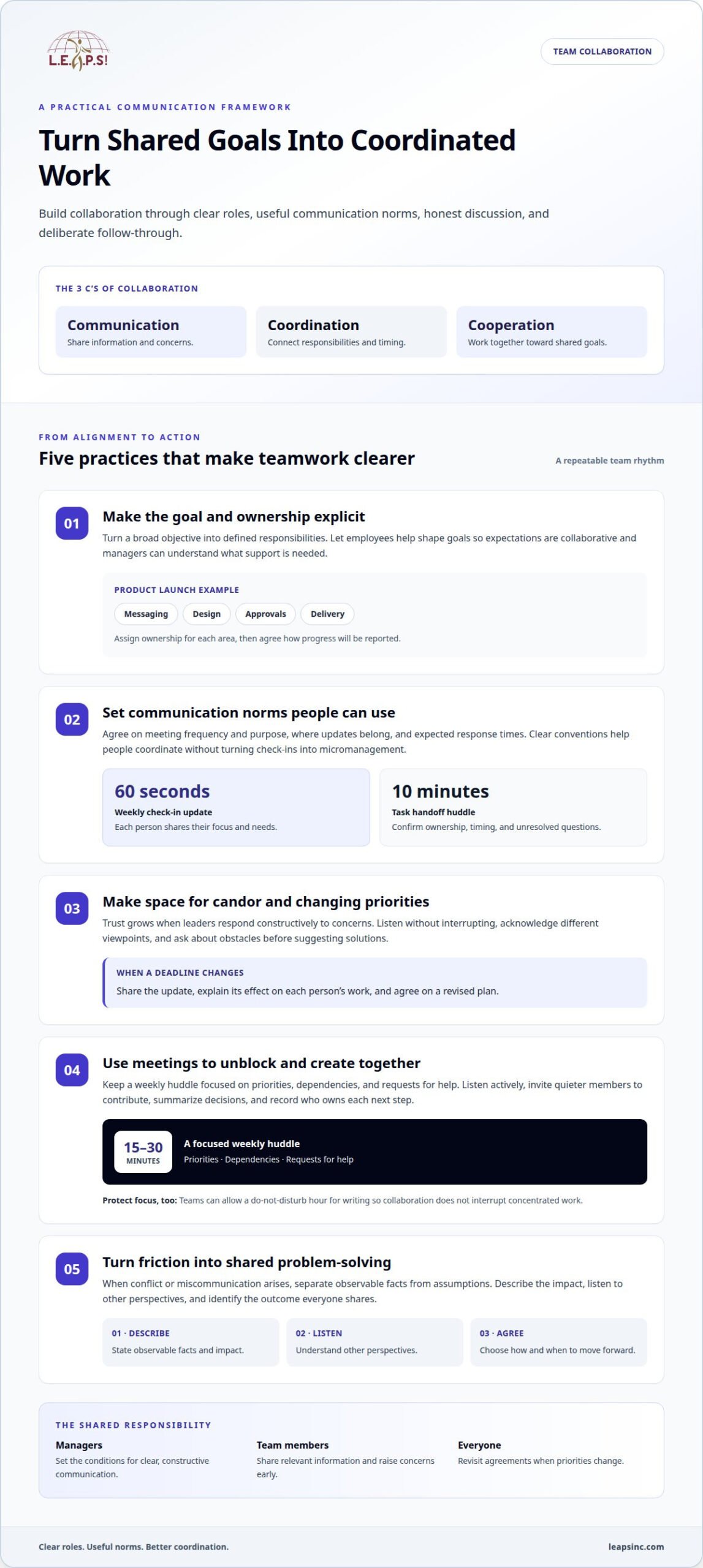
Professionals who advise leaders on how to improve team collaboration often begin with communication, coordination, and cooperation, the 3 C’s that turn shared goals into coordinated work. They clarify what the team is trying to achieve, assign responsibilities, establish communication norms, and make room for honest discussion. These practices help members raise concerns early and understand how their work connects with others.
To establish clear goals and roles, a professional can help managers turn a broad objective into defined responsibilities. For example, a team preparing a product launch might assign ownership for messaging, design, approvals, and delivery, then agree how members will report progress. Employees can also help shape their goals, making expectations more collaborative and giving managers a clearer view of the support people need.
Trust grows when leaders respond constructively to concerns rather than punishing candor. A professional can help managers listen without interrupting, acknowledge different viewpoints, and ask people to explain obstacles before suggesting solutions. When a deadline changes, for example, team members can share the update, explain its effect on their work, and agree on a revised plan. These everyday actions foster psychological safety more effectively than slogans.
Communication conventions make expectations usable. A professional can help a team agree on meeting frequency, each meeting’s purpose, where updates belong, and expected response times. A weekly check-in can begin with a 60-second update from each member on their focus and needs. For a task changing hands, a 10-minute handoff huddle can confirm ownership, timing, and unresolved questions. These structures support engagement without turning check-ins into micromanagement.
Productive meetings also create space for co-creation. A weekly huddle lasting 15 to 30 minutes can focus on priorities, dependencies, and requests for help, while participants listen actively and clarify what they heard. The facilitator can invite quieter members to contribute, summarize decisions, and record who owns each next step. Teams can also set focus norms, such as allowing a do-not-disturb hour for writing, so collaboration does not interrupt concentrated work.
When conflict or miscommunication arises, a professional can help team members distinguish observable facts from assumptions. Each person can describe the impact, listen to other perspectives, and identify the outcome they share. The team can then agree how to make a decision and when to choose a way forward. Open communication, fairness, and collaborative problem-solving turn disagreement into useful information instead of ongoing friction.
A practical answer to how to improve team collaboration is to make communication a shared responsibility. Managers set the conditions, team members share relevant information, and everyone revisits agreements when priorities change. Clear roles, meeting norms, and expectations for handling conflict help people coordinate while preserving the trust they need to contribute fully.
2. What is team collaboration in the workplace?
Workplace collaboration brings people with different skills and perspectives together to solve shared problems. Teamwork gives that effort structure through defined roles, accountability, and a common goal. A product launch, for example, may require design, customer support, and operations to coordinate their work toward one delivery. Effective teams connect these contributions instead of treating each department’s work as separate.
The benefits can appear in performance, engagement, and retention. Teamwork is associated with 23% higher employee engagement and an 18% increase in performance. Employees are 29% more likely to stay with their company for the next year when teamwork is effective. These figures describe associations, not guaranteed outcomes, but they show why collaboration matters beyond completing a single project.
Problem-solving improves when team members bring different expertise to the same challenge. In a service team, a customer support representative may spot recurring complaints while a product specialist identifies the feature causing them. Sharing those observations can help the group address the underlying issue rather than repeat temporary fixes. Different perspectives can also help teams identify potential problems before they affect customer service or project delivery.
Managers can assess collaboration by reviewing shared goals alongside practical indicators: whether milestones are met, where work stalls at handoffs, and whether team members resolve dependencies. They can also monitor engagement, performance, and retention trends over time. Repeated delays between design and approval, for example, may point to unclear ownership even when each department meets its own targets.
Common barriers include siloed information, competing priorities, unclear ownership, and reluctance to raise concerns. Managers can address them by clarifying who owns each outcome, creating a shared place for project updates, and inviting affected team members to discuss competing priorities. If a handoff repeatedly fails, map where information gets lost, agree on what the next person needs, and review whether the change resolves the delay.
Better collaboration can also shape the workplace experience. In surveys cited on the topic, 64% of employees worldwide said poor collaboration costs at least 3 hours per week in productivity, while 70% believed improved collaboration would improve productivity and save time. Another 60% believed it would positively affect morale. The practical value is not simply fewer wasted hours; stronger teamwork can help people contribute ideas and support one another through complex work.
To assess progress, leaders can review outcomes and team experience together rather than relying on meeting attendance alone. A quarterly discussion about progress toward shared goals can reveal whether responsibilities, cooperation, and problem-solving are improving. If recurring friction is limiting results, a professional conversation about team dynamics can help clarify what kind of support would move the group forward.
3. How professionals select digital collaboration tools for remote teams
Before choosing collaboration tools, map how the organization works remotely. Identify where employees share updates, co-edit files, track tasks, and meet face to face. A team coordinating customer launches, for example, may need shared documents and task visibility more than another messaging channel. The goal is to support relationships and clear handoffs, not add technology for its own sake.
Tool overload is a real consideration: the average employee switches between 10 tools per day. A professional can review which platforms already serve a clear purpose, where information gets duplicated, and which activities lack a reliable shared space. If project decisions sit in scattered conversations, the team may benefit from a central project workspace. If quick questions interrupt focused work, agreed messaging practices can help everyone use channels more deliberately.
Match tool categories to specific tasks. Messaging supports brief coordination; shared documents let people develop and review material together; project platforms show tasks, owners, and progress; video conferencing supports live discussion. A remote design team, for instance, might gather feedback in a shared document and track revisions on a project board. Assess the actual workflow before choosing a combination.
When choosing shared platforms, consider who needs access, how team members exchange information, and where decisions should be recorded. Map a typical task from assignment through approval, then identify which tool supports each handoff. An organization working on one shared project may need a simpler setup than a group managing several interdependent workstreams. Clear conventions also help everyone know where to post updates and find current information.
Choose video conferencing based on the meeting’s purpose and participation needs. Consider whether remote employees need scheduled discussions, informal collaboration, or visual presentations. For a session reviewing visual designs, image clarity may matter; for a short status discussion, reliable access and clear turn-taking may matter more.
Consider how tools affect working relationships, too. Remote members need ways to contribute asynchronously, ask questions, and stay informed when they cannot attend a live meeting. A team across time zones, for example, can record decisions in shared project materials rather than relying on a conversation only some employees hear. That gives everyone a consistent reference point.
After selecting tools, define how each one will be used and evaluate whether it reduces friction. Observe a project handoff, gather employee feedback, and adjust the setup if updates remain difficult to find. A useful system makes collaboration more visible and coherent, keeping the team focused on shared work instead of constant platform switching.
4. How professionals recognize individual strengths
Identify strengths by looking at how each person contributes to real work, not just their job title. Review project outcomes, observe how team members solve problems, and ask which tasks energize or drain them. An employee who consistently clarifies complex information, for example, may be well suited to synthesizing input during planning. These observations help leaders align responsibilities with strengths while respecting different perspectives.
Recognition matters, but it works best when it reflects what the employee values. Only 10% of employees say someone has asked how they prefer to be recognized. A professional can help leaders make that question part of development conversations, then note whether a person prefers private feedback, public acknowledgment, or opportunities to take on meaningful work. Employees who receive recognition are four times more likely to be engaged.
Specific recognition connects positive feedback to an observable action. Instead of saying “good work,” a manager might explain how an employee’s careful review caught an inconsistency before a report went out. This gives the employee a clear understanding of the contribution and shows colleagues what effective collaboration looks like. Professionals can also help leaders notice behind-the-scenes support, such as sharing expertise or helping another team member meet a deadline.
Strengths become more valuable when team members combine them. Map the capabilities a project requires, then identify how people’s skills complement one another. A strategic thinker might frame the challenge, a detail-oriented colleague might test assumptions, and a relationship-builder might gather stakeholder perspectives. The goal is not to label people permanently, but to create flexible opportunities as project needs change.
Structured activities can reveal how people contribute in a different setting. During brainstorming, for instance, a facilitator can invite each person to suggest an idea, build on another’s suggestion, or identify a risk. A project retrospective can ask which actions helped the group move forward and who made those actions possible. These practices build team connection through shared reflection rather than forced familiarity.
Recognition should connect to meaningful growth, not become a substitute for fair treatment or autonomy. Only 23% of employees strongly agree they receive the right amount of recognition for their work. Leaders can review feedback regularly, notice whose contributions are overlooked, and offer appropriate chances to lead or develop a skill. Strengths-based teamwork contexts are associated with employees being 73% less likely to leave, underscoring the value of putting people’s abilities to purposeful use.
5. How professionals provide opportunities for team development
Team development works best when learning connects to shared goals and real workplace challenges. Start by asking employees which projects energize them and which make it harder to contribute. If staff enjoy solving customer problems but struggle with handoffs, focus development on collaboration across those transitions. This gives leaders a practical starting point for improving team collaboration through relevant learning.
Next, identify the skills the team needs to strengthen. A group facing recurring disagreements may benefit from practicing constructive feedback and conflict resolution. A team launching a new service may need guided brainstorming to bring operational knowledge together with customer perspectives. Activities matched to an observed need give participants a clear reason to engage and a shared goal.
Team-building sessions, retreats, role-playing exercises, and brainstorming meetings offer opportunities to practice. In a role-play, colleagues can rehearse a difficult project conversation, then reflect on which responses opened dialogue. During brainstorming, each person can build on another’s idea before raising concerns. These exercises turn abstract teamwork skills into actions employees can apply to current responsibilities.
Professionals can structure development as a focused experiment. The team chooses one collaboration behavior, applies it for a 30-day period, then reviews what changed at month’s end. For example, members might test a consistent process for sharing project feedback. A facilitator helps define what the team will observe, gathers perspectives, and guides discussion about whether the practice supports its shared goal.
Learning continues between formal sessions. A coach or mentor can offer a neutral perspective when employees are unsure how their actions affect colleagues. Workshops or courses in communication, public speaking, and conflict resolution can strengthen an individual’s ability to contribute. Reflecting on past team experiences and gathering colleague feedback helps connect new skills to specific workplace situations.
Development can shape workplace culture when leaders make learning visible and reinforce it in daily work. A manager might recognize a team member who invites quieter colleagues into planning, then consider how that practice could support an upcoming project. A team mentor can also be someone employees approach with questions, extending learning beyond a scheduled workshop. This creates a more deliberate path for applying new skills.
When team activities feel disconnected from work or familiar friction keeps returning, professional support can help. A facilitator can assess team dynamics, design a tailored workshop, and guide the group in turning insights into practical habits. For leaders exploring how to improve team collaboration, the right development opportunity starts with the challenge employees actually face. Schedule a conversation about team development to consider a structured path from shared learning to stronger collaboration.
LEAPS
LEAPS Inc. offers professional support when communication challenges, unclear direction, or strained working relationships keep a team from moving forward. Its Business Coaching supports leadership and organizational development, helping business leaders consider how team dynamics connect with broader goals. When individual or group concerns affect collaboration, Therapy Intensive or Group Therapy can provide a setting to explore those challenges.
Consider professional guidance when recurring friction persists despite clearer processes, or when leaders need a more structured perspective on team development. The right support depends on whether the central need involves organizational direction, leadership growth, or personal and relational well-being. Contact LEAPS Inc. to discuss a path forward.
Build the conditions for stronger collaboration
Lasting progress begins when a team treats collaboration as an ongoing practice rather than a temporary fix. To improve team collaboration, identify what is holding people back, then choose support that fits the need. A leadership challenge may call for Business Coaching, while personal or relationship concerns may benefit from Therapy Intensive, Group Therapy, or Family Therapy.
LEAPS offers these services to support growth in professional and personal settings. Rather than prescribe one approach for every team, its professionals help people clarify challenges and consider a purposeful way forward. When leaders are ready to strengthen direction, or individuals and groups need support with relationship dynamics, professional guidance can help turn intention into deliberate action.
Bring your questions and goals into a conversation, and take the next step toward a more constructive working culture. Contact LEAPS to discuss your team. A stronger future for your team can begin with one thoughtful conversation.
Frequently Asked Questions
What is team collaboration in the workplace?
Team collaboration is the coordinated effort of colleagues combining knowledge and work toward a shared outcome. It can involve people in different roles, not just members of one department. A customer concern, for example, may require support staff to explain the issue, product specialists to assess it, and operations to coordinate a response. Collaboration connects those contributions so the group can address the whole problem.
Why Is Teamwork Important in the Workplace?
Teamwork helps employees combine expertise, coordinate complex work, and learn from one another. A colleague who spots a risk can alert the person managing delivery before it disrupts a project. Cooperation also gives employees opportunities to contribute ideas and develop skills through shared work. For organizations, the value lies in reaching goals while building a workplace where people offer support and take responsibility together.
Are collaboration and teamwork the same thing?
Collaboration and teamwork are closely related, but emphasize different aspects of working together. Teamwork usually centers on a shared objective and the roles needed to deliver it. Collaboration emphasizes combining knowledge and perspectives to create or solve something together. A team might divide research tasks, then collaborate to interpret the findings and decide which recommendation best addresses the client’s needs.
How Do Remote or Hybrid Teams Improve Teamwork?
Remote and hybrid teams can work together effectively by making participation possible across different locations and schedules. Pair live discussions with written summaries so employees who miss a meeting still understand decisions and next steps. For example, record project changes in a shared workspace after a video call. Managers can also invite written input before discussions, giving employees time to reflect and contribute thoughtfully.
How Do You Build a Successful Team at Work?
Build a successful team by matching people’s capabilities to the work, supporting respectful relationships, and creating accountability for shared outcomes. At the start of a project, a manager might identify the expertise required, clarify how decisions will be made, and give employees a clear way to raise concerns. Regular reflection helps the team identify what is working and where it needs support, so its approach can adapt as the work changes.
What Are Practical Teamwork Tips for Better Performance?
Improve performance by making requests specific, sharing relevant context, and closing the loop when work changes hands. Instead of sending “Please review,” identify the document, explain the decision needed, and state what information would help. Colleagues can acknowledge the request and say if competing priorities affect delivery. These small habits reduce ambiguity and keep people focused on the task instead of interpreting incomplete messages.
What Is the Leader’s Role in Team Effectiveness?
A leader creates conditions for people to contribute, learn, and take responsibility. That means demonstrating respectful communication, addressing obstacles across reporting lines, and giving team members appropriate autonomy. When two departments disagree about a project priority, for example, the leader can clarify the organization’s objective and bring decision-makers together. Effective leadership supports accountability without taking ownership of every task away from employees.
What skills are necessary for successful teamwork?
Successful teamwork relies on clear communication, active listening, reliability, adaptability, and constructive problem-solving. Team members need to explain concerns without personal attacks, consider colleagues’ information, and follow through on agreed work. Adaptability matters when new information changes a plan. Curiosity helps, too: asking what another person has noticed can reveal context the team might otherwise overlook. These skills strengthen everyday coordination and challenging discussions alike.