


Article by
Dr. John E. N. Daniel
Dr. John E. N. Daniel is a visionary with a burning desire to coach, counsel, teach and empower individuals from diverse backgrounds towards the attainment of their maximum potential, life purpose and destiny. He coaches, counsels, consults, mentors, and ministers to the global community through diverse media and environments.
A business plan explains how your company operates; a strategic plan clarifies where it is going and how it will get there. Strategic planning for a small business turns that direction into priorities, measurable goals, and practical decisions, rather than leaving growth to day-to-day pressures.
It’s understandable to treat the two plans as interchangeable: both help shape a business’s future. But a business plan often supports a launch or funding request, while a strategic plan keeps attention on longer-term direction, commonly over three to five years. The distinction matters because a clear vision can help you choose what to pursue, what risks to prepare for, and how to focus limited time and resources.
This guide explains how the plans differ and how to set a direction that reflects your business’s purpose and position. You’ll assess strengths, weaknesses, opportunities, and risks; define measurable goals; and connect each priority to practical actions and regular reviews. The aim is not a polished document for its own sake, but a working roadmap that helps you lead with clarity as your business changes.
Key Takeaways
- Separate your long-term direction from the operational detail of a business plan so each document has a clear purpose.
- Use your mission, vision, values, and competitive advantage to shape a direction your team can understand and act on.
- Assess internal strengths and weaknesses alongside changing markets, customer needs, and competitors to identify risks and opportunities.
- Turn priorities into measurable goals with a timeframe, an accountable owner, and a way to track progress.
- Review the plan as conditions change, and connect strategic marketing decisions to the direction you’ve set.
What’s the difference between a business plan and a strategic plan?
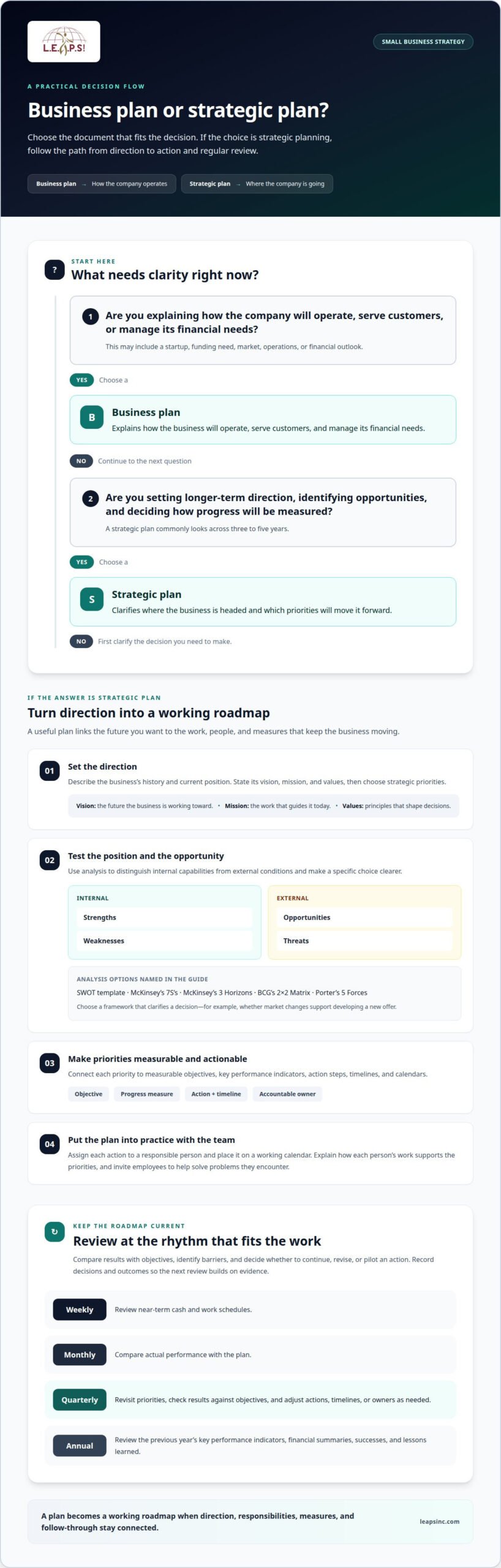
A business plan explains how a company will operate, serve customers, and manage its financial needs. A strategic plan sets its longer-term direction, identifies opportunities, and defines how leadership will measure progress, generally across three to five years.
A small business strategic plan should include its mission, vision, values, priorities, measurable goals, action steps, responsibilities, and progress measures. Useful tools include a SWOT template and frameworks such as McKinsey’s 7S’s, McKinsey’s 3 Horizons, BCG’s 2×2 Matrix, and Porter’s 5 Forces.
- Choose the document for the decision at hand. Develop a business plan to explain a startup, funding need, market, operations, and financial outlook. Use a strategic plan to clarify where the business is headed and which priorities will move it forward. For example, a business plan can explain a new service launch, while its strategic plan sets the broader direction behind that launch.
- Build the strategic plan around direction and execution. Describe the organization’s history and current position, then state its vision, mission, and values. Add strategic priorities, measurable objectives, key performance indicators, an action plan, timelines, calendars, and accountable owners. This structure connects the desired future to the work and measures that show whether the business is progressing.
- Use a framework to make analysis specific. A SWOT template organizes strengths, weaknesses, opportunities, and threats, helping leadership distinguish internal capabilities from external conditions. McKinsey’s 7S’s or Porter’s 5 Forces can offer another lens. Choose a tool that clarifies a decision, such as whether market changes support developing a new offer.
- Translate priorities into implementation. Assign each action to a responsible person and add it to a working calendar. Share the strategic plan with the team, explain how each person’s work supports its priorities, and invite employees to help solve problems they encounter. A written roadmap guides the business only when people understand their roles and follow-through continues after planning.
- Review results on a defined rhythm. Strategic planning for small business owners should adapt as conditions change. Review near-term cash and work schedules weekly, compare actual performance with the plan monthly, and revisit priorities quarterly. An annual review can examine the previous year’s key performance indicators, financial summaries, successes, and lessons learned.
- Adjust the plan when evidence changes the choice. At each quarterly review, compare results with objectives, identify barriers to progress, and decide whether to continue, revise, or pilot an action. Update timelines, owners, or priorities as the business changes. Record decisions and outcomes so the next review builds on evidence, not assumptions.
Mission, vision, values, and competitive advantage
Set a direction that connects your business’s purpose with the advantage it can build. A planning engagement’s cost depends on scope, time, and outside support; service pricing depends on the case and is given after a quote request.
Develop vision and mission statements
Write a vision that describes what the business should look like in 5-10 years, then define the mission that guides its work today. For example, a neighborhood bakery might envision becoming a trusted local gathering place, while its mission describes the products and service that make that possible. Check that the vision is ambitious but connected to the business’s ability and resources.
Use the mission to explain whom the business serves and what value it provides. Avoid promises that depend on capabilities the company has not developed. Connect each statement to a choice, such as which customers to prioritize or which opportunities support the future you intend to build.
Identify values and competitive advantage
Name the values that should shape decisions, then identify what customers can receive from your business that alternatives do not provide in the same way. A repair company might prioritize clear communication and dependable workmanship, then distinguish itself through a specialized service or more personal customer experience. Tie each value to observable behavior, not just a word on a page.
Check whether the advantage fits customer needs and the company’s strengths. Common risks include choosing priorities that exceed available capacity, overlooking changing customer expectations, or treating a competitor’s approach as proof of demand. If a proposed direction requires new skills, identify the capability gap before committing resources.
Build a shared vision
Bring leadership and employees into the planning conversation before finalizing priorities. Ask what customers value, where work slows down, and which strengths the team can build on. Employees may see obstacles in daily operations, while leadership can connect those observations to the company’s longer-term direction.
Turn the discussion into decisions: record the agreed vision, explain why priorities matter, and assign responsibility for putting them into practice. Avoid presenting a finished plan without context; people need to understand how their roles contribute. Address unresolved differences before they become barriers to execution.
With a clear vision, values, and advantage, leadership can test whether each opportunity supports the chosen direction. If your team needs structured support to clarify that direction and align priorities, schedule a planning conversation.
SWOT analysis
Use market evidence and internal realities to test your direction. SWOT identifies strengths, weaknesses, opportunities, and threats. OKRs turn priorities into objectives and key results, while a balanced scorecard tracks performance across business perspectives.
Gather market and competitor data
Gather evidence about customers, market shifts, and direct competitors before choosing a response. Compare competitors’ products, sales methods, pricing, marketing, and social media use. For example, a retailer might notice that competitors promote online ordering, while customer feedback points to unmet demand for in-store advice.
Separate observed facts from assumptions. Consider changes in demographics, technology, market conditions, and competitors’ offerings before deciding whether your current business model still fits. Focus the analysis on a decision, such as whether to retain a service, refine its positioning, or develop a new offer.
Conduct a SWOT analysis
List internal strengths and weaknesses separately from external opportunities and threats. A bookkeeping firm might identify trusted client relationships as a strength, limited staff capacity as a weakness, new businesses in its market as an opportunity, and changing software as a threat. Ask owners and employees for examples that support each item.
Then connect the categories. A strength may help the business pursue an opportunity, while a weakness may make a threat more serious. Rank items by their likely effect on the business’s success and its ability to act. A long list is not a strategy; choose the findings that should shape decisions.
Assess competitive analysis and market advantage
Use competitor findings to identify where your business can serve customers distinctively. Compare the customer experience, product range, pricing approach, and promotion methods, then ask which differences matter to your target market. A service business could stand out through a specialized offering or a clearer explanation of its process.
Test whether the advantage is meaningful and sustainable. A lower price alone may be easy for competitors to match, while expertise or a carefully designed service may be harder to replicate. Link each proposed advantage to customer needs and evidence, not simply to what the business prefers to provide.
Test financial viability with break-even analysis
Calculate the break-even point in units by dividing fixed costs by the difference between price and variable costs. This helps owners estimate the sales volume needed to cover costs and test whether a proposed opportunity is financially workable. The SBA recommends adding about 10% to a break-even analysis for unpredictable miscellaneous expenses.
Use the result as a planning estimate, not a precise forecast. The SBA cautions that break-even analysis isn’t intended to determine accounting or financing with 100% accuracy. Revisit assumptions when costs, prices, or sales expectations change, and compare the analysis with other market evidence before committing resources.
Setting measurable short-term goals and objectives
Set goals across one-, three-, and five-year horizons, then translate long-term direction into near-term decisions. Define each goal by its intended result, timeframe, accountable owner, and measure of progress.
Prioritize business goals
Choose a small number of priorities for the next 90 days. Give each one a defined result, an accountable owner, and a way to measure progress. This focus helps business owners direct attention and resources toward work that supports the company’s direction.
Compare proposed goals with customer needs, available capacity, and the strategic outcomes they support. If a new initiative competes with work already underway, decide which has greater impact before assigning resources. Not every worthwhile idea is urgent; a focused plan helps teams understand what deserves attention now.
Make goals and objectives measurable
Write each goal as an observable result with a timeframe. “Improve customer retention” is difficult to assess; “increase the share of returning customers by the end of the year” gives the team a defined outcome and deadline.
The Hartford recommends making strategic-plan goals measurable and including a time frame. For example, a cleaning business might aim to increase its residential market share for eco-friendly products from approximately 2% to 5% during the year. Use a baseline, target, and end date, then check that the result reflects the intended direction.
Choose measurable KPIs
Select key performance indicators that show whether a goal is advancing. For a sales improvement goal, a business might track qualified leads, conversion rate, and completed sales. Give each KPI a clear definition, data source, and review schedule so team members interpret progress consistently.
Keep each measure connected to the outcome. Website visits alone may not show whether marketing is bringing in customers; compare visits with inquiries or conversions. Do not track numbers simply because they are easy to collect. A useful KPI informs a decision, such as whether to refine an offer or adjust outreach.
Break goals into actionable steps
Translate each objective into actions, owners, and deadlines. If the goal is to improve lead conversion, steps might include reviewing inquiry responses, revising follow-up messages, and tracking completed sales. Add each action to a calendar and make clear who is responsible for moving it forward.
Limit quarterly objectives to 3-7, and connect each action to its intended goal and KPI. Review progress against the agreed measures, identify delays, and adjust next steps when evidence points to a better approach. This creates a practical bridge between long-term ambitions and the work teams deliver each week.
Strategic planning and business survival
A strategic plan cannot remove uncertainty, but it can help an organization spot pressure early and respond deliberately. Use these steps to connect priorities, resources, and decisions as conditions change.
- Define the risks that could disrupt your direction. Start with your SWOT analysis, then identify threats that could weaken sales, cash flow, staffing, or customer demand. For example, a supplier delay may threaten a retailer’s busiest season, while declining repeat orders may signal changing customer expectations. Distinguish an immediate operational problem from a risk that calls for a change in strategy.
- Document assumptions, decisions, and results. Record why the organization chose each priority, what evidence informed it, who owns the next action, and what happened afterward. A documented decision trail helps business owners learn from a missed target instead of repeating the same assumption. It also gives the team a shared reference when leadership changes course or tests a new response.
- Connect financial resources to strategic priorities. HBR reports that 60% of organizations do not tie financial budgets to strategic priorities. A small business can address that gap by linking each major spending decision to a defined objective. If a planned marketing investment supports customer acquisition, specify the intended outcome and measure results before expanding the commitment.
- Build execution capacity into the plan. Bridges Business Consultancy reports that 20 years of research show leaders consistently underestimate what successful strategy implementation requires. Its research also reports that 48% of organizations fail to meet at least half of their strategic targets. Assign capacity, decision authority, and follow-through alongside each priority, rather than treating implementation as work that happens automatically.
- Set an early-warning trigger and response. Choose indicators that reveal a meaningful decline, such as falling sales, profitability, or morale. When an indicator weakens, identify the cause, assign a corrective action, and pilot a solution if the right response remains uncertain. The Journal of Small Business Management reports that 71% of fast-growing companies have strategic plans, business plans, or similar planning tools. Planning supports informed action, not guaranteed survival.
If your priorities, execution capacity, or response to changing conditions need clearer alignment, schedule a business planning conversation.
LEAPS: Strategic Marketing
LEAPS Inc. offers Strategic Marketing as a natural next step when your business has set its direction but needs to align its market presence with that plan. The work can help connect your priorities to decisions about your audience, positioning, and how you communicate your value. Consider Strategic Marketing support when your goals are clear, yet your approach to reaching customers needs greater focus. A coherent strategy helps keep marketing choices connected to the direction you have defined, rather than treating each activity as a separate effort.
If you’d like to discuss how strategic marketing could support your business, contact LEAPS Inc.
Turn your direction into deliberate action
The next stage of growth begins when your choices reflect the future you want to create. Strategic planning for a small business becomes meaningful through consistent decisions, honest reflection, and a willingness to adjust when evidence changes. Keep your attention on the organization you are building, not only the urgent demands of today.
Business leadership also draws on personal resilience and healthy relationships. LEAPS Inc. offers Therapy Intensive, Group Therapy, and Family Therapy to support personal and relational needs alongside the focus leaders place on business goals.
If you’re ready to clarify your next steps, schedule a conversation with LEAPS Inc. Take the next step with intention, and keep building toward the future you envision.
Frequently Asked Questions
How Do Small Business Owners Move Forward When Their Gut Contradicts the Data?
Treat a conflict between instinct and data as a signal to investigate, not a reason to dismiss either source. Identify the assumption behind your instinct, then examine whether the data reflects the right customers, timeframe, and business outcome. If uncertainty remains, run a limited test before making a larger commitment. For example, trial a revised offer with a defined customer group, then compare the response with your original expectation.
What is a good objective?
A good objective describes a specific result that advances a business priority and gives the team a clear basis for decisions. If the priority is improving customer retention, for example, an objective could focus on increasing repeat purchases within a defined timeframe. Connect the objective to a measure the team can observe, and keep it within the organization’s influence. Avoid describing activity without stating the intended outcome.
What’s a good goal?
A good goal names a meaningful outcome and a timeframe, so business owners can judge whether their decisions are moving the company forward. “Strengthen customer loyalty” expresses a direction; a goal might focus on increasing repeat business by a set deadline. Choose an outcome that matters to the organization, then clarify what evidence will indicate progress. A goal should inspire action without depending entirely on factors outside the business’s control.
Who should be involved in strategic planning?
Include the owner or leadership team and employees who understand the work affected by the plan. Sales staff, for example, may identify recurring customer objections, while operations employees can surface capacity constraints. Invite people to contribute relevant evidence, then clarify who has authority to decide and who owns execution. If outside expertise is involved, define its role so internal leaders remain accountable for choices and follow-through.
What is strategic planning for a small business?
Strategic planning for a small business is a decision-making process that defines the future the organization is working toward and the priorities guiding its choices. It helps owners connect customer needs, capabilities, and resources to action. Use the plan as a filter when new opportunities arise: assess whether an idea supports the agreed direction before committing time or money. This keeps urgent demands from automatically displacing longer-term priorities.
What are the steps to create a small business strategic plan?
Begin by reviewing the business’s current position and identifying what has changed. Clarify the future direction, gather input from relevant employees, and select priorities that fit the organization’s capacity. Define expected results, assign owners, and connect actions to measures of progress. Then share the decisions with the team and schedule a review. This sequence turns discussion into choices people can understand, carry out, and revisit as circumstances evolve.
How often should a small business review and update its strategic plan?
Review priorities quarterly, and revisit the plan sooner when a major change affects customer demand, available resources, or the assumptions behind a key decision. A review does not require rewriting the entire document. Compare current conditions with the plan, identify what needs attention, and record whether to continue, revise, or pause an initiative. A clear decision log helps the next review build on what the team has learned.
How can a small business conduct market and competitor analysis?
Start with a specific question, such as whether customers want a new service or why inquiries are not converting. Gather relevant evidence from customer conversations, sales patterns, public competitor messaging, and market changes. Organize findings by what they may mean for your business, separating direct observations from assumptions. Then decide what to test or investigate next. This makes the analysis useful for a business decision rather than an exercise in collecting information.