


Article by
Dr. John E. N. Daniel
Dr. John E. N. Daniel is a visionary with a burning desire to coach, counsel, teach and empower individuals from diverse backgrounds towards the attainment of their maximum potential, life purpose and destiny. He coaches, counsels, consults, mentors, and ministers to the global community through diverse media and environments.
A leader’s confidence is tested less by having every answer than by how they respond when the answer isn’t clear. Learning how to build confidence as a leader starts with small, consistent wins, commitments within your control, and the willingness to learn from conflict and feedback. Confidence doesn’t require certainty; it calls for clear communication, sound judgment, and follow-through.
It’s understandable to feel pressure to appear decisive, especially when your team is looking to you for direction. But confident leadership isn’t about hiding uncertainty or avoiding mistakes. It means being honest about what you know, listening to different perspectives, and choosing a thoughtful next step.
This article explains what confident leadership looks like and how everyday progress can build trust in your own abilities. You’ll learn to recognize small wins, focus on actions within your control, handle conflict constructively, and use feedback to support your growth and your team’s performance. These practices help turn confidence from a feeling you wait for into a capability you develop through purposeful action.
Key Takeaways
- Recognize confidence through clear communication, thoughtful decisions, and openness about uncertainty.
- Use small, visible wins to build a stronger sense of capability and momentum.
- Focus leadership effort on commitments and actions within your control, then follow through consistently.
- Turn conflict and feedback into opportunities to listen, learn, and strengthen trust.
- Build team confidence by treating mistakes as learning opportunities and staying committed to shared goals.
1. What Is A Confident Leader?
Self-confidence is a judgment of capability; self-esteem is a judgment of self-worth. A confident leader doesn’t need to feel certain in every meeting. They can explain a decision, acknowledge a knowledge gap, and identify a next step. For example: “I don’t have that data yet. I’ll review it with the team and return with a recommendation.” This combines candor with responsibility.
Confidence also shows in clear communication and assertiveness. A leader can state a priority directly, invite disagreement, and explain how they reached a decision without dominating the conversation. In a project meeting, for example, they might summarize the shared goal, clarify who owns each action, and ask quieter colleagues for their perspectives. Clear expectations make leadership more deliberate.
Mentors and supportive professional communities give leaders room to learn and receive constructive challenges. A peer can offer perspective on a difficult conversation, while an external mentor can provide candid feedback on performance. Coaching can help leaders identify whom to approach, prepare focused questions, and build a network that offers encouragement and honest reflection. The aim isn’t to collect praise, but to create useful relationships that support continued growth.
Books such as The Leadership Challenge by James Kouzes and Barry Posner, and Dare to Lead by Brené Brown, offer structured ideas for reflection. A leadership course can provide practice, while executive coaching can focus on a leader’s specific communication and development goals. The best fit depends on whether the priority is independent learning, group discussion, or tailored support.
In coaching, a leader can rehearse a message before delivering it, then reflect on how it landed. A useful structure is to state the purpose, share relevant facts, clarify what remains uncertain, and explain the next action. Using this structure in team updates helps colleagues understand what has changed and what remains consistent. It also lets a leader communicate uncertainty without leaving the team guessing.
Learning how to build confidence as a leader means aligning actions with values, not performing certainty. A coach may help a leader identify a value such as fairness and turn it into an observable behavior: hearing both sides before resolving a team disagreement. Reflecting on that example can strengthen a leader’s sense of identity over time and provide a practical reference for future decisions, especially when a new challenge tests their judgment.
Building confidence through small wins with professional coaching
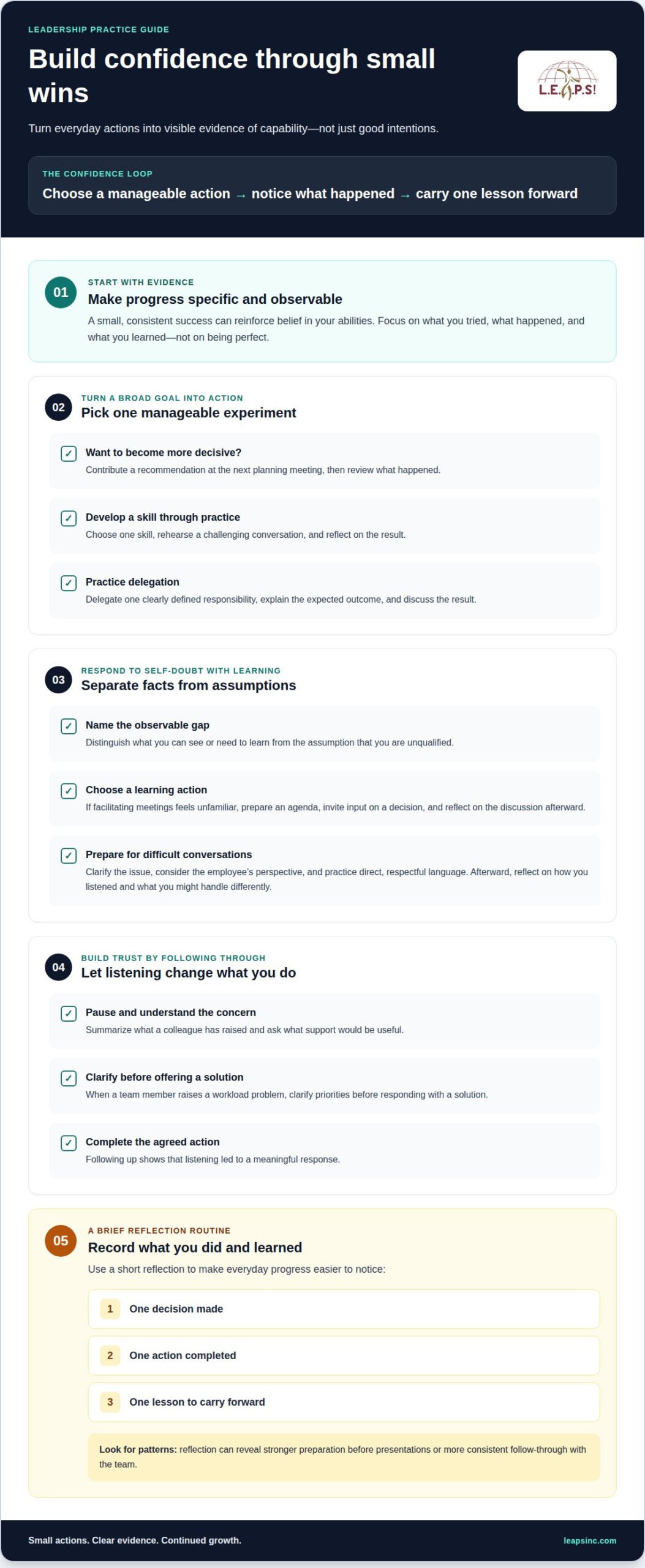
Confidence grows when leaders can point to evidence of capability, not just good intentions. Albert Bandura’s self-efficacy theory describes how mastery experiences, including small, consistent successes, can reinforce belief in one’s abilities. A coach can help turn a broad goal, such as becoming more decisive, into a practical experiment: contribute a recommendation at the next planning meeting, then review what happened. This makes progress visible and gives the leader a specific experience to learn from.
Practical coaching may involve choosing a skill to develop, rehearsing a challenging conversation, and reflecting on the result. For example, a newly promoted manager might aim to delegate one clearly defined responsibility, explain the expected outcome, and discuss the result with a coach. The focus isn’t perfection. It’s identifying what worked, what needs adjustment, and what manageable step comes next.
Self-doubt can intensify when a new leader interprets unfamiliar responsibilities as proof they’re unqualified. A coach can help distinguish observable gaps from assumptions and identify a learning action for each gap. If a leader worries about facilitating meetings, they might prepare an agenda, invite input on a decision, and reflect on the discussion afterward. This approach gives imposter feelings a practical response without treating them as evidence of failure.
Support also matters in challenging situations. A coach can help a leader prepare for a difficult performance conversation by clarifying the issue, considering the employee’s perspective, and practicing direct, respectful language. Afterward, the leader can reflect on how they listened, what they learned, and what they might handle differently. This kind of reflection turns a stressful interaction into an opportunity to develop skills, rather than a verdict on leadership ability.
Listening builds trust when it changes what a leader understands or does. A coach might help a leader practice pausing before responding, summarizing a colleague’s concern, and asking what support would be useful. If a team member raises a workload problem, for instance, the leader can clarify priorities before offering a solution. Following up on the agreed action shows that listening led to a meaningful response.
Daily habits make small wins easier to notice. A coach can help a leader choose a brief reflection routine: record one decision made, one action completed, and one lesson to carry forward. Reviewing these notes can reveal patterns, such as stronger preparation before presentations or more consistent follow-through with the team. Leaders seeking structured support for these practices can schedule a coaching conversation and focus on a current leadership challenge.
Focusing on controllable commitments with professional coaching
A leader can’t control every market shift, customer response, or employee decision. They can control how clearly they set priorities, communicate expectations, and follow through. In coaching, a leader can sort a difficult goal into factors within their influence and those outside it. A delayed project may depend on a supplier, for example, but the leader can clarify internal ownership, share an update, and prepare an alternative plan.
This distinction helps prevent scattered effort. A coach can help a leader choose a few essential commitments, define what completion looks like, and make those commitments visible to colleagues. If a team needs clearer direction, the leader might commit to sending a decision summary after each planning meeting. Keeping that promise builds a record of reliability, even when larger outcomes depend on others.
Coaching can also help leaders identify strengths they underuse. A leader skilled at synthesizing complex information might draw on that ability when a decision feels difficult. Someone who excels at building relationships could use that strength to align employees around a shared priority. Gallup research cited in leadership guidance associates a focus on strengths with confidence, engagement, and goal achievement. A coach can help connect a strength to a specific leadership behavior.
Strengths matter across the team, too. A leader can observe how employees solve problems, explain ideas, and support colleagues, then match those abilities to meaningful responsibilities. An employee who spots process gaps, for example, might help refine a workflow, while a colleague who communicates clearly could present the new process. Coaching can help leaders make assignments thoughtfully, recognize contributions, and avoid assuming everyone succeeds in the same way.
A useful coaching conversation can distinguish a commitment from an aspiration. “Improve morale” is broad; “hold a listening conversation with the project team and share the themes” describes an action the leader can take. A coach can then help review whether the action happened, what response it produced, and what adjustment makes sense. This supports accountability without treating every unpredictable result as a personal failure.
Leaders should remember that commitment does not mean refusing to adapt. If customer feedback or new data changes the situation, a confident leader explains why the plan is changing and what remains steady. A coach can help prepare that message, test its clarity, and keep the team focused on its strengths. Over time, repeated follow-through on controllable actions gives leaders a more dependable basis for judgment and helps employees see how their work contributes to shared objectives.
Managing conflict and receiving feedback with professional coaching
Conflict can shake a leader’s confidence, especially when colleagues disagree about priorities. A coach can help separate the issue from assumptions about intent. If two employees dispute ownership of a project, for example, the leader can clarify the shared outcome, hear each person’s concerns, and agree on responsibilities. This establishes a fair process rather than turning disagreement into a contest of authority.
Preparation helps leaders stay objective during difficult conversations. A coach can help identify the specific behavior or decision at issue, consider its impact, and practice a direct opening statement. “The handoff was delayed, and the client update went out late” describes an observable concern. The leader can then ask what happened before deciding on next steps. This keeps the discussion focused on resolution rather than blame.
Coaching can help leaders seek specific feedback instead of asking, “How am I doing?” After a presentation, a leader might ask, “What did you find most useful?” After a meeting, they could ask, “What was your biggest takeaway?” These questions invite concrete observations the leader can consider and apply. A coach can help distinguish a useful pattern from a single reaction and identify a practical adjustment.
Feedback matters most when leaders are willing to hear different perspectives, including from colleagues they find intimidating. A coach can help a leader listen without interrupting, ask for an example, and reflect back what they understood. If a colleague says decisions arrive too late, the leader might ask which decision caused the greatest delay. Specifics make feedback easier to assess and respond to constructively.
Coaching helps leaders balance confidence with humility by treating feedback as information, not a verdict on their worth or ability. A leader can name what they handled well, acknowledge a gap, and decide what to change. After interrupting a team member, for instance, they might recognize the impact, apologize, and invite that person to finish their point. This shows accountability without surrendering leadership authority.
When conflict involves a mistake, a leader’s response can encourage openness or make employees reluctant to raise problems. A coach can help the leader acknowledge their part, focus on what the team can learn, and agree on a corrective action. The leader can then follow up by sharing what changed in the process. This visible follow-through turns feedback into action and builds trust through consistent behavior.
5. Benefits of confidence for leadership and team performance
A confident leader helps a team move from uncertainty toward purposeful action. Confidence supports clear decisions, steady communication, and commitment to shared goals. When a product launch is delayed, for example, a leader can explain current priorities, identify the next decision, and keep employees focused on their roles. That clarity gives the team practical direction, even before every problem is resolved.
Confidence also helps leaders make decisions without pretending every complex choice has an obvious right answer. A leader can gather relevant information, invite perspectives from affected employees, and use judgment to choose a path. If new data changes the situation, adjusting the decision shows responsiveness, not weakness. The team sees both the leader’s ability to act and their willingness to learn.
This matters especially during setbacks. A confident leader can acknowledge a mistake, identify what it reveals, and guide the team toward a correction. The Celebration Grid offers a way to examine what teams learn from successes and failures. After a missed handoff, for instance, the team can identify where the process broke down and assign someone to improve it. The mistake becomes an opportunity to improve the work, not a reason to hide problems.
Confidence can shape how employees respond to challenging conditions. Leaders may feel worried but can still communicate calmly, explain what’s known, and describe the next step. That doesn’t mean concealing real risks. It means avoiding unsupported alarm and showing commitment to the people working toward the goal. A team facing a demanding deadline benefits from a leader who clarifies priorities and remains available for questions.
Confidence is not the same as infallibility. A leader who believes in a goal can still ask for help, recognize limits, and make room for others’ expertise. When the author of a project brief invites a colleague to challenge its assumptions, the final plan may become more considered and easier to execute. This openness gives employees room to contribute their insights, strengthening shared ownership instead of relying on one person for every answer.
The practical takeaway is that leadership confidence matters most when it creates better conditions for collective performance. It helps people understand the goal, raise concerns, learn from errors, and act with greater clarity. Leaders who want to strengthen these capacities can schedule a coaching conversation focused on their leadership challenges and team goals.
LEAPS
LEAPS helps leaders turn insight into purposeful growth through professional support tailored to their goals. For challenges involving team direction, decision-making, or leadership development, Business Coaching may be a relevant path. When confidence is also affected by personal or family concerns, Therapy Intensive, Group Therapy, or Family Therapy can provide a different form of support.
Consider reaching out when self-doubt is affecting your communication, follow-through, or ability to lead with intention. Contact LEAPS to discuss the support that may fit your goals.
Carry your leadership growth into what comes next
Your next stage of leadership doesn’t require a complete reinvention. It begins with a deliberate choice about the influence you want to have and the conditions that help you lead with integrity. As you consider how to build confidence as a leader, look beyond immediate demands: identify the contribution you want your team to remember and the values you want your decisions to reflect.
That vision can guide professional growth, especially when leadership pressures affect your sense of balance or purpose. Support can help you explore what’s getting in the way, clarify what matters, and move forward with greater intention. LEAPS offers coaching and therapy services to support personal and professional development.
Contact LEAPS to discuss your leadership goals and consider a next step aligned with the future you want to create. Your capacity to lead can continue to grow, one intentional choice at a time.
Frequently Asked Questions
What Is A Confident Leader?
A confident leader makes considered choices, communicates their reasoning, and remains accountable for the effects. They don’t need to project certainty in every situation. If a proposed change disrupts a team’s workflow, for example, they can explain the decision, invite relevant concerns, and revise the plan when evidence supports it. Confidence shows in how they respond, not in a claim to always be right.
What Does Self-Confidence Mean?
Self-confidence is trust in your ability to handle a task, make a judgment, or learn what a situation requires. It can be specific rather than universal: a leader may feel capable of guiding a team discussion while still developing budgeting skills. Noticing this distinction helps leaders identify where preparation, practice, or support could help, instead of treating uncertainty in one area as proof they can’t lead.
How can coaching help leaders improve communication and decision-making confidence?
Coaching can help leaders prepare for high-stakes conversations and clarify how they’ll make a decision. Before announcing a team restructure, for example, a leader might work through likely questions, identify what can be shared, and practice explaining the rationale plainly. A coach can also help examine decision criteria, such as customer impact and team capacity, so the leader can communicate a coherent choice rather than relying on authority alone.
What role does leadership experience play in building confidence?
Leadership experience gives people opportunities to practice judgment and recognize patterns across different situations. A manager who has handled a missed deadline may be better prepared to distinguish a one-time obstacle from a recurring process issue. Experience alone isn’t enough, though. Reviewing outcomes, considering other perspectives, and applying lessons to future decisions turn responsibilities into practical learning, rather than simply accumulating time in a role.
How can leaders seek feedback and use it to build confidence with coaching support?
A leader can request feedback on a specific behavior, such as how clearly they communicate ownership during cross-team handoffs. Coaching can help the leader listen for concrete examples, separate observable feedback from interpretation, and decide what deserves action. They can then try one adjustment, such as documenting the agreed owner after a meeting, and ask for follow-up input on whether it improved coordination.
How can coaching help leaders stay confident when facing mistakes or criticism?
Coaching can help leaders respond to criticism without becoming defensive or dismissing useful information. After a missed deadline, for example, a leader can identify their contribution, clarify the impact, and agree on a corrective step with the team. A coach can help distinguish accountability from self-blame, then prepare a concise update explaining what will change and how progress will be assessed.