


Article by
Dr. John E. N. Daniel
Dr. John E. N. Daniel is a visionary with a burning desire to coach, counsel, teach and empower individuals from diverse backgrounds towards the attainment of their maximum potential, life purpose and destiny. He coaches, counsels, consults, mentors, and ministers to the global community through diverse media and environments.
What if a business disagreement is about more than the decision at hand? Mismatched expectations or a shared vision that has drifted may be driving the conflict. Knowing how to handle conflict with a business partner starts with identifying the underlying issue, reviewing the partnership agreement’s dispute process, and arranging a structured conversation focused on workable next steps.
Tension can make clear communication difficult. A disagreement may affect trust and daily decisions, but addressing it candidly and respectfully can clarify what each partner needs and whether common ground remains.
This article explains how to identify the causes of a partnership dispute, decide whether a neutral mediator could help, and develop a resolution strategy with clear responsibilities and documented agreements. It also explores how revisiting your mission, vision, and business goals can shift the conversation from immediate friction toward a more aligned future.
Key Takeaways
- Review your partnership agreement to understand the process for resolving disputes and clarify decision-making responsibilities.
- Consider mediation when direct conversations stall, and look for a neutral professional with relevant business-dispute experience.
- Separate the visible disagreement from its underlying causes, such as unclear expectations, communication breakdowns, or competing priorities.
- Turn productive discussions into a documented plan with shared goals, defined responsibilities, and clear next steps.
- Revisit your mission and business direction together to find common ground that can guide decisions beyond the current conflict.
1. Dispute-resolution clauses in partnership agreements
When disagreement disrupts decisions, start with the partnership agreement, not assumptions about what either partner can decide. The document may set out roles, responsibilities, voting rights, profit distribution, capital contributions, ownership percentages, and exit procedures. Its dispute-resolution clause may also describe the process partners agreed to use, such as negotiation, mediation, or arbitration before court proceedings.
Read the clause carefully to understand the steps and decision-making rules it specifies. Does it identify who participates, how a neutral third party is selected, or what happens if direct discussions stall? Some partnership and buy-sell agreements require arbitration instead of court proceedings. Because an arbitrator makes an often-binding decision, partners should understand the clause before choosing how to proceed.
A business coach can facilitate a practical review of decision-making terms by helping partners compare written responsibilities with everyday practice. If the agreement gives one partner final authority over spending, for instance, the coach can guide a discussion about which purchases fall within that authority. This work can clarify operating expectations and surface questions for a lawyer, without interpreting legal rights or replacing legal advice.
Operating agreements and partnership agreements can address different business structures, but both may provide a framework for the working relationship. A coach can help partners identify unclear language, conflicting expectations, and decisions without an agreed process. For example, partners can distinguish routine operational choices from major commitments, then record who leads each area and how they will make joint decisions.
How can a business coach help document a business partner dispute and protect the company? A coach can facilitate a fact-focused record of the disagreement, including key decisions, each partner’s concerns, and agreed actions. While the dispute remains unresolved, partners should preserve relevant communications and business records. Coaching does not determine legal exposure or guarantee protection.
Documentation can make the situation easier to discuss respectfully. A written meeting summary, for example, can separate an observed event from an interpretation: “The budget was approved without a joint review” is more actionable than “You never respect my input.” Partners can record decisions, assigned responsibilities, and unresolved points, then share the summary so everyone has the same account.
When reviewing or updating an agreement, involve a legal professional to assess its language and relevant requirements. A coach can help prepare business questions, clarify where everyday practice differs from the document, and facilitate a focused discussion about workable changes. This keeps roles clear: the coach helps partners align on operations, while legal counsel addresses the agreement’s legal effect.
2. Benefits and selection of a mediator
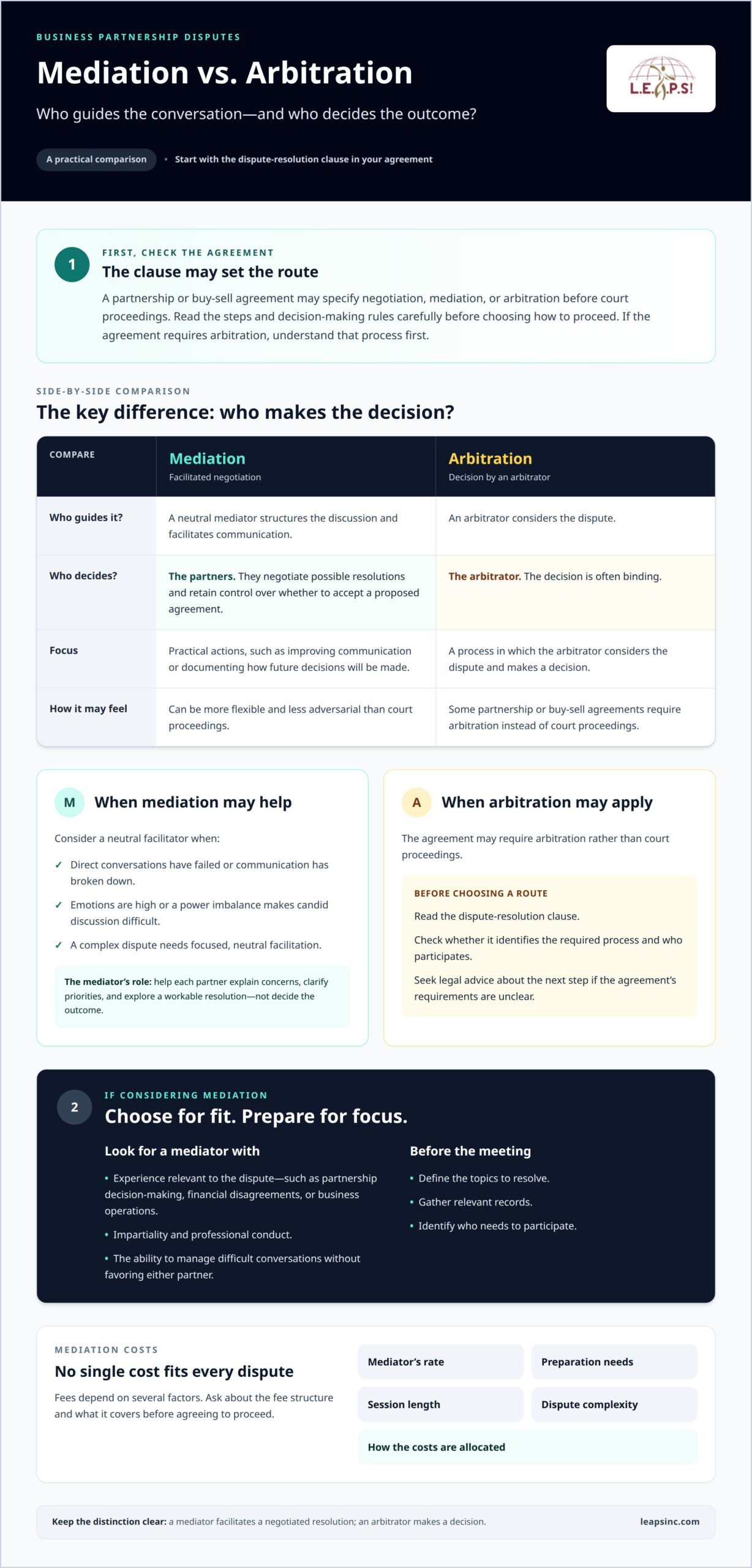
A mediator gives business partners a structured setting to discuss disputes and negotiate possible resolutions. Rather than deciding the outcome, the mediator facilitates communication; partners retain control over whether to accept a proposed agreement. If disagreement about spending has strained the relationship, for example, a mediator can help each partner explain concerns, clarify priorities, and explore a workable approval process.
Mediation can be more flexible and less adversarial than court proceedings. Partners can focus on practical actions, such as improving communication or documenting how future decisions will be made. The U.S. Environmental Protection Agency notes that skilled mediation may be necessary when serious conflict is possible. Mediation can help partners address behavior and business needs without turning every disagreement into a contest to win.
When should a business partner conflict be handled by a mediator? Consider mediation when direct conversations have failed, communication has broken down, emotions are high, or a power imbalance makes candid discussion difficult. It may also help with a complex dispute that needs focused, neutral facilitation. If the partnership agreement requires arbitration, understand that process before choosing mediation.
Arbitration differs from mediation. An arbitrator considers the dispute and makes an often-binding decision, while a mediator helps partners negotiate their own resolution. Some partnership or buy-sell agreements require arbitration instead of court proceedings. Reviewing the agreement helps clarify whether partners can choose mediation, must arbitrate, or should seek legal advice about the next step.
How much does business mediation typically cost in the United States? There is no single cost for every dispute. Fees depend on the mediator’s rate, preparation needs, session length, complexity, and how costs are allocated. A dispute involving several operational issues may require different preparation from a focused discussion about one decision. Ask for the fee structure and what it covers before agreeing to proceed.
Choose a mediator whose experience fits the dispute, such as partnership decision-making, financial disagreements, or business operations. Consider impartiality, professional conduct, and the ability to manage difficult conversations without favoring either partner. Relevant experience can help keep discussion specific: what happened, how it affected the business, and what action could address it.
Before mediation, partners can define the topics to resolve, gather relevant records, and identify who needs to participate. A mediator can establish meeting expectations, give each person space to speak, and guide discussion toward options. The outcome might be a written action plan covering responsibilities, communication, and review dates. Legal counsel can assess any agreement that needs legal review.
If a neutral, structured conversation could help clarify the next step, schedule a conversation.
3. Identifying the underlying issues behind partnership disagreements
A business coach can help partners look beyond the latest disagreement to the pattern beneath it. Start with specific examples: a missed deadline, a decision made without consultation, or recurring tension over spending. A coach can help each partner distinguish observable events from assumptions, then explore how different expectations shaped the situation. This makes resolution more focused than reacting to each incident in isolation.
What are the most common causes of conflict between business partners? Miscommunication, conflicting goals, unmet expectations, unclear responsibilities, and concerns about unequal contributions can all create friction. For example, one partner may expect shared approval for hiring, while the other assumes hiring is part of their own role.
Communication problems deserve close attention. Emails and text messages can make neutral wording seem critical, especially when partners interpret it through different experiences or beliefs. A coach can help compare what one partner intended with what the other understood, then identify where the message changed meaning. The Agency for Toxic Substances and Disease Registry notes that limited ongoing communication or collaboration can contribute to mistrust between partners.
Trust concerns often emerge through repeated behavior, not one isolated disagreement. A partner may stop sharing updates, miss meetings, or question financial decisions. A coach can help partners document specific incidents and their business impact, then consider whether each points to a process gap, a broken commitment, or a deeper relationship concern.
Power issues can surface when one partner routinely makes decisions without consultation or dismisses the other’s expertise. A coach can map which decisions are shared, delegated, or disputed, then explore how each partner experiences the arrangement. Recurring conflict over client commitments, for instance, may reflect unclear authority rather than opposing intentions.
A structured review can separate the dispute into four parts: the event, each partner’s interpretation, the impact on work, and the unmet expectation. This can reveal an underlying cause, such as a change in priorities that was never discussed. Partners can then define what information, behavior, or decision-making process needs to change.
Documentation supports a clearer account of the dispute. A coach can help organize meeting notes, relevant communications, and business records by issue, while distinguishing confirmed facts from personal interpretations. This record can guide a resolution conversation, but it does not establish legal rights or replace legal advice.
If the disagreement involves alleged contract breaches, fiduciary duties, or significant financial claims, seek legal advice. Litigation may become relevant when serious legal issues remain unresolved. A coach’s role is to help identify communication and operating patterns partners can address. Keeping these roles separate helps make the business discussion precise and the next action grounded.
4. Developing a collaborative resolution strategy
A business coach can help partners turn competing positions into a practical plan. A useful starting point for how to handle conflict with a business partner is to clarify the decision at issue, each partner’s needs, and the business impact. If partners disagree about hiring, for example, a coach can help them separate the role’s responsibilities, budget, and approval process. This can prevent misunderstandings from becoming assumptions about each other’s intentions.
Prepare for a difficult conversation by organizing the facts and deciding which outcome matters most. A coach can help partners describe events clearly, identify concerns, and rehearse respectful language. For example, they can explain how a missed approval affected a project instead of opening with blame. Preparation gives the discussion a clear purpose while leaving room for another perspective.
Meeting ground rules can reduce escalation. A coach can help set an agenda, identify necessary participants, and establish that each partner will speak without interruption. Partners can pause before responding, summarize what they heard, and ask focused questions. If emotions run high, a brief cooling-off period can help each person return ready to address the issue rather than react.
Fair compromise starts by distinguishing core needs from preferences. A coach can help partners compare options and consider how each affects responsibilities, resources, and business priorities. If one partner wants faster decisions while the other wants oversight, for example, they might agree that routine choices stay with the responsible lead, while defined major commitments require joint approval.
Structured negotiation makes expectations visible. A coach can help partners assess the practical consequences of each option and identify acceptable trade-offs. A temporary approval process, for instance, could address an immediate concern while partners evaluate whether the arrangement works. This keeps negotiation focused on a solution rather than on whose position prevails.
Direct, open communication is a useful starting point before mediation or arbitration. If partners cannot discuss the issue productively, a neutral third party may facilitate the next conversation. The right dispute-resolution approach depends on the agreement, the nature of the disagreement, and whether both partners can participate constructively.
Once partners identify a workable resolution, a coach can help shape it into a collaborative action plan. The plan can state the goal, each person’s responsibilities, required resources, and how progress will be reviewed. Partners addressing delayed project handoffs, for example, could clarify ownership at each stage and set regular check-ins.
Document decisions and share the record with everyone involved. Include agreed actions, unresolved questions, and the expectations each partner accepted. If the resolution changes legal or financial terms, a legal professional should review the relevant agreement. For partners considering how to handle conflict with a business partner over time, consistent follow-through helps turn a one-time agreement into a more reliable way of working together.
5. Shared mission, vision, and business goals
Partners can disagree about daily choices while sharing an underlying purpose. A business coach can help make that purpose explicit and connect it to the company’s direction and practical goals. A mission describes why the business exists; a vision describes the future partners are working toward. Clarifying both gives difficult discussions a reference point beyond personal preference.
For example, two partners may differ on whether to pursue larger clients or preserve a smaller, specialized business model. A coach can invite each partner to explain their reasoning, including which customers and values they want the business to serve. Comparing these perspectives may reveal shared priorities, such as sustainable growth or consistent service, even when the partners favor different strategies.
From there, partners can develop a mission statement that reflects the business’s purpose and direction. A coach can facilitate a discussion about which commitments belong in the statement and what each means in practice. If “client-centered service” is a shared value, partners can define how it informs project selection, response standards, and investment decisions.
Shared language needs concrete goals. A coach can help partners distinguish short-term objectives, such as improving a particular process, from longer-term aims, such as expanding into a new market. For each goal, partners can establish clear responsibilities, measures of progress, and a review process. This turns broad ambitions into visible commitments they can discuss and adjust.
Unequal contributions can complicate alignment. One partner may bring more client relationships, while another carries more operational responsibility. A coach can help partners identify what each contribution involves, set expectations, track progress, and address gaps without reducing the conversation to blame. Clear accountability gives both partners a basis for discussing whether commitments match business priorities.
Values misalignment calls for a focused action plan. Partners can identify the value in question, describe the behavior or decision creating tension, and agree on the change they expect. If transparency is disputed, for instance, they could define what financial information to share and how often to review it. A coach can help monitor progress and refine the plan as business needs change.
Regular discussions about mission and goals can help prevent smaller disagreements from becoming entrenched. Partners can review business performance together, revisit priorities when circumstances shift, and record decisions in shared notes. If a dispute still requires mediation or arbitration, a clear account of the company’s shared purpose can help frame the issues, but it does not replace the process set out in an agreement.
For structured support in aligning business priorities and responsibilities, schedule a conversation.
LEAPS
LEAPS Inc. helps business partners turn recurring tension into clearer communication, shared priorities, and purposeful next steps. Through Business Coaching, partners can examine how disagreements affect leadership and operations, clarify expectations, and reconnect decisions with company goals. This support can be useful when conversations keep returning to the same issues or partners need a structured perspective on moving forward.
Coaching supports business reflection and planning; it does not replace legal advice, mediation, or arbitration when those processes are needed. For disputes involving legal rights or agreement terms, consult a legal professional alongside business-focused support. If you’re ready to explore a more constructive path forward, contact LEAPS.
Move toward a stronger working future
A business partnership’s future depends not only on how a disagreement ends, but also on what both people choose to build afterward. A difficult period can prompt a more intentional conversation about leadership, trust, and the working relationship each partner wants to sustain. The next step is to act on that intention with care and a clear sense of purpose.
Learning how to handle conflict with a business partner can also mean recognizing when the strain calls for professional support. Business Coaching can help partners focus on their working relationship and business direction. If conflict is affecting personal well-being or family life, LEAPS Inc. also offers Therapy Intensive, Group Therapy, and Family Therapy as distinct forms of support.
You don’t have to let unresolved tension define what comes next. Consider the kind of partnership and future you want to create, then take a deliberate step toward it. Contact LEAPS to discuss your options and explore a path forward with greater clarity.
Frequently Asked Questions
What communication strategies can a business coach use to help resolve business partner disagreements?
A business coach can structure conversations so each partner explains their concern, listens without interruption, and responds to what was actually said. If partners disagree about a delayed project, for example, the coach can help separate the timeline, decision points, and impacts from assumptions about intent. The discussion can then identify a specific change, such as an approval checkpoint, and clarify how both partners will assess whether it helps.
What should a partnership agreement say about disputes and deadlock?
A partnership agreement should explain how partners address disputes and what process applies when they cannot agree on a decision. It can define decision authority, voting rights, responsibilities, and steps such as negotiation, mediation, or arbitration. For a deadlock, clear terms can specify how the issue is escalated and which decisions remain paused while partners seek resolution. A lawyer can draft or review these provisions for the partners’ circumstances.
What legal options exist if business partners cannot resolve a conflict?
Partners may use mediation, follow an arbitration clause, negotiate a settlement, or pursue litigation. Mediation supports negotiation, while arbitration places the decision with a neutral arbitrator and may be binding. The partnership agreement can affect which route is available or required. Legal advice is especially important when disputes involve contract or fiduciary-duty claims, intellectual property, valuation, buyouts, dissolution, real estate, or substantial financial disagreements.
When should you consider buying out a business partner or dissolving the partnership?
Consider a buyout or dissolution when partners cannot make essential decisions, their business goals remain incompatible, or continued operations are no longer workable. Before acting, assess the agreement’s exit provisions, the business’s financial position, ownership interests, and the practical effects on employees and customers. A buyout agreement may address payment, financing, intellectual property, and other terms. Legal and financial advisers can help evaluate the options and document the chosen path.