

Article by
Dr. John E. N. Daniel
Dr. John E. N. Daniel is a visionary with a burning desire to coach, counsel, teach and empower individuals from diverse backgrounds towards the attainment of their maximum potential, life purpose and destiny. He coaches, counsels, consults, mentors, and ministers to the global community through diverse media and environments.
Understanding how to improve employee morale and motivation starts with employees’ everyday experience at work. Leaders can strengthen it through sincere recognition, meaningful development, clear communication, trust, and thoughtful responses to feedback. These actions help people feel valued, supported, and able to contribute.
Employee experience is shaped not only by formal programs but also by daily conversations, decisions, and follow-through. When morale feels low, lasting progress starts with understanding what employees need and responding consistently. Recognition, professional growth, transparency, and regular check-ins can all support motivation. Surveys and workplace patterns can also help leaders assess whether their efforts are making a difference.
Key Takeaways
- Make recognition sincere and specific so employees understand which contributions matter.
- Connect development opportunities and cross-training to employees’ strengths and future goals.
- Build trust by communicating decisions clearly and following through on commitments.
- Use regular check-ins and employee feedback to identify practical changes that can strengthen engagement.
- Track morale through employee input and workplace patterns, then adjust support based on what you learn.
1. Employee appreciation and recognition
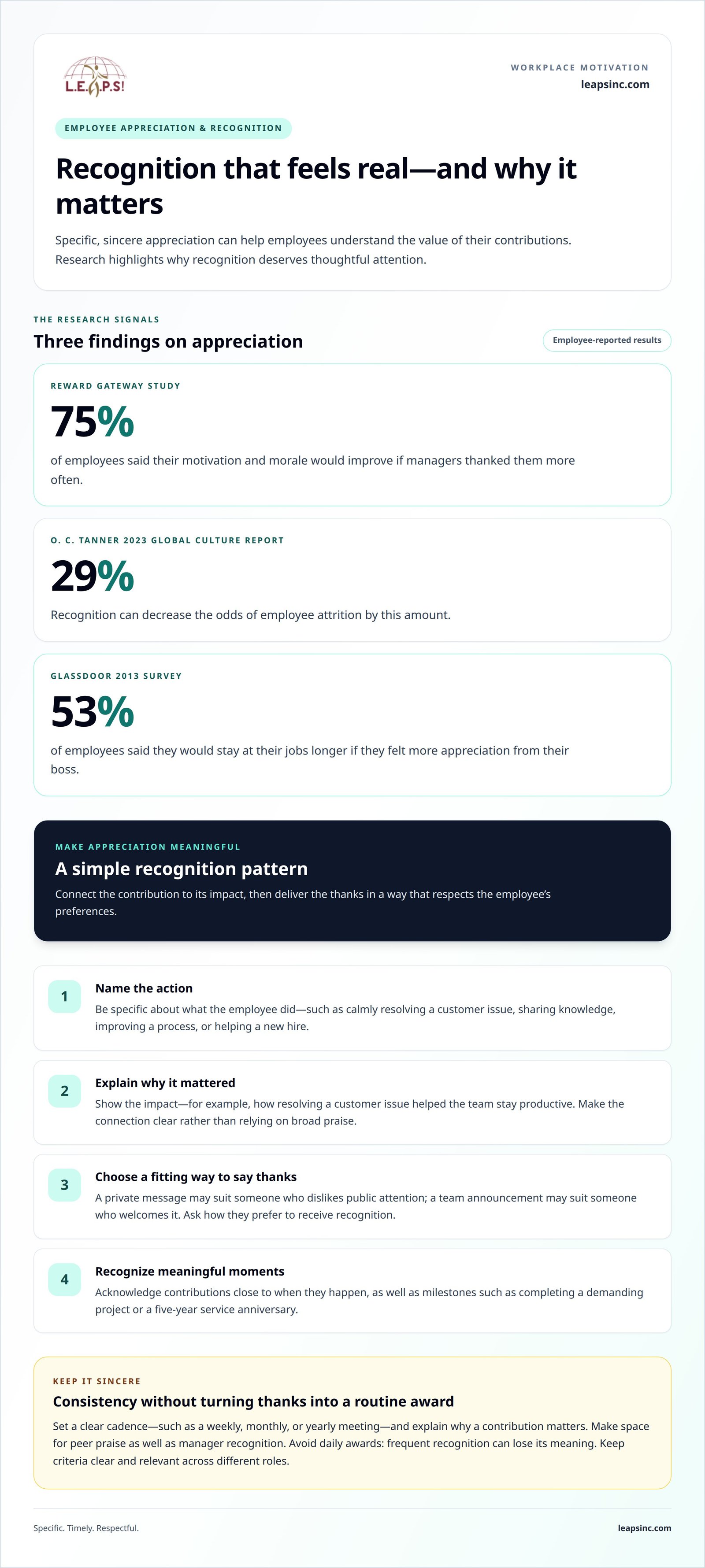
Recognition works best when it connects a specific contribution to its impact. Instead of saying “good job,” a manager might thank an employee for calmly resolving a customer issue and explain how that helped the team stay productive. This makes appreciation concrete. A thoughtful private message may suit an employee who dislikes public attention, while a team announcement may suit someone who welcomes it.
Research points to appreciation as a useful motivation strategy. A Reward Gateway study found that 75% of employees said their motivation and morale would improve if managers thanked them more often. The O. C. Tanner 2023 Global Culture Report found that recognition can decrease the odds of employee attrition by 29%. These findings support making recognition sincere, specific, and attentive to the employee’s preferences.
Recognize achievements close to when they happen, and name the action rather than relying on broad praise. For example, acknowledge a colleague who shares knowledge, improves a process, or helps a new hire become confident in their role. If an employee’s sales result is 25 percent higher than other employees’ results, recognize the achievement in context. Explain what the employee did well, without implying that every role should be judged by sales.
Make appreciation part of the workplace without turning it into a performance. Thank someone in a one-on-one conversation, write a personal note, or recognize a team member during a meeting. Ask how they prefer to receive feedback: public praise may energize one employee but embarrass another. Recognition should feel earned and respectful, not scripted or used as a substitute for fair working conditions.
Choose occasions that reflect meaningful contributions and milestones. A five-year service anniversary can mark sustained commitment, while completing a demanding project offers a timely opportunity to acknowledge shared effort. Set aside time at a weekly, monthly, or yearly meeting to celebrate achievements. A traveling trophy awarded each month can recognize strong overall performance, provided the criteria are clear and relevant to different roles.
Avoid turning appreciation into a daily award routine; frequent awards can lose their meaning. Set a consistent cadence, explain why a contribution matters, and make space for peer praise as well as manager recognition. Glassdoor’s 2013 survey found that 53% of employees said they would stay at their jobs longer if they felt more appreciation from their boss. Thoughtful recognition can reinforce satisfaction and help employees see how their work contributes to a larger purpose.
2. Professional development and cross-training
Employees are more likely to invest in their work when they can see a path forward. Make development practical by discussing each person’s interests, strengths, and next-step skills during a career conversation. For example, a team member who enjoys solving customer problems might shadow a colleague handling complex cases, then practise with support. This gives learning a clear purpose and connects daily responsibilities with future possibilities.
LinkedIn research found that employees who spend time learning on the job are 47% less likely to be stressed and 39% more likely to feel productive and successful. The same research found they are 23% more able to take on additional responsibilities and 21% more likely to feel confident and happy. These findings point toward learning that happens during work, not only through occasional external courses.
Cross-training helps team members understand how different roles contribute to a shared outcome. A manager might pair a new employee with an experienced colleague to learn a process, then ask each person to explain the steps back. Keep the practice focused: identify the task, name who will guide the learning, and agree on how the employee will practise. This encourages skill sharing without assuming everyone wants the same career path.
Development needs a visible connection to advancement. Pew Research Center found that a lack of advancement opportunities was among the top reasons U.S. workers quit their jobs in the previous year. In a one-on-one meeting, leaders can clarify which capabilities matter for a desired role and identify projects where an employee can demonstrate them. If promotion is not immediate, a meaningful stretch assignment or added responsibility can still make growth more tangible.
Make learning accessible within team routines. Set aside time for a colleague to demonstrate a tool, invite team members to share lessons from a completed project, or rotate responsibility for presenting a process update. For example, one member of a marketing team could explain how customer feedback shaped a campaign, while another describes how performance data informed the next decision. These exchanges make expertise visible and help colleagues learn from one another.
Leaders can strengthen this work by aligning employee capability with organizational priorities. Business development support can help organizations consider how growth plans, roles, and team capacity fit together. If you’re shaping a development strategy around business goals, schedule a conversation with LEAPS to explore the direction.
3. Building trust and transparency
Trust grows when leaders explain decisions, acknowledge uncertainty, and follow through on commitments. If a project’s priorities change, describe what changed, why it matters, and how responsibilities will shift. Employees can then understand the reasoning rather than guessing about hidden motives. IBM found that companies outperforming their peers are 30% more likely to identify openness as a key influence on their organization.
Transparency also means being honest about what leaders can and cannot share. Explain the criteria for assigning a high-profile project, for example, while protecting confidential employee information. If a decision is pending, say what remains unresolved and when the team can expect an update. Clear boundaries build credibility; silence and promises without follow-through can undermine it.
Build employee confidence by giving people meaningful ownership and specific feedback about their abilities. A manager might ask an employee to lead a process review, then explain how their analysis helped the team identify a bottleneck. The opportunity communicates trust, while the feedback connects effort with a visible contribution. Avoid inflated praise or comparisons that diminish another worker’s success.
Make team-building employee-led rather than assuming leaders know what everyone will enjoy. Invite team members to suggest activities that reflect different interests, access needs, and comfort levels. One group might prefer a collaborative problem-solving exercise; another might choose a shared lunch or volunteer project. Offering a few options and letting employees decide can make participation feel more authentic.
Give team activities a clear purpose, and don’t use them as a substitute for addressing workplace concerns. A team could map how information moves between roles, then identify where handoffs create confusion. This combines cooperation with practical improvement. Afterward, share what the group learned and which changes leaders will consider. Visible follow-through shows that employee input matters.
Trust grows through repeated actions, not a single team event. Leaders can explain decisions consistently, invite employees to raise concerns, and respond without punishing candor. If a suggestion cannot be adopted, explain why and describe any alternative under consideration. These practices help employees feel respected while maintaining honest boundaries. In a dependable workplace, people can contribute ideas, take responsibility, and work toward shared goals.
4. Clear communication and employee engagement
Employees need to understand what the organization expects and how their work contributes. Managers can explain priorities in team meetings, clarify who owns each task, and define what a successful result looks like. Before a project begins, for example, share its purpose, deadline, decision-maker, and how to raise obstacles. Clear instructions help people focus instead of interpreting incomplete information.
Make feedback a regular exchange, not a one-way performance announcement. In a check-in, ask what is working, where progress is blocked, and what support would help. Then agree on a next step and revisit it. Salesforce research found employees who feel their voice is heard at work are 4.6 times more likely to feel empowered to perform their best work. Listening matters most when leaders act on what they hear.
Motivate remote and hybrid employees by setting clear outcomes, holding consistent one-on-one check-ins, and making team discussions accessible to those outside the office. Ask about workload, connection, and support, then follow through on agreed actions. This gives employees a direct way to raise concerns and ensures participation does not depend on being physically present.
Internal communication should provide context for important changes. When a process shifts, explain what is changing, why the organization is making the change, and how it affects each team. Share common information in a team update, then make space for questions in a meeting or private conversation. A clear message reduces conflicting interpretations and helps employees connect their responsibilities to organizational priorities.
Feedback becomes more useful when it clarifies both the task and its purpose. In BlessingWhite Research’s Employee Engagement Research Update, 20 percent of respondents said greater clarity about what the organization needed them to do and why would most improve their performance. Managers can translate that insight into practical coaching: describe the expected outcome, explain why it matters, and invite the employee to identify barriers. Specific direction gives people a clearer basis for action.
Community volunteering can create a shared purpose beyond routine responsibilities. Invite team members to suggest a cause, such as preparing supplies for a community food program or joining a neighborhood cleanup. Keep participation voluntary and explain the activity, timing, and expectations clearly. Employees can then decide whether it suits their interests and circumstances.
Close the communication loop by explaining what happened after employees shared feedback. Summarize a recurring concern, name the change being implemented, and explain what cannot change and why. This follow-through strengthens engagement because people can see how their input informs decisions. It also helps leaders assess whether communication is supporting greater participation across the organization.
5. Measuring employee satisfaction and morale
Identify causes of low morale by combining anonymous surveys with conversations and workplace trends. Ask about workload, respect, role clarity, advancement, and whether employees feel supported. Then compare responses with turnover, absenteeism, and productivity patterns. This can help distinguish a team-wide issue from a concern affecting a specific role or process.
Changes that support morale, work-life balance, and burnout prevention include manageable workloads, clear priorities, and boundaries around work communication. Leaders can review after-hours expectations, redistribute recurring bottlenecks, and ask employees which adjustments would help. According to Gallup, employees at companies investing in well-being are 59% less likely to look for a job with a different organization in the next 12 months.
Common management mistakes include ignoring feedback, showing favoritism, and making promises leaders cannot keep. These actions weaken trust and may discourage employees from raising concerns. Explain what can change, follow through on commitments, and give a clear reason when a requested change isn’t possible.
A useful survey asks about specific workplace experiences rather than whether employees are simply “happy.” Include direct questions about workload, communication, recognition, and confidence in leadership. Leave space for comments, but avoid collecting identifying details when anonymity is promised. Clear questions make patterns easier to interpret and help leaders choose a relevant response.
Read survey results alongside operational indicators. If absenteeism rises while productivity falls in one department, examine staffing, workload, and unclear responsibilities before assuming employees lack motivation. If employees report low trust but attendance remains steady, follow-up conversations may reveal concerns that aggregate figures cannot explain. Numbers suggest questions; context helps leaders understand them.
Set a consistent review rhythm and communicate what happens next. After each pulse check, summarize the themes, name one or two actions, assign responsibility, and set a date to report progress. A survey without follow-through can weaken participation; visible action shows employees their input matters. Track whether the same concern persists at the next check-in.
Use results to improve workplace culture, not to rank individuals or pressure teams to raise scores. Pair morale questions with clear, fair performance conversations so employees understand expectations and how their work is assessed. Review whether people feel fairly evaluated, and address concerns about unclear or inconsistent criteria.
If employee feedback points to deeper workplace well-being concerns, schedule an appointment to discuss next steps.
LEAPS: Employee Assistant Program (EAP)
LEAPS offers an Employee Assistant Program (EAP) for organizations that want to include employee assistance in their approach to workplace well-being. Consider it when feedback suggests morale concerns extend beyond unclear priorities or team processes and employees may benefit from additional support. An EAP can complement practical management changes, such as reviewing workload, clarifying expectations, and responding to employee input.
Morale efforts are strongest when organizations address both working conditions and employee needs. LEAPS also offers Therapy Intensive, Group Therapy, and Family Therapy. These options may be appropriate when a different form of support better fits the situation. Start by understanding the concern employees have raised and the kind of support they are seeking.
Contact LEAPS to discuss an appropriate next step.
Make employee experience an ongoing leadership priority
A stronger employee experience takes shape through leaders’ daily choices and deliberate reflection. Treat morale as an ongoing leadership priority, not a problem to address only after engagement declines. Ask what kind of workplace your organization wants to create, then align decisions, expectations, and support with that vision. The question of how to improve employee morale and motivation becomes more useful when it leads to consistent action and honest attention to employees’ needs.
When workplace concerns call for support beyond management practices, LEAPS offers services including an Employee Assistant Program (EAP), Therapy Intensive, Group Therapy, and Family Therapy. The right next step depends on the concern and the kind of support being sought. Contact LEAPS to discuss employee experience and explore a thoughtful path forward. Each intentional step can help shape a workplace where people are better positioned to contribute and grow.
Frequently Asked Questions
What rewards can you give?
Offer rewards that match the contribution and the employee’s preferences. Options include time for professional learning, a preferred project assignment, more schedule flexibility, or a team experience. Ask which forms of recognition feel meaningful, and use transparent criteria to determine who receives them. For example, a project team that improves a customer handoff might choose a shared learning session instead of individual gifts.
What are the most effective ways to improve employee morale and motivation?
An effective approach combines fair expectations, meaningful work, supportive leadership, and opportunities to grow. Start by identifying the issue employees are experiencing rather than assuming a perk will solve it. If a team feels overwhelmed by shifting priorities, for example, clarify who makes decisions before adding social activities. A coordinated response addresses root causes and makes everyday work more sustainable.
How does recognition and appreciation affect employee motivation?
Thoughtful recognition helps employees understand which contributions the organization values. It can reinforce initiative, collaboration, or careful problem-solving, especially when a manager explains the impact of a specific action. Thanking an employee for documenting a process, for instance, signals that sharing knowledge matters, not just visible individual results. Recognition feels credible when it reflects genuine work and does not replace attention to workplace concerns.
What are low-cost employee morale improvement ideas?
Low-cost ideas include clearer project handoffs, peer-led skill exchanges, and protected time for focused work. A manager could ask employees to identify a recurring interruption, then test a practical change, such as consolidating routine updates. Teams can also share useful tools or lessons during existing meetings. These steps rely on attention and coordination rather than expensive perks, while making daily work easier to navigate.
How can leaders improve employee engagement through communication and feedback?
Leaders can strengthen engagement by making expectations specific and feedback two-way. When assigning a task, clarify the desired outcome and ask what could get in the way. In a follow-up conversation, discuss an observable example, its impact, and a useful next step. This gives employees a chance to explain the context, understand priorities, and help shape solutions instead of receiving unclear criticism.
How do fair pay, benefits, and career development influence motivation?
Fair pay and relevant benefits help employees assess whether their contributions and needs are respected; development shows how their capabilities can grow. Organizations can review role expectations and compensation practices for consistency, then explain available growth paths. An employee seeking broader responsibility, for example, could agree on a skill-building assignment and clear readiness criteria. These elements work together rather than serving as interchangeable incentives.
How should organizations measure employee morale and motivation?
Use a consistent set of questions, then compare responses over time with indicators such as turnover, absenteeism, and team-specific workload patterns. Ask whether employees have the resources, clarity, and support they need to do their work. Review results by team only when privacy is protected, and investigate meaningful changes through conversations. A single overall score can conceal distinct concerns across roles.
How can companies create an employee recognition program?
Define the behaviors the program aims to recognize, such as collaboration, customer care, or process improvement. Set clear nomination and selection criteria, explain who can participate, and offer more than one way to acknowledge contributions. Invite employee feedback on the design before launch. Then review whether recognition reaches different roles fairly, and adjust the program if employees find it inconsistent or inaccessible.