


Article by
Dr. John E. N. Daniel
Dr. John E. N. Daniel is a visionary with a burning desire to coach, counsel, teach and empower individuals from diverse backgrounds towards the attainment of their maximum potential, life purpose and destiny. He coaches, counsels, consults, mentors, and ministers to the global community through diverse media and environments.
Remote teams don’t need leaders who simply monitor activity; they need leaders who build trust, communicate with intention, and make accountability clear across distance. A leadership development program for remote teams can strengthen these skills while helping managers respond thoughtfully to the challenges of distributed work.
It’s understandable to want practical management skills, not just leadership theory. This article explains how professional development can strengthen trust, communication, and performance management, and what to consider when choosing a program’s format and workload. You’ll also learn how structured learning and peer discussion can help leaders turn insights into consistent habits that support a more connected, capable team.
Key Takeaways
- Build trust across distance through responsiveness, follow-through, and clear ownership of results.
- Strengthen remote management by making performance expectations consistent, transparent, and easier to understand.
- Choose a learning format that balances focused sessions with time to apply new leadership practices between them.
- Use intentional communication to support alignment, connection, and constructive conversations across a dispersed team.
- Consider LEAPS’ Employee Assistant Program (EAP) when organizational support is part of the next step.
Building trust in virtual teams
What are the best leadership development programs for remote teams? The strongest fit combines practical coaching, peer learning, and opportunities to apply skills to real work. The right mix depends on leaders’ needs, the team’s environment, and whether learning should happen in person, virtually, or through self-paced materials.
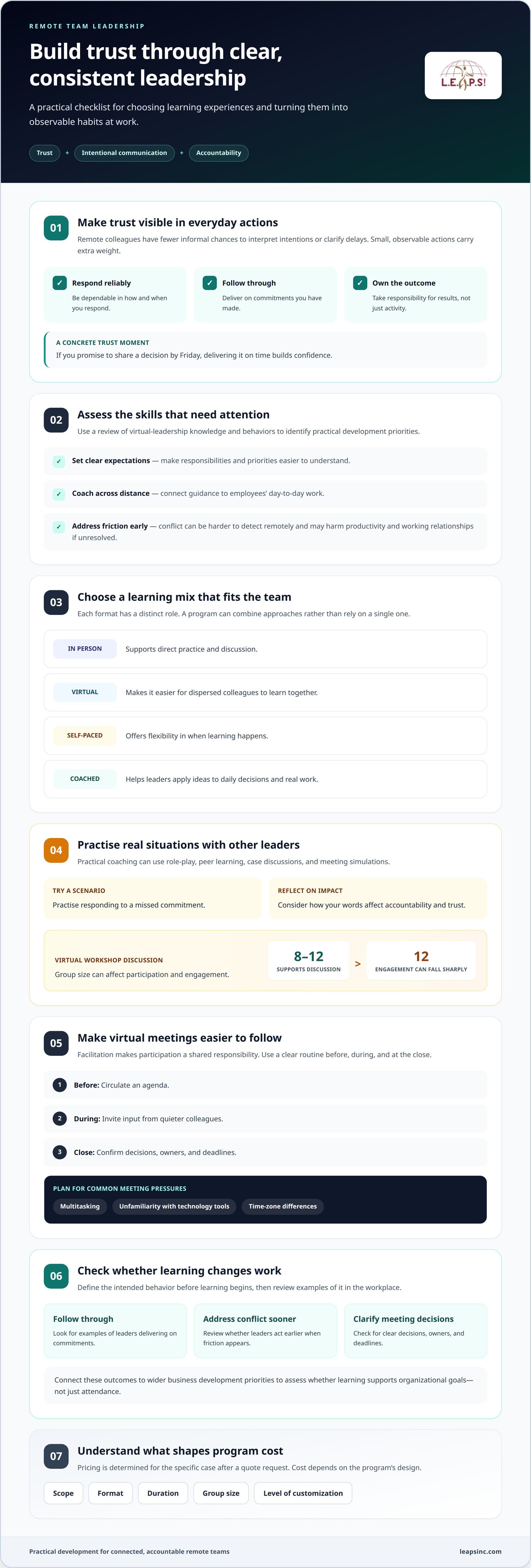
Trust in a virtual team grows through observable actions: responding reliably, following through on commitments, and taking responsibility for results. A leader who promises to share a decision by Friday builds confidence by delivering it on time. These small moments shape relationships because remote colleagues have fewer informal opportunities to interpret intentions or clarify delays.
Spencer Stuart notes that virtual leaders can strengthen their effectiveness by assessing their knowledge of virtual leadership and the behaviors they use. That assessment can reveal practical development priorities, such as setting clear expectations, coaching across distance, and addressing friction early. Conflict can be harder to detect remotely, and if left unresolved, it may harm productivity and working relationships.
Each learning format serves a different purpose. In-person sessions allow direct practice and discussion, while virtual sessions make it easier for dispersed colleagues to learn together. Self-paced learning offers flexibility, and coached application helps leaders connect ideas to daily decisions. A program can combine these approaches instead of relying on one format.
Professional coaches may use role-play, peer learning, case discussions, and meeting simulations to develop virtual leadership skills. For example, participants can practise responding to a missed commitment, then reflect on how their words affect accountability and trust. A facilitated virtual workshop works best when participants can contribute meaningfully; groups of 8-12 support discussion, while groups exceeding 12 can see engagement fall sharply.
Virtual meeting facilitation makes participation a shared responsibility. A leader can circulate an agenda beforehand, invite input from quieter colleagues, and close by confirming decisions, owners, and deadlines. Spencer Stuart identifies multitasking, unfamiliarity with technology tools, and time-zone differences as challenges to effective virtual meetings. Clear facilitation helps teams stay focused despite these pressures.
How much do remote leadership development programs cost? Costs depend on scope, format, duration, group size, and the level of customization; pricing is determined for the specific case after a quote request. These factors matter more than choosing a format by name alone.
Measure effectiveness by defining the intended behavior before learning begins, then reviewing examples of that behavior at work. Track whether leaders follow through, address conflict sooner, and create clearer meeting decisions. Connecting these outcomes to wider business development priorities helps assess whether learning supports organizational goals, not just attendance.
How can a professional coach improve my remote team management skills?
A professional coach helps managers turn broad goals into observable practices for remote work. This includes clarifying performance expectations, guiding employees through change, and building connection across remote and hybrid arrangements.
Performance and Expectations
Remote performance management starts with clear outcomes, ownership, and communication. A coach can help leaders turn a broad goal, such as improving customer response, into defined responsibilities and regular progress conversations. The focus is on results and support, not treating online presence as proof of performance.
Harvard Business Review reports that only 23% of managers feel confident managing remote workers. Coaching can help close that confidence gap by rehearsing feedback conversations and identifying where employees need guidance. Leaders should look for practices that make expectations consistent and transparent across dispersed teams, including clear priorities, constructive feedback, and a shared understanding of what good performance means.
Change and Common Challenges
Change can unsettle priorities, roles, and communication. A coach helps leaders identify what employees need to understand, which concerns could disrupt work, and how to explain decisions clearly. For example, when a project changes direction, a manager can restate the goal, explain what has changed, and invite questions before assigning revised responsibilities.
Motivation and delivery can also need attention: 45% of remote performers report motivation issues, while 15% struggle with executing deliverables. These figures point to different management responses. A coach can help a leader explore whether an employee needs clearer milestones, timely feedback, or a more direct conversation about obstacles. Addressing a concern early can protect progress and working relationships.
Remote and Hybrid Team Management
Remote and hybrid teams need performance practices that are fair across different work locations. Spencer Stuart says organizations that plan virtual team structure and define good performance are better positioned to get a return on investment. Coaching can help managers clarify how work moves between colleagues, where decisions sit, and how employees receive equal access to guidance.
For example, a hybrid meeting can exclude remote employees from an important exchange unless the leader deliberately invites their input. A coach can help managers review meeting habits, handoffs, and communication channels, then adapt them to the team’s actual work. The goal is to support accountability without treating location as a measure of commitment.
Coaching is most useful when leaders bring a current management challenge, such as missed deadlines or unclear ownership. A coach can help them examine the situation, practise a response, and define what progress should look like. Spencer Stuart also notes that virtual leaders can coach people and strengthen accountability, even when those employees don’t report directly to them.
To connect leadership development with organizational needs, align learning goals with the team’s performance expectations. A focused discussion about your management priorities can help clarify a useful next step; schedule a conversation.
Remote-team leadership course format and workload
How do professionals design a leadership development program for remote managers? They start with the team’s priorities, leaders’ responsibilities, and skills that need development. Then they choose a format and workload that give managers time to practise between sessions, rather than treating attendance as the outcome.
A distributed workforce often benefits from shorter learning blocks with application work between them. One recommended structure replaces a four-hour leadership workshop with four 75-minute sessions across four weeks. That format gives managers space to test a conversation or meeting practice at work, then return with a specific example for peer discussion.
For deeper cohort learning, a recommended design uses one 75-90-minute session every two to three weeks, with application work between meetings. Cohorts of 10-12 leaders can develop relationships and cohesion over several months. Sessions can combine peer learning, activities, and in-depth discussion of remote leadership challenges, so each team member can connect concepts to real decisions.
Individual support uses a different rhythm. Biweekly virtual coaching sessions of 45-60 minutes are recommended for most leaders. Between sessions, managers can apply one agreed practice, such as clarifying a decision owner or adapting a check-in for an employee who needs more direction. The next conversation can examine what happened and refine the approach.
How can professionals adapt leadership development programs across time zones and cultures? They can rotate meeting times, choose examples that reflect different work contexts, and set application tasks that don’t require everyone to meet at once. A facilitator can also invite participants to explain how local communication norms shape feedback, decision-making, and expectations.
Motivation depends partly on relationships: teams are 16 times more likely to be motivated when they trust co-workers. A course can build that foundation through structured peer partnerships, shared problem-solving, and reflection on team culture. For example, managers might discuss how recognition is expressed across their workforce, then consider whether their current habits reach remote colleagues consistently.
Customization should connect learning activities to the team’s actual responsibilities. A group managing complex handoffs may practise clarifying ownership; a newly reorganized team may focus on communicating change. The professional designs the sequence around those priorities, then adjusts examples and discussions as participants bring forward challenges. This keeps the format relevant without turning a two-day retreat into a 16-hour Zoom event.
Communicating clearly and compellingly at a distance
Remote communication shapes collaboration, accountability, and employees’ sense of connection. Clear practices help dispersed colleagues align decisions with daily work.
Remote Communication and Collaboration
Spencer Stuart identifies clear, compelling communication as essential to trust, relationships, conflict management, influence, coaching, motivation, and decision-making. Leaders can make collaboration more reliable by matching each message to its purpose. For example, use a shared project document to record decisions and a direct conversation for sensitive feedback.
Digital tools should improve access and productivity, not multiply competing channels. Harvard Online recommends selecting tools that increase productivity and access between remote employees. A leader can define where the team shares project updates, records decisions, and raises urgent issues, then use those channels consistently.
Communication Boundaries and Expectations
Boundaries clarify when employees should respond, which channel fits a request, and how urgent work is identified. For example, a manager can label a message as informational or action-required, name the responsible person, and state the deadline. These cues reduce ambiguity without treating every notification as an immediate demand.
Time-zone differences can complicate collaboration, so leaders can document decisions for colleagues who cannot attend live discussions. A concise meeting summary should capture the decision, owner, next step, and deadline. This creates a dependable record and gives employees a clear way to raise questions asynchronously.
Alignment and Engagement
Communication aligns teams when leaders connect individual responsibilities to shared priorities. Spencer Stuart says virtual leaders should create a sense of community to engage and motivate people from a distance. A manager can invite each project lead to explain how their work supports the shared goal, then clarify dependencies before deadlines approach.
Facilitation matters, too. A leader can circulate a focused agenda, invite input from different roles, and close by confirming decisions. Groups exceeding 12 participants can see engagement drop sharply, so large discussions benefit from structured contributions rather than open-ended conversation alone.
Use feedback to test whether a message created shared understanding. After announcing a change, ask team members to summarize the new priority and explain its effect on current work. If their responses differ, clarify the message before execution begins. This simple step helps surface misalignment early and strengthens accountability.
Success depends on communication habits employees can use consistently. A remote leadership course can practise concise updates, written decision records, and facilitated conversations through realistic scenarios. Leaders can then apply those practices to actual projects, review where handoffs broke down, and refine team norms to support connection and collaboration.
Skills and strategies for leading remote teams
Strong remote leadership is less about constant oversight and more about directing work while enabling people to contribute. A professional development plan can build the ability to prioritize, coach, influence, and support employees across distance. The key is to develop strategies around the work leaders must lead, rather than abstract leadership ideals.
A McKinsey survey found that 53% of leaders indicated building skills was the best way to close their company’s capability gaps in the next year. For remote organizations, that means identifying where leadership practice limits execution. A facilitator can map business priorities to skills, then shape learning around real situations, such as shifting project ownership or resolving competing demands.
Effective leaders also guide people beyond formal reporting lines. Spencer Stuart says virtual leaders can coach colleagues and strengthen accountability even when those people don’t report directly to them. A practical development exercise can ask leaders to practise influencing a cross-functional partner: clarify the shared outcome, surface constraints, and agree on the next action. This builds influence without relying on authority alone.
Prioritization is another essential ability. Remote work can make urgent requests visible while important work stays less obvious. A coach can help leaders distinguish immediate interruptions from strategic priorities, then communicate how teams should make trade-offs. For example, if a deadline changes, a leader can identify which deliverable moves, explain why, and align affected colleagues before redirecting work.
Peer partnerships create a structured opportunity to reflect on leadership choices. A recommended approach is a 30-minute biweekly check-in between peers. A facilitator can give those conversations a useful focus, such as examining a recent delegation decision or planning how to support an employee facing a new responsibility. The cadence gives leaders a recurring space to test assumptions and consider alternative responses.
Intentional strategies should account for differences in experience, autonomy, and support needs. One employee may thrive with broad ownership, while another may need more frequent direction while learning a new role. A professional can help managers adapt their support without lowering expectations, using scenario discussions to explore how coaching, delegation, and follow-up change with context.
To assess development, organizations can connect learning objectives to observable leadership actions. A facilitator might help define effective delegation, then review examples from team projects and feedback conversations. The focus stays on evidence of changed practice, not attendance alone. This helps leaders identify growth opportunities and adjust the development plan as responsibilities evolve.
If you’re ready to clarify the leadership capabilities your organization needs, schedule a conversation.
LEAPS: Employee Assistant Program (EAP)
LEAPS Inc.’s Employee Assistant Program (EAP) offers organizations a way to include employee support in broader leadership and workforce priorities. Consider this option when remote team challenges involve not only management practices but also employee well-being and the support people need to participate at work. The program can complement leadership development as part of a thoughtful approach to team culture.
For concerns that call for another form of care, LEAPS Inc. also offers Group Therapy, Family Therapy, and Therapy Intensive. The right path depends on whether the need is organizational or personal and what kind of support is appropriate.
To discuss employee support and leadership priorities, contact LEAPS Inc..
Turn leadership insight into lasting progress
A leadership development program for remote teams can mark the beginning of a more intentional way to lead, not a one-time intervention. The next step is to identify the leadership capacity your organization wants to strengthen and connect that intention to a meaningful business priority. From there, development can become a sustained practice: leaders reflect, adapt, and grow in response to their team’s evolving needs.
For leaders seeking individualized support, LEAPS offers Executive Coaching. It can create space to examine leadership challenges and clarify a purposeful direction for professional growth. The work is most meaningful when new insight becomes deliberate action shaped by the realities of the team and organization.
Discuss your leadership development goals with LEAPS and take a considered step toward the future you want to lead.
Frequently Asked Questions
How long is the program?
Program length depends on the development goals, the skills being addressed, and the time leaders need to apply them. A focused learning experience may address a specific challenge, while broader development may allow more time for practice and reflection. For example, a team refining delegation may need a different learning sequence from one preparing managers for organizational change.
Is the training customizable for my team’s needs?
Yes. A professional can tailor learning objectives, examples, and activities to the team’s responsibilities and current challenges. For instance, a product group managing frequent handoffs might examine decision ownership, while a newly formed leadership group might focus on shared expectations. Customization is most useful when goals reflect real work situations rather than general leadership themes that don’t match participants’ roles.
What is remote leadership training?
Remote leadership training develops the judgment and practices managers need to guide employees working apart. A leadership development program for remote teams can address how leaders set direction, support people, and make decisions when colleagues aren’t in the same workplace. Learning may include facilitated discussion and practical activities, giving managers a chance to consider how their choices affect team coordination and employee experience.
What topics are covered in the workshops?
Workshop topics can include trust, communication, performance expectations, conflict, and employee support. The focus depends on the leadership challenges participants bring. A session might examine how a manager can respond when a project partner misses a commitment or give feedback across distance. Peer discussion and applied activities help participants compare possible responses and consider their effects before using them at work.
What’s the right cadence for virtual leadership development sessions?
The right cadence leaves enough room for learning and workplace application without letting development lose focus. Consider participants’ responsibilities, time-zone differences, and how quickly they can practise a new approach. If managers need to test a skill between meetings, leave time to reflect on what happened. A consistent rhythm also helps participants prepare examples and carry learning into their next discussion.
What is a leadership development program for remote teams?
It’s a structured learning experience that helps managers lead distributed colleagues with greater intention. Rather than focusing only on remote-work tools, it develops practices for guiding people, coordinating work, and responding to challenges across distance. A useful program connects its goals to the organization’s real priorities, so managers can apply ideas to their teams’ responsibilities and evolving work environment.
What skills should remote leadership training cover?
Training should build skills leaders can use in everyday decisions: prioritizing work, delegating clearly, coaching employees, and influencing colleagues across functions. It can also help managers recognize when a team member needs autonomy or more guidance. For example, when assigning a new responsibility, a leader can clarify the desired outcome and invite the employee to identify the resources or support needed to move forward.
How long should a remote leadership development program last?
Set the program’s duration around the change leaders are expected to make, not a preset calendar. A single development priority may call for a focused sequence, while broader goals can require sustained opportunities to practise, receive feedback, and refine new habits. The design should also account for managers’ workloads and the complexity of applying skills across roles. Review progress against the learning goals as the program unfolds.