

What if the invisible architecture of your intimacy is the single greatest predictor of your professional legacy? Many high-achieving individuals view their personal lives and executive performance as separate silos, yet the recurring patterns of misunderstanding or the sudden fear of abandonment often stem from the same source. These dynamics are rooted in your attachment styles in relationships, an internal blueprint that dictates how you navigate conflict and connection. It’s frustrating to feel like a visionary in the boardroom while struggling to maintain emotional equilibrium at home. We understand that this disconnect limits your maximum potential.
This guide illuminates how to decode your unique attachment script and provides the strategic framework to cultivate a secure, high-potential partnership. You’ll learn to master co-regulation and align your emotional health with your long-term goals. We’ll explore the science of secureness and the actionable steps required to transform your relationship destiny into a foundation for global impact. By rewriting these internal scripts, you can finally bridge the gap between your private vulnerabilities and your public achievements.
Key Takeaways
- Understand how early caregiver interactions establish your psychological foundation, shaping both your intimate bonds and professional leadership style.
- Identify the specific attachment styles in relationships that dictate your response to conflict, intimacy, and the fear of abandonment.
- Recognize the “Visionary Leader’s Shadow” to prevent insecure attachment patterns from undermining your team synergy and executive legacy.
- Master the protocol of co-regulation to stabilize emotional fluctuations and cultivate a secure, high-potential partnership destiny.
- Explore how high-level clinical interventions can rapidly accelerate your journey toward emotional transformation and earned security.
The Architecture of Connection: Defining Attachment Styles in Relationships
Have you ever considered that your current relationship struggles are actually echoes of a much older story? Attachment theory provides the essential psychological framework for human bonding, revealing how our earliest connections establish the foundation for all future intimacy. These foundational years create what clinicians call an “internal working model,” a subconscious map that influences how we interpret trust, conflict, and closeness. This map doesn’t just suggest a path; it often dictates a relationship destiny that repeats itself until it’s consciously addressed. Developing an awareness of attachment styles in relationships is the key to unlocking a life of profound satisfaction and professional resilience. It’s the difference between being a victim of your history and the master of your future. When we look at connection through this architectural lens, we see that every interaction is either reinforcing an old blueprint or helping us draft a new one. This clarity is vital for anyone seeking to align their personal happiness with their public impact. By understanding the structural roots of your behavior, you can begin to dismantle the barriers to true connection.
The Visionary Perspective on Attachment
Viewing your attachment through a visionary lens means moving beyond the limitations of clinical labels. Instead of seeing a “style” as a permanent diagnosis, we view it as a strategic growth opportunity to reclaim personal power. This process involves auditing emotional defaults and architecting excellence. This transformative work is central to our therapeutic philosophy, where emotional well-being serves as the engine of your professional legacy. When you understand your blueprint, you stop reacting to the past and start designing your future.
The Science of the Secure Base
The biological need for a “secure base” is a requirement for high-level performance. In high-stress environments, a secure internal map functions as a psychological anchor, allowing for calculated risk-taking and visionary leadership. Without this stability, hyper-vigilance drains the cognitive resources needed for innovation. Your attachment style is a strategic blueprint for intimacy that determines the height of your professional and personal ceiling. Cultivating security provides the freedom to pursue audacious goals with an unbreakable foundation.
Decoding the Four Blueprints: How Your Internal Map Shapes Intimacy
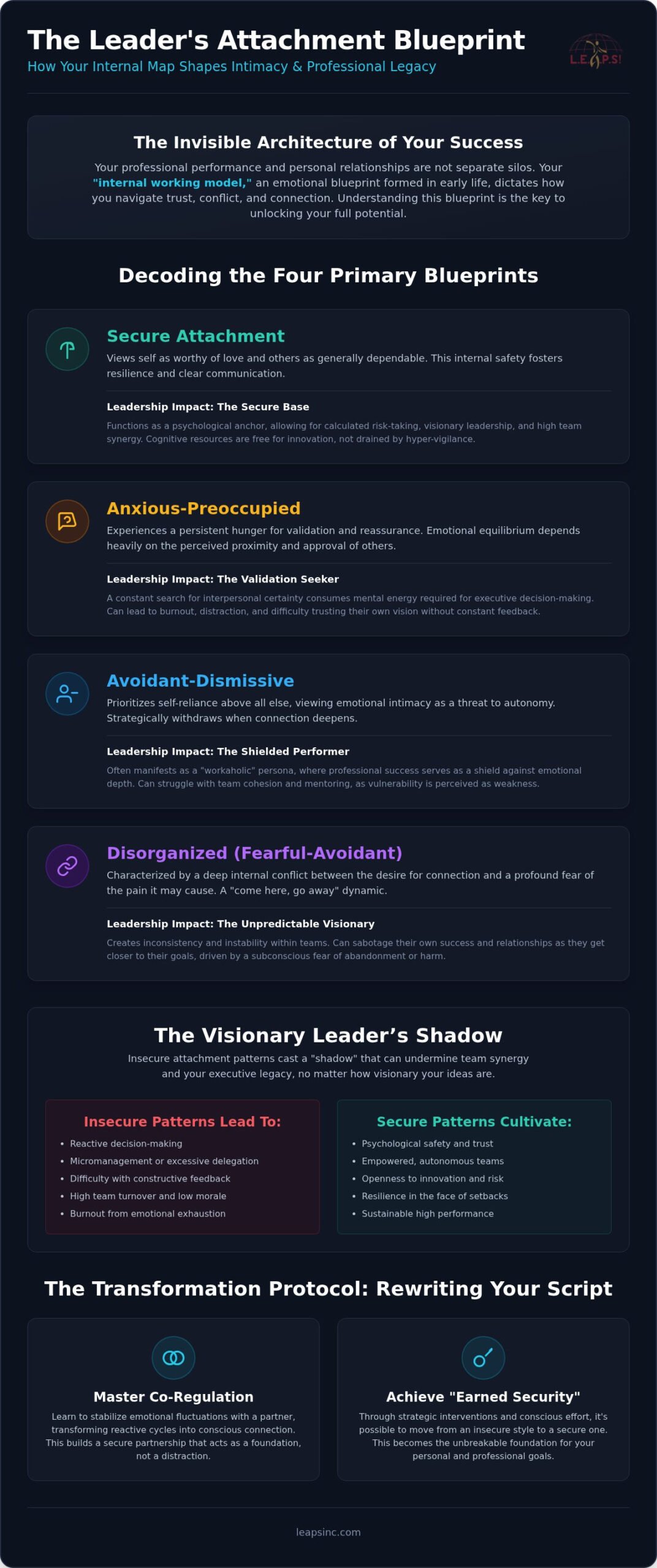
Every individual operates from one of four primary blueprints: Secure, Anxious-Preoccupied, Avoidant-Dismissive, or Disorganized. These aren’t just personality quirks. They are sophisticated operational systems that dictate how you manage vulnerability and autonomy. While the “Secure” style represents the gold standard of emotional health, the three “Insecure” variations often stem from adaptive strategies developed in childhood. Recognizing these attachment styles in relationships is vital for anyone in a high-stakes partnership. It allows you to anticipate friction points before they derail your shared vision. Without this awareness, you’re likely to repeat the same reactive cycles, regardless of how much you achieve in your professional life.
Secure and Anxious-Preoccupied Styles
Secure individuals possess an innate resilience. They view themselves as worthy of love and others as generally dependable. This internal safety allows for clear communication and a total lack of manipulative game-playing. In contrast, those with an Anxious-Preoccupied style often feel a persistent hunger for validation. Their emotional equilibrium depends heavily on the perceived proximity of their partner. This constant search for reassurance can bleed into the professional sphere. A lack of interpersonal certainty consumes the mental energy required for executive decision-making, leading to burnout or distraction.
Avoidant-Dismissive and Disorganized Styles
Avoidant-Dismissive individuals prioritize self-reliance above all else. They often view intimacy as a threat to their autonomy, leading to strategic withdrawal when a partner attempts to deepen the bond. This can manifest as a “workaholic” persona where professional success serves as a shield against emotional depth. Then there is the Disorganized style, which is characterized by a conflict between the desire for connection and a deep-seated fear of pain. It creates a painful loop where the person moves toward intimacy only to retreat in a state of hyper-vigilance.
- The Avoidant-Anxious Trap: A common cycle where one partner’s pursuit triggers the other’s retreat, creating a perpetual state of instability.
- Strategic Distancing: Using professional obligations or intellectualization to avoid genuine emotional vulnerability.
- The Quest for Security: Moving from a reactive state to a proactive, “earned” secure attachment through conscious effort.
Understanding the structural “why” behind these behaviors is the first step toward transformation. You aren’t “broken”; your internal map is simply following an outdated script that no longer serves your current potential. If you’re ready to move beyond these reactive patterns, it’s time to audit your emotional infrastructure to ensure it supports your highest relationship destiny.
The Visionary Leader’s Shadow: How Attachment Styles Influence Professional Synergy
The boardroom is often a theater for the unresolved. While we’ve established how attachment styles in relationships dictate your private life, these same psychological blueprints govern your professional synergy and leadership efficacy. High-achieving individuals frequently ignore the invisible scripts that drive their executive decisions, yet your attachment style often acts as the silent architect of your corporate culture. When a leader’s internal map is rooted in insecurity, it creates a “shadow” that can dim the potential of an entire organization. Integrating clinical depth with strategic advancement through executive coaching allows you to align your emotional architecture with your professional legacy, ensuring that your success isn’t built on a foundation of reactive patterns.
The “Avoidant Executive” is a common archetype in the prestige professional world. These individuals often present as the ultimate high-performers: decisive, fiercely independent, and seemingly unflappable under pressure. However, their strategic withdrawal from emotional vulnerability creates a hard ceiling for team cohesion. Because they view the needs of others as a potential “engulfment,” they may struggle to build the deep trust required for visionary collaboration. Conversely, the “Anxious Entrepreneur” might build a successful empire fueled by a desperate need for external validation. Their business success becomes a proxy for self-worth, leading to hyper-vigilance regarding market shifts or employee feedback, which eventually results in erratic decision-making and founder burnout.
Leadership and the Secure Base
Secure leaders function as a “secure base” for their organizations, providing the stability necessary for true innovation. When a leader is securely attached, they don’t perceive a team member’s mistake or a pivot in strategy as a personal threat or an act of abandonment. This security fosters a culture of psychological safety where employees feel empowered to take calculated risks. Through entrepreneurship coaching, visionary founders can learn to cultivate this secure base, moving beyond the “lone wolf” mentality to embrace a more collaborative and sustainable model of growth.
- Effective Delegation: Secure attachment allows leaders to trust their team’s competence without the need for micromanagement.
- Conflict Resilience: Secure leaders view disagreements as strategic hurdles rather than personal attacks.
- Innovation Sprints: Psychological safety is the primary driver of creative risk-taking in high-stakes environments.
Rewriting the Professional Script
Transformation begins with identifying your “attachment triggers” in the boardroom. Does a critical board report feel like a rejection of your identity? Does a partner’s request for more autonomy trigger a need for control? Understanding your attachment styles in relationships allows you to pause before reacting, moving from a defensive posture to a proactive leadership stance. You’re no longer at the mercy of early caregiver maps; you’re the architect of a new professional destiny. Emotional security is the ultimate competitive advantage.
Transformation Protocol: Secure Attachment & Co-Regulation
Transformation isn’t a passive event; it’s a strategic realignment of your emotional defaults. To move from a reactive state to what clinicians call “earned security,” you must master the art of co-regulation. This is the interactive process where partners serve as emotional stabilizers for one another, creating a rhythmic feedback loop of safety and trust. When you understand the underlying mechanics of attachment styles in relationships, you gain the power to rewrite your narrative with clinical intentionality. This evolution is a core component of achieving a high-potential partnership, a concept we explore deeply in our visionary guide to Modern Connection. By moving beyond survival strategies, you create space for a legacy of genuine intimacy.
Step 1: Awareness and Deconstruction
The first stage of the protocol involves a rigorous audit of your relationship history. You must deconstruct the recurring themes that have defined your past connections to see the fingerprints of your attachment map. By identifying core wounds, you learn to name a “trigger” before it escalates into a full-blown reaction. This level of self-mastery often requires the clinical depth of individual therapy to provide a secure mirror for your growth. It’s about moving beyond surface-level symptoms to address the structural vulnerabilities in your attachment styles in relationships. Awareness is the prerequisite for any lasting emotional transformation.
Step 2: Practicing Co-Regulation
Practicing co-regulation requires a deliberate shift from defensive posturing to mutual grounding. We advocate for the “Visionary Pause,” a period of strategic silence used to regulate your nervous system rather than as a tool for emotional withdrawal. During moments of high tension, use “I” statements to signal your internal state rather than projecting a threat onto your partner. This transparency invites your partner into a collaborative solution rather than a power struggle. It transforms conflict from a source of damage into a strategic opportunity for deeper connection and mutual stabilization. For those navigating recurring domestic friction, applying proven family conflict resolution techniques alongside co-regulation practices can accelerate the shift from reactive cycles to lasting emotional repair.
Step 3: Intentional Integration
Integration is the consistent choice of secure behaviors over old, defensive instincts. It’s not enough to intellectually understand your style; you must actively practice new scripts until they become your new baseline. Engaging in couples therapy provides a structured environment to test these skills in real-time under professional guidance. By establishing a clear “Relationship Vision,” you prioritize mutual security as the foundation for your shared destiny. This intentionality ensures that your private life supports, rather than distracts from, your professional peak performance.
If you’re ready to architect a more secure future and move toward your maximum relationship potential, you can schedule a strategic consultation to begin your transformation protocol today.
Strategic Healing: Integrating Clinical Depth to Rewrite Your Relationship Destiny
Attachment isn’t a static diagnosis or a life sentence; it’s a starting point for strategic evolution. While many resources offer surface-level advice or simple workbooks, true transformation requires a high-level clinical intervention that addresses the structural roots of your behavior. By integrating clinical depth into your growth strategy, you stop managing symptoms and start rewriting your relationship destiny. This visionary approach treats your internal map as a dynamic system capable of profound realignment. Understanding your attachment styles in relationships is the necessary first step, but the second is engaging a mentor who can guide you through the complexities of emotional deconstruction and rebuilding. You don’t have to navigate this terrain alone.
Beyond Traditional Counseling
For high-achievers and visionary leaders, time is the most valuable asset. Traditional weekly sessions often struggle to maintain the momentum needed for deep-seated change, as the distractions of the work week frequently stall progress. This is why we specialize in therapy intensives, which compress months of therapeutic progress into a few focused, high-impact days. It’s a focused immersion that bypasses the noise of daily life to facilitate rapid, lasting shifts in your emotional architecture. You can explore our Comprehensive Guide to Therapy Intensives to understand how this prestige format serves the needs of those committed to excellence. By focusing exclusively on your emotional and professional alignment, you unlock the synergy required for peak performance in every silo of your life.
Your Legacy of Connection
Your journey toward secure attachment is a strategic investment in your family ecosystem. When you cultivate earned security, you break generational cycles of dysfunction and provide a stable foundation for your children and colleagues alike. This holistic resilience is the cornerstone of family therapy, where individual growth catalyzes collective transformation. Your relationship health is the ultimate ceiling of your potential. If your foundation is cracked, your professional legacy will eventually feel the strain. By securing your internal blueprint, you ensure that your success is sustainable and your impact is profound. You’re not just healing yourself; you’re architecting a legacy of secure connection for generations to come.
The path to a high-potential relationship destiny begins with a single, decisive step. Don’t settle for a life of reactive patterns and emotional silos that limit your maximum potential. You have the power to architect a connection that fuels your vision and honors your life’s purpose. Schedule an appointment today to begin your transformation and claim the legacy of connection you deserve.
Architecting Your Relationship Destiny
Your internal blueprint shouldn’t be a constraint; it’s a strategic starting point for your highest potential. We’ve explored how identifying specific attachment styles in relationships allows you to dismantle the shadow behaviors that limit both your intimacy and your professional synergy. By mastering co-regulation and embracing a structured transformation protocol, you transition from being a passenger of your history to the architect of your future. You’ve learned that emotional security isn’t just a personal goal but a competitive advantage that defines your leadership legacy.
True emotional realignment demands more than surface-level insights. It requires the clinical expertise and visionary mentorship provided by our team, led by Dr. John E. N. Daniel. We offer specialized intensive programs designed to compress months of progress into days, providing a national standard of prestige care for high-level professionals and entrepreneurs. This multi-disciplinary approach ensures your internal depth matches your external success. The legacy of connection you build today is the foundation for your ultimate life purpose. If you’re ready to bridge the gap between your private vulnerabilities and your public achievements, secure your future and schedule your consultation today. Your maximum potential is waiting to be unlocked.
Frequently Asked Questions
Can you actually change your attachment style in adulthood?
Yes, you can achieve “earned security” through a deliberate process of neuroplasticity and emotional deconstruction. While your early maps are foundational, they aren’t permanent. By engaging in targeted clinical work, you can rewire your responses to intimacy. This transformation allows you to move from reactive survival strategies to a proactive, secure state. It’s a strategic shift that requires intentionality and expert guidance to ensure the new neural pathways become your permanent baseline.
How do I know if I have an insecure attachment style in my relationship?
You likely have an insecure attachment style if you experience chronic anxiety about your partner’s availability or a reflexive need to withdraw during emotional depth. These patterns often manifest as hyper-vigilance or an inability to maintain equilibrium during conflict. Recognizing these attachment styles in relationships is the first step toward reclaiming your personal power. If you find yourself consistently feeling misunderstood or fearing abandonment, your internal map is likely operating from an insecure script.
What is the “anxious-avoidant trap” and how do we escape it?
The “anxious-avoidant trap” is a painful cycle where one partner’s pursuit of connection triggers the other’s need for distance. This creates a perpetual loop of pursuit and withdrawal that drains emotional energy. To escape, both partners must identify their triggers before the reaction occurs. By practicing co-regulation and the “Visionary Pause,” you can break the cycle. It requires a mutual commitment to prioritizing safety over defensive instincts to architect a new relationship destiny.
How does my attachment style affect my performance as a business leader?
Your attachment style serves as the invisible architect of your corporate culture and leadership efficacy. Anxious patterns can lead to micromanagement and a constant need for external validation; meanwhile, avoidant styles often result in a lack of team trust and low emotional vulnerability. Secure leaders, however, foster innovation by providing a “secure base” for their employees. Aligning your internal depth with your professional legacy is essential for reaching your maximum executive potential.
What is the difference between co-regulation and codependency?
Co-regulation is a healthy, mutual process of emotional stabilization where both partners maintain their individual autonomy. In contrast, codependency is a dysfunctional reliance where one person’s identity and well-being are entirely consumed by the other. Co-regulation empowers both individuals to reach their peak state; meanwhile, codependency limits personal growth. Understanding this distinction is vital for anyone seeking to build a high-potential partnership that supports both personal and professional advancement.
How long does it take to develop a secure attachment style through therapy?
The timeline for developing “earned security” varies based on the depth of the core wounds and the frequency of intervention. Traditional weekly therapy often takes several months to produce structural changes in your attachment styles in relationships. However, high-impact models like therapy intensives can compress this progress into just a few days. The focus is on the quality and intensity of the work rather than just the duration of the process.
Can a therapy intensive really help with deep-seated attachment issues?
A therapy intensive is specifically designed to bypass the noise of daily life and address deep-seated attachment issues with clinical precision. By immersing yourself in the work for several consecutive days, you can reach core wounds that traditional hourly sessions might take months to uncover. This prestige format is a catalyst for rapid transformation; it provides the concentrated focus required for high-achievers to rewrite their internal scripts and unlock their maximum potential.
Is it possible for two insecurely attached people to build a secure relationship?
It’s entirely possible for two insecurely attached people to build a secure relationship if both are committed to the transformation protocol. This journey involves learning to recognize each other’s triggers and mastering the art of co-regulation. By intentionally choosing secure behaviors over defensive reactions, the couple can create a “secure base” together. This shared commitment transforms the relationship from a source of instability into a foundation for mutual growth and visionary success.