

What if your organization’s future feels clear to some leaders but uncertain to everyone else? A compelling vision can inspire, but if people interpret it differently, it may not guide priorities, culture, or everyday choices. Corporate visioning services help leaders and teams explore a shared direction and connect it to how the organization moves forward.
You may already know that alignment matters. The challenge is turning broad aspirations into a direction people can understand and use, without confusing vision with mission, values, goals, or strategy. When those elements have distinct roles, the vision can inform decisions, shape organizational culture, and focus strategic effort.
This article explains what corporate visioning services help organizations do, clarifies how vision differs from related concepts, and explores how to carry shared direction into practical choices. It also considers how vision connects with culture, strategy, business development, marketing, and brand development, areas LEAPS Inc. supports alongside corporate visioning.
Key Takeaways
- Corporate visioning services help leaders and teams clarify the future they want to create and build alignment around organizational direction.
- Distinguishing vision from mission, values, and strategy gives each a clear role in guiding purpose, conduct, and choices.
- Explore a shared future, align its meaning, and articulate direction using a flexible framework rather than a one-size-fits-all formula.
- Turn vision into practice by setting priorities, identifying aligned behaviors, assigning ownership, and reviewing progress.
- Connect organizational direction with relevant business development, strategic marketing, brand development, and coaching considerations.
What Are Corporate Visioning Services, and What Organizational Challenge Do They Address?
Corporate visioning services guide an organization in clarifying the future it wants to create and aligning people around the direction needed to move toward it. The work brings leadership intent into conversation with organizational identity, culture, and strategy. Its value is not simply finding polished words. It is making clear what those words mean for the organization and its people.
A corporate vision differs from a forecast, which estimates what may happen, and from a slogan, which condenses a message into a memorable phrase. It also differs from a short-term performance target, which names a nearer-term result. A vision describes an intended future that can help shape choices over time. A useful vision statement should express more than ambition: it should give people a meaningful point of reference as conditions and plans change.
Leaders often seek shared direction when teams appear aligned on paper but hold different assumptions about what the organization is becoming. One department may interpret “growth” as reaching new customers, while another sees it as strengthening service or deepening expertise. Corporate visioning services create space to examine those interpretations and connect aspirations with culture and strategic choices. LEAPS Inc. offers corporate visioning to help organizations consider their direction and alignment.
What questions does corporate visioning help leaders explore?
Visioning can help leaders examine questions that routine planning may leave unresolved:
- What purpose should guide the organization’s future?
- What should the organization be known for, and by whom?
- Whose needs or experiences should its work meaningfully affect?
- Which aspects of its identity should endure as it grows or changes?
Consider a hypothetical organization whose leaders all describe its goal as “innovation.” One means launching new offerings; another means improving existing work; a third means changing how teams collaborate. The shared term hides different expectations. Exploring the intended future helps leaders make those assumptions visible and establish a more coherent direction.
Who can benefit from a corporate visioning process?
Executives, founders, and leadership teams may find visioning useful when shaping a new organization, responding to growth, or reconsidering direction during change. It can also help when different functions or leadership levels interpret priorities differently. The right participants depend on the questions at hand. Involving perspectives relevant to the organization’s future can reveal how its aspirations are understood beyond the executive table.
The goal is not to make everyone hold identical opinions. It is to distinguish genuine agreement from familiar language that people interpret in different ways. A clearer shared understanding gives the organization a stronger foundation for the strategic choices and cultural expectations explored in the next stages of visioning.
How Does Corporate Visioning Connect Leadership Intent to a Shared Future?
Leadership may set an ambitious destination, but a future becomes shared only when people can interpret its meaning and see how their perspectives relate to it. Corporate visioning services help create that connection through deliberate discussion: surfacing assumptions, examining differences, and clarifying the direction leaders want the organization to pursue.
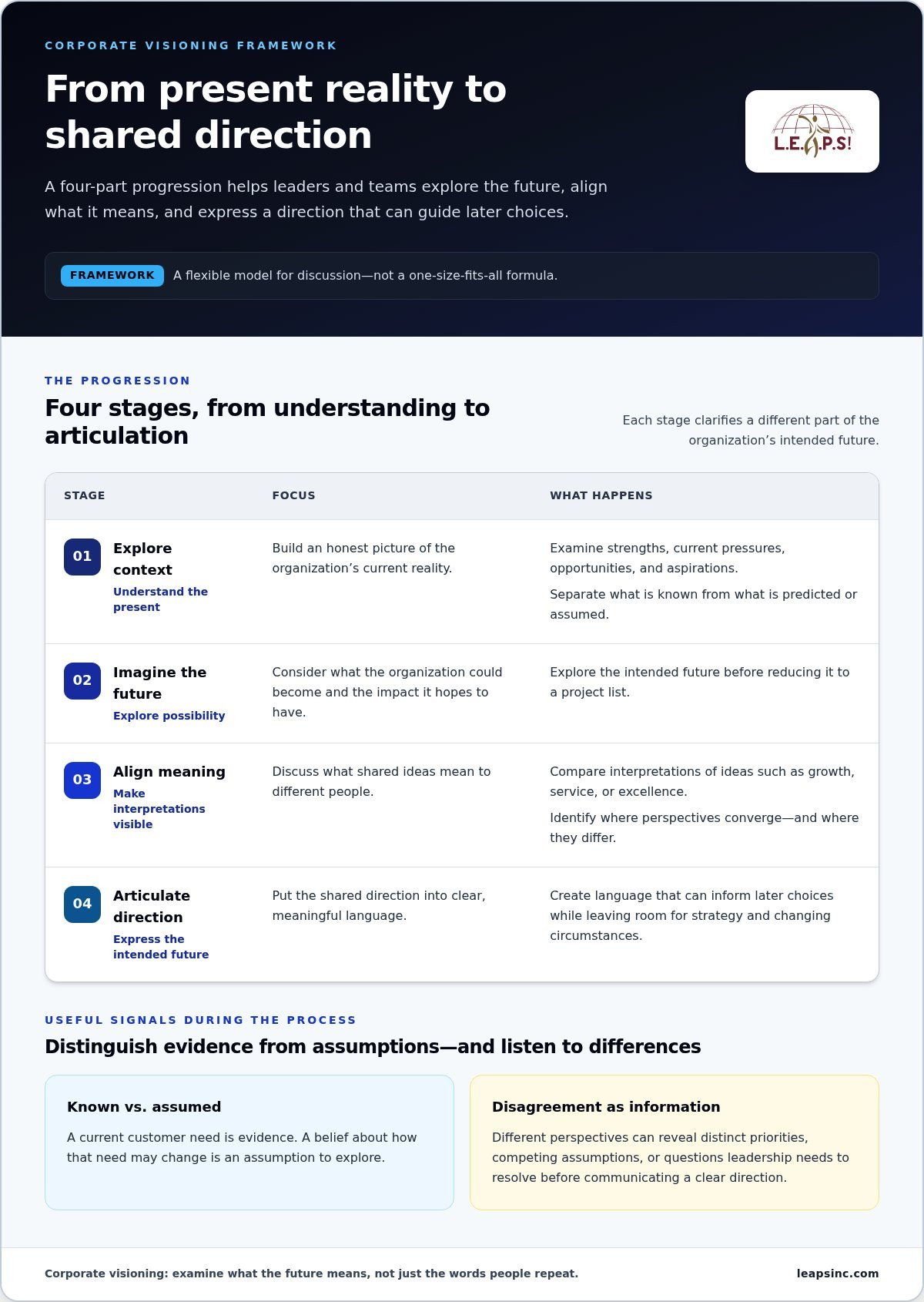
A useful way to understand visioning is as a progression from understanding the present to expressing an intended future. The following four-part model is a general framework, not a one-size-fits-all formula.
- Explore context. Examine organizational strengths, current pressures, opportunities, and aspirations. Separate what is known from what is predicted or assumed.
- Imagine the future. Consider what the organization could become and the impact it hopes to have, before reducing that future to a project list.
- Align meaning. Discuss how participants interpret ideas such as growth, service, or excellence. Identify where perspectives converge and where they differ.
- Articulate direction. Express the intended future in clear language that can inform later choices while leaving room for strategy and changing circumstances.
Corporate visioning moves leadership intent toward shared direction by helping people examine what the future means, not simply asking them to repeat the same words. Guided discussion can make room for different perspectives and encourage participants to explain their reasoning. Disagreement is useful information, not evidence that the process has failed. It may reveal distinct priorities, competing assumptions, or questions leadership needs to resolve before communicating a clear direction.
How do leaders move from current realities to future possibilities?
Begin with an honest picture of the present. Consider capabilities the organization can build on, pressures it must account for, and opportunities it may be positioned to pursue. Then distinguish documented conditions from expectations. A current customer need is evidence, while a belief about how that need may change is an assumption to explore.
Invite perspectives from people close to different parts of the work. One group may see a promising opportunity; another may recognize a capacity constraint. Holding both observations in view lets leaders test possibilities without dismissing valuable tensions or mistaking every concern for resistance.
How can a team express a vision people understand?
Describe a future state rather than listing tasks, initiatives, or targets. Clear language gives people a picture to interpret; vague language leaves each role to supply its own meaning. For example, rather than naming “expansion” alone, a team can clarify what kind of organization it intends to become and whom that future should benefit.
Discuss draft wording across relevant roles. Ask what people understand, what feels unclear, and whether the direction makes sense beyond the leadership table. Leaders can explore LEAPS Inc.’s corporate visioning service and schedule a conversation about organizational direction.
Corporate Vision, Mission, Values, and Strategy: What Is the Difference?
These terms often appear together in planning conversations, but they answer different questions. Treating them as interchangeable can leave leaders with an inspiring statement and no shared understanding of what it means for the organization. Corporate visioning services can help clarify the distinctions and explore how the ideas support one another.
Vision: What future does the organization want to help create?
Mission: What is the organization’s purpose, and whom does it serve?
Values: What principles should guide conduct and shape culture?
Strategy: What choices and priorities will move the organization toward its intended direction?
A vision is not merely an inspirational slogan. A slogan may be memorable, but it doesn’t necessarily describe a meaningful future or help people make choices. Visioning has practical value when leaders can use its direction to consider priorities, trade-offs, and the kind of organization they are building. Each concept has a distinct role; together, they provide a clearer basis for action.
How is a corporate vision different from a mission statement?
A vision looks forward to a desired future. A mission describes the organization’s purpose: why it exists and the contribution it aims to make. Consider a hypothetical engineering firm. Its vision might describe a future where public buildings can adapt more readily to community needs. Its mission might explain that the firm designs and improves functional spaces for public use.
The vision can guide a leadership conversation about the future the firm wants to help shape. The mission can inform discussion about whom it serves and what its work is for. Neither statement replaces the other. A future-facing vision without a clear purpose may feel detached from the organization’s work; a mission without a vision may explain today’s purpose without clarifying its intended direction.
How do values and strategy make a vision more practical?
Values shape how people pursue the future, especially when pressures make a decision difficult. If the hypothetical firm names accessibility and stewardship as values, leaders can use those principles to examine design choices and workplace expectations. Values are most useful when they guide conduct, not when they appear only in a statement.
Strategy turns direction into choices. The firm might prioritize adaptable design and invest in capabilities that support it, while setting aside opportunities that don’t fit its intended future. Strategy is not every possible initiative; it involves deciding where to focus and what to defer. As circumstances change, strategic choices may shift while the organization’s underlying direction remains a reference point.
For senior leaders, these distinctions can sharpen alignment: vision names the future, mission grounds the purpose, values guide conduct, and strategy sets the course of action. Executive coaching for C-suite leaders can complement discussions about leadership alignment and direction.
How Can Organizations Turn a Shared Vision Into Priorities and Everyday Practice?
A shared vision becomes useful when it influences what the organization chooses to do, how people work, and what leaders are willing to set aside. Without that connection, even a compelling direction can remain separate from operating decisions. Corporate visioning services help leaders clarify direction; carrying it into practice requires priorities, ownership, communication, and reflection.
How can leaders connect vision to priorities and accountability?
Translate the desired future into a focused set of priorities that reflect both ambition and organizational capacity. A vision of becoming more responsive to customers, for example, might lead leaders to prioritize service improvements over launching several unrelated initiatives at once. The aim is not to turn every phrase in the vision into a project. Use it as a filter for deciding where attention and resources belong.
- Choose priorities. Identify the work most closely connected to the future the organization intends to create. Name what will not be pursued now, so trade-offs are explicit.
- Define aligned behaviors. Describe the everyday actions that would make the direction visible in decisions, collaboration, and service.
- Assign ownership. Make clear who will lead each priority and who needs to contribute. Shared direction still requires identifiable responsibility.
- Review progress. Select indicators relevant to the priorities and revisit them at a rhythm suited to the work and context.
Leaders strengthen commitment by explaining why a priority supports the intended future, not simply announcing what has been selected. That reasoning helps teams understand how their work fits and makes competing demands easier to discuss. Progress indicators can show whether actions are moving in the intended direction, but they cannot guarantee a particular business result. Treat them as evidence for learning and adjustment, not proof that the vision alone caused an outcome.
Before approving a decision, leaders can use this brief checklist:
- Does this choice support the direction we have articulated?
- Does it reflect the conduct and culture we want to strengthen?
- Do we have the capacity to deliver it responsibly?
- What existing priority may need to change if we proceed?
- How will we learn whether the decision is helping?
What helps a corporate vision remain relevant over time?
A vision should be steady enough to orient decisions, yet open to thoughtful review as the organization and its context change. Revisit it when important assumptions shift or when repeated choices seem out of step with the stated direction. Avoid rewriting it in response to every new pressure. First ask whether the vision is no longer meaningful, or whether priorities, communication, or follow-through need attention.
Gather feedback from people whose work brings them close to customers, operations, and organizational culture. Ask where decisions reflect the vision and where everyday behavior tells a different story. Leaders can schedule a conversation about corporate visioning with LEAPS Inc. to explore how to strengthen this connection.
How LEAPS Inc. Supports Corporate Visioning Alongside Organizational Development
An organization’s direction reaches beyond a statement of future intent. It can shape questions about how the organization develops, presents its identity, and aligns leadership choices with the future it hopes to create. LEAPS Inc. offers corporate visioning services to help organizations consider their direction and alignment. This work connects naturally with related organizational services, including business development, strategic marketing, brand development, executive coaching, and business coaching.
Visioning helps leaders examine what they want the organization to become; related services address other dimensions of organizational work. Depending on the questions an organization is exploring, these areas can inform its broader consideration of direction, culture, and strategy.
How can visioning relate to business development and organizational identity?
A shared direction gives leaders a reference point for considering development priorities: which opportunities fit the future they want to pursue, and which may pull attention elsewhere? It can also prompt reflection on organizational identity, including what the organization wants to be known for and how its actions express that identity. Business development support can help leaders consider how the organization develops in light of its aims.
Visioning does not automatically determine a development plan. The vision can inform the questions, while leaders weigh context, capacity, and strategic choices. Strategic marketing and brand development can relate to how an organization communicates and expresses its direction. Coaching can support leaders as they consider alignment and leadership challenges. The relevant areas of support depend on the organization’s needs.
What should leaders bring to an initial visioning conversation?
Leaders don’t need a finished strategic plan to begin. It can be more useful to bring the questions already on the table, especially where assumptions or perspectives differ. A candid starting point gives the conversation room to clarify what the organization wants to explore before settling prematurely on wording or solutions.
- Current questions about organizational direction, culture, or growth
- Different leadership perspectives about the organization’s future
- Considerations about whom the organization serves and the impact it hopes to have
- Areas where present decisions seem misaligned with its intended direction
LEAPS Inc. was founded and is led by Dr. John E. N. Daniel. An initial conversation can help leaders describe the questions they are carrying and consider how corporate visioning relates to wider organizational concerns, without needing a formal commitment or a fully developed plan beforehand.
If your leadership team is reflecting on its future direction, culture, or alignment, you can schedule an appointment to discuss your organization’s visioning needs.
Give Your Organization a Direction It Can Grow Into
A shared vision is not a document to complete and set aside. It is a point of reference leaders can return to as opportunities emerge, constraints shift, and difficult choices arise. Consider where your organization’s assumptions, aspirations, and decisions need greater alignment, and what future you want your work to make possible.
LEAPS Inc. offers corporate visioning services alongside related support in business development, strategic marketing, brand development, and coaching. These connected areas help leaders explore organizational direction in relation to development, identity, and leadership needs.
You don’t need to arrive with a finished plan. Bring the questions your team is wrestling with, the differences in perspective you want to understand, and the future you’re ready to explore. A thoughtful conversation can be a meaningful first move toward greater clarity and shared direction. Schedule an appointment to discuss corporate visioning and consider what your organization can build toward together.
Frequently Asked Questions
What are corporate visioning services?
Corporate visioning services help an organization clarify the future it wants to create and establish shared language for discussing that direction. Leaders might use the work to explore what the organization wants to be known for or how its impact should evolve. The result is useful when it informs real conversations, such as explaining why a new opportunity fits the organization’s aspirations, rather than functioning only as polished wording.
How does corporate visioning differ from strategic planning?
Corporate visioning clarifies the future an organization hopes to pursue; strategic planning examines the choices and actions that could move it forward. For example, a vision may express an aspiration to make a service more accessible, while planning considers which audiences, capabilities, and investments deserve attention. Keeping the questions distinct helps leaders avoid treating a plan as the vision itself or expecting an inspiring direction to resolve operational decisions on its own.
Who should participate in a corporate visioning process?
Participation should reflect the decisions the organization needs to inform and the perspectives that can illuminate them. Executives and founders usually have a role because they shape organizational direction, while leaders from relevant functions can explain how priorities affect different parts of the work. Including an operations perspective, for example, may reveal practical implications that a leadership-only discussion misses. The aim is meaningful input, not automatically placing every employee in every conversation.
Can corporate visioning help align organizational culture and strategy?
Yes. It can give leaders a reference point for examining whether strategic choices and workplace behaviors support the organization’s aspirations. For instance, if an organization says collaboration matters, leaders can consider whether its decision-making practices create room for teams to work together. Visioning alone won’t resolve cultural tensions or guarantee agreement. Leaders still need to address conflicting expectations, communicate the rationale for choices, and notice where actual behavior diverges from stated intent.
How long does a corporate visioning process take?
The time required depends on the questions being explored, the organization’s context, and the range of perspectives involved. A leadership team seeking to clarify one central issue may have different needs from an organization working through several competing assumptions. Leaders can begin by describing what they hope to understand and which decisions the work should inform. That conversation helps clarify the scope before estimating the effort.
What happens after an organization creates its vision?
Leaders can use the vision as a reference during planning discussions, resource decisions, and leadership communication. A practical test is to revisit a recent choice and ask what the vision helped clarify, what tension it exposed, and what follow-up is needed. Teams can also gather examples of decisions that appear consistent or inconsistent with the intended direction. This reflection keeps the vision connected to organizational life instead of treating it as a finished announcement.
Is corporate visioning only for organizations experiencing major change?
No. Organizations may explore visioning during growth, leadership transitions, uncertainty, or steady operations. A founder, for example, may want to clarify what the organization should preserve as it expands, before new pressures make that question urgent. The useful signal is not a crisis, but a need to think deliberately about the future and how it should influence decisions. Visioning can help leaders clarify those aspirations before a major transition begins.