

What if a sexless marriage isn’t a problem to solve through pressure, but a pattern to understand together? When conversations about sex turn tense, go quiet, or circle the same painful arguments, it’s easy to read less intimacy as rejection or proof the relationship is over. Couples therapy for sexless marriage can offer a more careful starting point: exploring what each partner is experiencing without assigning blame or setting a required frequency.
Changes in sexual intimacy can be connected to emotional distance, unresolved conflict, stress, health concerns, or personal experiences. Often, more than one factor is at play. That uncertainty can feel isolating, especially when partners have different needs or struggle to talk openly about them.
This article explains how couple therapy can help you notice the patterns beneath the impasse, express needs with greater honesty and respect, and listen without becoming defensive. You’ll also learn how therapy can help you clarify shared goals and choose realistic next steps, whether progress means rebuilding closeness, understanding each other more fully, or defining what intimacy can look like for you both.
Key Takeaways
- A sexless marriage is best understood through each partner’s experience, not a universal standard of sexual frequency.
- Explore relationship conflict, emotional distance, stress, life transitions, and differences in desire as possible influences, not assumptions or diagnoses.
- Couples therapy for sexless marriage should support understanding and shared decisions, never pressure either partner to have sex.
- Before therapy, consider your feelings, concerns, hopes, and boundaries without treating the conversation as a test or a case to prove.
- LEAPS couple therapy offers a collaborative space to explore relationship concerns and clarify mutually respectful next steps.
What Does a Sexless Marriage Mean, and When Can Couples Therapy Help?
“Sexless marriage” is a phrase people use to describe a relationship with little or no sexual intimacy, but it doesn’t define what every couple should experience. One partner may feel content with the current level of intimacy while the other feels lonely or rejected. The difference between them, and how they make sense of it together, may matter more than the label.
Sexual intimacy can shift over the course of a marriage. Stress, changing circumstances, emotional closeness, and individual needs can all shape how partners experience connection. A change in frequency doesn’t mean either person is defective or that the relationship has failed. A useful definition is: a sexless marriage is a couple’s experience of little or no sexual intimacy, where consent and mutually chosen goals matter more than any prescribed frequency. For broader context, see this definition of a sexless marriage.
This video offers another perspective on discussing intimacy in a relationship:
Is there a standard definition of a sexless marriage?
People and sources use the phrase in different ways, so it isn’t a universal clinical rule or a required threshold for seeking support. The label alone can’t tell you whether a couple feels connected, distant, distressed, or at ease. What matters is how each partner experiences the relationship and whether expectations or needs feel difficult to discuss.
Sexual activity is never an obligation, and frequency doesn’t measure a relationship’s worth. Partners can acknowledge different feelings without treating one person’s preference as proof that the other is wrong.
When might couples therapy be worth considering?
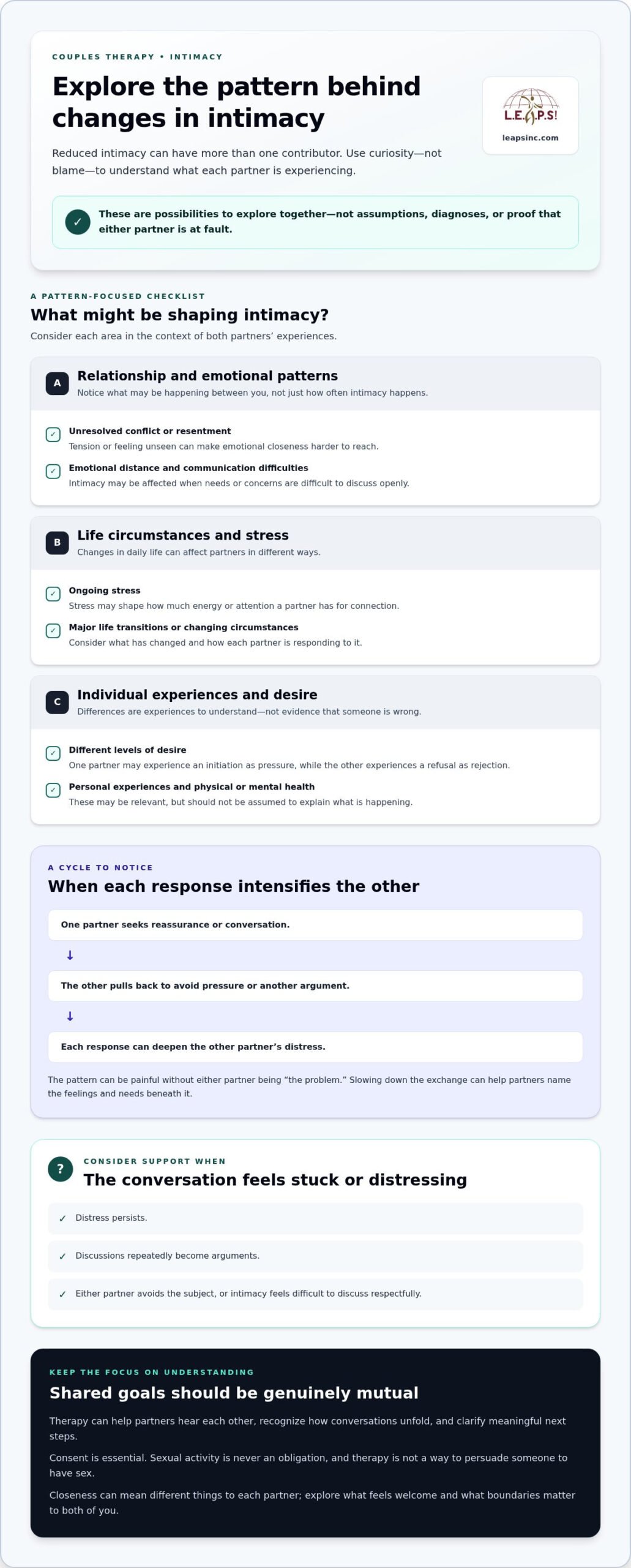
Consider support when distress persists, discussions repeatedly become arguments, either partner avoids the subject, or intimacy feels difficult to discuss with respect. Couples therapy for sexless marriage can help partners hear each other’s perspectives, recognize how their conversations unfold, and identify goals they both consider meaningful. Therapy isn’t a way to persuade someone to have sex; it’s an opportunity to explore concerns without pressure.
If you’re seeking a structured starting point, LEAPS offers couple therapy and resources to help you understand different types of therapy. The work can begin with a simple question: what would help each of us feel heard, respected, and more connected?
Why Can Sexual Intimacy Change in a Marriage? Explore the Pattern, Not a Single Cause
Reduced intimacy can have multiple, overlapping contributors, so it deserves curiosity rather than blame. For example, a demanding period at work may leave one partner with less energy, while unresolved tension makes the other feel unwanted. The key is to explore what has changed, what each person is experiencing, and how the couple responds to that change.
How can emotional and relationship patterns affect intimacy?
When conflict remains unresolved, resentment or feeling unseen can make emotional closeness harder to reach. Partners may then fall into a pursue-withdraw cycle: one seeks reassurance or conversation, the other pulls back to avoid pressure or another argument, and each response can intensify the other’s distress. Neither partner has to be cast as the problem for the pattern to be painful.
The Gottman Institute reports that a lack of sex can reflect deeper relationship concerns, including communication difficulties. In therapy, partners can slow down these exchanges, name the feelings and needs beneath them, and practice communicating more clearly. That process helps shift attention from assigning fault to understanding what happens between them.
What if partners have different levels of desire?
A difference in desire is a difference in experience, not proof that one partner is wrong or that the relationship lacks value. Yet the cycle around it can become distressing: one partner may experience an initiation as pressure, while the other experiences a refusal as rejection. Shame, silence, and repeated attempts to resolve the mismatch quickly can deepen the distance.
Rather than persuading either partner, couples can explore what closeness means to each of them, what boundaries feel important, and which forms of connection feel welcome. Consent remains essential; a shared goal must be genuinely mutual, not a compromise extracted under pressure. Couples therapy for sexless marriage can provide a structured setting to examine these interactions and clarify what both partners hope to work toward.
Noticing the pattern is a useful first step. If you’d like support exploring relationship concerns together, you can schedule an appointment with LEAPS.
Can Couples Therapy Help a Sexless Marriage Without Blame or Pressure?
It can, when the purpose is to understand the relationship and make room for honest conversation, not to persuade one partner to have sex. A therapist should not treat sexual activity as a requirement, a measure of commitment, or proof that therapy is working. Consent and emotional safety are foundational. Each partner must be able to express needs, uncertainty, and boundaries without being pressured into a particular outcome.
Couples therapy for sexless marriage can help partners slow down conversations that have become repetitive or charged. Instead of debating who is at fault, they can examine how assumptions, unmet needs, and reactions shape their interactions. The Can a Sexless Marriage be Saved article from The Gottman Institute also considers how couples might understand what is happening and work toward connection.
What can couples therapy help partners work through?
Partners may describe intimacy in different ways: one may miss sexual connection, while the other longs for affection, emotional closeness, or relief from tension. Therapy can help clarify what each person means, what feels missing, and what each hopes might change. A therapist can also help partners speak more directly, listen without immediately defending themselves, and notice how certain conversations escalate or shut down.
Progress doesn’t have to mean reaching a prescribed frequency. Partners can define shared goals around understanding, respectful communication, emotional safety, or exploring forms of connection that both freely welcome. LEAPS couple therapy provides a collaborative setting to explore relationship concerns and clarify mutually respectful goals.
What should therapy not demand or promise?
Neither partner owes sexual activity as proof of love, effort, or therapeutic progress. Therapy also can’t guarantee renewed desire, a particular frequency, resolution of every conflict, or that a couple will stay together. Its value may lie in helping partners understand their experience and make considered choices, even when they don’t arrive at the same preference or outcome.
Safety concerns require thoughtful, individualized attention. If there is coercion, abuse, or fear of retaliation, the approach to therapy may need to change; joint sessions may not be appropriate in every circumstance. A careful assessment can help clarify what support is safest and most constructive. The aim is not to force a shared answer, but to create conditions for each person’s voice, consent, and well-being to matter.
How to Prepare for Couples Therapy About Sex and Intimacy
Preparation can help each partner arrive with greater clarity, but it isn’t a test you need to pass or a case you need to prove. You don’t have to agree on what’s happening before therapy begins. The aim is to bring honest reflections, listen, and leave room for each person’s experience.
What should each partner reflect on before a session?
Before your first conversation, take a little time individually to consider what intimacy and connection mean to you. Your answers may differ, and that difference is useful to understand. You might reflect on:
- What feels painful or important to talk about?
- What has changed in your experience of closeness?
- What do you hope to understand, rather than demand?
- Which boundaries or sensitive subjects may need a slower conversation?
Keep these notes as reminders, not evidence to present against your partner. In couples therapy for sexless marriage, naming your own feelings and hopes can help you speak from experience instead of relying on assumptions about your partner’s motives.
How can couples talk about intimacy without escalating conflict?
Choose a calm moment to raise the subject, rather than starting a difficult conversation in the middle of an argument or an intimate situation. Use first-person language: “I feel distant and want to understand what’s changed” describes your experience more openly than “You never care about us.” Try to be specific without turning one moment into a sweeping judgment.
Listen to understand, not to prepare a rebuttal. If either person becomes overwhelmed, agree to pause and return to the conversation later. A pause should protect emotional safety, not become a punishment or a way to silence concerns. If talking together feels unsafe, prioritize that concern and bring it up when considering support.
Faith may also shape how a couple understands marriage, intimacy, or healing. If shared faith is important to you both, LEAPS offers faith-based couples therapy as a relevant avenue for relationship support.
Before your session, you might agree on one intention: to understand each other more clearly, even if you don’t yet know what the next step will be. That modest, shared starting point can make a sensitive conversation feel more manageable. Schedule an appointment to explore support together.
How LEAPS Couple Therapy Can Support Your Next Steps
When intimacy has become difficult to discuss, deciding what to do next can feel just as challenging as the issue itself. LEAPS offers couple therapy as clinical support for relationship concerns and emotional well-being. It can give partners a structured, collaborative space to explore what they’re experiencing, communicate more openly, and consider goals that respect both people.
There’s no required outcome to bring into therapy. You can arrive uncertain about what has changed, what you want, or where the relationship is headed. Couples therapy for sexless marriage isn’t a promise to restore sexual activity or remain together. It’s a choice to seek perspective and better understand the relationship before deciding on next steps.
What can couples bring into therapy?
Bring the concerns that feel most important, even if they’re difficult to put into words. That may include emotional distance, communication that repeatedly breaks down, differences in expectations, or uncertainty about intimacy and the future. Each partner can share what they hope to understand or change without needing to arrive with matching answers.
You can also name boundaries around sensitive subjects and ask to approach them at a pace that feels respectful. The conversation doesn’t need to begin with a complete history or a solution. Starting with what feels hardest to say can help clarify what deserves attention and what support might feel constructive.
What does a constructive next step look like?
A useful first step may be an honest conversation about whether you’re both willing to explore the concern together. Readiness doesn’t mean agreement on every detail. It can mean a willingness to listen, share perspectives, and consider what each person needs in order to take part respectfully.
Seeking therapy doesn’t obligate either partner to stay in the relationship or have sex. It creates an opportunity to gain perspective, understand what matters to each of you, and make more considered decisions. LEAPS offers faith-based couples therapy for partners for whom faith is central to their approach.
You don’t need certainty about the destination to begin considering a next step. Schedule an appointment with LEAPS to explore couple therapy as a supportive space for your relationship concerns.
Choose a Next Step Toward Greater Understanding
A change in sexual intimacy can have more than one contributor, and partners may experience its meaning differently. The first step isn’t to assign blame or meet a prescribed frequency. It’s to make room for honest conversation, respect each person’s boundaries, and clarify what progress would mean to you both.
Couples therapy for sexless marriage can offer a structured space to explore relationship concerns, understand recurring patterns, and identify mutually respectful next steps. LEAPS provides couple therapy within its clinical therapy services, along with individual therapy and therapy intensives. Therapy can help you gain perspective, without guaranteeing a specific relationship or sexual outcome.
You don’t need to have every answer before seeking support. Schedule an appointment with LEAPS to begin exploring what could help you move forward together. With care, honesty, and respect for each partner’s choices, a clearer path can emerge.
Frequently Asked Questions
Can couples therapy help a sexless marriage?
Yes, couples therapy can help partners understand what the change in intimacy means to each of them and how they want to move forward. It can offer space to communicate more openly, identify recurring interactions, and clarify shared goals. The process doesn’t guarantee renewed desire or a particular outcome. Progress may instead involve greater understanding, more respectful conversations, or clearer decisions about the relationship.
What is considered a sexless marriage?
There isn’t one universal frequency that defines a sexless marriage for every couple. The phrase generally describes a relationship with little or no sexual intimacy, but the couple’s own experience matters more than a numerical label. Partners may feel differently about the same situation: one may feel content, while the other feels disconnected or distressed. Sexual activity is never an obligation or a measure of relationship worth.
Why might a married couple stop having sex?
Sexual intimacy may change for a range of reasons, and more than one factor may be involved. Relationship conflict, emotional distance, stress, life transitions, or different levels of desire can affect how partners connect. Personal circumstances and physical or mental health experiences may also be relevant. These possibilities aren’t diagnoses. Understanding what each partner has experienced can help the couple explore the change without assuming fault or a single cause.
How do you bring up a sexless marriage with your spouse?
Choose a calm, private moment and describe your experience without assigning blame. For example, you might say, “I’ve been feeling distant and would like to talk about how we’re both experiencing intimacy.” Ask an open question, then listen to your spouse’s perspective. Avoid ultimatums or assumptions about motives. If the conversation becomes overwhelming, pause and return to it when both of you feel able to engage respectfully.
Will couples therapy pressure us to have sex?
No. Couples therapy shouldn’t treat sex as an obligation, a measure of love, or proof that either partner is trying. Consent and personal boundaries remain essential. A constructive process explores each partner’s feelings and concerns, then helps clarify goals both can genuinely support. Therapy also can’t guarantee a particular frequency or outcome. If there are safety concerns, those deserve careful, individualized attention before deciding on an approach.
What happens in couples therapy for a sexless marriage?
Couples therapy for sexless marriage can begin with each partner describing their concerns, hopes, and understanding of the change. The therapist may help the couple notice how conversations unfold, clarify what intimacy means to each person, and identify goals they both consider respectful. The focus is not to prove who is right or demand a specific result, but to create a clearer basis for understanding and next steps.
Can couples therapy help if only one partner wants more sex?
Yes. A difference in desire can be explored without treating either partner as wrong or expecting one person to change on demand. Therapy may help each partner explain what the difference means to them, identify whether pressure or rejection is affecting communication, and discuss boundaries and hopes. If one partner isn’t ready to attend, an individual therapy conversation may still help that person reflect on their experience and possible next steps.