

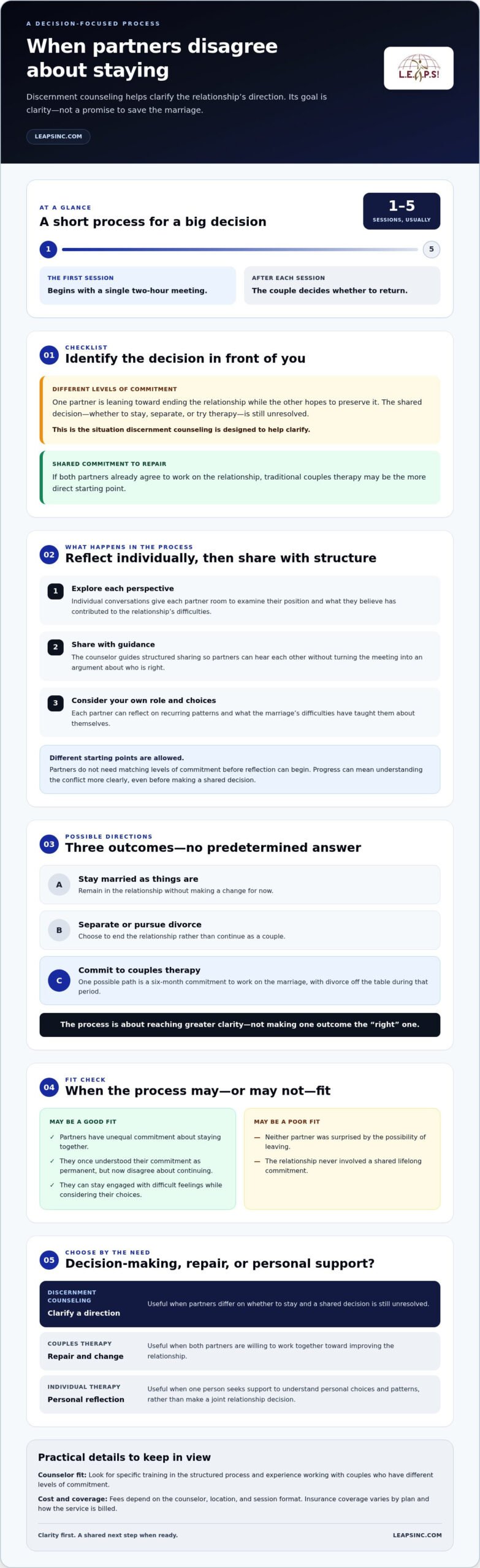
The defining outcome of discernment counseling is clarity, not a promise to save a marriage. If you’re asking what discernment counseling is, it’s a short-term process, usually one to five sessions, that helps a couple decide whether to stay as they are, separate, or commit to couples therapy. The focus is on understanding each partner’s perspective and what has contributed to the uncertainty.
It can be especially relevant when one partner is leaning toward ending the relationship while the other hopes to preserve it. Ordinary couples therapy may feel premature in this situation: before trying to repair the relationship, both people may need space to consider what they truly want. Discernment counseling respects each partner’s perspective rather than treating ambivalence as something to overcome.
This article explains who the process may serve, what outcomes are possible, and how decision-focused discernment counseling differs from relationship-focused couples therapy. You’ll also find a practical comparison to help you decide which approach best fits the choice in front of you.
Key Takeaways
- Assess whether the central challenge is uncertainty about staying together or a shared commitment to repair the relationship.
- Recognize how a leaning-out partner and a leaning-in partner may approach the decision with different needs and hopes.
- Use the process to consider three possible directions: maintain the relationship as it is, separate, or try couples therapy.
- Notice how individual conversations and structured sharing can help each partner reflect on their own role and choices.
- Consider individual therapy when personal reflection and support are more relevant than making a joint decision about the relationship.
Who are the couples best served with Discernment Counseling?
Discernment counseling may suit couples with unequal commitment to the marriage: one partner is leaning toward divorce, while the other wants to work on the relationship. If both spouses already agree to try to repair the marriage, traditional couples therapy may be a more direct starting point. The immediate goal is the key distinction. Discernment counseling helps partners decide what direction to take; couples therapy focuses on addressing relationship problems together.
To understand what discernment counseling is, consider a couple where one spouse wants to separate and the other is asking for counseling. Rather than assuming they share a goal, the process makes room for each person’s position. It usually spans one to five sessions, beginning with a single two-hour session. After each session, the couple decides whether to return, giving both partners a structured opportunity to reflect before choosing a next step.
Sessions combine individual conversations with carefully structured sharing between partners. Each person can explore their perspective, including what they believe contributed to the relationship’s difficulties. The counselor guides the couple’s shared reflections, helping them hear each other without turning the meeting into an argument over who is right. This structure can help when partners have different levels of readiness but can stay engaged with difficult feelings.
One possible path is a six-month commitment to couples therapy, with divorce off the table during that period. Other options include staying married without making changes or choosing separation. The process is best suited to partners who once understood their commitment as permanent but now disagree about continuing it. It may be a poor fit when neither partner was surprised by the possibility of leaving or when the relationship never involved a shared lifelong commitment.
| Option | Starting point | Primary focus | Useful when |
|---|---|---|---|
| Discernment counseling | Partners differ on whether to stay | Clarifying a direction | A shared decision is still unresolved |
| Couples therapy | Both partners are willing to work together | Relationship repair and change | Partners share a goal of improving the relationship |
| Individual therapy | One person seeks personal support | Understanding personal choices and patterns | A joint decision process is not the current focus |
Choose based on whether you need to decide about the relationship first or are ready to work on it together. For couples seeking faith-centered relationship support, Christian marriage counseling is another relationship-focused option to consider.
In the United States, there is no single cost for discernment counseling; fees depend on the counselor, location, and session format. Insurance coverage varies by plan and how the service is billed, so review your benefits for this type of counseling.
To find a qualified counselor nearby, search for “discernment counseling” with your city or region, then look for a professional who describes specific training and the structured process. Confirm that the counselor works with couples facing different levels of commitment, rather than offering only relationship-repair sessions.
What Outcomes Can You Expect from Discernment Counseling?
The central outcome is greater clarity about the relationship’s direction, not a predetermined decision to stay or separate. The process supports both spouses’ emotional needs and makes room for ambivalence rather than treating it as a problem to eliminate.
Leaning-Out Partners
A leaning-out partner may feel closer to ending the marriage while remaining uncertain about what that choice means. In a session, they can examine what has led them toward separation and whether those concerns reflect a temporary crisis or a deeper shift in commitment. Unlike relationship-repair work, the immediate task is to understand their position, not persuade them to stay.
Supporting Both Spouses
A leaning-in spouse may arrive hoping to repair the relationship while their partner is considering leaving. Discernment counseling gives both positions room without declaring one more valid. For example, the leaning-in spouse can explore what they want to preserve, while the leaning-out spouse considers what feels unsustainable. Each person can reflect on their own reasons and choices.
The partners’ different starting points shape the work. The leaning-in spouse may focus on restoring closeness; the leaning-out spouse may need to understand the weight of unresolved concerns. The counselor helps each person express their perspective and listen to the other, without requiring matching levels of commitment before reflection can begin.
Progress can mean understanding the conflict more clearly, even before reaching a shared decision. Each spouse can consider what the marriage’s difficulties have taught them about themselves, including their contributions to recurring patterns. That reflection can clarify whether thoughts of separation are temporary or signal a larger change in the relationship.
Possible directions include:
- Remaining married without making a change for now.
- Separating or pursuing divorce.
- Choosing a deliberate course of couples therapy to work on the marriage.
These outcomes differ in direction, not in whether the process has been useful. A couple that separates may still gain a clearer understanding of how to communicate as co-parents. Partners who stay together may recognize that their current arrangement needs attention, even if they have not yet committed to relationship work.
Notice what changes in your conversations: can each spouse explain their position more clearly, acknowledge the other’s perspective, and name a next direction? Those signs of reflection can help you assess whether the work is creating decision-making clarity. If you want support exploring your own emotional responses and choices, you can schedule an appointment.
Clarity and decision-making versus relationship repair
Discernment counseling focuses on deciding what direction to take, not repairing the marriage during the sessions. Traditional couples therapy focuses on relationship change, such as improving communication or addressing recurring conflict. The distinction matters when one spouse is considering divorce and the other wants to preserve the relationship. Before choosing an approach, identify whether you share a goal for the work.
Clarity and confidence come from examining what happened and each partner’s contribution to the relationship’s problems. Individual conversations give spouses room to name concerns they may struggle to express together. Structured sharing then helps each person understand the other’s perspective. For example, one partner might describe feeling emotionally distant, while the other identifies unresolved conflict as a reason for withdrawing.
The process can help couples distinguish temporary thoughts of separation from a larger change in commitment. It respects each spouse’s reasons for ending or preserving the marriage. One useful reflection is to ask: “What would need to change for me to choose this relationship?” Then consider whether the answer points toward working together, staying as things are, or moving apart.
Relationship status can shape the decision, but marriage is not the only relevant factor. People who are not married may still be eligible for discernment counseling. A central consideration is whether both partners once understood their relationship as a permanent commitment. If only one partner assumed that commitment was mutual, discussing those different expectations can clarify what each person believed.
Couples can consider three possible paths:
- Maintain the relationship as it is: Stay together without making a change now.
- Separate or divorce: Accept that continuing the relationship is not the chosen direction.
- Try couples therapy: Make a deliberate commitment to work on relationship problems together.
Alcohol misuse can complicate trust and decision-making. When clinically appropriate and included in an agreed recovery plan, alcohol monitoring can provide objective information about drinking. It cannot replace counseling or the work of rebuilding trust, and it cannot establish whether a partner feels safe in the relationship again. Couples need to distinguish information about drinking from the emotional repair that trust requires.
For couples who separate, discernment counseling can support healthier post-divorce communication and co-parenting. The decision process can clarify what each person needs to discuss, particularly when children require ongoing coordination. The goal is not to make divorce painless or force reconciliation. It is to understand the choice more fully and identify a direction for moving forward.
Individual conversations and shared reflections
Discernment counseling combines private conversations with structured time together, giving each spouse a chance to speak openly and hear the other’s perspective. Its purpose is to explore the relationship decision, not to conduct traditional couples therapy focused on repair.
A session may begin with the counselor meeting individually with each partner. This gives each spouse space to describe emotional reactions, concerns, and hopes without immediately managing the other person’s response. For example, one partner can explain why staying feels difficult, while the other describes what they hope to preserve. The counselor helps each person reflect on their own role and choices.
The couple then shares reflections in a guided conversation. The counselor can help partners listen, clarify what they heard, and identify where their accounts differ. One spouse might say, “I understood your silence as not caring,” while the other explains that silence was a response to repeated conflict. The aim is understanding, not proving whose interpretation is correct.
How many sessions are typical, and how long does each last? Discernment counseling usually spans one to five sessions, beginning with one two-hour session; couples decide after each meeting whether to return. Subsequent sessions are typically 1.5 hours, or 90 minutes.
This format differs from individual therapy, where one person focuses on personal emotional health, patterns, and decisions rather than making the session a joint relationship process. Individual therapy may be a better fit when there was no shared expectation of permanent commitment, or when one partner needs private space to understand their own contributions and choices. It can also support someone who wants to save the relationship but needs to decide what changes they can make.
Before starting, consider whether each person can stay engaged through uncomfortable conversations. The work asks partners to tolerate strong feelings without lashing out or shutting down. If one spouse cannot listen or reflect while distressed, that barrier may need attention before meaningful shared reflection can happen.
After discernment counseling, couples who choose to work on the relationship may move into couples therapy. The focus then shifts from deciding whether to try to actively addressing relationship patterns. Partners can carry forward insights from private conversations, such as recurring misunderstandings or unmet needs, and use them to set priorities for their shared work.
To prepare for a session, each spouse can identify one concern, one personal contribution to the difficulty, and one question about the future. These prompts provide a clearer starting point for individual conversations and shared reflection. They can also help distinguish a desire for repair from a need for more time to make a thoughtful decision.
Goals and outcomes of discernment counseling
The goal is not to produce a particular answer, but to help each spouse understand the decision before them. Discernment counseling focuses on what partners can learn about themselves from the marriage’s difficulties, including their own contributions. That self-understanding can clarify whether staying, separating, or trying couples therapy reflects a considered direction rather than pressure from the moment.
For a spouse who feels uncertain, a useful outcome may be identifying what the uncertainty is about. Are they considering separation because of a specific unresolved situation, or because they no longer want the commitment? The distinction can shape what comes next. For example, recognizing that conflict patterns are central may point toward couples therapy, while deciding the marriage is over may lead toward separation.
Each partner can examine the choices within their control. A spouse who wants to preserve the marriage might identify how they have contributed to recurring problems and what they are prepared to change. A spouse leaning away can consider what they have learned about their needs and limits. This reflection does not assign equal blame; it helps each person understand their part in the relationship’s history and decide what comes next.
Discernment counseling can lead to different outcomes, each with a distinct meaning:
- Remain married without a change: The couple chooses the current arrangement for now, while recognizing what remains unresolved.
- Separate or divorce: Partners move toward ending the marriage, with greater understanding of their reasons.
- Commit to couples therapy: Both choose relationship-focused work and make a deliberate effort toward change.
Choosing to stay married without changing anything is not the same as choosing to repair the relationship. The decision may reflect a temporary preference for the status quo, while therapy involves actively addressing problems. Naming the difference can prevent one spouse from interpreting “staying” as a promise of reconciliation when the other has not made that commitment.
Separation can also have a meaningful outcome beyond the decision itself. Couples who part ways may communicate and co-parent more healthfully after divorce when they gain clarity about the relationship and each person’s perspective. That does not erase grief or conflict. It can, however, help partners focus on practical conversations their family needs, such as coordinating parenting responsibilities.
A grounded takeaway is to assess progress by the quality of the decision, not by whether the couple stays together. Can each spouse describe what they learned, their own contributions, and the direction they are choosing? If you need support exploring your emotional responses and choices, schedule an appointment.
LEAPS: Individual Therapy
LEAPS offers Individual Therapy for people who want space to understand their emotions, choices, and personal contributions to relationship difficulties. It may be a useful next step when you need individual support alongside discernment counseling, or when a joint decision about the relationship isn’t your immediate focus.
If both partners decide to work on the relationship, Couple Therapy can support shared efforts toward change. The right direction depends on whether you’re seeking personal reflection or are ready to engage together. LEAPS also offers Therapy Intensive and Group Therapy for different therapeutic needs.
To explore Individual Therapy or another appropriate next step, visit leapsinc.com or contact LEAPS.
Choose Your Next Step With Intention
Understanding what discernment counseling can clarify is only part of the work. The next step is deciding what kind of support matches your needs now: space to understand your own emotions, focused therapeutic work, or a shared commitment to address the relationship. You don’t need to force certainty before seeking support. You can begin by naming the question you most need help exploring.
LEAPS offers Individual Therapy, Therapy Intensive, and Couple Therapy. Individual work can help you examine your own experience and choices; couple work may fit when both partners are ready to engage together. The purpose is not to impose a direction, but to support a thoughtful path forward.
If you’re ready to discuss which form of support may fit your situation, contact LEAPS to discuss your options. A considered next step can help you move toward greater understanding and a future shaped by your values.
Frequently Asked Questions
What Does “Success” Look Like in Discernment Counseling?
Success means leaving with a clearer, personally understood direction, even if the couple chooses a different future than they had hoped for. A practical way to assess progress is for each spouse to explain their reasons, identify what they have learned about their role, and state the next step they are willing to take. For example, one partner might recognize a need for individual reflection before deciding whether to pursue relationship work.
What is discernment counseling and what is its purpose?
People asking what discernment counseling is usually want to know whether it can help resolve uncertainty about a relationship. It is a structured process for couples with different levels of commitment, particularly when one partner is leaning toward ending the relationship and the other wants to preserve it. Its purpose is to help both people examine their perspectives and choose a direction, rather than assume they share a goal of repair.
Who is discernment counseling for, and who is it not appropriate for?
Discernment counseling is intended for partners who once understood their relationship as a permanent commitment but now differ about continuing it. It may be a poor fit when neither person was surprised that the other was considering leaving, or when the relationship lacked a mutual lifelong commitment. The process also requires each partner to tolerate difficult feelings and stay engaged rather than lash out or shut down.
How does discernment counseling differ from couples therapy or marriage counseling?
Discernment counseling centers on deciding what to do about the relationship; couples therapy centers on working on it together. Consider the difference between partners who cannot yet agree to try repairing recurring conflict and partners who both want to address it. The first situation calls for clarity about commitment, while the second gives therapy a shared purpose. The distinction is the immediate goal, not the value of either approach.
What happens during a discernment counseling session?
A session includes private conversations with each partner and guided time for the couple to share reflections. One spouse might explain a concern privately, then discuss it together, with the counselor helping both partners listen and clarify. The focus is on each person’s understanding and contribution, not on winning an argument. Couples initially commit to one session and decide after each meeting whether to return.
What are the three paths couples consider in discernment counseling?
Couples consider staying married as they are, separating or divorcing, or trying couples therapy. To make the options concrete, each partner can ask: “Am I choosing the current relationship, choosing to end it, or choosing focused work toward change?” Naming the path helps distinguish staying together without change from actively committing to relationship-focused therapy.
What are the benefits, limitations, and risks of discernment counseling?
One benefit is that partners can examine their own perspectives before committing to a shared course of action. A limitation is that the process focuses on decision-making rather than improving communication or repairing the relationship. Conversations may bring difficult emotions into focus. Alcohol monitoring, when clinically appropriate and part of an agreed recovery plan, can offer information about drinking, but it cannot rebuild trust or establish that a partner feels safe.
What should couples expect after discernment counseling ends?
After the process, couples move forward with the direction they have chosen: maintaining their relationship as it is, separating, or beginning couples therapy. The next step is to turn that choice into a practical conversation. Partners choosing therapy can identify the relationship concerns they want to address; partners separating can focus on communication and, when they co-parent, the conversations needed to coordinate care for their children.