

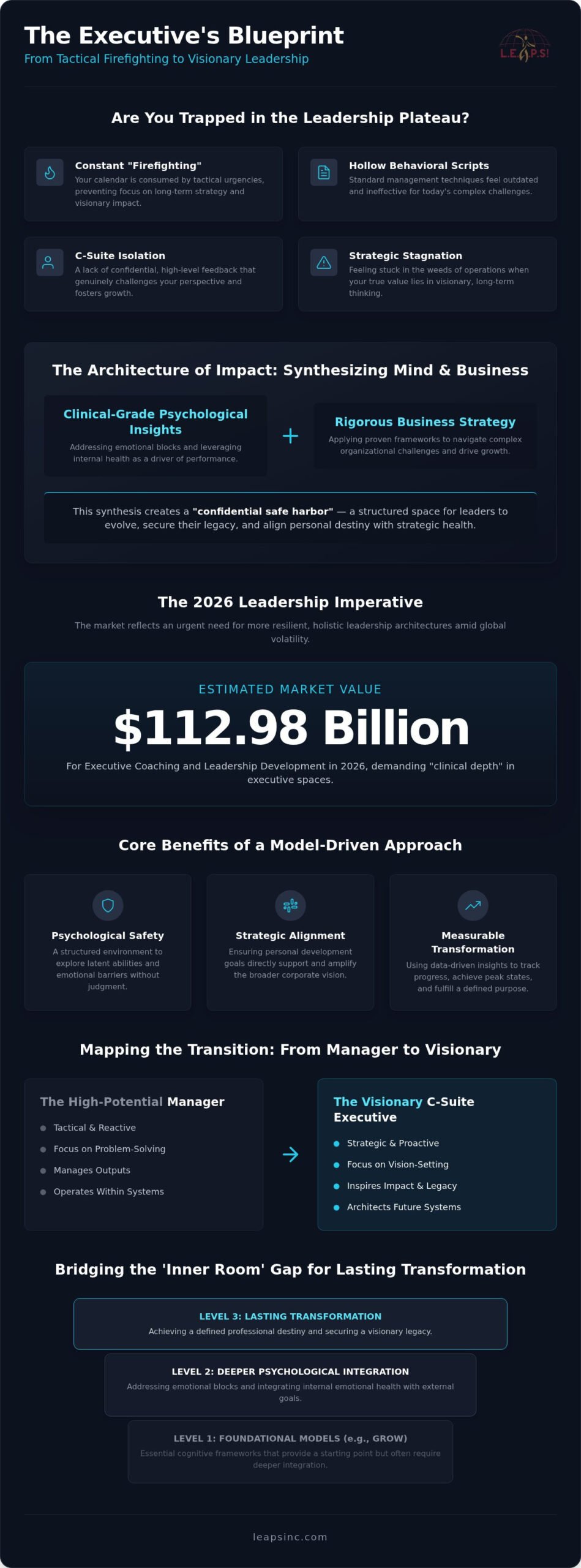
What if the tactical “firefighting” that consumes your calendar isn’t a badge of competence, but a symptom of a leadership framework that has reached its expiration date? You’ve likely reached a plateau where standard behavioral scripts feel hollow and the isolation of the C-suite leaves you craving confidential, high-level feedback that actually challenges your perspective. It’s frustrating to feel stuck in the weeds of operations when you know your true value lies in visionary strategy and long-term impact.
We understand that your professional destiny is inextricably linked to your internal emotional health. This guide promises to help you master the sophisticated executive coaching models required to transform high-potential managers into visionary leaders. By synthesizing clinical-grade psychological insights with rigorous business strategy, you’ll gain the practical tools needed to lead high-performing teams while maintaining personal well-being. We will explore the shift from transactional problem-solving to a transformational architecture that secures your legacy in 2026 and beyond.
Key Takeaways
- Discover how elite executive coaching models provide a structured, confidential “safe harbor” for senior leaders to navigate complex strategic challenges.
- Learn why traditional behavioral frameworks like the GROW model are essential foundations but often require deeper psychological integration for lasting transformation.
- Master the art of the leadership audit to determine if your primary barriers are tactical skill gaps, emotional blocks, or organizational misalignments.
- Explore the synthesis of clinical authority and business strategy that bridges the gap between internal emotional health and external corporate success.
- Identify the specific roadmap required to shift from a high-potential manager into a visionary C-suite executive with a defined professional destiny.
The Architecture of Impact: Why Executive Coaching Models Define Leadership
Leadership at the highest levels isn’t merely about managing outputs; it’s about the internal architecture that supports every decision, vision, and interaction. Sophisticated executive coaching models serve as structured psychological and strategic frameworks that anchor a leader’s development in proven methodology rather than haphazard trial and error. These models act as a visionary blueprint, helping high-potential individuals transition from the exhausting cycle of tactical “firefighting” to the expansive clarity of visionary leadership.
For the modern C-suite, these frameworks offer a confidential “safe harbor.” High-level isolation is a documented reality for many executives who lack a space to process emotional vulnerability or receive unvarnished feedback. By utilizing established frameworks, a leader can explore their internal landscape within a secure environment that prioritizes both their personal destiny and the organization’s strategic health. If you’re seeking a framework that bridges the gap between mental health and corporate strategy, exploring executive coaching can provide the necessary catalyst for your next professional evolution.
To visualize how these frameworks translate into daily practice, watch this breakdown of one of the industry’s most enduring tools:
The Evolution of Executive Development in 2026
The corporate world has moved beyond the era of superficial performance reviews. In 2026, the executive coaching and leadership development market has surged to an estimated $112.98 billion, reflecting a desperate need for more resilient leadership architectures amid global volatility. We’re seeing an unprecedented requirement for “clinical depth” in executive spaces, where leaders must understand the psychological underpinnings of their behavior. This holistic transformation recognizes that professional success is a direct reflection of internal emotional health. When exploring the broad field of business and executive coaching, it’s clear that the most effective interventions are those that treat the leader as a whole human being, not just a corporate asset.
The Core Benefits of a Model-Driven Approach
Adopting a structured framework provides more than just a roadmap; it creates a shared language for growth between the leader and their stakeholders. This alignment ensures that behavioral outcomes are measurable and consistent, which is critical in an era where leadership is increasingly judged on trust and consistency under pressure. Proven executive coaching models reduce the “cognitive load” of decision-making by providing a reliable scaffolding for complex organizational navigation.
- Psychological Safety: Models create a structured environment that encourages the exploration of latent abilities and emotional barriers.
- Strategic Alignment: The right framework ensures that personal development goals directly support broader corporate visioning objectives.
- Measurable Transformation: Data-driven insights allow for the tracking of peak states and the fulfillment of a defined purpose.
Ultimately, the “right” model must align with your unique personal worldview. It’s not about forcing a leader into a scripted box, but about providing the tools to unlock their maximum potential and fulfill their professional destiny. This methodical approach ensures that every step forward is grounded in both strategic logic and psychological depth.
The Cognitive Frameworks: Deconstructing Industry-Standard Models
Cognitive frameworks are the essential scaffolding that elite coaching councils utilize to ensure behavioral consistency and measurable growth. These industry-standard executive coaching models provide a shared language for transformation, allowing leaders to move from abstract intentions to concrete results. By 2026, the International Coaching Federation (ICF) has updated its minimum skills requirements for performance evaluations; this makes the mastery of these structured approaches more critical than ever for those seeking peak performance. These frameworks don’t just solve problems; they provide a methodical path toward fulfilling your professional destiny.
The GROW Model: Strengths and Limitations
The GROW model stands as the foundational entry point for most corporate leadership programs. Its linear path through Goal, Reality, Options, and Will offers a clear, logical sequence for solving tactical problems and improving immediate performance. It’s a reliable tool for high-potential managers who need to clarify their objectives and commit to specific actions. However, GROW often reaches its limit when it encounters deep-seated psychological barriers. It focuses on external actions while sometimes neglecting the internal emotional health that drives those actions. For a leader aiming for a long-term visionary shift rather than just a performance boost, relying solely on GROW can feel scripted or shallow.
Acronym-Based Models: A Comparative Analysis
While GROW is the standard, other frameworks offer specialized arcs for different leadership needs. The CLEAR model (Contracting, Listening, Exploring, Action, Review) focuses heavily on the process of the coaching session itself. This makes it ideal for C-suite executives who require a highly structured environment for confidential feedback and deep exploration. In contrast, the OSKAR model (Outcome, Scaling, Know-how, Affirm + Action, Review) is solution-focused. This approach often resonates better with fast-paced entrepreneurs who need to scale their impact quickly and build on existing strengths rather than deconstructing past failures.
The STEPPA model serves as the vital bridge between cold logic and the heat of human emotion by identifying the psychological triggers that often derail even the best-laid plans. By integrating Subject, Target, Emotion, Perception, Plan, and Action, this framework ensures that a leader’s internal state is aligned with their external objectives. If you feel that standard behavioral scripts aren’t reaching the core of your challenges, you might consider how a more integrated approach can help you unlock your latent abilities and secure your future potential.
Choosing between these executive coaching models requires a nuanced understanding of your current leadership state. Are you solving a skill gap, or are you navigating a complex organizational misalignment? The most effective intervention often synthesizes these cognitive frameworks with a deeper, clinical-grade understanding of the individual’s inner life. This methodical approach ensures that every strategic advancement is supported by a grounded, structured foundation of psychological depth.
The ‘Inner Room’ Gap: Bridging Behavioral Scripts with Psychological Depth
Why do so many leadership interventions feel like temporary fixes that evaporate under the heat of a real crisis? The answer lies in the “Inner Room” gap. Most standard executive coaching models focus exclusively on behavioral scripts; what to say, how to delegate, or when to pivot. While these tactics are helpful, they often result in shallow, performative changes because they ignore the leader’s internal psychological landscape. Authentic leadership presence isn’t something you can script; it’s something that radiates from a place of deep internal alignment, guiding you toward your peak state.
Integrating emotional vulnerability into executive strength is the next frontier of leadership development in 2026. This synthesis prevents burnout by ensuring that your external business strategy doesn’t come at the expense of your internal well-being. Our approach at LEAPS Inc. is grounded in a unique therapeutic philosophy that bridges the divide between corporate strategy and clinical insight. We believe that your professional destiny is fulfilled only when your mind and business operate in total synergy. By looking toward your future potential rather than just fixing immediate problems, you transform the way you interact with your team and your mission.
Leadership as an Emotional Ecosystem
Your leadership style doesn’t exist in a vacuum. It’s an emotional ecosystem influenced by your personal history, past successes, and even early life experiences. When high-stakes conflict arises, your “Internal Depth” determines whether you react with tactical panic or visionary composure. Traditional models that ignore this history often fail to provide lasting solutions. To understand how to navigate this intersection, read our comprehensive resource on Therapy vs. Coaching: A Visionary Guide to integrated growth. This methodical approach ensures you aren’t just reacting to fires, but leading with a sense of calm authority.
Overcoming the Imposter Phenomenon at the C-Suite Level
The imposter phenomenon is a persistent barrier for many C-suite leaders, yet traditional executive coaching models often struggle to address it beyond surface-level affirmations. Confidence exercises don’t work when the root cause is a deep-seated psychological narrative. By using clinical-grade frameworks, we help leaders unlock latent abilities that have been suppressed by self-doubt. A true Visionary Mentor provides the secure, confidential environment needed to dismantle these barriers, allowing your visionary power to finally take center stage. This process isn’t about mere improvement; it’s about a complete professional transformation that aligns your internal reality with your external success.
Designing a Bespoke Roadmap: How to Select Your Coaching Framework
Selecting from the array of available executive coaching models isn’t a passive exercise; it’s a strategic intervention that requires a clinical eye and a visionary heart. To move beyond the standard behavioral scripts discussed earlier, you must design a bespoke roadmap that accounts for your specific leadership stage and internal depth. This methodical selection process ensures that your investment yields a permanent transformation rather than a fleeting performance boost. By aligning the framework with your ultimate professional destiny, you create a secure path toward peak state fulfillment.
- Step 1: Audit your leadership state. Are you currently operating in a tactical “firefighting” mode, or have you ascended to strategic and visionary levels? Acknowledge where you are to determine where you must go.
- Step 2: Identify the primary barrier. Determine if your progress is stalled by a specific skill gap, a deep-seated emotional block, or a systemic organizational misalignment. Each requires a distinct theoretical approach.
- Step 3: Align with Core Values. Ensure the chosen model resonates with your internal worldview. A framework that contradicts your personal ethics will never result in authentic leadership presence.
- Step 4: Pilot the framework. Test the effectiveness of your selection through a Leadership Impact Intensive. These intensives provide the high-stakes environment needed to validate a model’s impact on your real-world challenges.
Matching Models to Leadership Archetypes
The “Founder” archetype often requires entrepreneurship coaching models that prioritize agility, rapid scaling, and a high-energy “burning desire” for change. These leaders need frameworks that can keep pace with market volatility while grounding their visionary impulses in strategic logic. Conversely, the “Corporate Executive” must prioritize executive coaching for C-suite frameworks that emphasize strategic influence, stakeholder trust, and organizational health. This distinction ensures that the coaching architecture supports the specific demands of your professional ecosystem.
Implementation and Measurement of Success
Measuring the success of executive coaching models requires a blend of quantitative data and qualitative behavioral transformation. In 2026, elite programs utilize 360-degree feedback loops to validate that internal growth is translating into external business success. Setting specific Key Performance Indicators (KPIs) for traits like behavioral consistency and psychological safety within your team allows for a data-driven view of your evolution. A bespoke roadmap ensures peak state fulfillment by harmonizing your unique psychological profile with the rigorous demands of global leadership. To begin your personalized leadership audit, schedule a consultation with our visionary mentors today.
The Visionary Mentor: LEAPS Inc. and the Synthesis of Mind and Business
LEAPS Inc. stands as the definitive bridge between clinical mental health and high-level corporate strategy. Led by Dr. John E. N. Daniel, our approach provides a sophisticated blend of clinical authority and aspirational energy. While other executive coaching models might focus on superficial behavioral shifts, we facilitate a multi-disciplinary synthesis that addresses the whole person. We don’t just solve problems; we ignite a burning desire for peak performance. This methodical approach ensures that your professional growth is grounded in both strategic logic and psychological depth.
Our methodology seamlessly weaves together the therapeutic depth of Individual Therapy with the strategic rigor of Executive Coaching. This integration ensures that your professional advancement is supported by internal emotional health, treating them as two sides of the same coin. We view leadership through a “Visionary Lens,” focusing on the concept of destiny and the fulfillment of your life’s purpose. It’s time to stop settling for standard results and start pursuing your maximum potential through a framework that respects your unique psychological architecture.
A Mission-Oriented Partnership
LEAPS functions as a catalyst for transformation rather than a passive service provider. We project an authoritative yet empathetic presence, speaking from a position of seasoned experience and high-level training. Our commitment to confidentiality and methodical growth creates a secure harbor for senior leaders to process their most complex challenges. By supporting your “Inner Life,” we clear the path for “Strategic Advancement” that is both sustainable and visionary. We value order and clear frameworks, ensuring every step of your journey is structured toward a defined goal of peak state fulfillment.
Next Steps: From Inquiry to Impact
Your journey from inquiry to impact begins with a professional consultation designed to assess your current leadership state. We’ll determine which framework best aligns with your psychological profile and organizational needs, moving you beyond the tactical firefighting mentioned earlier. This path often leads toward comprehensive Corporate Visioning, ensuring that your entire leadership team is aligned with your peak state. Don’t let your future potential remain latent or your abilities go untapped. Schedule your visionary consultation today to embark on a transformative journey that finally harmonizes your mind and your business success.
Igniting Your Professional Destiny: The Path to Visionary Leadership
Mastery of executive coaching models in 2026 requires far more than a passing knowledge of behavioral scripts. It demands a sophisticated synthesis of clinical depth and strategic rigor to ensure that your external business success is mirrored by internal emotional health. By bridging the “Inner Room” gap and selecting a bespoke roadmap, you can finally move beyond tactical firefighting to fulfill your ultimate professional destiny. This journey isn’t merely about performance; it’s about the total transformation of your leadership architecture.
Led by Dr. John E. N. Daniel, LEAPS Inc. provides an integrated clinical and strategic approach that serves as a powerful catalyst for your transformation. Our specialized leadership intensives offer the deep intervention needed to dismantle psychological barriers and foster a truly authentic presence at the C-suite level. We’re committed to your maximum potential, offering a structured environment where your visionary power can finally take center stage. Unlock your visionary potential with LEAPS Inc. Executive Coaching and begin the methodical process of securing your legacy. Your peak state is within reach; it’s time to lead with the authority and purpose you were destined to hold.
Frequently Asked Questions
What is the difference between an executive coaching model and a leadership framework?
An executive coaching model is the specific methodology a practitioner uses to facilitate growth, whereas a leadership framework is the structural philosophy a leader applies to their organization. One governs the developmental relationship; the other governs corporate governance and culture. Sophisticated executive coaching models provide the process to master those broader leadership frameworks, ensuring that personal transformation supports organizational vision and strategic health.
How long does it typically take to see results from a structured coaching model?
While every journey is unique, research from 2026 suggests that standard engagements typically range from six to twelve months. You’ll often notice initial behavioral shifts and increased clarity within the first three months of consistent application. For those requiring more rapid transformation, specialized intensives can accelerate this timeline by providing deep, focused intervention over a condensed period, moving you toward your peak state faster.
Can an executive coaching model be integrated with traditional therapy?
Integration is not only possible but often essential for visionary leaders who want to align their internal emotional health with external business success. LEAPS Inc. specializes in this multi-disciplinary approach, bridging the gap between individual therapy and professional development. By treating these as two sides of the same coin, you ensure that your strategic advancement is supported by a grounded, structured foundation of psychological depth and well-being.
How do I know if I need executive coaching or business development consulting?
You need executive coaching if the barrier to growth is your individual leadership style, emotional regulation, or visionary capacity. Business development consulting focuses on external systems, strategic marketing, and revenue infrastructure. If you’re feeling stuck in tactical “firefighting” despite having solid business systems, the challenge is likely internal, requiring a structured coaching model to unlock your latent abilities and fulfill your professional destiny.
What are the most effective coaching models for C-suite executives in 2026?
In 2026, the most effective models for C-suite leaders are those that synthesize strategic outcomes with psychological depth, such as the STEPPA or CLEAR frameworks. These approaches move beyond simple goal-setting to address emotional triggers and organizational misalignments. High-level leaders benefit most from executive coaching models that provide a confidential safe harbor while challenging them to fulfill their maximum potential and visionary purpose.
Is the GROW model still relevant for modern visionary leaders?
The GROW model remains a valuable entry point for tactical performance and immediate problem-solving. However, for modern visionary leaders, it often feels too scripted or shallow on its own. To achieve lasting transformation, you must augment GROW with models that explore the “Inner Room” of leadership, ensuring that your external actions are fueled by deep internal alignment and clinical-grade psychological insights rather than temporary behavioral scripts.
How does an executive coaching intensive differ from weekly sessions?
Weekly sessions offer steady, incremental progress and ongoing accountability for long-term growth. An executive coaching intensive, such as our Leadership Impact Intensive, provides a deep, high-energy intervention designed for rapid breakthrough. These intensives are ideal for leaders facing immediate, high-stakes transitions or those who have reached a plateau and require a powerful catalyst to reignite their burning desire for change and professional evolution.
What should I look for in a coach who uses these models?
Seek a mentor who possesses a sophisticated blend of clinical authority and seasoned business experience. Verify their credentials, such as ICF certification, which became more rigorous in 2026 with new mentor coach specializations. Ensure they offer a visionary lens that looks toward your future potential and destiny rather than just remediating immediate problems, providing a structured path for your personal and professional peak state fulfillment.