

What if leading well under pressure depends less on enduring more and more on choosing your response with intention? Executive resilience coaching explores how leaders can build that capacity. When demands rise, clear thinking and consistent action can become harder, even for leaders whose success looks effortless from the outside. Strain may stay hidden until familiar habits begin to cost energy, focus, or connection.
Resilience isn’t a fixed trait or a reason to push through at any cost. It’s a leadership capacity that can be strengthened through reflection and deliberate practice. The aim is not to eliminate pressure, but to understand how you respond to it and make more room to act in line with your values and priorities.
This article explains what executive resilience coaching can help leaders examine, how to assess whether coaching fits your goals, and how insight can become practical leadership habits. It also clarifies how coaching differs from therapy and general leadership development. At LEAPS Inc., executive coaching and clinical therapy are distinct services with different purposes, so understanding that distinction matters when deciding what kind of support may be right for you.
Key Takeaways
- Executive resilience coaching can help leaders examine how they respond under pressure and choose more purposeful actions.
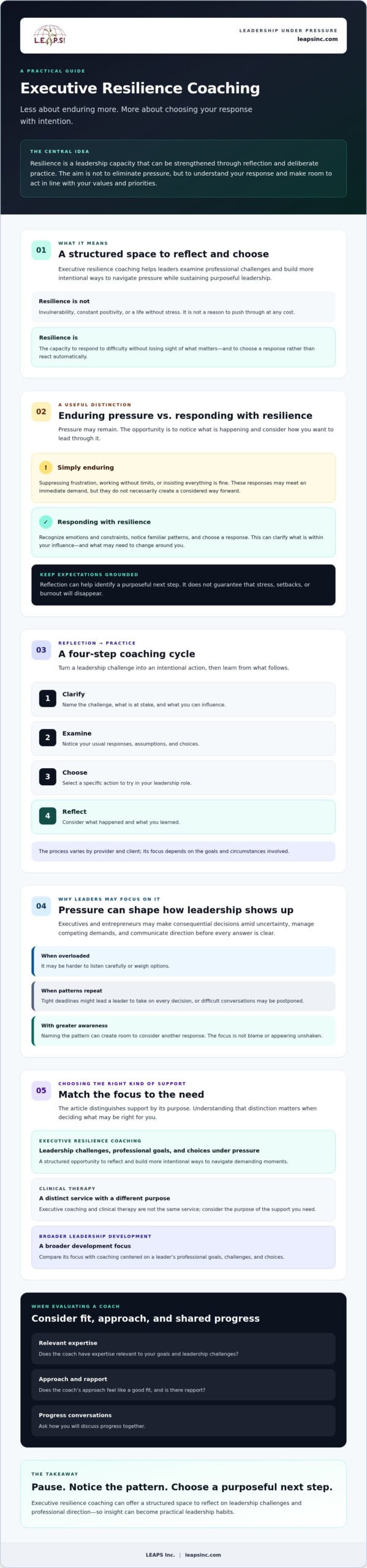
- A practical coaching cycle can turn reflection into leadership practice: clarify a challenge, examine your response, choose an action, and reflect on what follows.
- Use the focus of support to distinguish executive coaching from therapy and broader leadership development, then consider which best matches your needs.
- Assess a coach’s relevant expertise, approach, and rapport, and ask how you’ll discuss progress together.
- Explore how LEAPS Inc.’s executive coaching may offer a structured space to reflect on leadership challenges and professional direction.
What Executive Resilience Coaching Means for Leaders Under Pressure
Leadership pressure can make familiar decisions feel difficult. Uncertainty, competing priorities, and responsibility for others can test judgment. Noticing that strain isn’t evidence of personal weakness. It’s a reason to pause and consider how you want to lead through a demanding moment.
Executive resilience coaching is a structured opportunity to reflect on leadership challenges and build more intentional ways to navigate pressure while sustaining purposeful leadership. Resilience isn’t invulnerability, constant positivity, or a life without stress. It’s the capacity to respond to difficulty without losing sight of what matters. The broader idea of psychological resilience offers useful context, while coaching applies reflection to a leader’s professional goals and choices.
For a perspective on resilient leadership, watch this video:
How resilience differs from simply enduring pressure
Enduring pressure can look like suppressing frustration, working without limits, or insisting everything is fine. Those responses may help someone meet an immediate demand, but they don’t necessarily create a considered way forward. Resilience means recognizing emotions and constraints, then choosing a response rather than reacting automatically.
Reflection can make recurring patterns easier to spot. A leader might realize that tight deadlines lead them to take on every decision themselves, or that they postpone difficult conversations. Naming the pattern creates an opportunity to consider another response. It doesn’t guarantee that stress, setbacks, or burnout will disappear. It can help clarify what is within the leader’s influence and what may need to change around them.
Why executive roles make resilience relevant
Executives and entrepreneurs often make consequential decisions amid uncertainty, manage competing demands, and communicate direction before every answer is clear. Their internal experience can affect how they approach those responsibilities. Feeling overloaded, for instance, may make it harder to listen carefully or weigh options. Recognizing that connection isn’t about blaming the leader. It creates space to respond with greater awareness.
For executives, entrepreneurs, and businesses considering executive coaching, resilience can be a useful focus for examining leadership challenges and professional direction. The work is not about appearing unshaken. It’s about making room to reflect, identify a purposeful next step, and lead with intention even when circumstances remain demanding.
How Executive Resilience Coaching Can Build More Deliberate Responses
Executive resilience coaching can create a collaborative space to examine a leadership challenge and consider how you want to respond. The process varies by provider and client, and its focus depends on the goals and circumstances involved. A useful starting cycle is straightforward:
- Clarify the challenge, what’s at stake, and what you can influence.
- Examine your usual responses, assumptions, and choices.
- Choose a specific action to try in your leadership role.
- Reflect on what happened and what you learned.
This reflection-to-action approach is consistent with the leadership focus of Harvard Business School Online’s discussion of Resilient Leadership. Coaching may invite exploration of self-awareness and emotional regulation, but it doesn’t guarantee a particular change or result.
From leadership challenge to a focused coaching goal
A broad concern such as “I’m not handling pressure well” can become a more useful coaching question: “How do I want to communicate priorities when a project changes suddenly?” The question connects reflection to an observable behavior and a real responsibility. To make a goal actionable, identify the situation, the response you want to practice, and how you’ll reflect on what happens. That gives the conversation direction without assuming a standard timeline or fixed coaching plan.
Hypothetical example: An entrepreneur notices that uncertainty about a major client decision leads them to send hurried messages to their team. In coaching, they might clarify what information is missing, consider how urgency affects their communication, and choose to state what is known, what remains undecided, and when they’ll revisit the issue. Later, they can reflect on whether that response matched their intentions and responsibilities. This example is illustrative, not a LEAPS Inc. client story.
Practices leaders may explore between conversations
Brief observations after a demanding moment can make reflection concrete. A leader might note:
- What triggered the pressure, and what assumptions arose?
- What options did I consider before deciding or communicating?
- What helped me recover attention after the moment passed?
These prompts aren’t a required system or clinical treatment. Adapt any practice to your circumstances, role, and support needs. If you’re considering coaching to reflect on leadership challenges and next steps, you can explore scheduling options with LEAPS Inc.
Executive Resilience Coaching, Therapy, and Leadership Development Compared
These forms of support can all involve reflection and growth, but they serve different purposes. Executive coaching generally focuses on goals, leadership, and professional development. Therapy is clinical support that may address mental health and emotional well-being. Leadership development is a broader category that can include learning experiences designed to strengthen leadership knowledge and skills. The American Psychological Association’s guidance on building resilience offers psychological context, but it doesn’t replace considering what support fits your circumstances.
| Support | Primary focus | Typical questions | When to explore it |
|---|---|---|---|
| Executive coaching | Professional goals, leadership, and development | “How do I want to handle this leadership challenge?” | When you want to reflect on work-related goals, leadership behavior, or professional direction |
| Therapy | Clinical support for mental health and emotional concerns | “What’s affecting my well-being, and what support may help?” | When you’re concerned about your mental health or want to discuss emotional difficulties with a qualified clinical professional |
| Leadership development | Building leadership knowledge and skills | “What capabilities do I want to develop?” | When you’re seeking learning or development opportunities related to your leadership role |
When executive coaching may be a relevant option
Executive resilience coaching may be worth exploring if your focus is on leading through work-related challenges, clarifying professional direction, or becoming more deliberate in how you approach leadership responsibilities. Before proceeding, ask a provider about their approach, the scope of coaching, and how you’ll determine whether your goals are a good fit. Learn more about LEAPS Inc. executive coaching.
When clinical support may be more appropriate
If you’re experiencing significant concerns about your mental health, consider seeking an assessment from a qualified clinical professional. Coaching isn’t psychiatric care, doesn’t treat mental health conditions, and shouldn’t be viewed as a substitute for therapy. The right kind of support depends on your needs. A provider can help clarify the scope of their service and whether it’s appropriate to your goals.
LEAPS Inc. offers executive coaching and provides clinical therapy as a separate service. Keeping those purposes distinct can help you make a more informed decision about the support you want to explore.
Evaluating an Executive Resilience Coach: Getting Started
Choosing a coach is a decision about fit, trust, and the kind of growth you want to pursue. Clarify your aims, review relevant expertise, ask about the coach’s approach, and notice whether the conversation feels respectful and constructive. A good fit leaves room for honest questions, not pressure to commit before you understand the service.
Questions to ask before choosing a coach
Ask whether the coach’s experience is relevant to executives, entrepreneurs, or the leadership context you’re facing. Then explore how the work is shaped and what falls within its scope. Questions to consider include:
- How do you approach leadership challenges like the one I’m bringing?
- How would we clarify goals and discuss progress?
- What are your qualifications, and where can I verify them?
- How do you handle confidentiality, and what are its limits?
- What are the fees, session logistics, and expectations for each person involved?
Don’t infer qualifications, confidentiality terms, or service details from a website description alone. Confirm them directly with the provider. Progress may be discussed by reflecting on goals and relevant leadership situations, but ask how that conversation works rather than assuming a particular assessment or measurement system.
A simple preparation checklist for a first conversation
Before speaking with a potential coach, outline what you want the conversation to clarify. You don’t need a complete plan. A concise starting point can help you assess whether the provider’s approach fits your needs.
- Name one current challenge. Identify a decision, communication pattern, or responsibility that feels difficult to navigate.
- Describe a more useful response. What might you do differently in a way you could observe in your leadership role?
- Note your context. Consider relevant responsibilities, constraints, and the outcomes that matter to you.
This preparation can help you discuss executive resilience coaching with greater clarity while leaving space to learn how the coach works. If you’re ready to explore whether LEAPS Inc. executive coaching aligns with your goals, schedule an appointment.
Executive Resilience Coaching at LEAPS Inc.: Connect Leadership Growth With Purpose
Leadership growth begins with an honest question: what do you want to approach differently, and why does it matter to the work you’re here to do? LEAPS Inc. offers executive coaching for executives, entrepreneurs, and businesses. Coaching can provide an opportunity to reflect on leadership challenges and professional direction, without promising a particular method or outcome.
A coaching conversation grounded in leadership and development
You might bring a current leadership question, a professional growth aim, or a challenge that’s prompting you to reconsider how you lead. For example, you could want to think through how to communicate during uncertainty or how your priorities align with the direction you want to take your organization. These are possible topics to raise, not a prescribed coaching program. Learn more about executive coaching at LEAPS Inc. to understand the service as described by the practice.
Before moving forward, ask how the coach’s approach, scope, and experience relate to your goals. A useful conversation should help you understand whether the service is relevant to your leadership context and what to expect, without assuming that coaching will resolve every source of pressure. The intention is to create space to reflect, clarify what matters, and consider a deliberate next step.
Take a considered next step
Before contacting the practice, write down what you hope to explore. It might be a recurring leadership challenge, a decision you’re weighing, or a professional direction you want to examine. Consider what would make the conversation useful to you. Arriving with a clear question can help you discuss fit and scope directly.
Keep the distinction between coaching and therapy in view. Executive coaching focuses on professional goals and leadership development; clinical therapy is a separate service with a different purpose. If you’re unsure which kind of support fits your needs, ask the provider to clarify the boundaries of each service.
If you’d like to explore whether LEAPS Inc. executive coaching aligns with your aims, schedule an appointment to begin an inquiry. You can ask about fit and scope before deciding on a next step.
Lead Forward With Greater Intention
Resilience isn’t about being untouched by pressure. It’s the capacity to reflect, recognize your choices, and respond in ways that align with your leadership priorities. Executive resilience coaching can offer a focused space to explore work-related goals and turn insight into deliberate practices, while therapy serves a distinct clinical purpose.
Choosing support begins with clarity: identify what you want to work on, ask about a provider’s approach and scope, and consider whether the fit feels right. LEAPS Inc. offers executive coaching for executives and entrepreneurs, business coaching, and separate clinical therapy services. Asking questions before proceeding can help you determine which support best matches your needs.
If you’re ready to explore your leadership goals, schedule an appointment with LEAPS Inc. A thoughtful next step can help you lead with greater purpose, even when the path ahead is demanding.
Frequently Asked Questions
What is executive resilience coaching?
Executive resilience coaching is a professional development process focused on how a leader navigates pressure, responds to challenges, and pursues meaningful goals. Its specific approach depends on the coach and client. It isn’t a promise to remove stress or prevent setbacks. Before engaging a coach, ask about their qualifications, methods, boundaries, and how they define progress so you can assess whether the service fits your aims.
Who can benefit from executive resilience coaching?
Executives, entrepreneurs, and other leaders may explore coaching when they want to reflect on leadership challenges, professional direction, or their responses to pressure. Whether it’s a good fit depends on the person’s goals and the coach’s scope. A conversation with the provider can help clarify expectations and relevance to your role. Coaching isn’t a substitute for clinical assessment or mental health treatment when those forms of support may be needed.
How does executive resilience coaching work?
Coaching commonly involves discussing a professional challenge, clarifying a goal, considering possible responses, and reflecting on actions taken. The structure, frequency, and tools vary by provider, so don’t assume every coach follows the same method. Before starting, ask how goals are set, how progress is discussed, how confidentiality is handled, and how the coach determines whether your needs remain within the scope of coaching.
How is resilience coaching different from therapy?
Executive coaching generally focuses on professional goals, leadership, and development. Therapy is clinical support that may address mental health and emotional concerns. The boundaries matter, so ask providers to explain their qualifications, approach, and scope. Coaching shouldn’t be presented as diagnosing or treating a mental health condition. If you’re uncertain about what kind of support you need, consider discussing your circumstances with a qualified clinical professional.
Can executive resilience coaching help with burnout?
Coaching may offer a space to examine work-related pressures, habits, and professional goals, but it shouldn’t be promised to prevent or treat burnout. Persistent exhaustion, distress, or concerns about mental health may call for clinical guidance. Ask a coach what falls within their scope, and consider speaking with a qualified healthcare professional if symptoms are affecting daily functioning. Coaching and clinical care have distinct purposes.
What should I ask before hiring an executive resilience coach?
Ask about the coach’s relevant experience, qualifications, approach, confidentiality terms, fees, and how goals and progress are discussed. Clarify what coaching can and can’t address, and whether the coach understands your professional context. Consider whether the conversation feels respectful and useful. Verify qualifications and service details directly with the provider rather than relying on broad promises or assumptions about methods, outcomes, or fit.
How do I know if executive resilience coaching is right for me?
Start by identifying what you want to work on, such as a leadership challenge, professional transition, or response to pressure. Discuss that aim with a potential coach, then ask about fit, scope, and expectations. Coaching may not suit every need. If you have concerns about your mental health, consider discussing them with a qualified clinical professional. Clear questions can help you choose a considered next step.