

What if a stronger blended family didn’t require everyone to feel close right away or set aside the relationships and history they already have? Tension over discipline, household roles, or parenting expectations can leave children and adults unsure where they belong. Family counseling for blended families can help identify the patterns behind recurring conflict without casting one person as the problem.
It’s understandable to hope that everyone will simply adjust with time. But trust and connection often need room to develop, especially when family members are balancing different loyalties, routines, and expectations. Counseling doesn’t have to erase those differences or demand instant unity. It can help family members communicate more clearly, understand one another’s needs, and set expectations for daily life.
This article looks at common blended-family challenges, what family therapy may address, and how counseling can support stronger relationships while honoring existing bonds. You’ll also find practical first steps for discussing your family’s needs together, at a pace that respects each person’s experience.
Key Takeaways
- Affection and commitment can coexist with tension as family relationships and routines change.
- Family counseling for blended families can help identify recurring interaction patterns without blaming one person.
- Family, couples, or individual counseling may each address different concerns, depending on who is involved and what needs attention.
- Prepare for counseling by naming specific concerns, clarifying what you hope will change, and making room to hear one another.
- Family therapy at LEAPS Inc. offers a setting to explore family relationships and emotional well-being.
Why Blended Families Seek Counseling: Make Space for Change Without Blame
Affection and commitment can be present even when a family is experiencing tension. A blended family may include a couple and children from one or more previous relationships, step-siblings, half-siblings, or other meaningful family connections. There’s no single household structure or timeline for adjusting. Each person brings their own history, routines, expectations, and ideas about what family life should look like.
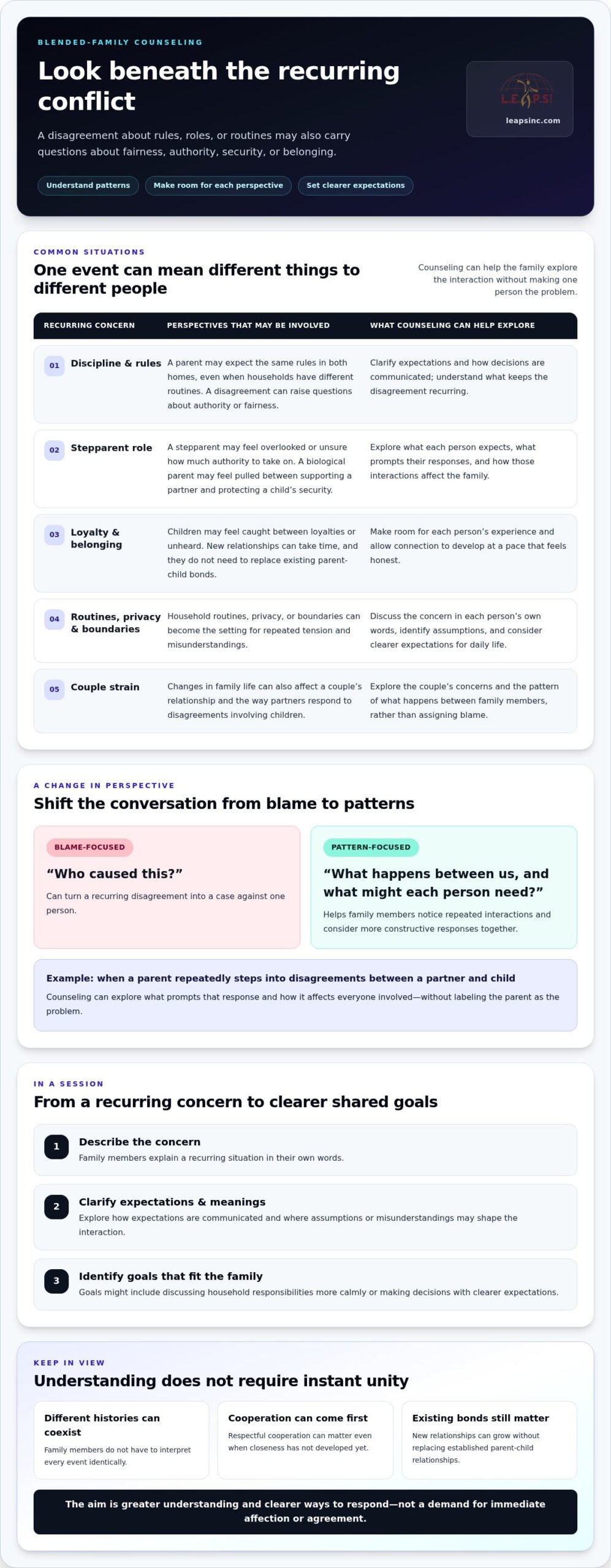
Those differences can shape ordinary situations. One parent may expect children to follow the same rules in both homes, while the households have different routines. A stepparent may be unsure how much authority to take on, or a child may want a relationship to develop at their own pace. Family counseling for blended families can help bring these experiences into view without deciding that one person is responsible for the strain.
Family therapy offers a way to look at relationships and interactions as a connected picture, rather than treating one person as the sole source of a problem. The field of family therapy includes approaches that consider family relationships and communication. Seeking counseling doesn’t mean a family has failed. It can reflect a willingness to understand what’s happening and consider how to move forward with greater care.
Which blended-family challenges can bring people to counseling?
Concerns often surface in recurring situations, such as arguments about discipline, household routines, privacy, or boundaries. A stepparent may feel overlooked or uncertain about their role, while a biological parent may feel pulled between supporting a partner and protecting a child’s sense of security. Children may experience competing loyalties or feel that their needs aren’t being heard.
These tensions can reinforce one another. A disagreement about a rule may carry deeper questions about authority, fairness, or belonging. Recognizing the pattern helps family members discuss the underlying concern instead of building a case against a particular person. For partners whose family changes are also affecting their relationship, Christian marriage counseling can provide a setting to explore the couple’s concerns.
Why connection may take time in a stepfamily
Adults, children, and siblings may adjust at different speeds. Respectful cooperation can be a meaningful starting point, even when warmth or closeness hasn’t developed yet. Pressuring someone to feel immediate affection can make connection feel like an obligation. Allowing relationships to form gradually gives each person room to participate honestly.
New bonds don’t need to replace existing parent-child relationships. A child can value a stepparent while remaining deeply connected to a biological parent, and a stepparent can build trust without taking someone else’s place. Making room for these bonds helps a family define what belonging means in its own household while allowing new relationships to grow.
How Family Counseling for Blended Families Creates a Shared Understanding
Family counseling offers a structured conversation about relationships, communication, and what each person in the household needs. Rather than deciding who is right, a therapist can help family members describe their experiences, listen for differences, and examine how their interactions unfold. The focus can shift from winning an argument to understanding what keeps it recurring.
For example, a disagreement about a child’s evening routine might involve more than a bedtime rule. One adult may value consistency, another may be trying to protect limited time with the child, and the child may experience the discussion as a loss of choice. Family counseling for blended families can help make those perspectives visible and identify responses that fit the family’s circumstances. It doesn’t promise instant closeness or a fixed timeline for change.
What can happen in blended-family counseling sessions?
A session may give family members room to describe a recurring concern in their own words. A therapist can help clarify what each person expects, how those expectations are communicated, and where assumptions or misunderstandings may shape the interaction. The family can then identify goals that fit its needs, such as discussing household responsibilities more calmly or making decisions with clearer expectations.
Family members don’t have to interpret an event identically for a conversation to be useful. Understanding what a situation means to someone else can create more choice in how to respond next time. LEAPS Inc.’s family therapy provides a setting to explore family relationships and emotional well-being.
How counseling can address patterns without assigning blame
A blame-focused conversation asks, “Who caused this?” A pattern-focused conversation asks, “What happens between us, and what might each person need in that moment?” The distinction matters. If a parent repeatedly steps in during disagreements between a partner and child, for instance, counseling can explore what prompts that response and how it affects everyone involved, rather than labeling the parent as the problem.
Collaborative family counseling is a guided process in which family members explore different experiences, recognize recurring interactions, and consider more constructive ways to respond together.
Shared understanding doesn’t require everyone to agree on every detail or set aside their own history. It can start with listening closely, naming the impact of a repeated interaction, and choosing one response to approach differently. You can schedule an appointment to begin a conversation about your family’s needs.
Family, Couples, or Individual Counseling: Which Format Fits the Concern?
The most useful format depends on whose experience or interaction needs attention. Is the concern happening between several people in the household, within the couple’s relationship, or primarily in one person’s inner life? These questions can help clarify where to begin. The format and participants can then be considered in light of the family’s needs and a thoughtful clinical plan.
| Format | Main concern | Participants | Conversational focus |
|---|---|---|---|
| Family therapy | Recurring household interactions | Relevant family members | How relationships and communication affect one another |
| Couple therapy | Relationship strain or shared parenting questions | Partners | Adult relationship patterns and parenting conversations |
| Individual therapy | Personal feelings or experiences | One person | Reflection, emotional well-being, and personal concerns |
When might family counseling be a useful starting point?
Family therapy may fit when a concern involves a repeated interaction among several family members, such as disagreements about shared responsibilities or how household decisions are made. The conversation can help participants describe what they notice, hear how others experience the same situation, and consider how their responses connect. LEAPS Inc.’s family therapy offers a setting to explore family relationships and emotional well-being.
Not everyone needs to participate in every conversation. Who joins can depend on the concern and clinical plan, with the aim of including perspectives that help clarify the issue. Family counseling for blended families can be a useful format when the interaction itself needs attention, rather than only one person’s feelings or the couple’s relationship.
When might a couple or individual format be relevant?
Couple therapy may suit partners who want to examine how they communicate, make decisions, or approach parenting together. For instance, they may want space to discuss how they respond when they disagree about a household expectation. This format focuses on the couple’s relationship. It isn’t automatically a replacement for conversations involving other family members.
Individual therapy can give one person dedicated space to reflect on emotions, stress, or personal experiences. A child or adult may value that focus, while a concern rooted in interactions across the household may call for a broader conversation. These formats address different needs, and one doesn’t make another less valid. Consider what the family hopes to understand and whose perspectives are needed to explore it.
A practical starting point is to describe the concern specifically: who is involved, what tends to happen, and what feels difficult to change. That description can help clarify whether the focus belongs with several family members, the partners, one individual, or a considered combination of perspectives.
Prepare for Blended-Family Counseling with Clear Goals and Honest Conversations
Preparation doesn’t require everyone to agree on what’s wrong. It can help to arrive with a few clear observations, hopes, and questions while leaving room for family members to see the same situation differently. The aim isn’t to build a case against one person. It’s to make concerns easier to discuss and the conversation more constructive.
What should family members consider before a first session?
Before a first session, invite each participant to reflect on what they hope to understand or change. Keep it manageable: a brief note is enough. These steps can help organize your thoughts:
- Name one or two concerns. Identify issues affecting family relationships, such as difficulty coordinating routines or conversations that repeatedly escalate.
- Describe a specific interaction. Note what happened, who was involved, and what each person did or said. “We argue about the evening schedule after school” is more useful than “Nobody listens.”
- Identify a hope. Consider what becoming clearer or more manageable might look like, such as discussing a household expectation without the conversation turning into a wider conflict.
- Prepare to listen. Make space for another person’s account, even if it differs from yours. Listening doesn’t require agreeing with every interpretation.
This preparation gives the family a starting point without scripting what anyone must say. If a child or adult isn’t ready to share a particular feeling, respect that boundary and let the conversation develop without pressure.
How to keep expectations constructive between conversations
Set expectations for respectful discussion together. You might agree to speak one at a time, avoid insults, and pause if a conversation becomes too heated to continue productively. These agreements won’t make disagreements disappear. They’re practical guardrails that can help family members express different views without turning difference into disrespect.
In family counseling for blended families, progress can be approached through small, observable shifts rather than demands for immediate harmony. For example, a family might notice whether a weekly conversation about plans feels more organized, or whether adults can pause before drawing a child into a disagreement. A small change won’t resolve every concern, but it can show what helps and what still needs attention.
During a disagreement, try to separate the immediate issue from the larger story attached to it. Clarify what decision needs to be made, summarize what you heard, and ask what would make the conversation more manageable. These family conflict resolution techniques can help keep discussion focused on the concern instead of assigning fault.
Preparing these reflections can make a first counseling conversation more purposeful. If your family is ready to explore its concerns with support, you can schedule an appointment.
Explore Family Counseling at LEAPS Inc. for Your Family
Choosing family counseling doesn’t require a complete plan or certainty about what needs to change. Sometimes the starting point is recognizing that the household feels strained, conversations keep getting stuck, or family members experience the same situation in different ways. At LEAPS Inc., family therapy is offered alongside individual, couple, and group therapy.
For blended families, counseling can create a structured opportunity to explore relationships, communication, and emotional well-being. The purpose isn’t to impose one definition of family or promise that everyone will feel close. It’s to make room for relevant perspectives, understand what the family is experiencing, and consider what may help next. Questions about roles, expectations, and how family members relate can all be part of that conversation.
What a family-centered next step can make possible
A first conversation can help clarify what brings the family to counseling and what each person hopes to address. One person may be concerned about recurring conflict; another may want clearer expectations or a chance to express how a transition has affected them. These different starting points can offer a fuller picture of the family’s needs, without requiring everyone to arrive with the same explanation.
As you prepare, consider bringing a few questions and hopes: What interaction would you like to understand better? What feels difficult to discuss at home? What would make daily life more manageable? You don’t need polished answers. Honest, specific questions can help shape a meaningful conversation. LEAPS Inc.’s therapeutic philosophy offers context for the practice’s broader perspective on therapy.
Move from uncertainty toward a purposeful conversation
You don’t have to resolve every family concern before reaching out. It’s enough to recognize that something deserves attention and be willing to explore it. A thoughtful first step can help you identify the questions, relationships, and hopes that matter most to your family, without deciding in advance what the outcome must be.
Family counseling for blended families can be an opportunity to approach those questions with care and purpose. Each household’s experience is distinct, and a conversation about your family’s needs can help establish a considered direction for support. The goal isn’t instant harmony, but a clearer understanding of where to focus and how to move forward.
If you’re ready to begin that conversation, schedule an appointment with LEAPS Inc.
Choose a Next Step That Honors Your Family’s Pace
Building connection doesn’t mean asking everyone to feel the same way or move at the same speed. It can begin with curiosity about what each person needs and what kind of relationships your household hopes to nurture. Family counseling for blended families can offer space to explore those questions with care while making room for existing bonds and individual perspectives.
You don’t need a complete explanation or a shared plan before beginning. Bring the concerns you can name, the questions you’re still holding, and a hope for what might feel more manageable. The first conversation can help your family identify where to focus next, one step at a time.
LEAPS Inc. offers professional therapy focused on emotional well-being. Schedule an appointment to begin a thoughtful conversation about your family’s needs. A more connected future can start with the decision to understand one another.
Frequently Asked Questions
Can family counseling help if the blended family is not in crisis?
Yes. Counseling can be useful before conflict becomes severe, especially when a transition is creating uncertainty or family members want to strengthen communication. A family might seek family counseling for blended families before a school-year change, a move between households, or a new caregiving arrangement, giving everyone a place to consider how the change may affect them. The focus can be preventive: identify pressure points early and make thoughtful choices rather than waiting for a breaking point.
Can counseling help when a child does not want a stepparent relationship?
Yes. Counseling can help a family respond to a child’s reluctance without treating closeness as an obligation. The child may be grieving a change, protecting an important bond, or simply needing more time; the reason can be explored with care rather than guessed at. Adults can focus first on predictable respect, such as agreeing on how to address one another and allowing the child to decline a shared activity, while keeping everyday communication considerate.
What if one parent or stepparent is hesitant about counseling?
One person’s hesitation doesn’t mean the family can’t begin exploring its concerns. Ask what feels uncomfortable: fear of being blamed, uncertainty about what happens, or doubt that the conversation will help. Describe a modest purpose, such as understanding one repeated disagreement, rather than demanding a promise of change. A hesitant adult can share questions before deciding how to participate; pressure or ultimatums may deepen resistance instead of building willingness.
How long does blended-family counseling take?
There isn’t a universal number of sessions or a set schedule for blended-family counseling. The length of care can depend on the concerns being addressed, the family’s goals, and how circumstances evolve. A family working through one specific decision may have different needs from one addressing several long-standing patterns. Over time, you can discuss with the therapist whether the focus should continue, shift, or conclude.
Can counseling address tension between step-siblings?
Yes. Counseling can help step-siblings examine situations that lead to tension, such as disagreements about belongings, privacy, shared spaces, or time with a parent. Rather than requiring them to act like close siblings, conversations can identify fair household expectations and ways to raise concerns without insults or exclusion. Adults can also consider whether rules are applied consistently and how to support each child without comparing them.
Does blended-family counseling mean everyone must attend every session?
No. Attendance can be shaped around the concern and the clinical plan, rather than requiring every family member at every meeting. A parent or couple may first discuss the issue, while a later conversation may include children or siblings whose perspectives are relevant. The therapist and family can consider who should participate and why, with attention to each person’s comfort and practical circumstances. Participation can be discussed as goals develop.
Can counseling help when the two households have different parenting expectations?
Yes. Counseling can help parents distinguish shared priorities from rules that reasonably differ, then plan how to communicate those differences to children. Bedtimes or screen routines, for instance, may not match exactly, but adults can clarify expectations in each home and avoid asking a child to carry messages between them. The aim needn’t be identical parenting; it can be reducing confusion around transitions and keeping children out of adult disputes.