

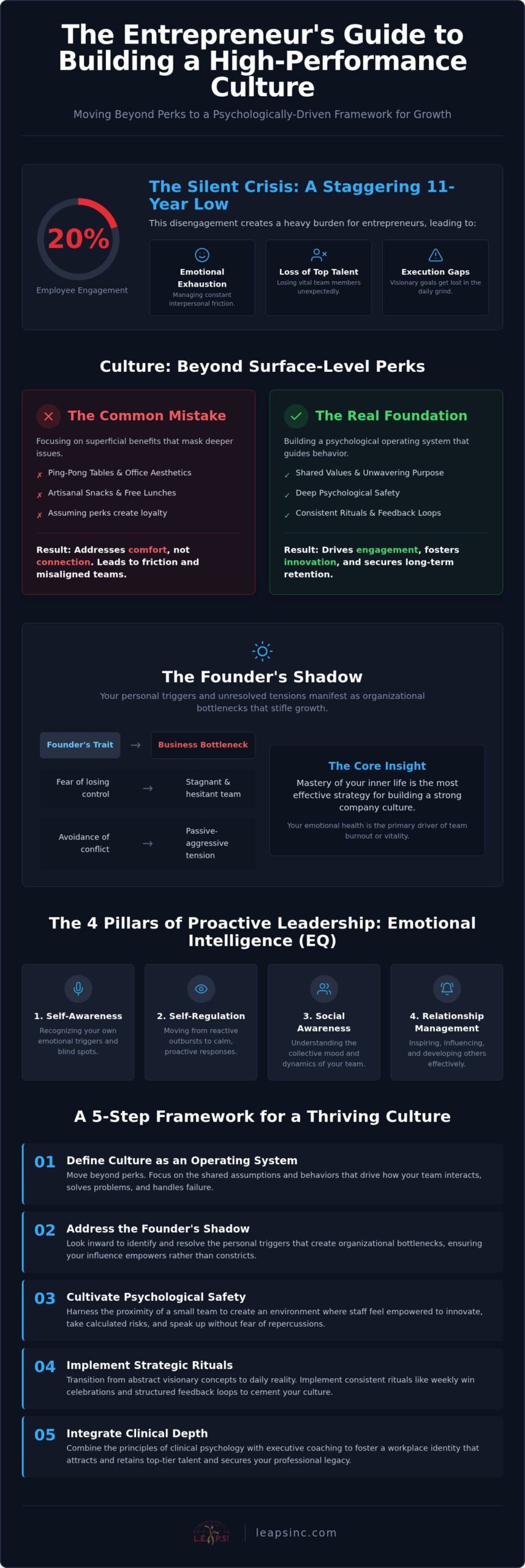
Global employee engagement has plummeted to a staggering 11-year low of 20% as of 2026, creating a silent crisis for entrepreneurs who feel the weight of every disengaged team member. You’ve likely felt the emotional exhaustion of managing interpersonal friction or the sting of losing top-tier talent just as they were becoming vital. It’s draining to watch your visionary goals get lost in the daily grind of execution gaps. You aren’t just looking for a standard HR manual; you’re seeking the definitive path on how to build a strong company culture in a small business that acts as a self-sustaining engine for growth and personal fulfillment.
We’ll move beyond surface-level perks to explore how your internal clarity as a leader shapes the collective emotional landscape of your firm. This guide promises to transform your culture from a rigid set of rules into a powerful, psychologically-driven catalyst for your business destiny. By integrating clinical depth with strategic advancement, we’ll outline a framework for building a high-performance team that allows you to reclaim your peace of mind while attracting the elite talent your vision requires.
Key Takeaways
- Move beyond superficial perks to define your culture as a sophisticated operating system that drives long-term engagement and team alignment.
- Uncover how to build a strong company culture in a small business by identifying the “Founder’s Shadow” and resolving the personal triggers that often create organizational bottlenecks.
- Harness the proximity advantage of smaller teams to cultivate deep psychological safety, ensuring your staff feels empowered to innovate without the fear of repercussions.
- Implement a methodical audit of your current team dynamics to transition from abstract visionary concepts into a structured, high-performance daily reality.
- Integrate clinical psychology with executive coaching to foster a workplace identity that attracts top-tier talent and secures your professional legacy.
Beyond Perks: Defining the Soul of Your Small Business Culture
Many leaders mistake office aesthetics for organizational health. They install ping pong tables or stock the breakroom with artisanal snacks, hoping these perks will mask the friction of a misaligned team. These surface-level benefits fail because they address comfort rather than connection. If you want to understand how to build a strong company culture in a small business, you must look deeper than the fun stuff.
Culture is the unspoken operating system that dictates how your team interacts, solves problems, and handles failure. It’s the psychological fabric of your firm. By examining the foundations of Organizational culture, we see it isn’t just about rules, but about the shared assumptions that guide behavior. From a clinical perspective, we can view workplace relationships through the lens of attachment theory. Just as children need a secure base to explore the world, employees need a secure professional base to innovate and take risks. When this security is missing, team members operate from a state of hyper-vigilance, which kills creativity and fuels turnover. Company culture is the outward manifestation of shared values and psychological safety.
The Difference Between Climate and Culture
Climate is the current weather of the office; it’s how people feel today based on a recent win or a stressful deadline. Culture is the underlying geography. It’s how they act when you aren’t in the room. Small businesses are uniquely vulnerable to toxic micro-climates because one dominant personality can shift the collective mood. To stabilize this, you must implement consistent rituals. Whether it’s a weekly win celebration or a structured feedback loop, rituals cement a long-term identity that survives individual bad days.
Why Purpose is the Ultimate Retention Tool
Retention isn’t about paying the most; it’s about providing the most meaning. While competitors focus on what they do, visionary leaders focus on why they exist. This purpose acts as a visionary anchor during seasons of growth. You can identify these non-negotiable principles using a strategic framework for your firm. When you align individual destinies with your company’s corporate visioning, you create a team that isn’t just working for a paycheck. This alignment is the secret to how to build a strong company culture in a small business.
The Founder’s Shadow: Why Culture Starts with the Leader’s Inner Life
Every small business is a reflection of its founder. Your personal triggers, fears, and unresolved tensions don’t stay at home; they manifest as organizational bottlenecks that stifle growth. This phenomenon, known as the “Founder’s Shadow,” explains why a leader’s emotional health acts as the primary driver of team burnout or vitality. If you struggle with delegation due to a fear of losing control, your team will remain stagnant and hesitant. If you avoid difficult conversations, your culture will be defined by passive-aggressive tension. These are not just management flaws; they’re emotional signatures. Mastery of your inner life is the most effective strategy for how to build a strong company culture in a small business. Through executive coaching, you can begin to identify these blind spots, ensuring your influence empowers rather than constricts your team’s potential.
Emotional Intelligence as a Cultural Foundation
High-stakes environments demand more than just tactical skill. They require the four pillars of Emotional Intelligence (EQ): self-awareness, self-regulation, social awareness, and relationship management. Moving from reactive management to proactive visionary leadership starts with your ability to regulate your own nervous system. When you model emotional stability during a crisis, you provide the psychological safety necessary for your team to remain focused. Proactive leadership involves recognizing a trigger before it results in a reactive outburst. This creates a ripple effect where the team learns to prioritize calm execution over chaotic urgency. This isn’t just “soft skill” development; it’s the structural engineering of a high-performance environment.
The Role of Therapy in Professional Excellence
The most successful founders understand that their professional peak is capped by their personal growth. Breaking the stigma around individual therapy is essential for those seeking maximum impact. Resolving internal personal conflicts clears the cognitive and emotional path for organizational expansion. By treating your mental well-being as a business asset, you bridge the gap between clinical depth and professional performance. The intersection of clinical depth and professional performance isn’t a luxury. It’s a necessity for those who wish to leave a legacy that isn’t marred by burnout or resentment. If you’re ready to explore how your inner landscape is shaping your firm’s future, consider how a professional consultation might illuminate your path forward. Vulnerability becomes a strategic advantage when it allows you to lead with authentic clarity rather than defensive posturing.
Frameworks for Building Psychological Safety in Small Teams
Psychological safety is the shared belief that the workplace is a secure environment for interpersonal risk-taking. It’s the conviction that one won’t be punished, humiliated, or marginalized for speaking up with ideas, questions, concerns, or mistakes. In larger corporations, this sense of safety often gets lost in layers of bureaucracy. However, small businesses possess a unique “proximity advantage.” Because team members interact more frequently and intimately, you have the opportunity to build deep trust through consistent, high-impact interactions. Understanding how to build a strong company culture in a small business requires leveraging this closeness to create a sanctuary of candor.
To move from theory to practice, leaders should implement a “Feedback Loop” framework rooted in radical transparency. This isn’t about harsh criticism; it’s about the clinical precision of identifying what works and what doesn’t without attaching shame to the outcome. When people feel safe to fail, they stop hiding errors and start solving problems. Research indicates that fostering high psychological safety accelerates innovation by 30%, as employees feel empowered to voice unconventional ideas that would otherwise remain silenced by fear.
Conflict Resolution as a Growth Strategy
Interpersonal friction is inevitable in any high-performance environment. Instead of suppressing it, visionary leaders transform it into “creative abrasion.” This involves leaning into disagreements to spark better solutions. You can effectively manage these dynamics by utilizing family conflict resolution techniques within your professional ecosystem. Since small businesses often feel like families, applying these clinical methods helps de-escalate emotional triggers and refocus the team on shared objectives. Your role is to act as a mediator and visionary guide, ensuring that conflict serves the company’s growth rather than its destruction.
Empowering Through Autonomy and Mastery
A truly self-sustaining culture is built on the principles of Self-Determination Theory: autonomy, competence, and relatedness. To master how to build a strong company culture in a small business, you must learn to delegate without losing the “founder’s touch.” This means giving your team the freedom to choose how they achieve their goals while providing the resources they need to gain competence.
- Autonomy: Provide the “what” and “why,” but let the team define the “how.”
- Mastery: Create clear paths for professional development so every employee sees a trajectory toward their personal destiny.
- Relatedness: Ensure every individual feels their work contributes to the collective corporate vision.
By fostering a culture of mastery, you ensure that your team isn’t just executing tasks but is actively pursuing professional excellence as a part of their own life purpose.
Strategic Implementation: From Visionary Theory to Daily Reality
Transforming abstract ideals into a tangible environment requires a methodical approach. The first step in how to build a strong company culture in a small business is conducting a rigorous audit of your “unspoken” culture. You must observe what behaviors are actually rewarded and what happens when a mistake occurs. Once you’ve identified the current reality, you can bridge the gap through corporate visioning. This collaborative workshop allows your team to co-author the company’s future, ensuring the values aren’t just posters on a wall but lived experiences. Integrating these standards into your daily operations ensures consistency across the board.
Establishing “Cultural Guardians” within your team is vital for maintaining momentum. These are individuals who naturally embody your core values and help uphold the standard when you aren’t present. By formalizing these roles, you ensure that culture remains a living, breathing entity rather than a forgotten document. If you’re ready to formalize your organizational identity, schedule an executive consultation to begin your transformation.
Hiring for Cultural Alignment, Not Just Skill
Technical proficiency is a baseline, but cultural alignment is the ceiling for your team’s potential. Screening for values during the interview process involves asking behavioral questions that reveal an applicant’s internal compass. You must avoid the “brilliant jerk,” the high performer whose toxic attitude erodes psychological safety. A small team cannot survive the friction caused by one misaligned ego. Your onboarding process should feel like an initiation into a mission, not just a review of payroll software. This sets the tone for a career defined by purpose rather than just tasks.
Sustaining Culture During Scale
Growth introduces complexity that can dilute your original vision. The “Rule of 15” suggests that culture shifts significantly as you expand from 5 to 15, and then to 50 employees. Maintaining that “small business feel” requires professionalizing your systems without losing the human touch. Utilizing a workplace wellness program can support this transition by prioritizing the mental health of your expanding team. As you grow, your culture must evolve from a set of intuitive habits into a structured framework for excellence. This evolution allows you to scale your impact while keeping your core identity intact.
The LEAPS Approach: Integrating Clinical Depth into Your Business Strategy
LEAPS Inc. operates on the foundational belief that the boardroom and the inner life of the individual are inextricably linked. We move beyond traditional consulting by applying the “Visionary Mentor” model, which treats organizational development as both a clinical and strategic endeavor. While many firms offer surface-level management advice, we bridge the gap between psychological health and executive performance. This unique integration is the definitive answer for those asking how to build a strong company culture in a small business that endures far beyond the initial growth phase.
A key component of this strategy involves treating mental health as a core business asset. Implementing an Employee Assistance Program (EAP) acts as a strategic investment rather than a mere administrative checkbox. It provides your team with the resources needed to navigate personal and professional stressors, ensuring that emotional vulnerability doesn’t lead to burnout. By providing this secure base, you transform your culture into a high-energy catalyst for transformation.
Corporate Consulting and Leadership Intensives
Real change often requires more than a weekly meeting. Our Leadership Impact Intensive is designed for founders who are ready to confront the “Founder’s Shadow” and unlock their team’s latent abilities. These sessions can resolve years of organizational stagnation in a single weekend by identifying the psychological bottlenecks that prevent scale. We focus on building emotional resilience, which serves as the bedrock for high-performance environments. The ROI of this investment is found in a team that is 23% more profitable and 18% more productive, as seen in high-engagement environments recorded in 2026. These intensives provide the structured intervention necessary to move from theory to a lived daily reality.
Your Journey Toward a Visionary Culture
The path to a self-sustaining team is a deliberate, steady progression from internal founder clarity to external cultural excellence. You’ve navigated the complexities of defining your organization’s soul, resolving personal triggers, and building frameworks for psychological safety. This journey requires you to lead with both purpose and clinical precision. By aligning your team’s individual destinies with your company’s corporate vision, you create a business identity that naturally attracts top-tier talent. It’s time to stop managing immediate problems and start facilitating your team’s maximum potential. If you are ready to align your team with your highest vision, Schedule your visionary consultation with LEAPS Inc. today. Your professional destiny is shaped by the courage to look within.
Step Into Your Professional Destiny
Your journey toward organizational excellence begins with the recognition that your firm is a living extension of your internal clarity. We’ve explored how identifying the “Founder’s Shadow” and prioritizing psychological safety are non-negotiable steps in how to build a strong company culture in a small business. By moving beyond superficial perks and embracing a structured, visionary framework, you transform your team into a self-sustaining engine for growth and fulfillment.
LEAPS Inc. provides the clinical authority and strategic structure necessary to facilitate this peak state. Led by Dr. John E. N. Daniel, our holistic integration of therapy and executive coaching ensures your professional success is mirrored by personal peace. Whether you require our specialized Leadership Impact Intensives or a deep-dive Corporate Visioning session, we offer the prestige professional support required to reach your maximum potential and secure your professional legacy.
The path to your professional destiny is open. Schedule your visionary consultation with LEAPS Inc. today and align your team with your highest purpose. You possess the power to create a workplace culture that truly inspires.
Frequently Asked Questions
How do I know if my small business culture is toxic?
A toxic culture often reveals itself through high employee turnover and a pervasive silence where team members fear voicing concerns. If you notice a persistent misalignment between your vision and team execution, it’s a sign of underlying friction. You should also watch for emotional exhaustion among leadership. These symptoms indicate that the unspoken operating system of your firm has become a bottleneck rather than a catalyst for growth and transformation.
Can a bad culture be fixed once it’s already established?
Yes, cultural transformation is possible through structured intervention and leadership clarity. It requires the founder to confront their own shadow and resolve personal triggers that influence the workplace. By utilizing specialized Leadership Impact Intensives, you can reset the emotional landscape of your organization. Success depends on moving beyond superficial perks to establish deep trust and radical transparency, effectively rewriting the psychological fabric of your small team to achieve its maximum potential.
What is the most important value for a small business to have?
Psychological safety is the foundational value that enables all other forms of high performance. It’s the shared belief that one won’t be punished for mistakes or for speaking up with innovative ideas. In the context of how to build a strong company culture in a small business, this safety allows for creative abrasion where conflict leads to better solutions. Without this security, your team will prioritize self-protection over organizational growth and visionary thinking.
How much should a small business spend on culture-building?
You should view culture-building as a strategic investment in human capital rather than a discretionary expense. While budgets vary, the cost of disengagement is high; global employee engagement fell to an 11-year low of 20% as of 2026. Investing in high-level executive coaching or a Corporate Visioning workshop provides a significant ROI. These interventions reduce productivity loss by creating a self-sustaining, high-performance team that attracts top-tier talent and aligns with your professional destiny.
Is company culture different from brand identity?
Yes, culture is the internal reality while brand identity is the external perception. Think of culture as the soul or the internal operating system that dictates how your team acts when no one is looking. Brand identity is the outward manifestation of that soul designed to attract clients. For a visionary leader, these two must be perfectly aligned. When your internal values match your external promises, you build a business identity that feels authentic and powerful.
How do I maintain culture in a remote or hybrid small business?
Maintaining culture in a distributed environment requires intentional, consistent rituals that replace the proximity advantage of a physical office. You must formalize communication loops and create digital spaces for emotional vulnerability. Since managers account for 70% of the variance in team engagement, their ability to model your values remotely is critical. Focus on shared purpose and corporate visioning to ensure every team member feels connected to the company’s destiny, regardless of their location.
What role does an EAP play in a strong company culture?
An Employee Assistant Program (EAP) acts as a structural safety net for your team’s emotional well-being. It signals that you value the holistic health of your employees, not just their productivity. By providing confidential access to clinical therapy, you reduce the risk of burnout and interpersonal conflict. This strategic investment helps you master how to build a strong company culture in a small business by treating individual mental health as a prerequisite for professional excellence.
How often should we review our corporate vision and values?
You should conduct a formal review of your corporate vision and values at least annually, or whenever your team reaches a significant growth milestone. The Rule of 15 suggests that culture shifts as you scale, requiring you to professionalize your systems. Regular workshops ensure your standards remain a living reality rather than a forgotten document. This consistent audit allows you to realign your team’s daily actions with the peak state of your long-term visionary goals.