

A corporate visioning process turns an organization’s hoped-for future into a shared direction for decisions and action. A strategic vision typically describes a desired long-term future over 3 to 10 years; it expresses the impact an organization aims to create, while its mission explains how it will contribute. Visioning imagines possibilities, rather than predicting exactly what will happen.
A future vision can inspire, but it guides an organization only when people understand it and see how their work connects to it. A corporate visioning process brings leaders and stakeholders together to define what success looks like, shape a focused vision statement, and communicate its meaning across the organization.
This guide explains how to facilitate visioning, draft and share a compelling vision, and distinguish the broad future it describes from the goals and measurable objectives that help move the organization forward.
Key Takeaways
- Describe the future impact your organization wants to create, then distinguish that vision from the mission explaining how you’ll contribute to it.
- Gather diverse perspectives and use shared themes to shape a clear, meaningful vision statement.
- Communicate why the vision matters and help employees see how their roles contribute to it.
- Translate the vision into focused, measurable goals and supporting objectives, then connect them to actions and resources.
- Revisit the vision and priorities as circumstances change, keeping the direction relevant and achievable.
Drafting a vision statement
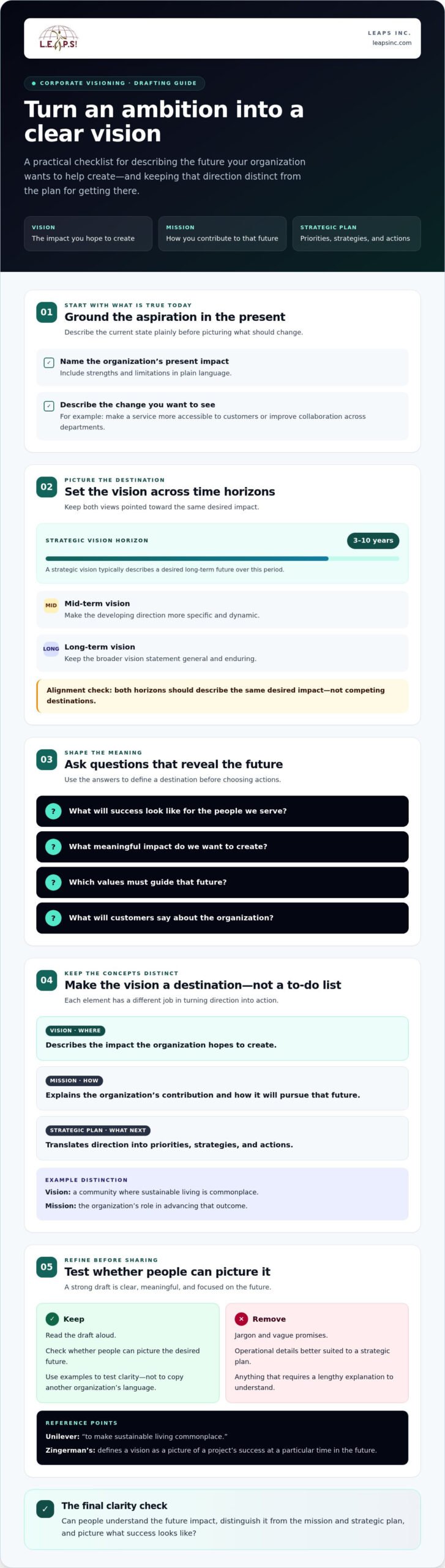
Draft the vision as a clear picture of the future your organization wants to help create. In a corporate visioning process, leaders connect that picture to the organization’s values and distinguish it from the mission and strategic plan.
Ask: What will success look like for the people we serve? What impact do we want to create? Which values must guide that future? These questions help a company define its desired destination before choosing the actions to reach it.
- Describe the current state before imagining the desired one. State the organization’s present impact, strengths, and limitations in plain language. Then describe what should change, such as making a service more accessible to customers or improving collaboration across departments. This contrast gives leaders a practical starting point and keeps aspirations connected to the organization’s work.
Develop Mid-Term and Long-Term Visions
Write a mid-term vision for the organization’s developing direction, then a long-term vision for its broader future. A strategic vision typically describes a desired future over 3 to 10 years. Keep the mid-term view more specific and dynamic, while the long-term vision statement remains general and enduring. Check that both describe the same desired impact rather than competing destinations.
- Separate the vision from the mission and strategic plan. The vision describes the impact the organization hopes to create; the mission explains its contribution and how it will pursue that future. A strategic plan translates direction into priorities, strategies, and actions. For example, a vision might describe a community where sustainable living is commonplace, while the mission explains the organization’s role in advancing that outcome.
Use Questions and Examples to Refine the Vision
Ask what customers will say about the organization, what meaningful change it will create, and which values should remain non-negotiable. Compare the draft with Unilever’s concise vision, “to make sustainable living commonplace.” Zingerman’s defines a vision as a picture of a project’s success at a particular time in the future. Use examples to test clarity, not to copy another organization’s language.
- Test and refine the statement. Read the draft aloud and check whether people can picture the desired future without needing a lengthy explanation. Remove jargon, vague promises, and operational details better suited to a strategic plan. For support in shaping organizational direction, corporate visioning guidance can help leaders turn an aspiration into a clear statement.
Definition and purpose of organizational visioning
Organizational visioning helps people define a desired future and use it to guide choices. Treat the vision as a shared direction, then translate it into decisions across the organization.
Analyze the Organization and Its Environment
Assess the organization’s strengths, weaknesses, opportunities, and threats before shaping its future direction. A SWOT analysis can reveal internal capabilities alongside external pressures; a SOAR analysis instead examines strengths, opportunities, aspirations, and results. Consider the organization’s strategic focus for the next 1 to 5 years, and assess available resources, including external partnerships, before identifying gaps or deciding to hire.
- Describe the conditions shaping the future. Identify customer needs, industry shifts, and internal capabilities that could influence the desired future. For example, a service organization responding to changing customer expectations can consider how its teams, processes, and partnerships might adapt. Separate current evidence from assumptions so the vision encourages creativity without ignoring practical constraints.
Align Subunit and Organization-Wide Direction
Compare each department’s priorities with the organization’s broader vision and mission. A customer service team might improve access, while a product team develops offerings that support the same impact. Check that each unit contributes to the shared direction, even when its contribution is indirect. Avoid visions that compete for resources or pull teams toward incompatible outcomes.
- Translate the shared direction across teams. Use the organization-wide vision as an anchor, then define how each function contributes through its priorities and decisions. A marketing team, for example, can align its messaging with the intended impact, while operations considers the capabilities needed to deliver it. This approach creates coherence without requiring every team to have identical objectives.
Guide Growth and Decision-Making
Use the desired future as a decision filter when weighing growth opportunities, investments, or new initiatives. Ask whether each option advances the vision, fits the organization’s strengths, and supports its mission. A vision can encourage innovation by inviting teams to imagine ideal outcomes, but leaders should match ambition to available resources and organizational capacity.
- Review choices against the direction. When proposals compete, compare their expected contribution to the shared future rather than relying only on short-term appeal. For example, leaders can prioritize a partnership that strengthens a core capability over expansion that distracts from the organization’s purpose. If your leadership team wants structured support aligning direction and decisions, schedule an appointment.
Communicating vision to support strategy implementation
A vision becomes strategic when leaders connect it to planning, decisions, and employees’ daily contributions. Common risks include vague aspirations, excluding stakeholders, and leaving conflicting priorities unresolved.
- Use the vision as the foundation for strategic planning. Begin planning discussions by restating the desired future, then identify the mission, strategies, and tactics that can advance it. For example, a company seeking more accessible services could assess which customer experiences and operational changes support that outcome. Keep plans tied to the vision instead of letting urgent tasks become the strategy.
- Turn the future picture into practical steps through backcasting. Start with the outcome the organization wants, then work backward to identify the milestones, strategies, and actions needed to reach it. If a company envisions more sustainable operations, leaders can trace backward from that future state to identify changes in purchasing, processes, and staff responsibilities. Backcasting links aspiration to a sequence of decisions.
- Make strategic visioning workshops engaging and purposeful. Invite stakeholders to discuss what the future should look like, why it matters, and what could prevent progress. A structured workshop can surface differences before leaders turn the vision into a plan. If the session uses a licensed framework or materials, clarify permission for their use and distinguish those materials from the organization’s own vision.
- Explain how the vision was developed. Share who participated, how input was gathered, and which themes shaped the final direction. For example, leaders can explain how employee discussions influenced the company’s priorities, then present the vision in accessible formats and through varied communication methods. This context helps stakeholders understand both the destination and the reasoning behind it.
- Connect the plan to each team’s work. Leaders should share the strategic plan with teams and explain the desired future, why it matters, and how employees can contribute in their roles. A customer support team might connect its service practices to a broader goal of improving customer access. Invite team discussions so employees can identify actions within their influence.
- Review communication as implementation unfolds. Use staff meetings, team updates, and planning discussions to keep the vision present in decisions. When priorities shift, explain what changed and how the organization’s direction still guides its response. For tailored support aligning vision and implementation, leaders can schedule an appointment.
Explain how goals were identified and who participated, then share them through varied methods and accessible formats. Backcasting works backward from a desired future to identify the steps and strategies needed to achieve it.
Distinguishing goals from objectives
Goals translate an organization’s vision into specific, measurable outcomes; objectives clarify the concrete progress that supports each goal. Developing both gives people a practical path toward the desired future and helps leaders prioritize work.
- Separate the destination from the steps. Write each goal as an outcome that advances the vision, then identify the actions or measurable results that support it as objectives. For example, a goal might focus on stronger member engagement, while objectives could specify how the organization will improve participation. Avoid treating broad aspirations as objectives, because they don’t show teams what progress looks like.
- Keep the goal list focused. Strategic plans should focus on 3 to 5 goals, each supported by strategies and measures. A longer list can divide attention and make it harder to assign responsibility. Ask whether each proposed goal meaningfully advances the vision, then set aside lower-priority ideas for later review instead of crowding the plan.
- Prioritize goals through structured discussion. Use multivoting to surface priorities: individuals usually vote for five choices they consider most important. A decision matrix can then compare options against agreed criteria, such as alignment with the vision, available resources, and expected impact. Treat the matrix as a discussion tool, not a substitute for judgment or shared understanding.
- Connect goals to resources before committing. Assess existing strengths and resources, including support available through external partnerships, before identifying gaps or deciding to hire. A goal that depends on new capacity may require a different sequence than one supported by current teams. Recognize indirect contributions too: a department may enable progress without owning a specific goal.
- Make the plan accessible to its audience. Share the vision and goals in formats that accommodate people with visual or hearing impairments, and provide interpretation or translation for people whose preferred language isn’t English. Explain how priorities were chosen and who participated. Accessible communication helps people understand the direction and see how their work contributes.
- Review and adapt as conditions change. Revisit goals when community circumstances or needs shift, and update the vision and plan when the original direction no longer reflects them. For example, a nonprofit membership association set a three-year target to increase membership from 500 to 650. After goals are achieved, identify the next outcomes to prioritize rather than continuing to measure a completed objective.
Facilitation and participant experience
A visioning session moves from individual reflection to shared themes, draft language, and priorities. Its duration depends on participation and discussion; a facilitated group may spend about 15 minutes drafting a vision statement and 20-30 minutes creating draft goals.
Choose Who Participates
Invite employees and diverse stakeholders whose perspectives can shape or be affected by the organization’s future. Include people with different roles and experiences, not only senior leaders, and decide how customers or community partners can contribute. Zingerman’s gathered input from more than 200 staff members for its 2020 organizational vision, which 15 managing partners finalized by consensus.
Plan the Visioning Session
Set a clear framework before the session: collect individual reflections, group related ideas, draft a shared vision, then identify goals. Ask participants to picture organizational success three years ahead or explore a scenario ten or more years in the future. Allow time for silent reflection and discussion; group size and the depth of consensus shape the agenda.
Facilitate the Visioning Session
Guide participants from personal hopes toward organizational impact. Ask what customers might say about the organization, what actions led to success, and which results demonstrate progress. Have breakout teams record ideas on separate notes, share them with the full group, and cluster related themes. Give each participant five stickers to vote for the ideas they consider most important.
Use Visual Facilitation and Graphic Guides
Make the emerging vision visible on a shared wall, whiteboard, or digital canvas. A graphic guide can map themes, desired outcomes, and connections between ideas, helping employees follow the group’s thinking. For example, place votes beside themes before drafting the statement. Keep labels readable and explain symbols so participants can engage with the same picture.
- Close with a clear record and next step. Capture the agreed themes, unresolved questions, and draft language in a format participants can revisit. Assign someone to refine the wording and circulate it for review, so the session’s ideas continue beyond the discussion. If your organization wants help structuring a visioning session, schedule an appointment.
Vision and goal development can gather input individually through surveys and one-on-one conversations, or collectively through focus groups and facilitated visioning sessions. A visioning session is a structured workshop where participants collaborate to create a shared picture of the future.
To prepare, collect individual written reflections before teams consolidate vision elements. Ask participants to imagine what customers say about the organization, visualize the actions that led to success, and describe the results. These prompts connect a future picture with the actions and outcomes that matter to participants. Visioning requires people who can lead the process and have experience applying the tool.
LEAPS: Individual Therapy
LEAPS offers Individual Therapy for people seeking space to explore personal challenges and emotional well-being. Defining an organization’s future can involve demanding decisions, uncertainty, and pressure. Individual therapy provides a setting to reflect on those experiences and consider your needs beyond your leadership role.
Consider Individual Therapy when stress or personal concerns affect how you experience work and life. Therapy can help you examine what matters to you, recognize patterns, and clarify the support you’re seeking, without treating every leadership challenge as a clinical issue.
If you’d like to learn more, visit leapsinc.com.
Give Your Organization’s Future a Clear Next Step
A vision gains momentum when leaders make room for honest discussion about what the organization is ready to become. The next step might be naming an unresolved decision, inviting stakeholders into a focused conversation, or clarifying which future possibilities deserve attention first. A corporate visioning process can turn that reflection into deliberate direction, without requiring leaders to have every answer before they begin.
LEAPS offers Corporate Visioning to support organizations defining their direction. For leaders whose personal concerns need separate attention, LEAPS also offers Individual Therapy, Therapy Intensive, and Couple Therapy. Keeping organizational planning distinct from personal support helps each conversation focus on the needs it is meant to address.
Schedule an appointment to discuss your visioning priorities, and take a considered step toward the future your organization wants to create.
Frequently Asked Questions
What is Visioning?
Visioning is a structured way to imagine and describe the future an organization wants to create. It helps people move beyond immediate pressures and consider what lasting success could look like for customers, employees, or communities. For example, a service organization might picture a future where customers can access support more easily. That picture can inform choices instead of serving only as an inspirational phrase.
What is a corporate visioning process?
A corporate visioning process involves gathering perspectives, clarifying a desired future, and turning shared themes into direction. It can begin with confidential interviews or written reflections, then bring participants together to explore patterns and resolve differences. Leaders can use the resulting vision to assess proposals: does a new initiative advance the future described, or distract from it? This test makes the vision useful beyond its launch.
How do you facilitate a corporate visioning workshop?
Facilitate a workshop by setting a clear purpose, inviting balanced participation, and guiding the group through reflection, discussion, and synthesis. Before the session, explain which decisions participants can influence. During it, use silent writing before open discussion so early speakers don’t dominate. When disagreements arise, record the competing priorities and ask what shared outcome each perspective is trying to protect.
What is the difference between a corporate vision, mission, and strategy?
A corporate vision names the future an organization wants to help create. Its mission describes the organization’s contribution, while strategy sets the choices and coordinated actions intended to advance that future. For example, a vision might imagine healthier communities, a mission could describe providing accessible nutrition education, and a strategy might prioritize partnerships with local organizations. The terms work together, but each answers a different planning question.
How do you align employees and stakeholders around a corporate vision?
Help employees and stakeholders connect the vision to decisions they influence. Managers can discuss what the direction means for their teams, invite questions, and identify where existing work supports it. For instance, a product team might review whether its design choices reflect a commitment to accessibility. Provide a way to raise concerns after the initial announcement, then respond to recurring questions with consistent explanations and examples.
How do you turn a corporate vision into measurable goals and action plans?
Choose outcomes that advance the vision, then define how progress will be measured and who owns each action. An action plan can specify responsibilities, timelines, resources, and review points. For example, if the vision emphasizes easier customer access, a goal could focus on improving access, with objectives tied to service channels or response processes. Establish a baseline before setting targets so later reviews compare progress with a meaningful starting point.
How do you measure whether a corporate vision is effective?
Assess whether people can explain the vision, use it to guide decisions, and connect their work to the intended future. Review whether plans and resources reflect the direction, then examine progress against related goals. For example, if leaders repeatedly approve initiatives that conflict with the vision, the direction may be unclear or poorly integrated. Gather employee feedback and revisit the vision when circumstances or organizational priorities change.