

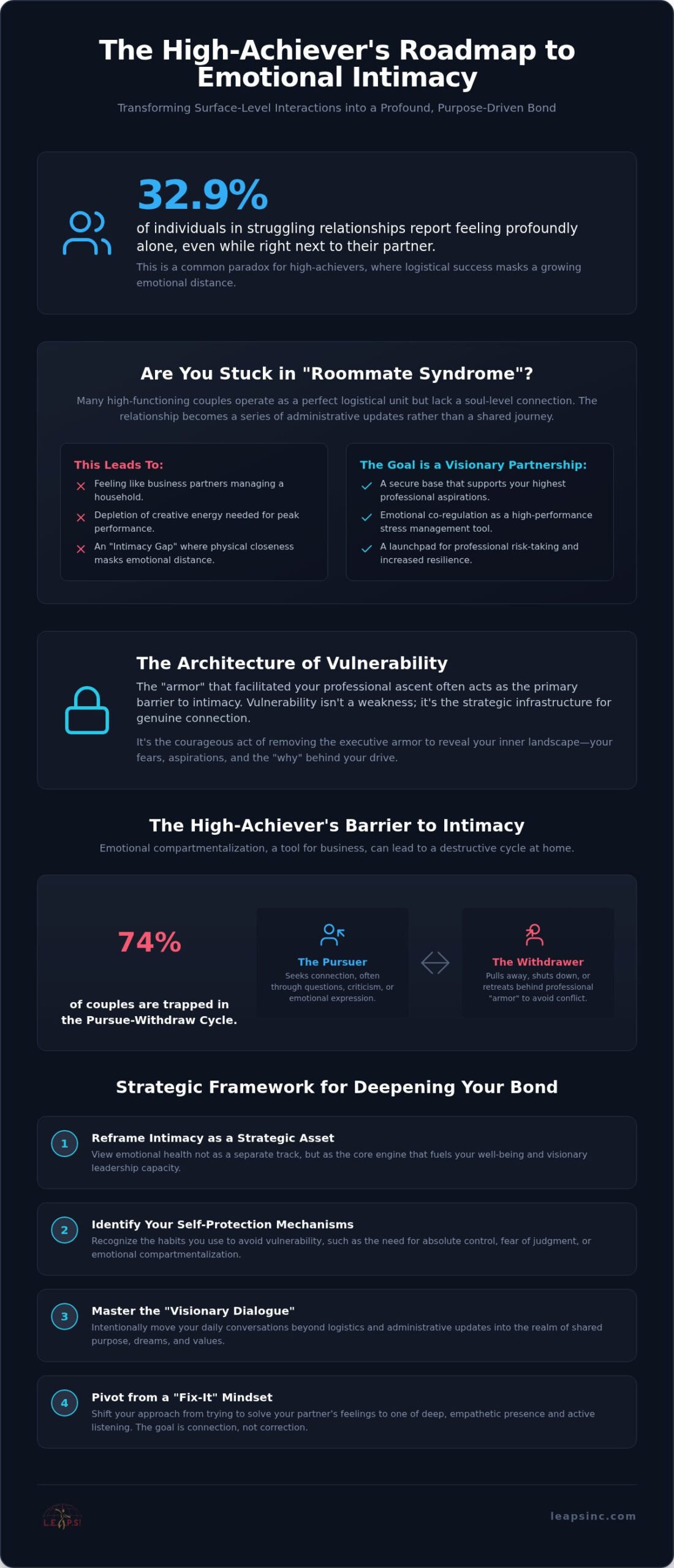
Why do 32.9% of individuals in struggling relationships report feeling profoundly alone even while lying right next to their partner? It’s a painful paradox for many high-achievers. You’ve likely mastered the logistics of a complex, busy life, yet your most vital partnership might feel like a series of administrative updates rather than a shared destiny. You don’t have to choose between professional strength and personal vulnerability. In fact, learning how to improve emotional intimacy in a relationship is the key to creating a secure base that supports your highest professional aspirations.
This article offers the strategic frameworks and psychological insights needed to transform surface-level interactions into a profound, purpose-driven bond. We’ll examine the mechanics of the “pursue-withdraw” cycle, the necessity of emotional responsiveness, and practical methods to maintain deep connection amidst a demanding career. By the end, you’ll have a roadmap to turn your relationship into a visionary partnership that empowers every area of your life. Discover how to move past logistics and into the deep emotional safety required to reach your maximum potential.
Key Takeaways
- Reframe emotional intimacy as a strategic asset that fuels both your personal well-being and your capacity for visionary leadership.
- Identify the specific self-protection mechanisms that high-achievers often utilize to avoid the vulnerability necessary for a profound bond.
- Master the “Visionary Dialogue” framework to move your daily conversations beyond logistics and into the realm of shared purpose.
- Discover how to improve emotional intimacy in a relationship by pivoting from a “fix-it” mindset to one of deep, empathetic presence.
- Understand the unique advantages of a Therapy Intensive for busy professionals seeking rapid, structured, and lasting relationship transformation.
What is Emotional Intimacy and Why is it a Visionary Asset?
Emotional intimacy is frequently mischaracterized as a sentimental luxury, yet in the context of high-level leadership, it functions as a strategic necessity. It represents a state of mutual vulnerability, radical transparency, and psychological safety. When you master how to improve emotional intimacy in a relationship, you are essentially fortifying the internal engine that drives your visionary output. Without this foundation, the cognitive load of maintaining a “performing self” at home eventually leads to a depletion of the creative energy required for peak professional performance.
The primary indicator of intimacy decay is “Roommate Syndrome,” where a couple operates as a high-functioning logistical unit but lacks a soul-level connection. You might manage a complex organization or a high-stakes portfolio, yet find your primary relationship reduced to administrative updates. LEAPS Inc. maintains that emotional health and professional success are not separate tracks but two sides of the same coin. Your capacity to lead others is inextricably linked to your capacity for deep, authentic connection with your partner. Learning how to improve emotional intimacy in a relationship is the first step toward reclaiming that lost leadership energy.
The Distinction Between Physical and Emotional Intimacy
While physical closeness is often the focus of early relationship stages, it can exist entirely without emotional depth. High-functioning couples frequently experience an “Intimacy Gap,” where the mechanics of a busy life mask a growing internal distance. Emotional intimacy is the courage to be known. It is the deliberate act of removing the executive armor to reveal your inner landscape, ensuring your partnership remains a space of true resonance rather than just physical proximity.
Intimacy as a Foundation for Personal Power
A secure relationship acts as a launchpad for professional risk-taking. When you have a partner who provides a secure base, your resilience in the face of market volatility and leadership challenges significantly increases. Emotional co-regulation serves as a high-performance stress management tool, allowing entrepreneurs to recover from high-stakes pressure more efficiently. For those seeking to bridge the gap between executive excellence and internal depth, our Modern Connection guide offers a strategic framework for aligning your personal well-being with your professional destiny.
The Architecture of Vulnerability: Moving Beyond Surface Connection
Vulnerability is often misinterpreted as a state of emotional fragility. In clinical therapy, however, it is recognized as the strategic infrastructure for genuine connection. For the high-achiever, the primary obstacle to intimacy is often the very “armor” that facilitated their professional ascent. You’ve spent years cultivating a persona of competence and control. While these traits are assets in the boardroom, they often act as barriers in the bedroom. Understanding how to improve emotional intimacy in a relationship requires a radical shift in perspective: viewing vulnerability not as a weakness, but as the ultimate strategic strength.
When you choose to be vulnerable, you’re inviting your partner into your internal world. This isn’t just about sharing past traumas; it’s about revealing your current fears, aspirations, and the “why” behind your professional drive. This level of transparency is essential for couples who view their relationship as a visionary partnership. If you believe your union has a higher purpose or destiny, vulnerability becomes the catalyst for reaching that peak state together. It turns a standard partnership into a secure base from which you can both pursue your maximum potential.
Identifying Your Internal Barriers
Many leaders struggle with emotional compartmentalization. You might be an expert at shutting down emotions to make tough business decisions, but this habit eventually leads to a “pursue-withdraw” cycle. Research from Empathi.com indicates that 74% of couples are trapped in this dynamic, where one partner seeks connection while the other instinctively pulls away behind their professional armor. These self-protection mechanisms, such as fear of judgment, the need for absolute control, and old attachment patterns, prevent the deep safety required for a visionary bond. Engaging in individual therapy is often a necessary precursor to dismantling these barriers, allowing you to show up as a more present and authentic partner.
Creating a Culture of Safety
Intimacy cannot thrive in an environment of criticism or “fix-it” energy. It requires a culture of non-judgmental witnessing. This means holding space for your partner’s internal experience without immediately trying to solve their problems or offer strategic advice. When your partner takes the risk of being vulnerable, it’s vital to reward that behavior with validation and presence. This positive reinforcement creates a feedback loop of safety that encourages further transparency. If you’re ready to bridge the gap between your professional success and your personal connection, you can start your transformation today. When you prioritize this architecture, you unlock the primary mechanism for how to improve emotional intimacy in a relationship.
Strategic Communication: Frameworks for Deepening the Bond
Communication is the operational language of intimacy. While many high-achievers are masters of negotiation and boardroom persuasion, they often lack the specific frameworks needed for emotional resonance at home. To understand how to improve emotional intimacy in a relationship, you must pivot from tactical logistics to visionary dialogue. This means moving beyond the “who is doing what” of daily life and into the “who are we becoming” of your shared future. It requires a structured approach that treats your relationship with the same intentionality you apply to your professional growth.
The Active Listening protocol is the first step in this transformation. Instead of listening to respond or “fix,” you must listen to understand. This involves reflecting your partner’s statements and validating their emotional state before offering any perspective. When you use “I” statements to own your internal experience, you remove the element of blame that often triggers defensive self-protection mechanisms. Implementing a Weekly Strategic Review for your relationship allows you to proactively address small disconnects before they calcify into resentment, ensuring your partnership remains a high-functioning sanctuary.
The 15-Minute Connection Ritual
Consistency is more impactful than intensity in building a secure base. This daily ritual creates a structured space for emotional co-regulation. It serves as a micro-intervention to counteract the “Roommate Syndrome” mentioned earlier. Follow these three steps to anchor your connection:
- Step 1: Digital Detox. Unplug from all professional devices and notifications to ensure 100% presence.
- Step 2: The High-Low Exchange. Share one emotional high and one low from your day. Focus on the feeling, not just the event.
- Step 3: Intentional Appreciation. Offer one specific, genuine appreciation for your partner. This reinforces the culture of safety and mutual respect.
Navigating Conflict with Emotional Intelligence
Conflict is not a sign of failure; it’s an opportunity for deeper understanding. Visionary partners shift their goal from “winning the argument” to “understanding the perspective.” This requires a high level of emotional intelligence and the ability to remain present even when uncomfortable. If you find yourselves trapped in a “pursue-withdraw” cycle that feels impossible to break, professional intervention through Couple Therapy can provide the mediation needed to resolve deep-seated communication blocks. Learning how to effectively “repair” after a disconnect is the most vital skill for long-term resilience. It prevents the buildup of emotional debt and allows you to return to a state of peak connection faster. By mastering these communication frameworks, you discover how to improve emotional intimacy in a relationship through strategic, purpose-driven action.
Overcoming the “High-Achiever” Barrier to Intimacy
High-level leadership requires a specific psychological architecture: efficiency, decisiveness, and a degree of emotional distance. While these traits are mandatory for scaling a business or managing a team, they are often corrosive to personal connection. If you apply a “CEO Mindset” to your partner, you treat them as a stakeholder to be managed rather than a companion to be known. This is a primary hurdle in how to improve emotional intimacy in a relationship. Efficiency, the hallmark of professional excellence, is the enemy of intimacy. Deep connection requires the “inefficiency” of presence, curiosity, and slow, unstructured time.
Leaders are trained to identify problems and implement immediate solutions. When your partner shares an emotional burden, your instinct is likely to enter “Fix-it” mode. This bypasses the emotional experience entirely. Instead of feeling supported, your partner feels managed. True intimacy comes from learning to hold space, which means remaining present with their discomfort without the urge to resolve it. This dynamic often leads to the “Entrepreneur’s Paradox”: you work relentlessly to build a legacy for your family while simultaneously neglecting the emotional health of the very people you’re building it for. Reversing this requires a conscious shift from a transactional to a relational mindset.
The Transition Ritual: From Executive to Partner
The professional armor you wear is heavy. You can’t expect to walk through your front door and immediately access the vulnerability required for a visionary partnership. You need a transition ritual to move from the “head” to the “heart.” This might involve a ten-minute mindfulness practice in your car or a literal “shedding” of your work attire to signal a shift in your internal state. Our Executive Coaching programs often focus on this specific integration, helping leaders maintain their professional edge while reclaiming their capacity for personal depth.
Shared Visioning for the Future
Just as a business requires a mission statement, a relationship thrives on a shared vision. Creating a “Couple’s Vision Statement” allows you to align your career trajectories with your relationship milestones. This ensures that your professional ascent doesn’t come at the cost of your primary bond. In the same way that Corporate Visioning defines a company’s destiny, relationship visioning defines the purpose of your union. Aligning your professional power with your personal connection is the ultimate strategy for how to improve emotional intimacy in a relationship. If you’re ready to dismantle the barriers between your success and your connection, schedule your initial consultation to begin your transformation.
Transforming Your Relationship Through Visionary Mentorship
Traditional weekly therapy often fails high-performing couples because it lacks the momentum required for deep, foundational shifts. For the executive or entrepreneur, a one-hour session every seven days can feel like a series of administrative check-ins rather than a catalyst for change. Real transformation requires a more aggressive, strategic approach. If you are serious about how to improve emotional intimacy in a relationship, you must move beyond maintenance and toward a visionary mentorship model that respects your time and your ambition.
LEAPS Inc. operates at the intersection of clinical psychology and executive leadership. We understand that your relationship is your most vital asset; it is the engine that powers your professional legacy. Closing the gap between your current state of “Roommate Syndrome” and your relationship’s ultimate destiny requires a structured intervention. This isn’t just about resolving conflict; it’s about unlocking the latent abilities within your partnership to create a secure, high-functioning base for your entire life.
The Power of the Therapy Intensive
For high-stakes couples, the Therapy Intensive is the gold standard for rapid results. This format replaces months of incremental progress with concentrated hours of focused clinical intervention. It allows for a strategic deep-dive into the “pursue-withdraw” cycles and attachment barriers we explored earlier, without the interruptions of a busy work week. The long-term ROI of a single weekend of deep work is profound. You emerge not just with “hacks,” but with a completely recalibrated relationship ecosystem that supports your highest potential.
Next Steps: Reclaiming Your Connection
The path to a visionary partnership begins with a clinical assessment of your relationship’s health. We offer a prestige level of service that prioritizes confidentiality, structure, and professional excellence. You’ve spent your life mastering the external world; it’s time to apply that same level of mastery to your internal landscape. Reclaiming your connection isn’t a passive process. It’s a proactive choice to invest in the emotional infrastructure that makes everything else possible. Discover how to improve emotional intimacy in a relationship by partnering with experts who understand the unique pressures of your lifestyle. Your shared destiny is waiting. Schedule a Consultation with LEAPS Inc. today to begin your transformation.
Reclaiming Your Visionary Partnership
Mastering how to improve emotional intimacy in a relationship is the ultimate strategic investment for your personal and professional future. You’ve discovered that intimacy isn’t a “soft skill” but the essential psychological infrastructure for a visionary life. By dismantling the professional armor that prevents personal connection and adopting structured communication frameworks, you transform your relationship into a secure base for your highest ambitions. Surface-level logistics no longer suffice when you’re building a shared destiny.
At LEAPS Inc., we facilitate this transformation through a holistic approach that merges clinical therapy with executive coaching. Under the clinical leadership of Dr. John E. N. Daniel, we provide specialized Therapy Intensives designed for rapid, profound recalibration of your relationship ecosystem. We don’t just treat symptoms; we empower you to unlock the latent potential within your partnership. It’s time to move beyond the roommate dynamic and into a union that fuels your creative and professional legacy. Your maximum potential is within reach when your home life is a sanctuary of mutual understanding.
Schedule a Visionary Consultation for Your Relationship
Your legacy deserves a partnership that is as powerful and intentional as your career. Take the first step toward reclaiming your connection today.
Frequently Asked Questions
How do I improve emotional intimacy when my partner is guarded?
To help a guarded partner, focus on creating a culture of psychological safety rather than demanding transparency. High-achievers often use silence as a self-protection mechanism against perceived judgment. By practicing non-judgmental witnessing and rewarding small moments of vulnerability, you lower the stakes for connection. This shift allows your partner to dismantle their professional armor at their own pace. Learning how to improve emotional intimacy in a relationship starts with modeling the openness you wish to see.
Can individual therapy help improve my relationship intimacy?
Yes, Individual Therapy is a powerful precursor to relationship transformation. It allows you to identify personal attachment styles and dismantle the emotional compartmentalization often required for executive leadership. By addressing your own internal barriers, you become more capable of providing the secure base your partner needs. This individual work ensures you aren’t bringing professional armor into your personal sanctuary, making you a more available and empathetic visionary partner.
What is the difference between a Therapy Intensive and regular counseling?
A Therapy Intensive provides a concentrated, strategic deep-dive that traditional weekly Couple Therapy cannot match. While weekly sessions focus on maintenance and immediate problem-solving, an intensive format allows for hours of uninterrupted clinical intervention. This rapid-results model is ideal for busy professionals who need to resolve deep-seated cycles quickly. It moves the relationship from surface-level logistics to a profound, purpose-driven bond in a single weekend, offering a significant long-term ROI.
How often should couples practice intimacy-building exercises?
Effective connection rituals should occur daily to maintain a secure base. We recommend a 15-minute connection ritual each evening to share emotional highs and lows, alongside a more structured Weekly Strategic Review. This cadence ensures you stay aligned on your shared vision and address micro-disconnects before they calcify. Consistency in these small moments is more vital than occasional grand gestures when learning how to improve emotional intimacy in a relationship.
Is it possible to rebuild emotional intimacy after infidelity?
Rebuilding intimacy after infidelity is possible through radical transparency and structured clinical support. The process requires moving beyond the initial crisis and addressing the underlying ecosystem of the relationship. By treating the recovery as a mission-oriented transformation, couples can often build a more resilient, visionary partnership than they had before. This path demands a high level of professional guidance to ensure that repair is thorough and that resentment doesn’t become a permanent barrier.
How do I balance professional ambition with emotional availability?
Balancing ambition with availability requires a conscious Transition Ritual to shift your internal state from executive to partner. Professional excellence often demands a level of emotional distance that is toxic to intimacy. By using mindfulness or physical cues to shed the armor, you can enter your home with the heart-centered presence required for connection. Executive Coaching can assist in this integration, treating your emotional health and professional leadership as two sides of the same coin.
What are the signs that we need professional help for our intimacy?
Signs that you need professional intervention include the Roommate Syndrome or a persistent pursue-withdraw cycle where one partner feels chronically alone. If your conversations have devolved into purely logistical updates about schedules and finances, your emotional infrastructure is in a deficit. When you find yourself unable to move past surface-level interactions or feel that vulnerability is a risk to your professional strength, it’s time to seek a strategic deep-dive through Couple Therapy.
Can emotional intimacy be restored if we have been distant for years?
Long-standing distance can be restored by recalibrating the relationship’s emotional ecosystem. Years of isolation often create layers of self-protection that require a more intensive clinical approach to dismantle. A Therapy Intensive is specifically designed for these scenarios, providing the time and focus needed to break old patterns and establish a new, secure base. Regardless of the duration of the distance, the capacity for transformation remains if both partners are committed to a shared destiny.