

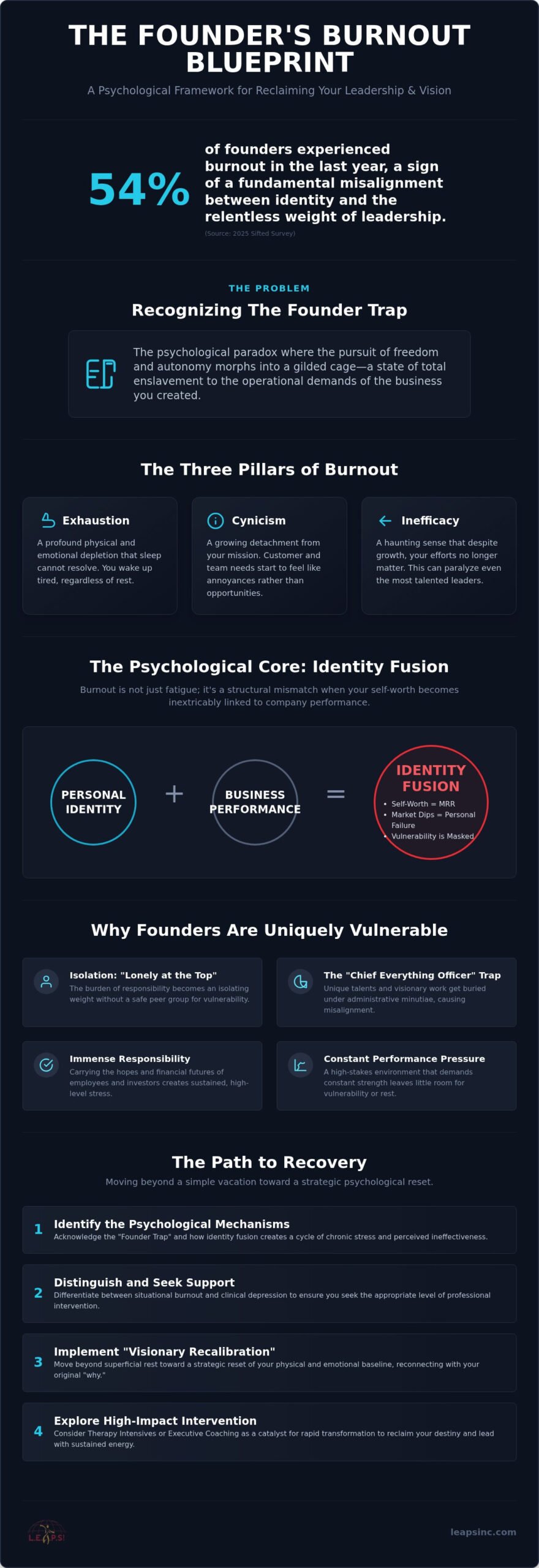
If you feel like your passion for your company has dissolved into a quiet sense of numbness, you aren’t alone; a 2025 Sifted survey found that 54% of founders experienced burnout in the last year. This exhaustion isn’t just a lack of sleep. It’s a fundamental misalignment between your identity and the relentless weight of leadership. You’ve likely felt the isolation of being the final decision-maker, carrying the hopes of investors and employees while your own energy reserves run dry. Understanding how to overcome founder burnout requires more than a simple vacation; it demands a deep psychological reset.
We believe your business is an extension of your life’s purpose, but that purpose shouldn’t cost you your mental well-being. This guide provides a comprehensive, psychologically-grounded framework to help you move from chronic exhaustion to visionary alignment. We’ll explore how to restore your clarity, reconnect with your original “why,” and develop a sustainable leadership model that protects your future. By the end, you’ll have the strategic tools needed to reclaim your destiny and ensure your leadership remains as impactful as your vision.
Key Takeaways
- Identify the psychological mechanisms of the “Founder Trap” and how identity fusion creates a cycle of chronic stress and perceived ineffectiveness.
- Discover a multi-dimensional framework on how to overcome founder burnout by shifting from systemic exhaustion to visionary alignment.
- Distinguish between situational burnout and clinical depression to ensure you seek the appropriate level of professional intervention and support.
- Implement the “Visionary Recalibration” framework, moving beyond superficial rest toward a strategic reset of your physical and emotional baseline.
- Explore high-impact Therapy Intensives as a catalyst for rapid transformation, allowing you to reclaim your destiny and lead with sustained energy.
Recognizing the Founder Trap: Why High-Achievers Succumb to Burnout
For many entrepreneurs, the dream of autonomy eventually morphs into a gilded cage. You started this journey to dictate your own destiny, yet you now find yourself answering to a relentless machine of your own making. This is the “Founder Trap.” It’s the psychological paradox where the pursuit of freedom leads to a state of total enslavement to operational demands. While Occupational burnout is a recognized global phenomenon, the version experienced by leaders is uniquely destructive because it strikes at the core of their identity.
Founder burnout is a distinct psychological phenomenon involving the systemic erosion of the visionary spirit, leaving a hollow shell where passion once lived. It manifests as a toxic blend of chronic stress, growing cynicism toward the mission, and a haunting sense of perceived ineffectiveness. To learn how to overcome founder burnout, you must first acknowledge that your irritability and decision fatigue aren’t personal failings. They are biological signals that your internal architecture is buckling under the weight of sustained leadership pressure.
To better understand this concept, watch this helpful video:
The Three Pillars of Burnout: Exhaustion, Cynicism, and Inefficacy
Burnout isn’t a single event; it’s a three-pronged assault on your professional capacity. First, there is a profound physical and emotional depletion that sleep cannot resolve. You wake up tired, regardless of how many hours you spent in bed. Second, you develop a “thick skin” that eventually turns into cold detachment from the mission. The problems of your team or the needs of your customers begin to feel like annoyances rather than opportunities. Finally, you face a nagging feeling that despite the company’s growth, your efforts no longer matter. This sense of inefficacy can paralyze even the most talented leaders.
Why Founders Are Uniquely Vulnerable
The “lonely at the top” syndrome is a significant driver of this crisis. Without a safe peer group, the burden of responsibility for employees and investors becomes an isolating weight. During the scaling phase, many founders fall into the “Chief Everything Officer” role, where their unique superpowers are buried under administrative minutiae. This high-stakes environment demands constant performance, leaving little room for vulnerability. If you’re struggling to navigate these pressures, engaging in Individual Therapy or Executive Coaching can provide the confidential space needed to recalibrate your leadership model and protect your long-term mental well-being.
The Psychological Architecture of Burnout: Identity vs. Alignment
While many believe a simple vacation is the answer, understanding how to overcome founder burnout requires a deeper look into your psychological architecture. True recovery starts by examining the “Identity Fusion” that occurs when a leader’s self-worth becomes inextricably linked to the company’s performance. If your sense of value is tied to monthly recurring revenue (MRR), every market dip feels like a personal indictment. This fusion forces you into a state of constant performance, where you must “mask” your vulnerability to maintain an image of strength for stakeholders, board members, and employees.
Founders often start as creators but end up as bureaucrats. This shift from visionary work to day-to-day administrative burdens creates a friction that accelerates exhaustion. When you spend 90% of your time on tasks that don’t utilize your unique talents, you aren’t just tired; you’re misaligned. This structural mismatch is a primary driver of chronic stress that sleep cannot cure. It’s an internal friction that wears down your resolve, making even small tasks feel like insurmountable hurdles.
Identity Fusion: When You Are the Business
Ego-driven leadership often stems from a fear of failure that is deeply personal. When you are the business, professional setbacks trigger an existential crisis. This psychological cost is immense. You spend your days performing a role rather than living your purpose. To avoid burnout as a startup founder, you must learn to detach your inherent value from the fluctuating outcomes of the venture. This separation is vital for long-term mental resilience and strategic clarity. It allows you to lead from a place of security rather than a place of constant defense.
The Alignment Gap: Purpose vs. Profit
Burnout often signals an internal “moral injury” caused by drifting away from your foundational principles. As a company scales, the pressure for profit can pull the trajectory away from your original vision. This creates the “Success Paradox,” where you achieve every milestone on your pitch deck but feel a growing sense of loss. You might find yourself acting as a reluctant manager of administrative burdens rather than the visionary leader you were meant to be. Reclaiming your purpose involves auditing these achievements to see if they still serve your ultimate destiny.
The first step in closing this gap is a return to basics. Learning how to find your core values allows you to audit your current role against your internal compass. When your daily tasks align with your “superpowers,” work becomes a source of energy rather than a drain. If you’ve lost sight of that alignment, it’s time to seek an outside perspective. You can schedule an appointment to begin the process of realigning your leadership model with your unique mission.
Founder Burnout vs. Clinical Depression: Navigating the Nuances
Distinguishing between professional depletion and clinical pathology is a critical step for any leader. Burnout is fundamentally a crisis of alignment; it’s situational. If you take a month away from the boardroom and your “oomph” returns, you’re likely dealing with burnout. However, clinical depression is pervasive, casting a shadow over every aspect of life regardless of your professional success. For high-achievers, the “Steep Bill of Self-Denial,” the habit of suppressing emotional vulnerability to ensure the company’s survival, often masks this transition. Learning how to overcome founder burnout requires identifying whether your symptoms are isolated to the office or if they have spread to your personal life. When you ignore your internal depth for too long, the erosion of the self becomes total. If left unaddressed, chronic burnout can evolve into clinical depressive episodes as the nervous system collapses under the weight of sustained performance.
Key Indicators: How to Tell the Difference
Identifying where your struggle lies requires radical honesty. Consider these markers to determine if your exhaustion is confined to your role or if it has permeated your entire existence:
- Situational Context: Does your sense of hope return during weekends or brief hiatuses? If the fatigue persists even in the absence of work, the issue may be deeper than simple burnout.
- Anhedonia: In burnout, you lose interest in your business. In depression, you lose interest in everything, including hobbies, family, and personal growth. You feel a flat emotional landscape that no longer responds to joy.
- Physical Manifestations: Look for psychosomatic pain, significant appetite changes, or sleep disturbances that don’t respond to standard rest. These are your body’s way of signaling a profound internal crisis.
The Danger of Misdiagnosis
Treating burnout as “just being tired” is a dangerous oversimplification that almost guarantees a relapse. When you misdiagnose the root cause, you apply surface-level solutions to a structural psychological problem. Understanding the nuance of therapy vs coaching is essential here. While coaching focuses on strategic advancement and future potential, therapy addresses the emotional injuries and internal depth that lead to psychological breakdown. If you find your self-worth entirely eroded, it’s time to seek clinical intervention from a licensed professional. Engaging in individual therapy allows you to distinguish between professional stress and clinical needs, providing a secure foundation to learn how to overcome founder burnout effectively. Don’t let your destiny be derailed by an unaddressed crisis; professional clarity is the only way to reclaim your visionary purpose.
Strategic Recovery: A Framework for Reclaiming Your Vision
Moving beyond surface-level advice requires a multi-dimensional strategy that addresses the leader as a whole human being. We call this the “Visionary Recalibration” framework. It’s built on three essential pillars: physical restoration, emotional processing, and strategic realigning. This isn’t just about taking a weekend off; it’s about a systemic reset that allows you to reclaim your destiny. Understanding how to overcome founder burnout involves more than tactical shifts. It demands a fundamental change in how you relate to your role and your energy reserves.
The Physical Reset: Restoring the Biological Foundation
High-stress leadership often leaves the nervous system in a state of permanent “fight or flight.” Radical rest involves moving beyond the “weekend off” to implement systemic boundaries that allow for true biological recovery. You need “Digital Sabbaths” to disconnect from the constant noise of notifications and market shifts. Prioritizing sleep hygiene is a non-negotiable executive duty, not a luxury. When your biological foundation is fractured, your strategic clarity is the first thing to suffer. You cannot lead a visionary company from a state of physiological bankruptcy.
The Emotional Audit: Processing the Weight of Leadership
You carry the weight of responsibility for employees, investors, and family. This burden requires active processing. Journaling provides internal clarity, but you also need a “Board of Advisors” for your personal well-being. This group focuses on your health, not the company’s MRR. Developing high Emotional Intelligence (EQ) allows you to handle team conflict and high-stakes negotiations without personal depletion. It’s about building the internal capacity to hold the pressure of leadership without letting it crush your spirit.
The Strategic Pivot: Designing Your Next Chapter
Recovery requires a “Superpower Audit” to identify the tasks that drain your energy and delegate them effectively. This is “Delegating Identity.” Your daily role must align with your natural strengths to be sustainable. Re-visioning means auditing the company’s direction against your personal values to ensure you aren’t winning a game you don’t want to play. Integrating corporate visioning ensures your personal growth is a core component of the business plan, not an afterthought.
Building a sustainable leadership model often requires the structured support of entrepreneurship coaching to ensure these changes take root. If you’re ready to move from chronic exhaustion to visionary alignment, you can schedule an appointment to begin your recalibration process today.
Beyond the Vacation: Recalibrating Your Destiny Through Professional Support
Tactical shifts and boundary setting are vital, but deep-seated burnout often requires a more immersive intervention. For the high-achiever, the traditional model of fifty-minute weekly sessions can feel frustratingly slow. When you’re drowning in decision fatigue and emotional numbness, you need a high-impact catalyst for change. Understanding how to overcome founder burnout at a systemic level means looking past temporary fixes and toward professional structures that facilitate rapid, profound transformation. This is where clinical depth meets strategic ambition.
The Power of the Therapy Intensive
A therapy intensive is a focused, multi-day clinical intervention designed specifically for those who operate at a high level of intensity. Rather than scratching the surface once a week, these sessions allow for an emotional deep-dive that uncovers the root of identity fusion and moral injury. You can expect a blend of trauma-informed processing and visionary planning that addresses the core of your exhaustion. The long-term ROI of this investment is immense. By fortifying your mental resilience, you protect your most valuable business asset: your ability to lead with clarity. These intensives provide the space to dismantle the “Founder Trap” in days rather than months, accelerating your path back to visionary alignment.
Integrated Growth: Merging Clinical Depth with Strategic Ambition
True recovery isn’t just about feeling better; it’s about leading better. This requires the strategic scaffolding provided by executive coaching. Having a mentor who understands both the intricacies of your P&L and the nuances of your psychological architecture creates a rare synergy. This integrated approach helps you move from “survival mode,” where you’re simply reacting to crises, to “visionary mode,” where you’re proactively shaping your company’s future. It allows you to build a leadership style that is both high-performing and sustainable for the long haul. You’ll learn to delegate not just tasks, but the emotional weight that previously led to depletion.
Burnout is not a signal that your journey is over. It’s a profound invitation to evolve into a higher-level version of yourself. It’s the friction that precedes a necessary shift in your leadership destiny. By choosing to engage with professional support, you aren’t just saving your business; you’re reclaiming your life. Your well-being is the foundation upon which your entire corporate vision rests. Reclaim your purpose, realign your identity, and step into the next chapter of your sustained leadership. The world needs your vision, but it needs you whole to see it through.
Step Into Your Next Chapter of Visionary Leadership
Your journey from chronic exhaustion to visionary alignment is a strategic evolution, not a retreat. We’ve explored the psychological architecture of the Founder Trap and the critical distinctions between situational stress and clinical needs. True recovery requires a holistic integration of your internal depth and professional ambition. Led by Dr. John E. N. Daniel, our approach merges clinical expertise with executive vision to help you navigate the complexities of high-level leadership.
Whether you need specialized therapy intensives for rapid, deep-seated transformation or ongoing mentorship to build a sustainable leadership model, the path forward is clear. Learning how to overcome founder burnout is the first step in reclaiming your professional destiny and ensuring your long-term mental well-being. Your business’s greatest asset is your health. Don’t let it be the price of your success.
Reclaim your visionary edge; schedule an Entrepreneurship Coaching consultation today.
Burnout is not the end of your story. It’s the beginning of a higher-level evolution that will define your legacy for years to come.
Frequently Asked Questions
What are the first signs of founder burnout?
The earliest indicators often manifest as persistent irritability and a pervasive sense of decision fatigue. You might find yourself emotionally withdrawing from your team or feeling a cold detachment from the mission that once inspired you. Physical signs like sleep disturbances and a lack of recovery despite rest are also common. Recognizing these signals is the first step in learning how to overcome founder burnout before it evolves into a deeper clinical crisis.
Can I overcome burnout without quitting my company?
Yes, recovery is possible through a strategic recalibration of your leadership model and personal boundaries. It requires moving beyond tactical fixes to address the underlying identity fusion that ties your self-worth to the company’s performance. By delegating administrative burdens and realigning your daily tasks with your superpowers, you can restore your energy. Professional interventions like Entrepreneurship Coaching provide the scaffolding needed to sustain this transformation while remaining at the helm.
How long does it take to recover from severe burnout?
Recovery timelines vary based on the depth of the depletion and the speed of intervention. While a standard vacation offers temporary relief, a systemic reset often requires several weeks or months of focused effort. Utilizing high-impact models like a Therapy Intensive can accelerate this process by addressing psychological roots in a multi-day format. Consistent nervous system regulation and ongoing professional support are essential to ensure the recovery is permanent and integrated.
Is founder burnout the same as clinical depression?
No, they are distinct but related phenomena. Burnout is fundamentally situational and alignment-driven; it’s often confined to your professional role and mission. Clinical depression is more pervasive, affecting all areas of life regardless of the context. However, chronic burnout can lead to the “Steep Bill of Self-Denial,” eventually triggering clinical depressive episodes if the internal depth of the individual is ignored for too long. Individual Therapy is critical for making this distinction.
How do I tell my co-founder or board that I am burned out?
Frame the conversation as a strategic update regarding your long-term leadership sustainability. Instead of presenting it as a personal failure, explain that you’re recalibrating your role to ensure the company’s continued growth and stability. Highlight the specific steps you’re taking, such as engaging in Executive Coaching, to protect the business’s greatest asset: your visionary clarity. This approach positions your well-being as a professional responsibility to your shareholders and your team.
What is a therapy intensive and how does it help with burnout?
A Therapy Intensive is a high-impact, multi-day clinical intervention designed for rapid transformation. Unlike weekly sessions, it provides the space for deep-dive emotional processing and visionary planning without the interruptions of daily operations. This model is particularly effective for high-achievers who need to dismantle complex identity fusion and moral injury quickly. It allows for a profound nervous system reset, helping you learn how to overcome founder burnout at a structural level.
How can I prevent burnout from recurring as my company scales?
Prevention requires building a sustainable leadership model that prioritizes your mental resilience as the company grows. Implementing an Employee Assistance Program (EAP) can scale sanity within your organization while you focus on delegating tasks that drain your energy. Regularly auditing your role against your core values ensures that your daily work remains aligned with your purpose. Maintaining boundaries, such as digital sabbaths, prevents the “Founder Trap” from reclaiming your identity during scaling.
Should I see a therapist or an executive coach for burnout?
The most effective approach often integrates both disciplines. Therapy addresses the internal depth, emotional injuries, and psychological roots of exhaustion. Executive Coaching focuses on strategic advancement, leadership style, and future potential. For founders, having a partner who understands both clinical psychology and the nuances of a P&L is invaluable. This hybrid model ensures that you aren’t just healing from the past but are actively designing a sustainable, visionary future for your destiny.