

What if the most helpful thing you can offer your grieving spouse isn’t an answer, but your steady presence? When grief has no clear timeline, it’s natural to search for the right words or try to make daily life feel manageable again. Learning how to support a grieving spouse starts with listening, staying open to what they need, and resisting the urge to fix what can’t be fixed.
Your spouse may want to talk, seek quiet, or move between the two. If you grieve differently, that difference can feel confusing, even when neither of you is doing anything wrong. You can offer meaningful help without setting a timeline or neglecting practical responsibilities. This article covers what to say when words feel inadequate, how to help with everyday tasks, and how to respect different needs while protecting your connection. It also explains when individual or couple therapy may offer additional support, and what signs call for urgent help. You don’t have to make grief disappear to show up with care.
Key Takeaways
- Learn how to support a grieving spouse by listening without trying to fix their pain or set a timeline for grief.
- Use gentle check-ins and practical offers that let your spouse choose what feels helpful.
- Recognize that different grieving styles don’t necessarily mean you’re growing apart; make room for both connection and space.
- Identify essential responsibilities together, while protecting time for rest and your own well-being.
- Consider individual or couple therapy if grief-related distress, isolation, or relationship strain persists or intensifies.
How grief can affect your spouse, and what support really means
Learning how to support a grieving spouse begins with recognizing that grief can affect far more than mood. Your spouse may have trouble concentrating, keeping up with familiar routines, connecting with others, or managing everyday responsibilities. Their capacity can change from day to day. Grief is personal and shaped by the loss and the life around it, not a predictable sequence of stages.
Support means being present, listening without judgment, offering practical help, and respecting your spouse’s choices. A broad overview of grief and its dimensions can help explain why responses vary, but it can’t tell you exactly what your partner needs. Compassionate support doesn’t remove grief. It helps your spouse face it without having to face it alone.
For another perspective on responding when a spouse withdraws, watch this video:
Why grief may look different from one person to another
One partner might talk openly, while the other seeks quiet or focuses on necessary tasks. Neither response measures how much someone loved the person who died. Comparing whose grief appears stronger can create distance rather than understanding. Culture, spiritual beliefs, relationship history, and the circumstances of the loss may all influence how someone expresses sorrow or finds meaning. Different coping styles don’t automatically signal a lack of love.
What your spouse may need from you
Ask what would help today instead of assuming you know. A gentle question such as, “Would you like company, some quiet, or help with something practical?” offers choices without requiring your spouse to explain everything they feel. If conversation is difficult, sit nearby, prepare a meal, or take care of a task you’ve agreed on. Ask before stepping in, respect a request for space, and check in again later. Needs may shift, so what helps today may not help tomorrow.
Steady support is responsive, not perfect. Notice what your spouse welcomes, follow through on what you offer, and leave room for both of you to experience the loss in your own way. When grief changes the rhythm of a relationship, patience and honest, low-pressure communication can help you stay connected without expecting either partner to grieve on a schedule.
How to support a grieving spouse with listening and practical care
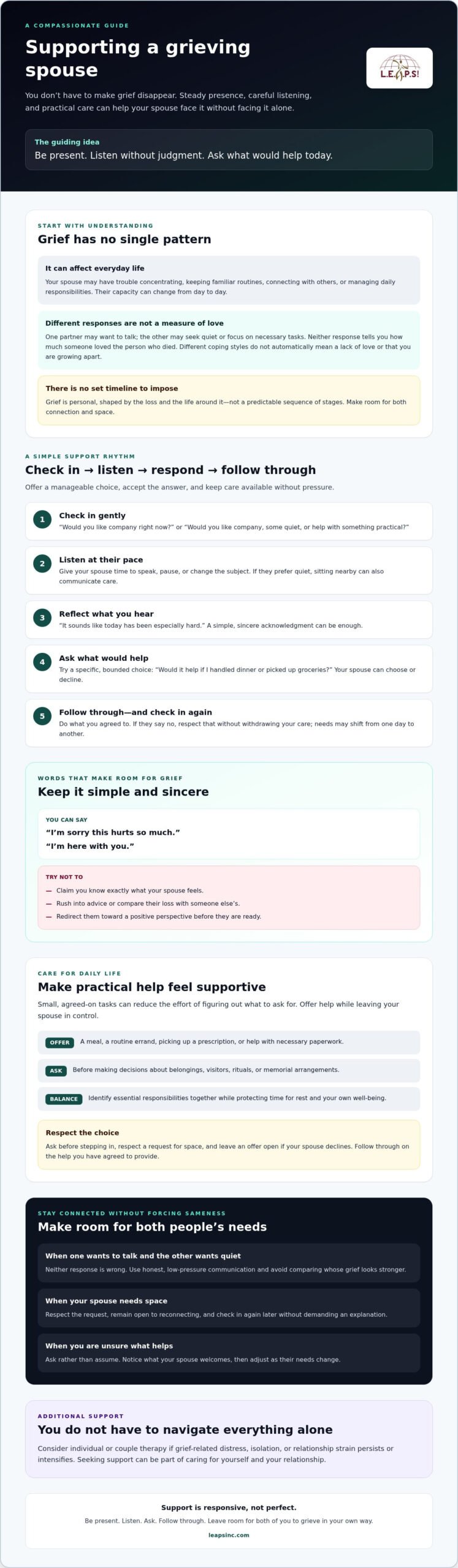
When you’re unsure what to do, use a simple sequence: check in, listen, reflect what you hear, ask what would help, then follow through. For example, “Would it help if I handled dinner or picked up groceries?” gives your spouse a manageable choice. If they decline, accept the answer without withdrawing your care. You can check in again later.
- Check in: “Would you like company right now?”
- Listen: Give your spouse time to speak, pause, or change the subject.
- Reflect: “It sounds like today has been especially hard.”
- Ask: “Would help with an errand or a household task make things easier?”
- Follow through: Do what you agreed to, and ask again another day.
Specific offers reduce the effort of figuring out what to ask for, while leaving your spouse free to choose or decline.
What to say when you do not know what to say
Simple, sincere words are enough: “I’m sorry this hurts so much,” or “I’m here with you.” You don’t have to claim you understand exactly what your spouse feels. Let them lead the conversation instead of quickly offering advice, comparing their loss with another person’s, or redirecting them toward a positive perspective. Harvard Health Publishing’s guidance on how to deal with grief offers additional perspective on coping. If your spouse prefers quiet, sitting beside them without pressing for conversation can also communicate care.
How to make practical help feel supportive
Offer bounded choices: “Should I take care of the laundry or call about that appointment?” You might prepare a meal, pick up a prescription, handle a routine errand, or help sort necessary paperwork. Ask before making decisions about belongings, visitors, rituals, or memorial arrangements, since these choices can carry personal meaning. If your spouse says no, respect that and leave the offer open. Remember to check in after the first wave of attention has passed or around a meaningful date, without expecting a particular response.
Keep the goal modest: reduce one burden, not take control. If you and your spouse would value help communicating through this difficult period, LEAPS Inc. offers couple therapy. Learn more about arranging a conversation through its appointment scheduling page.
What not to say, and how to handle different grieving styles
There’s no perfect phrase that can take away a loss or make your spouse move forward. In trying to comfort them, you may reach for reassurance that sounds hopeful to you but feels like pressure to them. The goal isn’t to find words that fix grief. It’s to acknowledge the loss, stay receptive, and let your spouse decide whether they want to talk.
Phrases that may feel dismissive, and more thoughtful alternatives
Comments such as “Everything happens for a reason,” “At least they lived a long life,” or “You need to be strong” can unintentionally minimize pain, impose beliefs, or suggest a deadline for grieving. Try language that makes room for your spouse’s experience instead:
- Instead of “You’ll feel better soon”: “I’m sorry this is so painful. I’m here.”
- Instead of “At least you still have…”: “I know this person mattered deeply to you.”
- Instead of “You have to stay strong”: “You don’t have to hide how you’re feeling with me.”
These are starting points, not scripts. Use words that feel sincere in your relationship, and don’t assume your spouse shares your beliefs or feels the way you would. A quiet pause can be more supportive than filling every moment with reassurance.
When partners cope in different ways
One of you may want to revisit memories and talk often, while the other finds comfort in privacy, familiar routines, activity, or ritual. That difference can create hurt: one partner may feel shut out, while the other feels pressed to speak before they’re ready. Neither response proves how much either person cares. Ask what kind of connection feels manageable instead of judging or demanding that you grieve alike.
Agree on a simple way to check in. You might ask, “Would talking help, or would you rather have quiet company?” You can also agree on a signal for needing space and a time to reconnect. Revisit the arrangement as needs change. What feels right today may not fit another day. This makes room for both conversation and privacy without leaving either partner to guess.
If something you say lands badly, repair matters more than defending your intention. Acknowledge the impact, apologize briefly, and ask what would feel more supportive: “I’m sorry. That came across as dismissive. Would you rather I listen, or give you some space?” Listening to the answer helps you learn how to support a grieving spouse with greater care. If grief is straining communication or connection, couple therapy may offer a space to work through those differences together.
How to support daily life while caring for your own well-being
Grief can make ordinary responsibilities harder to manage, so aim for a flexible plan rather than a strict schedule. Together, identify what must happen today, what can wait, and what can be simplified. This can keep practical decisions from becoming another source of pressure and help you use limited energy where it matters most.
Keep check-ins brief and low-pressure. You might ask, “Have you had anything to eat?” “Would you like company or some quiet?” or “Which responsibility feels most urgent today?” A check-in is an invitation, not a demand for a detailed answer. Adjust routines to your spouse’s capacity, your own needs, and changing circumstances. There’s no universal recovery timetable to follow.
Create a flexible rhythm for shared responsibilities
Write down a short list of essentials, such as meals, medication pick-ups, childcare, bills, or necessary calls. Decide together who can handle each task and which ones can wait. If you both agree, ask a trusted person for one specific contribution, such as dropping off dinner or driving someone to an appointment. Revisit the plan as energy, obligations, and preferences change. What works this week may not work next week.
Support your spouse without losing sight of yourself
Your grief matters, too. You can care deeply for your spouse without concealing your feelings or carrying every responsibility alone. Seek support from a trusted friend, family member, or other appropriate resource, without expecting your spouse to meet all your emotional needs while they’re grieving. Individual therapy can also offer a space to process your own experience; LEAPS Inc. offers individual therapy.
Supporting a grieving spouse means tending to the relationship and to the people within it. Notice when you’re becoming depleted, tell someone you trust what you need, and make room for rest where possible. Small adjustments can help you remain present without treating your well-being as secondary.
If you’d like personal support as you navigate grief and its effect on daily life, schedule an appointment to explore whether individual therapy may be appropriate for you.
When to seek additional support for grief or your relationship
Support from a spouse can matter deeply, but you don’t have to manage every part of grief together or on your own. Consider reaching out for professional support if distress, isolation, conflict, or difficulty managing daily responsibilities persists or intensifies. For example, communication may become consistently strained, or grief may make it difficult to keep up with essential parts of life. There’s no single timetable for seeking help, and doing so isn’t a failure or a required stage of grieving.
This article can’t diagnose grief or determine what kind of care you or your spouse need. A qualified professional can help you explore the situation and consider appropriate next steps. Learning how to support a grieving spouse also means recognizing when support from outside the relationship may be useful.
Choosing support that fits the situation
Individual therapy may provide space for one partner to explore personal emotions, coping needs, and the changes that follow a loss. Couple therapy may help partners communicate when grief is affecting connection or creating repeated misunderstandings. These are different options, and the choice depends on what each person wants to address. LEAPS Inc. offers individual therapy and couple therapy. Ask about the clinician’s qualifications and whether the service fits your circumstances.
Responding to immediate safety concerns
Take any statement about suicide, self-harm, or immediate danger seriously. Ask directly whether your spouse may harm themselves, and stay with them if it’s safe for you to do so. In the United States, call or text 988 to reach the Suicide & Crisis Lifeline. If there’s immediate danger or a medical emergency, contact emergency services. A blog or routine appointment is not a substitute for urgent crisis support.
Seeking help can be a thoughtful step toward steadier support, whether you’re looking for personal space to process grief or help communicating as a couple. If you’d like to explore therapy options with LEAPS Inc., schedule an appointment and discuss what may fit your needs.
Keep Showing Up, One Caring Step at a Time
Learning how to support a grieving spouse isn’t about finding perfect words or making sorrow disappear. It’s about listening without judgment, offering practical help your spouse can accept or decline, and respecting that you may cope differently. Small, steady acts of care can help you stay connected while making room for each person’s needs.
Grief can also strain daily life and your relationship. You don’t have to carry that strain alone or wait until you have every answer before seeking support. LEAPS Inc. offers individual therapy for personal support and couple therapy for partners who want help with communication and connection. These are options to explore, not requirements or a promise of a particular outcome.
If additional support feels like a useful next step, schedule an appointment to explore the support that may fit your needs. You can’t choose the pace of grief, but you can keep choosing presence, patience, and care for your spouse and yourself.
Frequently Asked Questions
What should I say to my grieving spouse?
Say something simple and sincere, such as, “I’m sorry this hurts so much,” or “I’m here with you.” You don’t need to find words that explain the loss or make your spouse feel better. Listen without rushing to offer advice, and let them choose whether to talk. If they prefer quiet, sitting nearby can communicate care without asking them to explain what they feel.
How can I support my spouse after the death of a loved one?
Ask what would help today, then offer a specific choice your spouse can accept or decline. You could ask, “Would you like company, or some quiet?” or offer to handle a meal, errand, or household task. Follow through on what you agree to do, and check in again as needs change. Practical support can reduce daily strain while showing that your care is steady.
Is it normal for my spouse and me to grieve differently?
Yes. One partner may want to talk about the person who died, while the other seeks privacy, routine, activity, or time to reflect. These differences don’t automatically mean either person cares less or is grieving incorrectly. Rather than comparing reactions, ask what kind of support feels manageable and agree on ways to reconnect. Needs can shift, so revisit those arrangements with patience.
What should I avoid saying to someone who is grieving?
Avoid comments that imply a deadline, demand strength, or minimize the loss, such as “You’ll be over this soon,” “You have to stay strong,” or “At least you still have other family.” Even well-intended reassurance can feel dismissive. Acknowledge the pain instead: “I’m sorry you’re going through this.” If your words hurt, apologize briefly, recognize their impact, and ask what would feel more supportive.
How long does grief last after losing a loved one?
There’s no fixed length of time that applies to everyone. Grief may shift in intensity and show up differently over time, rather than follow a predictable sequence or disappear by a particular date. The nature of the loss, the relationship, personal beliefs, and available support can all shape someone’s experience. Avoid setting a deadline for yourself or your spouse; pay attention to needs and changes in daily functioning.
Can grief affect a marriage or relationship?
Yes. Grief may affect communication, emotional closeness, routines, and each partner’s capacity to manage shared responsibilities. One person might seek conversation while the other needs quiet, which can lead to misunderstandings if both assume their own coping style is the only helpful one. Make room for different needs, agree on simple check-ins, and talk about practical responsibilities. Relationship strain is a reason to consider support, not proof that the marriage has failed.
When should a grieving spouse consider therapy?
Consider professional support if distress, isolation, conflict, or difficulty managing daily life persists or intensifies. Individual therapy can offer space to explore personal emotions and coping needs, while couple therapy may help when grief is affecting communication or connection. LEAPS Inc. offers individual and couple therapy. Discuss your circumstances and ask whether the available support is appropriate for your needs.