

What if the distance between you isn’t proof that your relationship is failing, but a signal that something needs attention? When conversations about closeness lead to conflict, silence, or uncertainty, it can be hard to tell whether the challenge is emotional, physical, or rooted in the relationship itself. Intimacy therapy offers a structured setting to explore those questions without reducing connection to performance or expecting you to share more than you’re ready to discuss.
It’s understandable to worry that therapy might feel awkward, exposing, or judgmental. A thoughtful process starts with your goals and circumstances. You can clarify what intimacy means to you, practise expressing needs and boundaries, and listen to one another with greater care. In this article, you’ll learn how individual or couple therapy can help you explore disconnection, what conversations may involve, and how to decide whether therapy is a useful next step. The aim isn’t to force closeness, but to understand what may be getting in its way and choose a grounded path forward.
Key Takeaways
- Learn how intimacy therapy can create space to discuss closeness and relationship concerns without treating them as proof that a relationship is failing.
- Recognize how emotional distance, different needs, trust concerns, and changing circumstances can shape connection.
- Compare individual and couple therapy to choose a starting point that reflects your goals and readiness.
- Prepare for a first conversation by noticing patterns, naming what you hope to understand, and identifying boundaries you want respected.
- Explore how LEAPS Inc.’s individual and couple therapy can support reflection on emotional well-being and relationship growth.
What Is Intimacy Therapy & How It Differs from Sex?
Relationship distance can be difficult to name, especially when care remains. You may still value one another yet feel less understood, less able to speak openly, or unsure how to approach closeness. Intimacy therapy is therapeutic conversation about closeness, connection, and concerns affecting intimate relationships. It offers a way to examine what intimacy means to you and what may be shaping your experience, without assuming that every concern is sexual or that one relationship pattern fits everyone.
Intimacy work can explore emotional well-being and relationship concerns through reflection and conversation. The focus may be on how partners interpret closeness, what feels difficult to discuss, and which needs or boundaries are important to express. Couples therapy can also address relationship concerns. The Couples Therapy overview provides broader context on this form of work.
What does intimacy mean in a relationship?
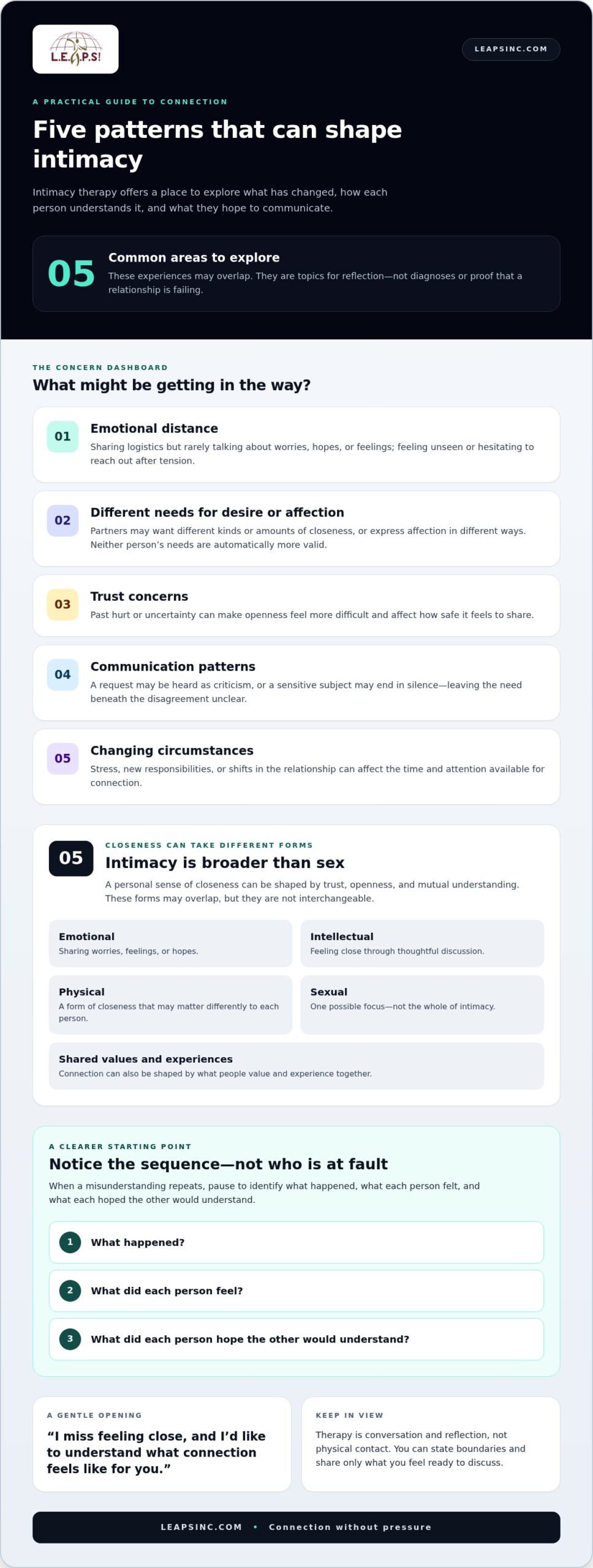
Intimacy is a personal sense of closeness shaped by trust, openness, and mutual understanding. It can be emotional, intellectual, physical, sexual, or connected to shared values and experiences. These forms may overlap, but they aren’t interchangeable. Talking honestly about a worry may create emotional closeness, while enjoying a thoughtful discussion may feel intellectually intimate.
Partners may experience or express closeness differently. One person might feel connected through frequent conversation, while another values practical support or quiet time together. Neither preference automatically signals a problem. Ask yourself, “When do I feel most understood?” or “What helps me feel close without feeling pressured?” Answers can clarify where expectations align and where each partner may need to explain their perspective.
There’s no universal measure of how much intimacy a relationship should contain. For reflection, consider whether the current experience feels meaningful and mutual to the people involved, and whether either person feels unable to voice a need, limit, or concern. Individual therapy can provide space to consider your own experiences and define what connection means to you.
Is intimacy therapy the same as sex therapy?
Not necessarily. Intimacy work may include sexual concerns, such as differing comfort levels or difficulty discussing desire, but it can also focus on emotional distance, trust, communication, and other forms of closeness. The terms used for this work can vary, so they don’t always describe identical areas of focus. In cases where physical health intersects with intimacy, specialized practices such as TurboUrolog – Dr Anna Bonder-Nowicka demonstrate how medical urology and sexology can address physiological factors alongside therapeutic support.
Therapy is based on conversation and reflection, not physical contact. A discussion about sexual intimacy doesn’t require you to disclose more than you’re ready to share. You can raise questions, state boundaries, and take time to find language for what feels difficult. A starting point might be identifying what you want to understand: a change in connection, a recurring misunderstanding, or uncertainty about what closeness means to you.
Which Intimacy Concerns Can Therapy Help You Explore?
Intimacy concerns don’t always arrive as one clear problem. You might notice shorter conversations, less affection, a change in sexual desire, or tension around trust. These experiences can be topics for exploration, not diagnoses or proof that a relationship is failing. Intimacy therapy can help individuals or partners look closely at what has changed, how each person understands it, and what they hope to communicate.
Concerns may overlap or show up in everyday interactions:
- Emotional distance: You share logistics but rarely discuss worries, hopes, or feelings.
- Different needs for desire or affection: Partners want different kinds or amounts of closeness, or express affection in different ways.
- Trust concerns: Past hurt or uncertainty makes openness feel more difficult.
- Communication patterns: A request is heard as criticism, or a sensitive subject ends in silence.
- Changing circumstances: Stress, new responsibilities, or shifts in the relationship affect time and connection.
Recurring misunderstandings can obscure the need beneath a disagreement. For example, one partner’s request for more time together might be heard as a complaint, while the underlying hope is reassurance or shared attention. Rather than deciding who is at fault, notice the sequence: what happened, what each person felt, and what each hoped the other would understand. That gives a conversation a clearer starting point.
How can emotional distance affect intimacy?
How can partners talk about differing needs?
Differences in desire or preferred affection don’t make one person’s needs more valid than the other’s. A less accusatory opening might be, “I miss feeling close, and I’d like to understand what connection feels like for you,” rather than assigning blame. Acknowledge your feelings, state what you need, and ask a genuine question. Therapy can provide space to explore together what a difference means and what each person wants to express.
For a more constructive first conversation, focus on curiosity rather than persuasion. Name one specific moment instead of summarizing the entire relationship, then describe your experience without assuming your partner’s intentions. You might say, “I felt distant after we changed our evening routine. How did that feel for you?” Listening to the answer can help you work out whether you’re discussing time, reassurance, stress, desire, or something else.
If you want a structured setting to explore a relationship concern, you can schedule an appointment and begin with the question that feels most important to you.
Individual or Couples Intimacy Therapy: Which Starting Point Fits?
Choosing a starting point for intimacy therapy depends less on finding a universally “right” format and more on your goals, readiness, and whether the concern feels personal, shared, or both. Ask yourself: Do I need space to understand my own experience, or do we want help making sense of a pattern together? Either answer can offer a meaningful place to begin.
| Format | Participants | Possible focus | Questions to consider |
|---|---|---|---|
| Individual therapy | One person | Personal feelings, boundaries, relationship history, and hopes for connection | What do I want to understand about my own needs or responses? |
| Couples therapy | Both partners | Shared communication patterns, differing perspectives, and relationship goals | Are we both willing to discuss the concern together? |
These formats aren’t competing paths, and one doesn’t determine what the other partner should do. You might start individually to clarify your perspective, or begin together when both partners want to explore an issue as a shared concern. Readiness matters, too. If one person feels uncertain about attending together, that hesitation can inform the decision without automatically ruling out future conversations.
When might individual therapy be a useful starting point?
Individual therapy can offer room to reflect on what you feel, which boundaries matter, and how past experiences shape your hopes for connection. You can begin exploring a concern without requiring your partner to attend. For example, you might want to understand why a conversation feels difficult before deciding how to raise it. LEAPS Inc.’s individual therapy services provide a setting for personal reflection. That reflection can clarify your own perspective, but it can’t decide what your partner thinks or should do.
When might couples therapy support shared understanding?
Couples therapy makes room for both partners to express their perspectives and hear how each experiences the relationship. Rather than treating disagreement as a contest to win, shared work can help identify recurring patterns, clarify what each person hopes for, and explore where communication becomes difficult. The aim isn’t to assume both partners want the same outcome or to promise reconciliation. It’s to create space for a considered conversation about what each person wants to understand.
As you weigh the options, name the concern as specifically as you can: “I want to understand my discomfort setting a boundary,” or “We keep misreading each other’s intentions when we discuss closeness.” Then consider whether your next useful step is personal reflection, a shared conversation, or both over time. You don’t need a complete explanation before beginning. A clear question is enough to give the process direction.
How to Prepare for Intimacy Therapy While Protecting Your Boundaries
Preparing for intimacy therapy doesn’t mean rehearsing a perfect explanation or deciding in advance what the relationship needs. A first conversation can begin with uncertainty. A few notes can help you stay oriented while leaving room to discover what matters as you talk.
Use this short sequence to gather your thoughts:
- Notice patterns. Identify moments when you feel connected, guarded, confused, or unheard. Note what tends to happen before and after, without trying to assign blame.
- Name your hopes. Consider what you want to understand or express, rather than setting a demand for how someone else must change.
- Identify questions. Write down what you’d like to ask about the process, your concerns, or how therapy relates to the goals you bring.
- Consider boundaries. Decide what feels manageable to discuss now, what you may need time to approach, and how you’ll communicate if you want to pause.
Keep the notes simple. One specific concern and one hoped-for change are enough to create a starting point. For example, you might write, “I find it difficult to speak up about what I need,” and “I hope to understand what makes that conversation feel hard.” You don’t need to explain the whole history at once.
What questions can you bring to a first conversation?
Ask how therapy may relate to the concerns and goals you bring, and what you can expect from the conversation. You might also consider what “feeling more connected” means to you personally or as a couple: more openness, greater understanding, or a clearer way to discuss difficult topics. Before the session, write down one concern and one change you hope to explore.
How can you approach sensitive topics at your own pace?
At the outset, you can share what feels comfortable to discuss and what you’re not ready to explore yet. Honest communication includes saying, “I’m not sure how to talk about this,” “I feel hesitant,” or “I need a pause.” You don’t have to cover every sensitive subject in the first session. Naming your pace makes your boundaries part of the conversation.
Boundaries aren’t barriers to meaningful work; they help clarify what feels possible and where you may want support. If a topic feels overwhelming, you can ask to slow down, shift focus, or return to it later. If you’re attending with a partner, consider discussing beforehand how each of you can signal discomfort without turning that moment into an argument. The aim is not to arrive fully prepared, but to begin with enough clarity to speak honestly and stay connected to your own needs.
If you’re ready to explore your concerns in a structured setting, schedule an appointment with LEAPS Inc.
How LEAPS Inc. Can Help You Move Toward Greater Connection
Taking a thoughtful step toward greater connection doesn’t require certainty about what’s wrong or a fixed picture of what should happen next. LEAPS Inc. offers individual and couple therapy as structured settings for exploring personal and relationship concerns, with attention to emotional well-being and growth. You can begin with the question that feels most immediate, then clarify what you hope to understand as you talk.
Intimacy therapy may be the phrase you’re using to describe a need for help with closeness, communication, or changing needs. The starting point can be identifying what feels difficult and what you want to make sense of. Therapy isn’t a commitment to a predetermined outcome; it’s an opportunity to examine your experience and consider what matters to you.
What can you bring to therapy at LEAPS Inc.?
You can bring a specific concern, a recurring interaction, or a feeling you haven’t yet found words for. Perhaps you feel disconnected, struggle to communicate about something important, or want to understand how your needs have changed. You don’t need to arrive with a polished explanation. Describe what you’ve noticed in your own words, even if your thoughts feel unfinished.
Questions are a valid starting point, too. You might be unsure whether a concern is personal, relational, or both, or uncertain about what you would want to change. Individual or couple therapy can begin with that uncertainty and make room to explore your goals and circumstances. You don’t have to present a complete plan before you begin.
What is a meaningful next step toward intimacy?
Choose one conversation or relationship pattern you want to understand more clearly. It might be a subject you avoid, a moment when you feel misunderstood, or a shift in how you experience closeness. Naming one focus gives you a practical point of entry without requiring you to solve every concern at once.
Meaningful movement begins with honest reflection and a willingness to engage thoughtfully. That doesn’t mean rushing into vulnerable conversations or deciding on an outcome before you’re ready. It means acknowledging what matters, expressing what you can, and remaining open to learning more about your own experience and the relationship.
If you’re ready to explore your concerns with LEAPS Inc., schedule an appointment. You can begin with the question you have today and decide on your next steps as your understanding develops.
Take the Next Step Toward More Intentional Connection
Closeness can grow from a willingness to ask a more honest question: What do I want to understand about myself, my relationship, or the way we communicate? You don’t need a perfect explanation or a predetermined destination. A thoughtful next step can begin with naming what feels important and making room to explore it with care.
At LEAPS Inc., individual and couple therapy offer structured spaces to explore personal and relational concerns, and therapy intensives are also part of the practice’s clinical services. The right place to begin depends on your circumstances and goals. You remain an active part of deciding what you’re ready to explore.
If intimacy therapy feels like a useful next step, schedule an appointment to begin a thoughtful conversation about your goals for connection and growth. You can start with one question and build understanding from there.
Frequently Asked Questions
What happens during intimacy therapy?
Intimacy therapy generally involves guided conversation about what’s happening in your relationship and what you want to understand. A therapist may invite you to describe a recent interaction, such as a moment when you felt close or misunderstood, and explore how each person interpreted it. You can ask questions, reflect on your responses, and identify themes worth revisiting. The pace and focus depend on the concerns and goals you bring.
Can intimacy therapy help if only one partner wants to attend?
Yes, one partner can begin with individual therapy even if the other isn’t ready or available to participate. You can examine your own feelings, choices, and ways of communicating, without treating therapy as a way to decide what your partner must do. For instance, you might explore how to raise a sensitive subject clearly or understand what you need before making a relationship decision. Your partner’s perspective remains their own.
Is intimacy therapy the same as couples therapy?
No, the terms aren’t interchangeable in every setting. Couples therapy describes a format in which partners attend together, while intimacy therapy refers to concerns around closeness and connection that may be explored individually or as a couple. The two can overlap: a couple may bring questions about affection, trust, or emotional connection into couples therapy. The focus depends on the people attending and the questions they want to explore.
Do you have to discuss sex in intimacy therapy?
No. You can focus on emotional closeness, trust, affection, communication, or another concern that matters to you. If sex isn’t relevant to your goals, you can say so; if you’re unsure whether you want to discuss it, you can name that uncertainty. For example, you might begin by describing how difficult it feels to raise a topic, without sharing details you aren’t ready to discuss.
How do you know if you need intimacy therapy?
You don’t need to meet a formal threshold to consider talking with a therapist. It may be worth exploring if the same disconnection or conflict keeps returning, if you’re avoiding an important conversation, or if uncertainty about closeness is causing distress. Ask yourself whether the pattern is affecting your well-being or your ability to relate in the way you value. Therapy can be a space to examine that question, not a verdict on the relationship.
Can intimacy therapy help partners communicate about different needs?
Therapy can offer a setting to examine how partners express and interpret differing needs, without framing one person as right and the other as wrong. For example, one partner may ask for more time together while the other hears a demand. Slowing the exchange down can help each explain what the request means to them and what response they hope for. Understanding the difference can make future conversations more deliberate.
Is physical contact part of intimacy therapy?
No. Intimacy therapy is conversation-based, not physical contact between a therapist and client. A session may involve talking through concerns, reflecting on relationship experiences, or considering ways to communicate outside therapy. If any exercise is discussed, it should be something clients choose to consider and carry out privately, not physical interaction with the therapist. You can state your boundaries and ask questions about anything proposed before deciding how to proceed.
How should you prepare for an intimacy therapy session?
Before a session, write down one situation you want to understand and one question you’d like to ask. You might note what happened, how you responded, and what you wish had been understood, without trying to build a case against anyone. Consider what you’d prefer to leave for another time, too. These brief notes can help you begin, but you don’t need a polished account or a complete plan to take part.