

A workable starting point for how to manage work-life balance as a business owner is to plan around a 40-hour workweek, then adjust the schedule to the needs of the business and your life. Balance doesn’t mean dividing every day evenly between work and personal time. It means setting deliberate boundaries so business priorities have space without consistently crowding out rest, health, and relationships.
When you’re responsible for a business, every request, deadline, and opportunity can feel urgent. But a schedule with no room to recover can make it harder to think clearly and sustain your effort. A more intentional approach to work-life balance starts by defining what it means for you, then protecting time for the work and personal commitments that matter most.
This article covers how to build a workable schedule, prioritize and decline low-value opportunities, and set boundaries that help you end the workday. You’ll also find practical ways to support your well-being and productivity, so business growth doesn’t require every other part of life to come second.
Key Takeaways
- Define what a sustainable balance looks like for you, rather than measuring your life against someone else’s schedule.
- Sort responsibilities by urgency and importance, then protect time for high-impact work and delegate what others can own.
- Build a schedule around focused work, breaks, and personal commitments, leaving room to adapt when business needs shift.
- Notice how ongoing stress affects your energy, concentration, sleep, and relationships, and respond before exhaustion becomes your norm.
- When emotional strain is difficult to manage alone, Individual Therapy can help you explore patterns and strengthen the choices that support your well-being.
1. Saying no to low-priority opportunities
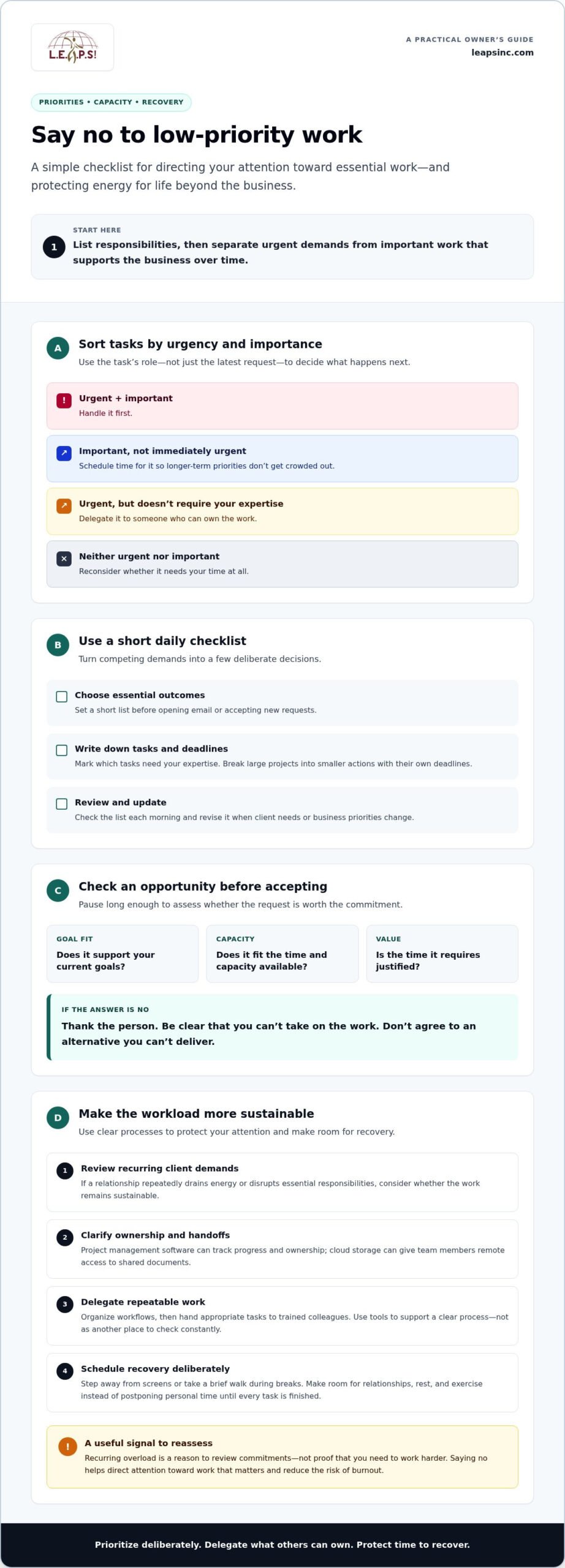
Practical ways to manage work-life balance as a business owner include setting priorities, protecting personal time, and declining work that drains energy without advancing essential goals. Start by listing your responsibilities and separating urgent demands from important work that supports the business over time. This makes it easier to choose where your attention belongs instead of accepting every opportunity.
A useful to-do list turns competing demands into decisions. Write down tasks and deadlines, and mark which ones require your expertise. Break large projects, such as launching a service, into smaller actions with their own deadlines. Review the list each morning and update it when a client need or business priority changes.
For a practical look at managing time and responsibilities, watch this video:
Prioritize tasks by urgency and importance. Handle urgent, important work first, and schedule important tasks without immediate deadlines. Delegate urgent work that doesn’t require your particular expertise, and reconsider tasks that are neither urgent nor important. This helps you preserve energy for decisions only you can make.
- Set a daily limit: Choose a short list of essential outcomes before opening email or accepting new requests.
- Assess opportunities: Ask whether a request supports your current goals, fits available capacity, and justifies the time it requires.
- Decline with clarity: Thank the person, state that you can’t take on the work, and avoid agreeing to an alternative you can’t deliver.
- Review client demands: If a client relationship repeatedly drains energy or disrupts essential responsibilities, consider whether the work remains sustainable.
Tools can make tasks, deadlines, and handoffs easier to track. Project management software helps monitor progress and clarify ownership, while cloud storage lets team members access shared documents remotely. Use these systems to organize repeatable workflows, then delegate appropriate tasks to trained colleagues. A tool works best when it supports a clear process instead of becoming another place to check constantly.
Declining low-priority work also means protecting recovery time. The U.S. Department of Labor says that, under the Fair Labor Standards Act, short workday breaks may be no longer than 20 minutes. Schedule breaks deliberately, and use them to step away from screens or take a brief walk. Regular exercise can also help make personal time a defined part of the week, not an opportunity postponed until every task is finished.
Finally, treat recurring overload as a signal to reassess commitments, not as proof that you need to work harder. Protecting personal life priorities alongside business responsibilities gives your schedule room for relationships, rest, and exercise. Saying no is a leadership practice: it directs attention toward work that matters and helps reduce the risk of burnout.
2. What is work-life balance for business owners?
For an entrepreneur, work-life balance means making room for business responsibilities and personal life without letting either consume the other. It doesn’t require a perfectly equal split every day. A product launch may demand extra attention, while a quieter week can leave more time for family, exercise, or rest. What matters is whether your choices reflect your priorities over time.
Set boundaries that people can understand and follow. Choose a regular start and finish time, then tell colleagues, clients, and family when you’re available. If you plan to work 40 hours per week, treat that as a suggested starting point, not a fixed standard for every business. Adjust your hours to real business demands, then protect personal commitments in your calendar.
Make boundaries between work and personal time visible in your surroundings and routines. If you work from home, use a separate workspace and close it at the end of the day. Silence work notifications during personal hours, and avoid opening your laptop for non-urgent tasks after your planned finish time. A routine such as writing tomorrow’s priorities before leaving your workspace creates a deliberate stopping point.
- Define availability: Set work hours and communicate them to clients, colleagues, and family.
- Protect transitions: Take a walk or change clothes after work to mark the shift into personal time.
- Set an exception rule: Decide what genuinely counts as urgent before an after-hours call arrives.
- Review the boundary: At the end of each week, note where work crossed into personal time and adjust one routine.
Reasonable work hours depend on your responsibilities, capacity, and business cycle. If an important deadline requires a temporary change, set a timeframe and plan how you’ll return to your usual schedule. Without that boundary, a short-term exception can become the default. Work-life balance is a pattern of choices, not a promise that every week will look the same.
Signs of burnout can include ongoing stress, insomnia, irritability, health problems, and strained relationships. More than half of small business owners report feeling stressed alongside issues such as these. Seek support when difficulties persist, affect daily functioning, or become increasingly hard to manage alone.
If setting limits brings up persistent stress or conflict, consider discussing those patterns with a professional. You can schedule an appointment to explore what support may help you protect your well-being and personal priorities.
3. Creating a schedule for work and life
A practical approach to how to manage work-life balance as a business owner starts with a calendar that reflects your real responsibilities, not idealized days. Add fixed commitments first, such as client meetings, school pickup, meals, and exercise. Then block focused work, schedule administrative tasks, and leave open time for unexpected demands. This makes trade-offs visible before the week fills up.
Use time blocking to give demanding tasks a clear beginning and end. For example, reserve 30 minutes at the start of the workday for email, then protect a focus block for planning or client work. Batch similar responsibilities, such as invoice processing or routine messages, into one period. Leave space between demanding meetings. Taking breaks during work can improve creativity and help employees stay engaged.
Flexibility matters when business needs shift. In Randstad’s 2024 Workmonitor survey of 27,000 workers globally, 81% of professionals prioritized flexibility in working hours. Around 80% of companies in the United States offer hybrid work options as part of regular practices. If your role allows, choose when focused tasks happen while setting clear availability for clients and colleagues.
- Schedule personal commitments: Add family time, exercise, appointments, and hobbies before filling open periods with work.
- Plan downtime: Reserve a lunch break and mark a clear finish to your workday.
- Protect vacation: Put time off on the calendar, then plan handoffs and client communication in advance.
- Review the week: Identify conflicts and move tasks that can wait.
To make time for family, health, and personal interests, put those commitments on the schedule rather than treating them as optional extras. A family dinner or exercise class can anchor the day and help define when work needs to stop.
Guilt or anxiety about time off can arise when you feel responsible for every decision. Treat rest as planned time, not a reward for completing an endless task list. Before vacation, document urgent contacts, delegate clear responsibilities, and set an email response that explains when you’ll return. These steps give colleagues direction and reduce unresolved decisions while you’re away.
If a full day away feels difficult, begin with a protected block for an activity you value. A work-life planning exercise can sort tasks by whether they need 15, 30, or 60 minutes, helping you place them realistically around work hours. For anyone asking how to manage work-life balance as a business owner, the goal is a schedule that can adapt without removing the commitments that sustain your well-being.
4. Benefits for productivity, stress, and health
A sustainable pace can help you give focused attention to important business decisions. When meetings and urgent requests claim every hour, strategic work gets fragmented. Protect uninterrupted time for planning, then set a clear stopping point so unfinished tasks don’t follow you into personal hours. This can make your day more focused and your attention more deliberate.
Delegating routine responsibilities can create more room for work only you can do. Start by identifying tasks with repeatable steps, such as preparing invoices or organizing project updates. Document the process, assign ownership, and train a team member to handle it. Track deadlines and progress in a shared task system instead of personally checking every detail.
Breaks can support productivity, too. Pausing during work can help employees stay engaged and make room for fresh thinking. Step away from a screen between demanding tasks, or take a short walk before returning to a complex decision. The Fair Labor Standards Act has specific rules for short workday breaks, so distinguish general scheduling suggestions from legal requirements that apply to your situation.
Long work hours are associated with health risks, including sleep loss, heart disease, and obesity. Adults should sleep about eight hours a night, and a consistent bedtime can support a more sustainable routine. If business demands regularly push sleep aside, review which responsibilities can be postponed, delegated, or redesigned. A schedule that depends on exhaustion is difficult to sustain.
- Protect focus: Reserve a work block for one high-impact task, and silence nonessential notifications.
- Delegate deliberately: Hand off repeatable work with written steps and clear ownership.
- Build recovery into the day: Take a screen break, eat away from your desk, or walk outdoors.
- Review the pattern: At week’s end, note which demands disrupted sleep, health, or relationships.
Address stress before it becomes a fixed feature of leadership. More than half of small business owners report feeling stressed, alongside concerns such as insomnia, irritability, health problems, burnout, and strained relationships. If you notice these difficulties, identify business conditions that may be contributing, such as unclear roles or repeated after-hours work, and choose one change to try.
Entrepreneurs are twice as likely to suffer from depression and three times as likely to experience substance abuse. These figures describe elevated risks, not an individual diagnosis. Persistent changes in mood, sleep, or coping deserve serious attention and support from a qualified professional. Seeking help can be part of responsible leadership, just like revising a workload or delegating a critical task.
Balance supports performance by helping preserve the judgment, energy, and perspective needed to lead over time. Track a practical indicator, such as missed meals or interrupted sleep, and use it to guide changes between work and personal life. Small, consistent adjustments can create a healthier foundation for both the business and the person responsible for it.
5. Defining work-life balance for business owners
For a business owner, work-life balance is a personal standard for how business responsibilities coexist with health, relationships, and meaning outside work. It doesn’t require equal hours or an identical routine each day. Define a work pattern you can sustain and the personal priorities you need to protect during demanding periods.
No single schedule suits every entrepreneur. A new launch may call for temporary focus, while a stable operating period can create room for family or personal interests. The key is whether extra work is a deliberate choice with an endpoint, or an unexamined pattern that repeatedly displaces life outside the business.
National comparisons provide context, not a personal scorecard: the United States ranks 29th out of 40 countries for work-life balance. In the United States, 11% of employees work 50 or more hours per week. Those figures describe broader work patterns; they don’t determine what is right for an owner. Your responsibilities, values, health, and business demands shape your own definition.
Make your definition concrete by writing down what you need in three areas: meaningful work, personal well-being, and connection with others. Then name one observable condition for each. Meaningful work might mean making time for strategic decisions; well-being might mean keeping a regular bedtime; connection might mean being present at a weekly family meal. Boundaries are easier to maintain when they protect something specific.
Employee expectations can offer another perspective without becoming a prescription. Randstad’s 2024 Workmonitor survey found that 93% of 27,000 workers globally prioritized work-life balance over career ambition. The same survey found that 83% prioritized mental health support, while 70% prioritized traditional career ambition. These priorities show why achievement alone may not capture what a sustainable working life means to you.
- Choose your measures: Track whether work hours, rest, and relationships match your stated priorities.
- Set a review point: At the end of each week, identify one boundary that held and one that needs adjustment.
- Separate choice from pressure: Ask whether extended work supports a defined goal or simply reflects an assumption that you must always be available.
- Revisit the definition: Update your standard when family needs, health, or business responsibilities change.
Achieving balance means building a working life that supports both the business and the person leading it. If clarifying your priorities feels difficult, or stress is interfering with your decisions, schedule an appointment to explore support and identify a path toward healthier work.
LEAPS: Individual Therapy
LEAPS offers Individual Therapy for business owners who want space to understand persistent stress, emotional strain, or patterns that make boundaries difficult to maintain. Therapy can help you examine how work pressures affect your well-being, clarify personal priorities, and consider healthier ways to respond to challenges. It may be a useful next step when stress is affecting sleep, relationships, concentration, or your ability to make decisions.
Individual Therapy can help you reflect on the expectations you place on yourself as a leader and how they shape life beyond the business. If work pressures affect a relationship, Couple Therapy may also be relevant; Group Therapy offers another setting for support and reflection.
If you’d like to explore support, visit leapsinc.com or contact LEAPS.
Choose a More Sustainable Way Forward
You don’t need to redesign your entire life at once. Choose one boundary or work pattern to strengthen, then notice how the change affects your focus, relationships, and sense of direction. Learning how to manage work-life balance as a business owner is an ongoing practice of making choices that honor both your ambitions and your well-being.
If stress, self-expectations, or relationship strain make change difficult, support can help you examine what’s getting in the way. LEAPS offers Individual Therapy for personal reflection, Therapy Intensive for focused therapeutic work, and Couple Therapy when business pressures affect a relationship. A thoughtful conversation can help you understand your patterns and move toward choices that better reflect the life you want to build.
Schedule an appointment with LEAPS to discuss your needs and consider a next step. You can make room for meaningful work without losing sight of the person and purpose behind it.
Frequently Asked Questions
What is work-life balance for business owners?
Work-life balance means pursuing business goals while maintaining a meaningful life beyond the business. For example, an owner might define success as completing strategic work, being present for family commitments, and having enough energy to enjoy time off. The definition is personal, so assess whether your choices support the priorities you value, not whether your days resemble another owner’s routine.
How can business owners set boundaries between work and personal life?
Set boundaries by explaining what counts as urgent and how people should reach you for it. For example, tell clients that you handle routine requests during business hours and direct genuine emergencies through a separate process. Use a work-only notification profile and turn it off at the end of the day. Clear expectations reduce interruptions and help others respond appropriately without relying on your constant availability.
How can small business owners delegate tasks and avoid burnout?
Start by identifying tasks with repeatable steps, such as preparing a weekly report or organizing customer records. Document the process, name the person responsible, and clarify which decisions they can make independently. Agree on a review point instead of checking every action. This transfers ownership, builds team capability, and helps you spot an unsustainable workload before exhaustion shapes every decision.
What time-management methods work best for entrepreneurs?
Choose a method that matches the work. For tasks requiring sustained concentration, try the Pomodoro Technique: work in focused 25-minute sessions followed by 5-minute breaks. For work that arrives in similar formats, group email replies or invoice reviews into dedicated periods. Test one approach for a week, then assess whether it reduces task-switching and helps you complete meaningful work without extending your day.
How can business owners create a sustainable work schedule?
Build a schedule with a normal operating rhythm and a plan for exceptions. Identify recurring demands, protect time for essential responsibilities, and leave room for unexpected client or operational issues. At the end of each week, compare planned work with what actually happened. If a recurring meeting or task keeps displacing recovery time, change its timing, shorten it, or assign it to someone else.
What financial and staffing plans help a business operate while the owner is away?
Before taking time away, prepare a cash-flow forecast that accounts for expected income, routine expenses, payroll, and upcoming bills. Assign an employee to oversee essential operations, document approval limits, and identify who handles client questions or urgent decisions. Share access to necessary procedures and records securely. Your handoff plan should also state which issues can wait until you return, so the team can act confidently without escalating every routine matter.