

What if reducing business stress isn’t about getting better at carrying everything, but changing what you carry alone? Managing stress as a small business owner can feel difficult when revenue is uncertain, every decision seems to rest with you, and work follows you into the hours meant for rest.
That pressure is real. Your business may depend on your judgment, but constant vigilance isn’t the same as effective leadership, and asking for support isn’t a sign that you’ve failed. Clearer routines, boundaries, and business systems may ease some sources of strain. Other concerns may call for support beyond your own efforts.
This guide will help you identify what’s driving your stress and choose realistic ways to address it, both personally and in your business. You’ll find practical ways to create space to switch off, approach delegation and uncertainty, and recognize when professional support could be useful. Individual therapy can provide space to explore emotional well-being and recurring stress patterns, while entrepreneurship coaching focuses on business and leadership development. The goal isn’t to eliminate every challenge. It’s to build a more sustainable way to lead without losing sight of your well-being.
Key Takeaways
- Managing stress as a small business owner starts with identifying which pressures you can change and which may need additional support.
- Notice how unfinished tasks and uncertainty affect your ability to step away from work and make decisions.
- Match your next step to the challenge: adjust business routines, consider coaching for business development, or explore therapy for personal well-being and recurring stress patterns.
- Build a manageable plan by choosing one pressure point, trying one practical change, communicating it, and reviewing how it works.
- Support can account for both your well-being and your business context. The right next step depends on what you need.
Managing stress as a small business owner starts with naming the pressure
Responsibility, uncertainty, and a steady stream of decisions can pile up when you own a business. One day may bring a customer concern, a cash-flow question, and a choice about your team, all before you’ve had time to consider what you need. Managing stress as a small business owner starts with recognizing that pressure is part of your experience, not a personal failure.
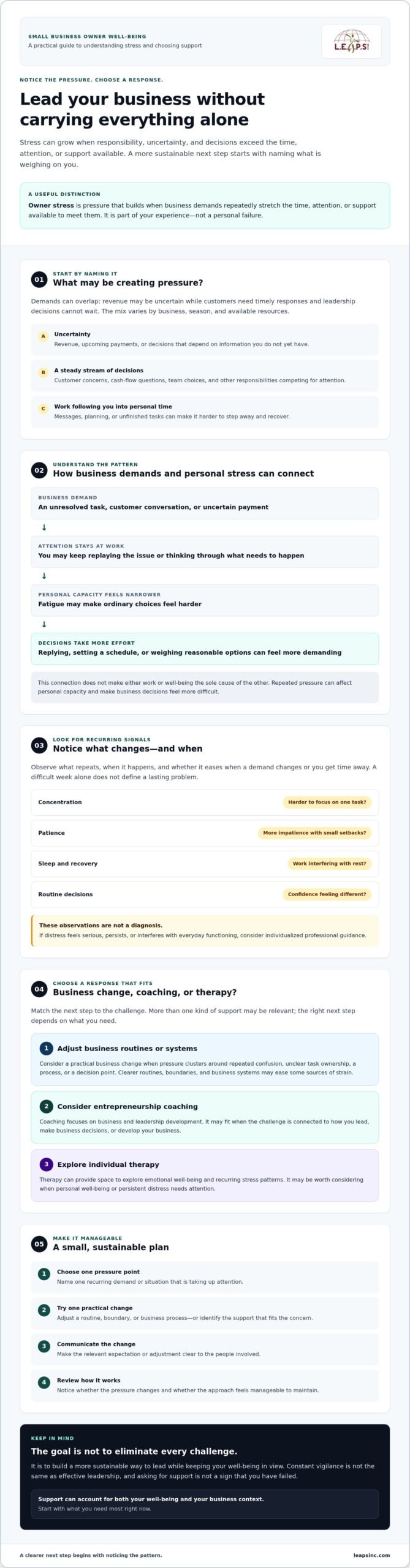
Owner stress is the pressure that builds when business demands repeatedly stretch the time, attention, or support available to meet them. Stress management means noticing that pressure and responding with personal and practical supports. Pressure may rise around a demanding deadline and ease afterward. Strain that continues or begins affecting daily life deserves attention. The broader idea of occupational stress can help frame how work demands and individual experience intersect.
For another perspective on working through business-owner stress, watch:
Why small-business ownership can feel relentlessly demanding
Different demands can overlap: revenue may be uncertain while customers still need timely responses, and leadership decisions may not be able to wait. The mix varies by business, season, and available resources, so there’s no single owner experience. When work messages, planning, or unresolved tasks spill into personal time, it can become harder to recover. That’s a signal to examine the pattern, not a reason to judge yourself.
How stress may show up in work and daily life
Notice whether pressure seems to coincide with changes in your concentration, patience, sleep, or confidence in routine decisions. A difficult week alone doesn’t define a lasting problem. Instead, observe what repeats, when it happens, and whether it eases when a demand changes or you get time away.
- Are you finding it harder to focus on one task?
- Do small setbacks prompt more impatience than usual?
- Is work interfering with sleep or time to recover?
These observations aren’t a diagnosis. If distress feels serious, persists, or interferes with everyday functioning, consider individualized professional guidance. Individual therapy may provide a space to explore personal well-being and recurring stress patterns. The appropriate support depends on your needs.
Understand the cycle between business demands and personal stress
An unresolved business task can keep claiming your attention after the workday ends. You may replay a customer conversation, mentally calculate whether an upcoming payment will cover expenses, or worry about a decision you can’t make until you have more information. Even away from your desk, part of your attention can remain on the business.
Fatigue may then make ordinary choices feel harder. Replying to an email, setting a schedule, or weighing two reasonable options can take more effort than usual. That pattern isn’t inevitable, and it doesn’t mean you’re incapable of leading. Repeated pressure can narrow an owner’s personal capacity and make business decisions feel more difficult, linking well-being and work without making either one the sole cause of the other.
Recognize recurring stress triggers in your business
For a short period, note the situations that reliably raise pressure. Record what happened, what responsibility or decision was involved, and what you could influence. The aim isn’t to monitor yourself perfectly. It’s to see whether strain clusters around particular demands.
- Urgent events: A customer issue or unexpected delay may need a focused response, followed by a clear stopping point.
- Recurring friction: Repeated confusion about who handles a task, how a request is processed, or when a decision is due may point to a process or role that needs attention.
- Factors within your influence: Identify what you can clarify, schedule, defer, or discuss, while recognizing what depends on circumstances outside your control.
This distinction matters. A one-time disruption may call for a short-term response; a recurring bottleneck may warrant a change to how work is organized. Guidance from the U.S. Chamber of Commerce on ways owners can manage the physical, mental, and emotional stress of running a business also highlights the value of considering personal practices alongside work demands. When physical strain or fatigue mounts, exploring dedicated medical care—such as services available through gpplus.com—can be an important step in safeguarding your overall health while leading an organization.
Notice when coping habits stop helping
Working longer may seem like the fastest way to catch up, while avoiding a difficult decision can offer brief relief. Taking every setback personally can also make leadership feel heavier. These are patterns to reflect on, not proof of a condition or a character flaw. Ask whether a coping habit resolves the underlying issue or simply postpones it.
Try noting when the habit appears and what happens next. If distress persists or disrupts your daily functioning, individualized guidance from a qualified professional may help you consider what support fits. If you’d like to discuss possible next steps, you can schedule an appointment with LEAPS Inc.
Choose the right response: business changes, coaching, or therapy
Once you’ve identified a pressure point, match your response to the challenge. A process issue may call for a business adjustment; a leadership-development goal may benefit from coaching; personal distress or recurring emotional patterns may be better explored in therapy. These options can complement one another, but they serve different purposes. Managing stress as a small business owner doesn’t mean treating every strain as a personal problem or expecting one form of support to solve everything.
| Primary challenge | Proportionate next step |
|---|---|
| Workload, unclear roles, or recurring process bottlenecks | Review priorities, responsibilities, routines, and repeatable tasks. |
| Business direction, leadership decisions, or entrepreneurship goals | Consider business or entrepreneurship coaching for development and planning. |
| Emotional well-being or stress patterns that persist beyond a specific business task | Consider individual therapy as a space to explore personal concerns with a qualified professional. |
| Financial questions requiring specialized analysis | Consult an appropriately qualified business or financial professional. |
When practical business adjustments may be the place to begin
If the main strain comes from too much work, unclear ownership, or a routine that repeatedly breaks down, start with the operating conditions. Where appropriate, delegate a task, clarify what takes priority, make schedules realistic, and document steps you repeat so they don’t depend on memory alone. These adjustments may ease an immediate bottleneck, while deeper role or workload challenges can require ongoing review. For complex financial decisions, seek advice suited to your circumstances rather than relying on stress-driven guesses.
When coaching or therapy may fit the challenge
Build a sustainable stress-management plan you can actually maintain
A useful plan doesn’t require you to redesign your business or add a demanding routine to an already full schedule. Start small. A clear change to one recurring pressure point can help you see what’s workable, what needs adjustment, and where further support may be useful. Managing stress as a small business owner is more sustainable when personal recovery and practical changes work together.
Start with one pressure point and a manageable change
Choose one recurring demand, not every challenge at once. Make the next step specific enough to try within your current time, staffing, and financial capacity. Then communicate the change to anyone it affects and choose a time to review it.
- Identify one pressure: Name a repeat demand, such as unclear responsibility for customer follow-up.
- Choose one change: Agree who owns the task, or set a reasonable stopping point for work that tends to expand into personal time.
- Communicate it: Share the new expectation with relevant colleagues, employees, or clients.
- Review what changed: At a date you choose, consider whether the pressure shifted, stayed the same, or revealed another issue.
The review isn’t a pass-or-fail test. If the change didn’t help, use what you learned to refine your approach. Some problems, such as a persistently unmanageable workload, may require broader changes rather than a personal habit layered on top.
Create support and boundaries around the plan
Consider who could help you think clearly or carry out the change: a trusted person, a professional with relevant expertise, or a peer who understands business ownership. Where appropriate, make expectations explicit. For example, clarify which requests require an immediate response and which can wait until your next working period.
Boundaries and recovery practices, such as protecting time away from work, addressing physical strain through chiropractic care such as healthylivinghickory.com, or taking a genuine break, can support well-being. They aren’t substitutes for addressing harmful workloads, unclear roles, or demands that remain unsustainable. If circumstances change, revisit the plan rather than treating it as permanent. Your business and personal needs may both shift.
If you’d like professional support as you consider what would be helpful, you can schedule an appointment with LEAPS Inc. to explore an appropriate next step.
How LEAPS Inc. can support your next step as an owner
Sustainable stress management can involve both the person carrying responsibility and the business context creating demands. Personal practices and operational adjustments may help, but they may not address every recurring concern. If you’re considering professional support, start by asking what you want help changing. That question can guide you toward a fitting kind of support without expecting one service to solve every challenge.
Match the support to what you want to change
LEAPS Inc. offers individual therapy and business or entrepreneurship coaching. These services have different purposes and aren’t substitutes for one another:
- Individual therapy provides a space to focus on personal emotional well-being, individual concerns, and recurring stress patterns. It doesn’t promise to resolve business challenges directly.
- Business or entrepreneurship coaching focuses on business, leadership, or entrepreneurial development. It isn’t clinical care, mental health treatment, or a way to diagnose distress.
You might be looking for a place to explore how ongoing pressure is affecting you, or support thinking through business and leadership development. You may also be uncertain about which need is most important. That uncertainty is a reasonable topic to raise as you discuss what support may fit.
Take a considered next step without waiting for a breaking point
Seeking support doesn’t mean you’ve failed or that you must wait until stress becomes unmanageable. It can be a deliberate choice to reflect, clarify what’s within your influence, and consider what would help you move toward your goals. The right next step depends on your circumstances, priorities, and the kind of support you’re seeking.
If you’re unsure which service may be appropriate, use the appointment process to discuss your needs and ask about fit. You don’t need to have every concern neatly defined before starting that conversation.
If exploring support feels relevant, you can schedule an appointment with LEAPS Inc. Consider what kind of capacity you want to build, both as an owner and as a person, so your long-term direction can stay connected to what matters to you.
Build a more sustainable way to lead
Managing stress as a small business owner begins with recognizing what’s creating pressure, then choosing a response that fits. A practical business change may help with recurring workload or unclear responsibilities, while personal boundaries and recovery time can support your well-being. When strain persists, it’s reasonable to consider professional support rather than waiting until you feel depleted.
LEAPS Inc. offers individual therapy focused on personal emotional well-being, as well as business and entrepreneurship coaching for business and leadership development. These are distinct forms of support, and the right fit depends on what you want to work on. You don’t need every answer before exploring your options.
Schedule an appointment to explore the support that fits your goals. A thoughtful next step can help you strengthen your capacity while staying connected to the work and life that matter to you.
Frequently Asked Questions
Why is owning a small business so stressful?
Owning a small business can be stressful because financial uncertainty, customer needs, and important decisions may compete for your attention at the same time. The pressure varies by business and owner, but responsibility can feel especially demanding when roles are unclear or there’s little time away from work. Naming the specific demands affecting you can help distinguish a temporary busy period from recurring issues that may need a practical change or added support.
How can I manage stress as a small-business owner?
Start by identifying one recurring source of pressure, then choose a realistic change to try. You might clarify who handles a task, set a stopping point for work, or write down priorities for the next day so they’re not all competing for attention after hours. Review whether the change helped. Managing stress as a small business owner can involve both personal recovery practices and adjustments to how work is organized.
Can stress affect how I run my small business?
Ongoing pressure can make it harder to concentrate, stay patient, or weigh routine decisions, although people respond differently. For example, when tired, an owner may find it more difficult to compare options or may put off a decision that usually feels manageable. This doesn’t mean every stressful period will harm business judgment. Noticing patterns over time can help you decide whether to adjust demands, seek practical advice, or explore personal support.
What are practical ways to reduce stress when I run a business alone?
When you work alone, make your plan small enough to fit your actual capacity. Choose a few priorities, group similar tasks, document steps you repeat, and decide when you’ll stop for the day if circumstances allow. You could also identify a trusted peer or qualified professional to consult about a specific business question. These steps won’t remove every demand, but they can reduce avoidable uncertainty and help protect time for recovery.
Should I choose business coaching or therapy for owner stress?
Choose based on what you want to address. Business coaching supports business, leadership, or entrepreneurial development; it isn’t mental health treatment or diagnosis. Therapy focuses on personal emotional well-being and individual concerns, including recurring stress patterns. LEAPS Inc. offers business and entrepreneurship coaching as well as individual therapy. If both business challenges and personal strain matter, consider which concern you want to focus on first and ask about the fit of available support.
When should a small-business owner seek professional help for stress?
Consider individualized professional guidance if distress persists, feels serious, or disrupts daily functioning, relationships, sleep, or your ability to manage ordinary responsibilities. You don’t need to wait until you reach a breaking point. A qualified professional can help you explore personal concerns; for business decisions, a professional with relevant business or financial expertise may be more appropriate. The best next step depends on what’s affecting you and the kind of help you need.
How can I set boundaries when my business depends on me?
Start with a boundary that reflects what your business can realistically support. For example, tell clients when you typically respond, define which issues need urgent attention, or set a daily point for reviewing messages. If you’re the only person responsible, create a simple plan for what can wait and what requires action. Communicate expectations clearly, then revisit them as customer needs, business conditions, or your capacity change.