

Healthy family relationships don’t require you to set aside your own needs. Setting boundaries with family members means identifying what feels acceptable, communicating those limits, and deciding how you’ll respond if they’re crossed. Therapy can help you understand patterns behind difficult interactions, practice direct conversations, and maintain boundaries while making room for connection.
It may feel easier to say yes, avoid disagreement, or take responsibility for how relatives react. But a boundary isn’t a demand that someone else change; it clarifies your needs and how you’ll participate in the relationship. This article explains why family boundaries matter, how therapy can help you set and sustain them, and how autonomy can coexist with closeness. You’ll also learn to recognize patterns that blur personal limits and approach boundary conversations with greater clarity and confidence.
Key Takeaways
- Notice when guilt, resentment, or feeling drained may signal a need for clearer limits.
- Identify what feels acceptable, what you need, and how you want to respond before starting a difficult conversation.
- Use calm, direct language to communicate boundaries with parents, siblings, and other relatives.
- Autonomy allows you to remain connected to family while protecting your privacy, choices, and individuality.
- Therapy can help you recognize family patterns, rehearse challenging conversations, and build confidence in maintaining your limits.
1. Why Are Boundaries Important?
Boundaries help family members stay connected without giving up their personal needs. With a parent, that might mean asking them to call before visiting. With a sibling, it could mean declining questions about a private relationship. Clear limits set expectations and ease the pressure to agree just to avoid tension. They also support emotional well-being by making room for individual choices, privacy, and rest.
Assertive communication makes limits easier to understand. Identify the behavior that concerns you, decide what you need, then state both calmly. For example, tell a parent, “I want to talk, but I can’t discuss this while you criticize my partner.” With a sibling, try, “I care about you, and I’m not comfortable lending money.” Direct language communicates your limit without attacking the other person.
How can you communicate boundaries clearly and respectfully? Use a brief “I” statement, make a specific request, and explain what you’ll do. “I feel overwhelmed by unplanned visits. Please text before coming; if I’m unavailable, we’ll arrange another time.” This keeps the focus on your experience and actions, rather than assigning blame or demanding that relatives feel differently.
Compassion doesn’t mean weakening your boundary. Acknowledge the relationship, then be clear: “I understand you’re disappointed that I can’t attend, and my schedule is full.” A parent or sibling may need time to adjust to changed expectations. Repeat your message without offering a lengthy defense. If guilt rises, pause, breathe, and return to what you intended to communicate.
What if a family member ignores or challenges your boundary? Calmly restate it, then follow through with the response you chose, such as ending a call if insults continue. A crossed boundary may not be deliberate, so a respectful reminder can help. Still, repeated pushback doesn’t mean you have to abandon your limit. Focus on what you control: whether you stay in the conversation, leave, or suggest another way to connect.
Living together calls for boundaries that work with shared routines. Agree on practical expectations, such as knocking before entering a bedroom, asking before borrowing belongings, or choosing a quiet time for difficult conversations. State what you need and what you’ll do if the agreement isn’t respected. For instance, “Please knock before coming in. I’ll keep my door closed when I need privacy.” Specific requests make daily interactions easier to navigate.
Setting healthy limits can feel unfamiliar, especially when family habits have gone unspoken for years. Start with one manageable issue, such as when visits happen or which topic you won’t discuss. Communicate your limit directly, kindly, and consistently. This helps parents, siblings, and other relatives understand your expectations while preserving room for mutual respect and a more balanced relationship.
2. How Does Family Therapy Help Me Set Boundaries?
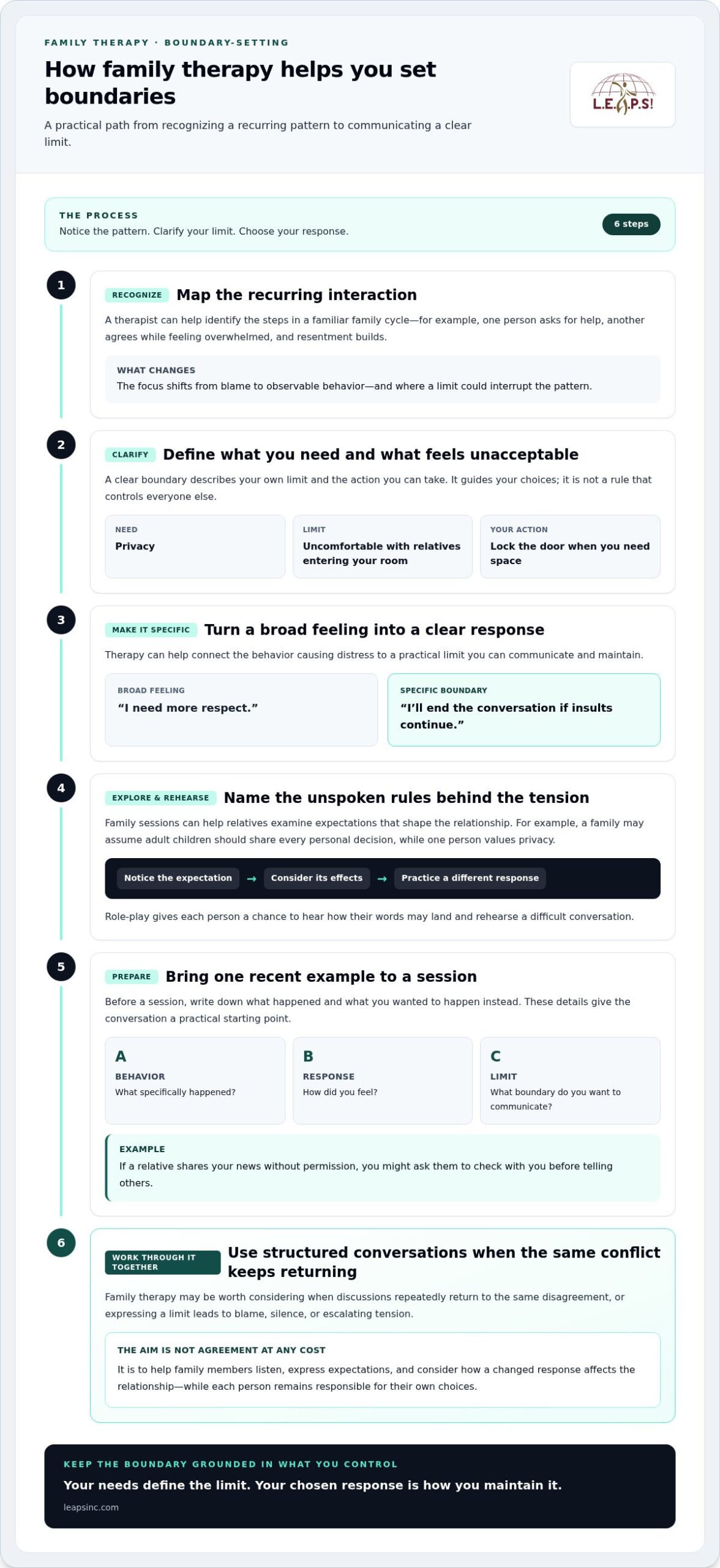
Family therapy can help make recurring interactions easier to recognize and change. A therapist may help relatives map a familiar cycle: one person asks for help, another agrees despite feeling overwhelmed, and resentment builds. Naming each step shifts attention from blame to behavior. It can also show where a personal limit could interrupt the pattern, such as pausing before answering a request.
Start by defining what you need, what feels unacceptable, and what action you can take. For example, you may need privacy, feel uncomfortable with relatives entering your room, and choose to lock the door when you need space. These limits describe your choices, not rules that control everyone else. A clear boundary is specific enough to guide your actions.
Therapy can help turn broad feelings into workable expectations. “I need more respect” can become, “I’ll end the conversation if insults continue.” A therapist can help you identify the behavior causing distress, clarify your limit, and rehearse your response. This can help you prioritize your needs without dismissing other people’s feelings or needs.
In family sessions, relatives can examine the unspoken rules shaping their relationships. A family might assume that adult children must share every personal decision, while one member values privacy. A therapist can help the family name that expectation, consider its effects, and practice a different response. Role-play also gives each person a chance to hear how their words may land.
When should you consider family therapy for boundary conflicts? Consider it when conversations repeatedly return to the same disagreement, or attempts to express a limit lead to blame, silence, or escalating tension. Therapy can help relatives identify patterns and practice difficult discussions in a structured setting.
Before a session, write down a recent interaction and what you wanted to happen instead. Note the specific behavior, your emotional response, and the limit you want to communicate. For instance, if a relative shares your news without permission, you might ask them to check with you before telling others. One clear example gives the conversation a practical starting point.
If you want guided support to clarify your needs and work through family dynamics, you can schedule a therapy appointment. Family therapy can help each person listen, express expectations, and consider how a changed response affects the relationship. The aim is not to make everyone agree; it’s to help people communicate limits while remaining responsible for their own choices.
agree; they make acceptable behavior clearer. Family boundaries are limits that define acceptable emotional, physical, and relational behavior. Brené Brown defines boundaries as a person’s lists of what is acceptable and unacceptable. In practice, identify your limits, communicate calmly, remain consistent, and respect other family members’ boundaries.
Using “I” statements to describe how another person’s actions affect you may help keep communication open and reduce defensiveness. The worksheet says you can leave a situation when someone crosses your boundaries and don’t have to explain or apologize.
3. Enmeshment and autonomy in family relationships
Enmeshment describes a family pattern in which one person’s emotions or problems become everyone’s responsibility. For example, an adult child may feel obligated to fix a parent’s distress, even when the parent hasn’t asked for help. This can make ordinary disagreement feel like betrayal. Autonomy offers another model: you remain part of the family while keeping your own opinions, privacy, and choices.
Healthy boundaries support mental well-being by distinguishing care from responsibility for another person’s feelings. You can listen to a sibling’s disappointment without changing your decision to miss a gathering. You can love a parent and decline to discuss a private matter. These limits make room for individual needs and mutual respect, while easing the pressure to manage everyone’s reactions.
Family expectations also need to reflect the relationship as it is, not an idealized version of it. If a relative often criticizes your choices, plan for a brief visit rather than expecting a deep conversation. Notice patterns: which topics leave you anxious, which interactions feel balanced, and what boundaries help you recover afterward. Realistic expectations protect your feelings without requiring you to give up hope for change.
At holidays or family gatherings, decide on your limits before arriving. Choose which subjects you’ll avoid, how long you’ll stay, and what you’ll do if tension rises. For example, you might drive separately so you can leave when needed. A simple “I’m not discussing that today” can redirect an intrusive conversation without turning the gathering into a debate.
When behavior is emotionally abusive or unsafe, prioritize safety over preserving a particular interaction. Consider communicating remotely, meeting in a public setting, bringing a trusted person, or leaving if the situation escalates. Keep the boundary focused on your actions, such as ending a call when insults begin. If you’re anxious about possible retaliation, discuss a safer plan with a trusted support person or therapist.
Taking a break from stressful relatives can help you notice how contact affects your mental health. You might pause calls for a while, decline an event, or limit conversations to practical topics. Use the space to notice changes in sleep, mood, and stress, then consider what level of contact feels sustainable. A pause offers information; it isn’t a punishment or a promise to cut ties forever.
Family patterns can pass between generations, so a familiar response may feel normal even when it limits individuality. Start with a recurring interaction and ask what closeness means to you. Healthy boundaries make room for warmth and independence together: you can care deeply about a relative while choosing a different path, keeping personal details private, or saying no.
4. Therapy support for family boundary-setting
A therapist can help turn a tangled family conflict into a clearer sequence. For example, you might describe a parent’s repeated questions, your anxiety, and your eventual silence. Together, you can define what feels intrusive and identify a response that fits your values. Reviewing the situation step by step can uncover patterns that are hard to recognize when emotions are rising.
Professional support can also help you prepare for a difficult conversation. Bring a recent example, then identify the behavior, its effect, and the change you need. A therapist might help you rehearse, “I’m willing to talk, but not while we’re raising our voices.” Practicing beforehand can make it easier to speak steadily when the real conversation begins.
Therapy offers a place to examine what happens after you state a limit. You may feel pressure to take it back when a relative becomes upset. A therapist can help you distinguish your responsibility to communicate respectfully from another person’s reaction. You can then plan a response, such as ending a call when the conversation turns insulting, and consider how that choice affects your well-being.
How can you handle guilt and anxiety after setting a boundary? Name the feeling, write down what you requested, and ask whether it reflects a need for safety, privacy, or time. If guilt persists, discuss the situation with a therapist or trusted peer rather than automatically reversing your decision.
Peer support can reduce isolation when family relationships become strained. A trusted friend can listen as you practice a sentence such as, “I’m not available to discuss that today.” A support group can offer space to compare strategies and hear how others manage similar pressures. Choose people who respect your privacy and won’t push you to reconcile or withdraw.
Physical signs can offer useful information during this process. Notice whether a particular call leaves you tense, restless, or unable to focus. Record the interaction, your feelings, and what would have helped. Sharing these observations with a therapist gives you specific material to work with, rather than relying on a general sense that family contact feels difficult.
Support can help when a relative refuses to accept a new limit. A therapist may help you consider whether a direct conversation, shorter visits, or less frequent contact best supports your well-being. If you’re not ready to involve relatives, individual therapy can still help you clarify your needs and prepare. Seeking support doesn’t decide the future of a relationship; it helps you approach that decision with greater awareness.
5. Family therapy and boundary-setting
Family therapy can help relatives see how repeated dynamics keep boundary conflicts alive. For example, one person may always manage communication after disagreements, while others avoid direct discussion. In a session, the family can identify this pattern and consider how each response sustains it. Recognizing the cycle creates a practical starting point for change, rather than assigning all responsibility to one person.
Therapy can help turn a broad concern into a clear boundary and a shared conversation. A family member might say, “I want to make my own decisions about work.” The therapist can invite others to describe what they heard before replying. That pause helps reveal whether the request was understood and gives the family a chance to discuss expectations without assuming everyone sees independence the same way.
Role-play offers a way to prepare for difficult conversations. A person can practice saying, “I’m not ready to discuss that topic,” while another family member practices listening without pressing for an explanation. The therapist can help both notice tone, interruptions, and emotional reactions. Rehearsal turns an abstract intention into words each person can use in a real interaction.
Clear boundaries also call for a response when someone crosses them. In therapy, a family can define what follow-through looks like. If a relative returns to a subject after being asked to stop, the person might repeat the limit and redirect the discussion. If the behavior continues, they might end the conversation. The consequence should describe their own action, not threaten to control someone else.
Pushback can happen when an established family pattern starts to change. A relative may interpret a new limit as rejection, while the person setting it may feel pressure to take it back. Therapy can help relatives name those reactions and explore what the boundary means to each person. Saying, “I value our relationship, and I still need this limit,” communicates care without withdrawing the request.
Family therapy can also make room for grief when relatives refuse to accept changed expectations. A person may need to acknowledge that the hoped-for response hasn’t happened, then decide what contact feels manageable. Sessions can help clarify choices, identify supportive relationships, and explore ways to protect emotional well-being. The family’s agreement isn’t required for someone to maintain a boundary.
The central takeaway is that boundaries shape participation, not another person’s inner response. Therapy can help families practice listening, repair misunderstandings, and sustain new ways of relating. If you’re ready to work through a recurring family pattern with professional support, schedule an appointment to begin that conversation.
LEAPS: Individual Therapy
LEAPS offers Individual Therapy for people who want support understanding family patterns and their own responses. It can be a useful next step when guilt, anxiety, or recurring conflict makes it difficult to maintain personal limits. In therapy, you can examine what feels uncomfortable, clarify the change you want, and practice communicating it. The focus is on your choices and well-being, not on controlling relatives’ reactions.
Consider reaching out when family interactions continue to affect your emotional health, or when you want a confidential space to prepare for a difficult conversation. LEAPS also offers Family Therapy for relatives who want to work on relationship patterns together. To discuss your next step, visit leapsinc.com.
Choose the next step that supports your growth
Change can begin with one deliberate choice: notice what you need, then act in line with it. Setting boundaries with family members isn’t a demand for perfect agreement. It’s a way to participate in relationships without losing sight of your values and direction.
If you want professional support, LEAPS offers Individual Therapy, Therapy Intensive, and Couple Therapy. Individual Therapy may help you explore your family patterns and prepare for conversations; Couple Therapy can support partners working through shared family pressures. The right next step depends on what you want to address and who is involved.
Bring one situation you’d like to approach differently. A therapist can help you clarify your goal and consider a practical path forward. Schedule an appointment with LEAPS to explore support. You can move toward stronger relationships while honoring your autonomy, one thoughtful step at a time.
Frequently Asked Questions
How Does Family Therapy Help Me Set Boundaries?
Family therapy helps relatives understand how their responses affect shared expectations. A therapist can guide a discussion where each person describes what they need from a specific interaction, such as deciding how family news is shared. The therapist can also help clarify misunderstandings and support respectful turn-taking. This structure is useful when family members want to stay connected but need a more workable way to communicate and make decisions together.
What Are Healthy Boundaries?
Healthy boundaries are clear, respectful limits that protect personal choices while allowing connection. They can shift as circumstances change, but they shouldn’t depend on one person agreeing to every request. For example, you might welcome visits while asking relatives to arrange them in advance. A healthy limit explains what works for you and leaves others responsible for their own decisions, feelings, and responses.
What does it look like to set boundaries?
Setting a boundary means stating what you will do in a specific situation, then following through calmly. For example, you could say, “I’m not discussing my career plans during dinner. If the topic comes up, I’ll change the subject.” This communicates your limit without requiring others to approve. A boundary guides your participation; it doesn’t dictate what another person must think.
Why Are Boundaries Important?
Boundaries help prevent unspoken expectations from shaping every family interaction. Imagine that one relative routinely handles all the planning for celebrations and begins to feel resentful. Saying, “I can organize the meal, but someone else needs to coordinate invitations,” makes responsibilities visible. Clear limits can support more balanced relationships by helping relatives understand what each person can offer, rather than relying on assumptions or repeated frustration.