

Could therapy for dealing with grief and loss offer support without asking you to move on before you’re ready? Grief can shift from day to day, feel difficult to explain, and leave you questioning whether your reactions are normal. There’s no single timetable or right way to mourn, and seeking support doesn’t mean you’re failing to cope.
Family, friends, community, and peer groups can bring connection and comfort. Therapy offers a different kind of support: a structured, confidential space to explore how a loss is affecting you, put words to what feels hard, and consider next steps that reflect your needs. It can’t erase the loss or prescribe how you should feel, but it may help you make sense of your experience at your own pace.
This article explains what grief therapy can and can’t offer, compares professional care with other sources of support, and outlines manageable ways to begin. You’ll also learn how individual therapy at LEAPS can provide space to explore loss and identify personally meaningful next steps, without pressure to grieve in a particular way.
Key Takeaways
- Grief can affect identity, relationships, routines, and your sense of what comes next; noticing where loss is showing up can clarify what support might help.
- Therapy for dealing with grief and loss offers a collaborative space to explore emotions, meaning, coping, and changes in daily life without expecting grief to disappear.
- Individual therapy, group support, family conversations, and peer connection serve different purposes; consider which kind of space feels most useful to you now.
- To decide whether therapy may fit, identify what feels difficult to carry alone and what you would like support addressing.
- LEAPS individual therapy can provide a structured setting to explore your experience and consider personally meaningful next steps at your own pace.
Therapy for Dealing with Grief and Loss: What Support Can Offer
A loss can reshape far more than a single relationship. It may affect emotions, family dynamics, daily routines, identity, and the future you expected to have. Some days, the impact may feel immediate; at other times, it may surface in decisions, anniversaries, or ordinary moments that suddenly carry new meaning. There is no universal pattern that proves someone is grieving correctly.
Grief therapy is professional support for processing a loss and navigating its effects on emotions, relationships, identity, and daily life. Therapy for dealing with grief and loss doesn’t aim to erase grief or sever attachment. Instead, it can offer space to understand what the loss means to you and consider how to care for yourself as life changes.
For another perspective on the purpose and scope of this support, Grief counseling outlines approaches and distinctions associated with grief counseling and grief therapy.
To hear a counselor respond to common questions about grief and loss, watch this video:
What kinds of loss can bring someone to therapy?
Bereavement after someone’s death is one reason people seek support. Other significant changes can also bring grief: the end of a relationship, a change in health or independence, losing a meaningful role, or a major life transition that alters familiar plans. These experiences aren’t interchangeable. The circumstances, the person’s connection to what changed, and what the loss represents all shape its impact.
Family, cultural, and spiritual contexts matter, too. A person may draw strength from rituals, faith, chosen family, or community traditions; another may feel unsure how to express grief within their surroundings. There is no single script for mourning. Therapy can make room for the individual meaning of a loss without ranking it against anyone else’s or imposing one belief about how grief should look.
What therapy can help with, and what it cannot promise
Therapy may help someone make room for difficult emotions, reflect on what has changed, and identify ways to manage everyday demands while carrying the loss. Sessions can offer a place to speak openly, notice patterns, and consider which relationships or routines might provide steadiness. The aim is not to force a positive interpretation, but to support reflection and personally meaningful choices.
Therapy cannot restore what was lost, dictate a deadline for grieving, or guarantee a particular outcome. You also don’t need to pursue it to validate your grief: professional support is an option, not a test of resilience or evidence that you’re coping incorrectly. For those who want one-to-one space to explore their experience, LEAPS individual therapy can provide a setting to consider current needs and meaningful next steps at a personal pace.
How Grief Therapy Works: Making Space for Emotion, Meaning, and Change
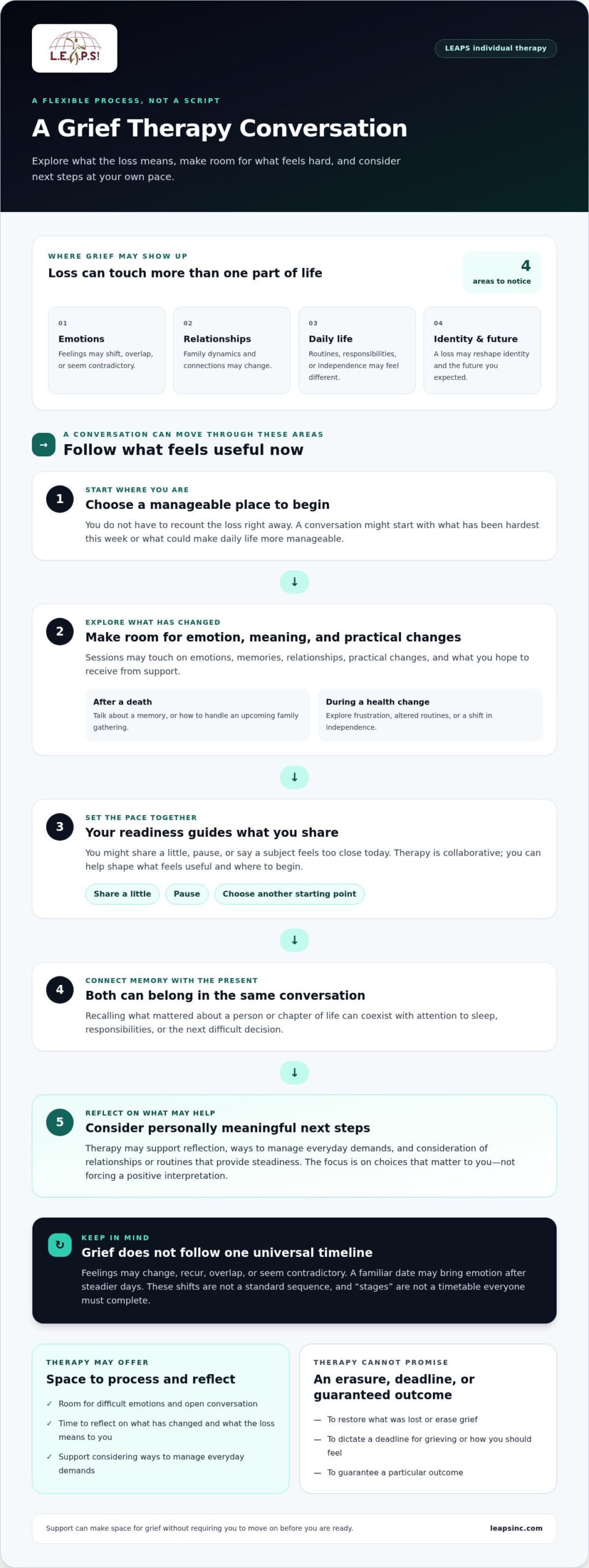
Grief therapy is usually a collaborative conversation, not a script the therapist applies to every person. You can help shape what feels useful, what you’re ready to discuss, and where you’d rather begin. If recounting the loss feels too difficult, a conversation might start with what has been hardest this week or what support would make daily life more manageable.
Grief experiences and therapy conversations differ because each person’s loss, relationships, meaning, and needs are distinct. This is a useful guide to expectations: therapy for dealing with grief and loss needn’t follow a single method or require a person to share everything at once. General grief-support concepts can describe possible areas of conversation, but they shouldn’t be mistaken for a specific approach used by every therapist or practice.
What might a conversation about grief explore?
A session may touch on emotions, memories, practical changes, relationships, and what you hope to receive from support. For example, someone coping with a death might want to talk about a memory, then focus on how to handle an upcoming family gathering. A person facing a health change might explore frustration, altered routines, or a shift in independence. The conversation can respond to what matters now.
Pacing should reflect your readiness, not a demand for disclosure. You might share a little, pause, or say that a subject feels too close today. Returning to memories can coexist with attention to the present: recalling what mattered about a person or chapter of life does not prevent you from discussing sleep, responsibilities, or the next difficult decision. Both can belong in the same process.
Why grief does not follow one universal timeline
Feelings may change, recur, overlap, or seem contradictory. A moment of relief can sit alongside sadness; a familiar date may bring a wave of emotion after a period of steadier days. These shifts don’t establish a standard sequence, and familiar “stages” should not be treated as a timetable everyone must complete or a checklist for judging progress.
Variation is not the same as a clinical diagnosis. Time alone cannot tell you whether an experience is healthy, unhealthy, or disordered. If distress is affecting an area of life you want help addressing, that can be a reason to discuss your concerns with a qualified mental health professional, who can consider your circumstances rather than relying on a calendar or a single emotion.
To make a first conversation more manageable, you might note one situation that feels especially difficult, one question you want to explore, or one practical change you’d like support navigating. You don’t need a complete account of your loss before beginning. If you’re considering a structured conversation about what support could look like, you can schedule an appointment when you feel ready.
Grief Therapy Compared with Peer, Family, and Group Support
Support can come from more than one place, and choosing therapy doesn’t mean your grief is abnormal or that you need to move on. Professional care, family conversations, group settings, and trusted peers offer different kinds of connection. The right fit depends on what you want help with, whom you feel comfortable involving, and what feels manageable now.
| Support option | Purpose | Who participates | May fit when |
|---|---|---|---|
| Individual therapy | Explore personal experiences and needs in a one-to-one setting. | You and a therapist. | You want space to reflect on your circumstances or discuss concerns at your own pace. |
| Group therapy | Share and reflect in a therapist-facilitated group. | A therapist and group participants. | Listening to others or speaking in a facilitated setting feels useful to you. |
| Family support or therapy | Address how loss affects communication, relationships, and shared life. | Family members, with or without a therapist. | You want to consider the impact of loss within family relationships. |
| Trusted community or peer support | Offer companionship, practical help, shared understanding, or connection through community. | Friends, peers, relatives, or community members. | You value informal connection, familiar traditions, or support from people you trust. |
When might individual therapy feel like the right starting point?
A one-to-one setting may suit someone who wants to reflect on personal needs, emotions, or circumstances without making a group or family conversation the starting point. You might want to discuss a concern you haven’t found words for, or explore how a loss is affecting a particular part of life. LEAPS’ individual therapy benefits can help you understand what this format may offer. Choosing therapy is not a declaration that grief is wrong; it is one way to seek support.
When could group or family support add something different?
Group therapy brings participants together with a therapist facilitating the setting; LEAPS offers group therapy. Family therapy focuses on relationships among family members, while informal peer and community support can offer connection outside professional care. These options aren’t substitutes everyone must choose, nor are they mutually exclusive. Someone might value individual reflection and also appreciate family conversations or community rituals, while another may prefer not to share grief in a group.
Consider the question you most want support with: Is it personal reflection, communication with relatives, connection with others, or practical companionship? Your answer can help identify a starting point, not lock you into a single format. Therapy for dealing with grief and loss can sit alongside trusted relationships and community support; you can choose, adjust, and combine forms of care in ways that respect your preferences and current needs.
How to Decide on Grief Therapy and Prepare for It
You don’t need to reach a particular point in grief before considering support. It may be worth exploring therapy if the experience feels difficult to carry alone or is affecting parts of life you’d like help addressing, such as relationships, responsibilities, or routines. There’s no fixed waiting period or checklist you must meet. The decision can begin with noticing what you need now.
Use this simple sequence as a guide, not a test:
- Notice what feels difficult. Identify a moment, concern, or part of daily life that has been weighing on you.
- Name the support you want. You might want space to speak openly, help thinking through a change, or support with communication.
- Consider a format. Reflect on whether an individual conversation, group setting, family discussion, or informal support feels most approachable.
- Prepare a few questions. Write down anything you want to understand about how sessions work, what you can discuss, or how you’ll shape your goals.
Questions to help clarify what support you want
Ask yourself: What feels hardest right now? What would I like to feel more manageable, even in a small way? Would I rather begin in a one-to-one setting, with family, or among others with shared experiences? You can also note any concern about talking through the loss, such as feeling unsure where to begin. You don’t need to settle that concern before seeking support.
These questions help turn a broad wish for help into a starting point. Your answer doesn’t have to be a polished goal. “I want to get through a difficult conversation,” or “I need space to sort out what I’m feeling,” is enough to begin exploring what might be useful. Therapy for dealing with grief and loss can start with uncertainty itself.
What to bring into an initial therapy conversation
Bring only what feels possible to share. You might describe what has changed, what has been especially challenging lately, or what kind of support you already have. If words are hard to find, a brief note on your phone or a few written questions can help. You can say that you’re not ready to discuss certain details; an initial conversation doesn’t require a complete account of the loss.
It’s reasonable to ask how sessions are structured, how goals are developed, and how you and the therapist will discuss whether the work feels helpful. You can also ask how to raise concerns or adjust the focus as your needs shift. Not knowing exactly what you want from therapy is a valid starting point, not a barrier to a useful conversation.
If you’re ready to explore whether individual therapy could fit your needs, schedule an appointment with LEAPS to begin a conversation at your pace.
How LEAPS Individual Therapy Can Support a Grief Journey
After considering the different forms of support available, individual therapy may be a useful next step if you want dedicated space to examine how a loss is shaping your life. At LEAPS, this setting can support reflection on your experience, present concerns, and what might feel meaningful to address. The focus is not on following a prescribed grief process, but on making room for your circumstances and priorities.
A person-centered starting point for grief support
Your history, relationships, beliefs, and daily responsibilities all influence what support may feel relevant. In individual therapy, you can help shape the conversation: perhaps begin with what has changed at home, consider a difficult relationship, or identify what you need to manage the coming week. Goals can develop through reflection rather than being imposed in advance. The purpose is support, not pressure to forget, feel differently, or recover on a schedule.
That distinction matters. Therapy for dealing with grief and loss should not require you to minimize the importance of someone or something you’ve lost. It can help you consider how to carry that significance while also attending to current needs and the life still unfolding. Some conversations may focus on emotions; others may turn toward choices, relationships, or practical challenges. You can approach these subjects at a pace that feels workable.
LEAPS’ therapeutic philosophy provides context for the practice’s broader approach to therapy. In an individual setting, the work begins with your own experience rather than assuming that a particular loss, family structure, belief system, or response to grief will look the same for everyone. That creates room to identify what you want support to help you understand or address.
Taking the next step with LEAPS
An appointment can be a practical first conversation about what has brought you to therapy and what kind of support might feel useful. You don’t need to arrive with a complete story, polished explanation, or fixed goal. You might simply say that daily routines have become harder, that a change in a relationship is weighing on you, or that you’re not sure where to begin. Uncertainty can be part of the conversation.
Before the meeting, you could jot down one concern you’d like to raise, a question about how therapy works, or an area of life you hope to make more manageable. If nothing comes to mind, that’s all right too. A starting point can be as simple as describing what feels most present today. The next steps can take shape from there, guided by your needs and your pace.
If you’re ready to explore individual support, schedule an appointment with LEAPS to begin the conversation.
Choose a Next Step That Respects Your Pace
You don’t have to know exactly what healing should look like before you begin. A next step might simply be acknowledging that something feels hard to carry and allowing yourself a conversation about it. Therapy for dealing with grief and loss can be part of making room for your experience while gradually considering what you need in the life ahead. There’s no requirement to leave your attachment behind or arrive with every question answered.
At LEAPS, individual therapy offers a setting to explore your circumstances and consider meaningful next steps. The practice was founded and is led by Dr. John E. N. Daniel, bringing a clear leadership perspective to its work. Beginning a conversation doesn’t commit you to having a perfect plan; it creates space to identify what support could look like for you.
Schedule an appointment to explore individual therapy and the support that may fit your grief journey. Take the next step in your own time, with room for both the loss you carry and the possibilities still ahead.
Frequently Asked Questions
Is therapy for grief only for people who feel unable to cope?
No. Therapy is an option, not a measure of how severe your grief is or proof that something is wrong with you. Someone might use sessions to reflect on a changed relationship, find ways to manage a difficult anniversary, or talk through decisions after a major loss. You can decide whether a conversation would be useful, even if you’re still meeting daily responsibilities and receiving support from people close to you.
How can therapy help someone dealing with grief and loss?
Therapy for dealing with grief and loss may offer room to express emotions, understand how a loss affects everyday choices, and consider coping strategies that fit your life. For example, you might explore how to approach a family gathering that now feels different or identify what support you need during a demanding week. Therapy doesn’t remove grief or promise a particular result. Goals and pace can be shaped around the individual.
When should someone consider therapy after a loss?
There’s no universal waiting period for seeking therapy after a loss. You might consider a conversation when you want help making sense of what happened, responding to changed responsibilities, or finding words for what you’re experiencing. You don’t need to reach a particular level of distress or wait for a milestone. If you’re unsure what you need, you can begin by saying so and use the conversation to explore possible next steps.
Can therapy help with losses other than the death of a loved one?
Yes. People may seek support after a relationship ends, health changes, a meaningful role is lost, or expected life plans shift. These experiences are distinct, and they shouldn’t be treated as identical to bereavement or to one another. You might describe what changed and why it matters to you, even if others don’t immediately understand its significance. A respectful conversation centers your circumstances rather than comparing whose loss is greater.
What happens in a first therapy session for grief?
An initial session may begin with what led you to consider therapy, what you’d like support with, and questions about how the process works. You can start with a practical concern, such as an upcoming decision or a change in routine, rather than recounting every detail of the loss. There’s no need to arrive with a complete goal. You and the therapist can discuss what feels comfortable and identify a possible direction together.
How long does grief therapy take?
The length of therapy varies with your circumstances, needs, and goals, so there isn’t a standard number of sessions or a deadline for feeling better. You can discuss what you hope to address, then revisit whether the conversations feel useful as your priorities evolve. Ending therapy doesn’t mean you’ve forgotten the person or loss. It can simply reflect that you’re ready to continue with a different kind of support or on your own.
Can grief return years after a loss?
Yes. A memory, significant date, family change, or new life experience can bring feelings connected to a loss back into focus. That doesn’t automatically mean you’ve failed or returned to the beginning; the reminder may hold a different meaning in your life now. Rather than judging the timing, consider what feels stirred up and what would help you respond. Support remains an option if you want space to explore it.