

What if seeking support could strengthen your ambition rather than diminish it? If you’re exploring therapy for entrepreneurs stress, you may be carrying more than a demanding workload: uncertainty follows you home, decisions keep turning over in your mind, and the confidence you project can leave little room to admit how heavy it feels.
That pressure can affect your energy, focus, relationships, and sense of self. It doesn’t mean you’re not capable of leading; it may mean the responsibility has become difficult to set down alone. Individual therapy offers a structured, confidential space to examine how entrepreneurial stress is affecting you, recognize emotional patterns, and consider responses that fit your values and goals. It can support clearer reflection without promising a particular business outcome or asking you to abandon your vision.
This article explores how business pressure can affect personal well-being, what therapy may offer, and how to prepare for a first conversation. It also distinguishes individual therapy from entrepreneurship or business coaching, so you can identify which kind of support fits the questions you want to address.
Key Takeaways
- Notice when business demands keep occupying your attention outside work, and consider how limited recovery may be affecting your well-being.
- Stress can affect thoughts, emotions, and relationships in different ways. Use the reflection points in this article to recognize patterns, not to diagnose yourself.
- Understand how therapy for entrepreneurs stress differs from coaching, so you can identify the kind of support that aligns with your needs.
- Prepare for a first therapy conversation with brief notes on recurring situations, their emotional effects, and what you hope to explore.
- LEAPS Inc. offers individual therapy as a space to reflect on stress and personally meaningful goals.
Therapy for Entrepreneur Stress: Recognizing When Business Pressure Follows You Home
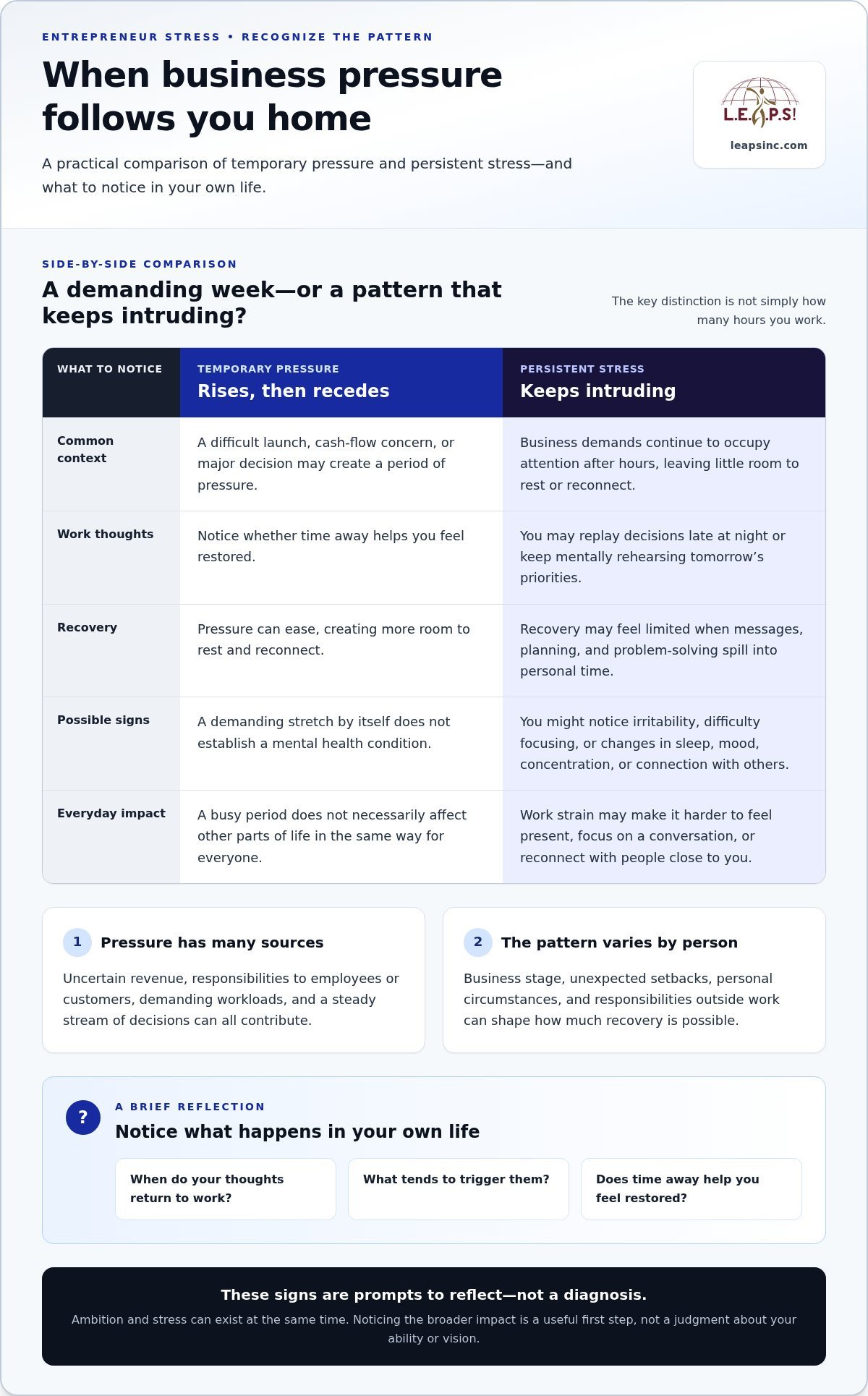
Entrepreneur stress can build when business demands persist and opportunities to recover feel limited. A difficult launch, cash-flow concern, or major decision may create temporary pressure. The key question is not simply whether you have a demanding week, but whether work keeps occupying your attention after hours, leaving little room to rest or reconnect.
Ambition and stress can exist at the same time. Feeling overwhelmed doesn’t mean you lack commitment or the capacity to lead; it may signal that responsibility is affecting more of your life than you want it to. Therapy for entrepreneurs stress can offer a place to examine that experience without treating ambition itself as the problem.
For perspectives on entrepreneurship and mental health, watch this conversation:
Why business ownership can make stress feel constant
Ownership can mean dealing with uncertain revenue, responsibilities to employees or customers, a demanding workload, and a steady stream of decisions. Even when the business is progressing, the next challenge may be difficult to predict. When messages, planning, and problem-solving spill into personal time, it can become harder to distinguish effort from recovery.
The pattern varies by person and circumstance. A new venture, a period of growth, and an unexpected setback can bring different pressures, while responsibilities outside work also shape how much recovery is possible. Rather than comparing your experience with another founder’s, notice what happens in your own life: when your thoughts return to work, what tends to trigger them, and whether time away helps you feel restored.
When stress starts affecting more than work
Look beyond the number of hours you work. Are you replaying decisions late at night, becoming more irritable with people close to you, or struggling to focus on a conversation? You may also notice changes in sleep, mood, concentration, or how connected you feel to family and friends. These signs aren’t a diagnosis, and a demanding stretch doesn’t automatically mean you have a mental health condition. They can, however, be useful prompts to pause and reflect.
Temporary pressure rises and recedes; persistent stress keeps intruding on daily life, recovery, or relationships. That distinction can help you decide whether the strain is passing or deserves more attention. The concept of Founder’s syndrome also describes how a founder’s strong identification with a venture can complicate leadership and affect an organization. It isn’t a label for every driven owner, but it may prompt you to consider whether business pressures are narrowing your perspective or affecting your interactions.
Individual therapy provides a clinical setting to reflect on emotional patterns and personal goals. You might bring recurring stress, changes in relationships, or another concern that feels important. Recognizing the broader impact is a useful first step, not a judgment about your ability or vision.
How Entrepreneur Stress Can Shape Your Thoughts, Emotions, and Relationships
Business pressure can set off a cycle that reaches beyond a busy calendar. A difficult decision or uncertain outcome may prompt worry, which then takes attention away from rest, relationships, or the next task. If recovery remains limited, fatigue may make the original pressure feel harder to manage. This pattern is possible, not inevitable, and it can look different from one person to another.
Your mind may keep reviewing a choice after the workday ends: Was that hire the right one? Should I have handled the client conversation differently? Repeatedly revisiting a decision can leave less attention for what’s happening now. Some owners notice self-criticism, fear of failure, or difficulty choosing between priorities. Others feel emotionally steady through a demanding period. Reactions vary with personal circumstances, available support, the stage of the business, and life outside work.
Ongoing pressure can narrow attention, intensify emotions, and make it harder to feel present with the people who matter. This describes a possible impact, not a clinical assessment or diagnosis. A stressful stretch alone doesn’t establish that someone has a mental health condition. The useful step is to notice how work strain may interact with your thoughts, feelings, and everyday connections instead of treating each effect as an unrelated problem.
There can also be pressure to appear certain. Employees, clients, partners, or investors may look to an owner for direction, and the owner may feel responsible for projecting confidence while privately questioning a decision. Keeping that uncertainty hidden can make it harder to acknowledge personal needs or share concerns. You may feel alone with choices that affect others, even when colleagues or loved ones are nearby.
That strain can spill into personal interactions. If you’re mentally rehearsing tomorrow’s priorities, you may be physically present at dinner but less engaged in conversation. A shorter temper or preoccupation with work can be misunderstood by a partner, family member, friend, or colleague, particularly when the underlying pressure hasn’t been expressed. These moments don’t mean every relationship is in trouble; they show how limited attention and unspoken worries can affect connection.
The phrase therapy for entrepreneurs stress points to more than managing a workload. It can also mean making room to understand how responsibility, self-expectations, and emotional strain affect your experience. If these patterns feel familiar and you’d like support exploring them, you can schedule an appointment.
Therapy for Entrepreneurs: What It Can Address, and What It Is Not
Therapy offers a clinical conversation focused on emotional well-being, recurring patterns, and goals that matter to you personally. As an entrepreneur, you might explore how uncertainty affects your reactions, what expectations you place on yourself, or how business pressure connects with experiences beyond work. Therapy isn’t reserved for a crisis or severe mental illness. You can seek support before you feel unable to function.
Therapy is not a business strategy session. It doesn’t promise a particular diagnosis, method, timeline, or business result. Instead, it creates space to examine your inner experience and consider what you want to understand or change. You might begin with a practical concern at work and then explore what it means to you personally.
Questions therapy may help an entrepreneur explore
A therapist may help you reflect on which situations intensify stress, how you respond when outcomes are uncertain, and whether your boundaries or self-expectations feel sustainable. A business setback, for example, might bring up both worry about the next decision and fear of disappointing others. The focus is on understanding your experience, not prescribing a universal answer.
Therapy and coaching can both support growth, but they serve different purposes. Coaching focuses on business, leadership, or performance goals; therapy centers on emotional well-being and personal patterns. Neither is inherently better. The right fit depends on the question you want to address, and the two forms of support aren’t interchangeable.
- Therapy: Supports emotional well-being and personal reflection. It may explore, “What is this pressure bringing up for me, and how is it affecting my life?”
- Entrepreneurship or business coaching: Focuses on business development, leadership, or performance aims. It may explore, “What direction or strategy could move this venture forward?”
- Different aims: Therapy considers personal experience and emotional patterns; coaching focuses on business-related objectives. Your needs may center on one, the other, or distinct goals addressed through separate support.
Therapy and coaching serve different purposes
Consider the difference between wanting to clarify a growth strategy and wanting to understand why uncertainty leaves you persistently unsettled. The first is a business-oriented question; the second concerns your emotional experience. Sometimes both matter, but one kind of support shouldn’t be treated as a substitute for the other. Naming what you want help with can make it easier to choose a starting point.
LEAPS Inc. provides individual therapy to explore stress, emotional patterns, and personally meaningful goals. The practice also offers entrepreneurship and business coaching for business-related aims. To begin a conversation about individual therapy, you can schedule an appointment.
How to Prepare for Therapy When Your Entrepreneurial Schedule Is Full
Preparing for therapy doesn’t require a polished explanation of what’s wrong or a complete account of your business. You can start with a simple observation: something feels difficult, and you want space to understand it. A few minutes of reflection may help you arrive with a starting point without turning preparation into another demanding task.
What to reflect on before beginning
Start with what feels most demanding and when you notice the strain. Is it strongest before a key decision, after a difficult conversation, or when you try to step away from work? Consider whether you’ve noticed changes in sleep, mood, attention, relationships, or your ability to enjoy time off. You don’t need to analyze each sign or decide what it means.
A short note on your phone or in a notebook can help you gather your thoughts. Keep it simple:
- Situation: What was happening when the pressure became noticeable?
- Response: What emotions or thoughts came up?
- Effect: Did it influence your rest, focus, or connection with others?
- Question: What would you like to understand or explore?
For example, you might write, “I felt tense after postponing a decision, kept thinking about it at home, and want to understand why it’s hard to let the issue rest.” That’s enough to open a conversation. You don’t need a business diagnosis, a perfectly framed problem, or certainty about what should change. You can discover what matters as you talk.
Making room for support without adding another burden
Think about a routine you can realistically sustain alongside work and personal responsibilities. Rather than building an ideal schedule you may struggle to maintain, consider what time and preparation feel manageable. Appointment formats and individual circumstances differ, so focus on what helps you participate consistently and speak openly.
It may help to notice what makes an honest conversation easier. You could write down a concern beforehand, start with the issue that feels simplest to name, or take a moment to gather your thoughts. There’s no requirement to share everything at once. Preparation is an invitation to arrive as you are, not a performance to get right.
Individual therapy can give you room to explore personal concerns and goals alongside the realities of a demanding professional life. If you’re ready to begin, schedule an appointment with LEAPS Inc. You don’t need certainty about the outcome; you can start by describing what you’re experiencing.
LEAPS Inc. Individual Therapy: A Next Step Toward Greater Clarity
Your business is part of your life, but it isn’t the whole of who you are. LEAPS Inc. offers individual therapy centered on emotional well-being and personal growth. You can bring the pressures you’re carrying, the patterns you’ve noticed, and the goals that matter to you, whether they relate directly to work or to how work affects life beyond it.
Therapy for entrepreneurs stress doesn’t need to begin with a crisis or a perfectly defined problem. Perhaps you’re unsure why a particular responsibility is difficult to put down, or you want to understand how your expectations influence your choices and relationships. Those questions are meaningful starting points. Therapy focuses on your experience as a whole person, not only your role as an owner or the outcomes your business produces.
Bringing your whole experience into individual therapy
Individual therapy gives you space to explore stress and personal goals in a clinical setting. You might discuss what feels demanding, what you value, and how your professional responsibilities intersect with other parts of your life. LEAPS Inc.’s individual therapy is grounded in this personal focus. You don’t need a complete explanation; you can begin with what feels most important to share.
Entrepreneurship coaching is a separate, business-oriented service that may focus on professional or venture-related aims. It isn’t a substitute for clinical therapy, just as therapy isn’t a business strategy session. Identifying the questions you want to explore can help you choose the kind of support that fits your purpose.
Choosing a purposeful next step
Starting can be as simple as naming one concern: “I want to understand why I can’t switch off,” or “I’d like to make room for my own needs while running this business.” Bring questions rather than a polished account of your situation. A first conversation gives you an opportunity to describe what you’re experiencing and what you hope to explore, at a pace that feels appropriate to you.
Seeking support doesn’t require you to set aside your vision. It can be a deliberate way to give your well-being attention alongside the responsibilities and aspirations that matter to you. If individual therapy feels like a meaningful next step, schedule an appointment with LEAPS Inc. to begin exploring support.
Move Forward With Your Vision and Well-Being in View
Your business vision deserves commitment, and so does the person carrying it. Seeking therapy for entrepreneurs stress can be a purposeful way to make room for your perspective, needs, and direction, rather than treating personal well-being as something to consider only after every business demand is met.
You don’t need to know exactly what should change before you begin. Start with a question, a concern, or a sense that you want to relate to work and life differently. At LEAPS Inc., individual therapy focuses on emotional well-being and personal growth, while entrepreneurship coaching supports distinct business-oriented goals. You can choose the starting point that matches what you want to explore.
Schedule an appointment to explore individual therapy with LEAPS Inc. You can honor your ambition while making space for your own growth, too.
Frequently Asked Questions
Can therapy help entrepreneurs who are not in crisis?
Yes. You can consider therapy even if you’re functioning at work and haven’t experienced a dramatic event. You might want to understand why routine decisions leave you tense or why a successful milestone hasn’t brought the relief you expected. You don’t need to prove that things are “bad enough.” A therapist can discuss what’s prompting you to seek support and whether therapy aligns with your concerns.
Do I need a mental health diagnosis before starting therapy for stress?
No. Wanting support is a valid reason to explore therapy; you don’t need to arrive with a diagnosis or decide for yourself what condition, if any, explains your experience. You might begin by describing a concrete concern, such as losing focus during meetings or feeling on edge before opening business email. A clinician can discuss your experience and whether therapy fits. This FAQ can’t determine an individual diagnosis or treatment need.
Can therapy help if my business is the main source of stress?
Yes. Therapy can help you explore how business demands affect your emotional life and the choices available to you, even if the external pressures remain. If an unpredictable workload makes it hard to be present at home, for example, you could examine what that strain means to you and which personal needs feel important. Therapy for entrepreneurs stress isn’t a substitute for operational guidance, and it can’t guarantee that circumstances will change.
Will a therapist tell me whether to close or change my business?
No. A therapist isn’t a substitute for financial, legal, or operational advice and shouldn’t make a major business decision on your behalf. Therapy may help you clarify the values and concerns influencing a choice, such as whether to expand, pause, or pursue a different direction. You remain the decision-maker. For a complex business question, keep clinical reflection distinct from the professional advice needed to assess the business itself.
Is what I discuss in therapy confidential?
Therapy conversations are generally private, but confidentiality has limits that can vary with applicable law and clinical circumstances. Before sharing details you consider especially sensitive, ask the therapist to explain their privacy practices and the limits that apply to your care. You can also ask how information is handled in circumstances relevant to you. Don’t assume every situation is covered identically; understanding privacy expectations can help you make an informed decision about what to discuss.
Can therapy support relationships affected by entrepreneurial stress?
Therapy can help you examine how work pressure may shape your communication, availability, or emotional connection with others. You might reflect on why you keep checking messages during time with family or how you respond when a partner raises concerns about work. Individual therapy focuses on your experience and goals; a partner or family member isn’t automatically included. The appropriate support depends on the people involved, and no specific relationship outcome is assured.