

Executive coaching can return five to seven times the initial investment, according to Harvard Business Review, with results depending on the program’s scope and leadership level. For leaders asking what the ROI of executive coaching is, the answer can include financial gains alongside stronger performance, engagement, and retention.
It’s reasonable to want evidence before investing in leadership development. The question “what is the ROI of executive coaching?” has no single answer for every organization. Revenue and cost savings matter, as do leadership behaviors that influence team performance and employee commitment. Start by deciding which outcomes matter and how you’ll measure them.
This article explains how to assess financial returns, connect leadership growth to business outcomes, and evaluate changes in engagement and retention. It also shows how to interpret published ROI figures in light of organizational goals, rather than treating one result as a universal benchmark.
Key Takeaways
- Assess financial returns alongside performance, engagement, and retention to see the broader value of leadership development.
- Connect coaching outcomes to business measures such as productivity, revenue, and employee turnover, while separating coaching’s contribution from other factors.
- Use a clear baseline and track outcomes over time to make return estimates more meaningful to your organization.
- Research findings offer useful context, but differences in study design and measurement mean no single ROI figure applies to every organization.
- When personal well-being is affecting professional life, LEAPS Inc. Individual Therapy offers space to explore challenges and support personal growth.
How does coaching affect engagement and retention?
Leadership coaching may influence engagement and retention by helping leaders communicate, set priorities, and support employees more effectively. To assess its business value, connect observed changes with measurable outcomes such as productivity, customer satisfaction, and turnover.
To see how coaching outcomes can be translated into financial value, watch this practical explanation:
Retention and Turnover
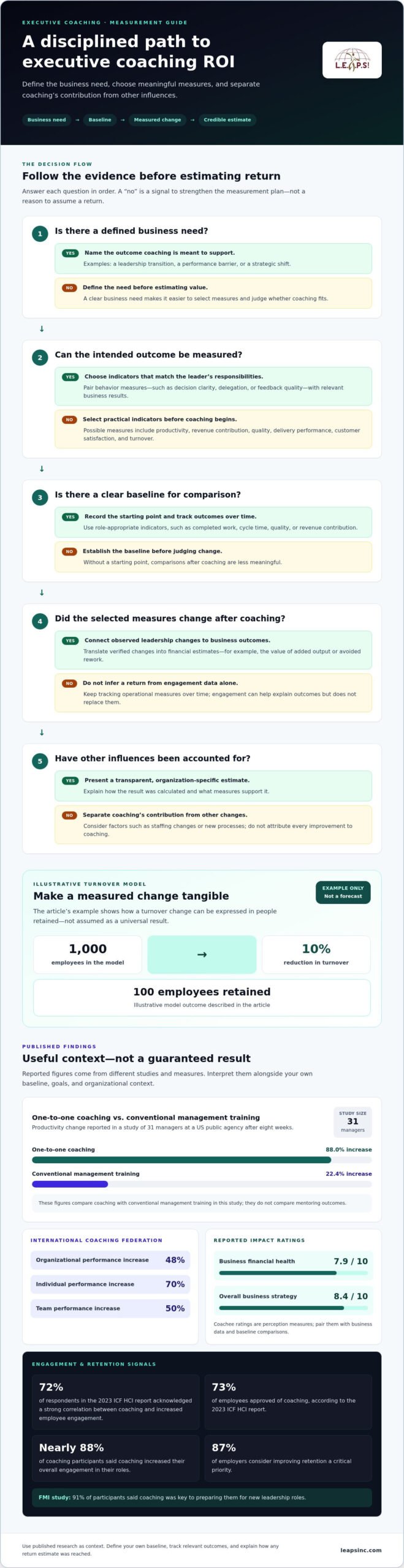
Retention measures employees who stay, while turnover tracks employees who leave; together, they show workforce stability. The 2023 ICF HCI Defining New Coaching Cultures report found that 72% of respondents acknowledged a strong correlation between coaching and increased employee engagement. It also found that 73% of employees approved of coaching. Since 87% of employers consider improving retention a critical priority, leaders can examine whether coaching supports the conditions that encourage employees to stay.
Leadership effectiveness matters because daily decisions shape employees’ experience at work. A manager who sets clear expectations, listens carefully, and addresses obstacles can help a team focus and collaborate. Track these changes alongside business outcomes such as output per employee, missed deadlines, customer satisfaction, repeat business, and turnover. For example, a service team could track customer complaints and employee departures, then assess whether changes in communication coincide with shifts in both.
Valuing Productivity and Retention Gains
Valuing productivity and retention gains means translating observed changes into financial estimates. Establish a baseline, compare results after coaching, and connect each change to a business measure. An illustrative model considers coaching for 1,000 employees and a 10% reduction in turnover, retaining 100 employees.
Set a productivity baseline using indicators suited to each role, such as completed work, cycle time, quality, or revenue contribution. Convert verified changes into dollars using the value of added output or avoided rework. Then account for other influences, including staffing changes or new processes, rather than attributing every improvement to coaching. This makes the estimate more disciplined.
Engagement data can help explain why outcomes changed, but it shouldn’t replace operational measures. Nearly 88% of coaching participants said coaching increased their overall engagement in their roles. Pair that signal with retention records, team productivity, and customer feedback. Leaders can use executive coaching to develop leadership behaviors, then evaluate whether those behaviors align with the organization’s chosen measures.
Executive Coaching ROI: Is It Worth the Investment?
Executive coaching may be worth the investment when it addresses a defined business need and outcomes can be measured. Its value is easier to assess when leaders connect behavioral changes with tangible results, such as stronger business-unit performance or a more effective transition into a role.
Compared with leadership training, coaching can support individualized development over time. In a study of 31 managers at a US public agency, productivity rose 88.0% after eight weeks of one-to-one coaching, compared with 22.4% after conventional management training; mentoring offers guidance, but these figures don’t compare mentoring outcomes.
Estimating Coaching’s Business Contribution
Estimate coaching’s contribution by linking observed leadership changes to business outcomes, then accounting for other influences. A transparent explanation of how the result was calculated makes the estimate more useful and credible.
The International Coaching Federation reports a 48% increase in organizational performance among coached executives. Coachees rated coaching’s impact on business financial health an average of 7.9 out of 10. Treat these findings as context, not a forecast: define a baseline, identify the outcomes coaching targets, and consider other changes affecting results.
When Coaching May Be Worthwhile
Coaching may be worthwhile when a leadership transition, performance barrier, or strategic shift calls for focused development. Define the business need first; that makes it easier to choose what to measure and decide whether coaching fits.
For example, a newly promoted leader may need to delegate more effectively, while an established executive may need to align a team around changing priorities. In an FMI study, 91% of participants said coaching was key to preparing them for new leadership roles. Organizations can assess whether that preparation supports role readiness and unit goals.
Measuring Leadership and Business Benefits
Assess leadership development by tracking behavior alongside operational results. This helps distinguish personal growth from changes that affect a business unit.
Set behavioral measures, such as decision clarity, delegation, or feedback quality, then pair them with relevant indicators. A sales unit could track forecast accuracy and customer satisfaction; an operations team could examine quality and delivery performance. Coachees rated coaching’s impact on improving overall business strategy an average of 8.4 out of 10, a useful perception measure alongside business data.
The International Coaching Federation reports a 70% increase in individual performance and a 50% increase in team performance among coached executives. Use measures that fit the leader’s responsibilities, and compare them with the baseline rather than relying on a general rating.
How Studies Measure Coaching ROI
Studies estimate coaching ROI by comparing benefits with the investment, while surveys may ask participants or organizations to assess outcomes. Check how each evaluation gathered and calculated its results before applying the findings to your organization.
A PricewaterhouseCoopers global survey reported a mean coaching ROI of 7 times the initial investment, while over a quarter of companies reported returns between 10 and 49 times their investment. In a 2009 executive coaching survey, 86% of companies said they had at least made their money back. Methods and reported outcomes vary, so examine what each study counts as a benefit.
Organizations considering leadership development can explore scheduling an appointment to discuss goals and the outcomes they want to strengthen.
Quantifying financial returns from executive coaching
Executive coaching may contribute to financial benefits through stronger leadership decisions, improved performance, and employee retention. Organizations can estimate ROI by comparing benefits attributable to coaching with the full investment, while recognizing that published results reflect different methods and contexts.
Potential benefits include increased revenue, avoided turnover, or reduced delays. For a useful calculation, connect each benefit to an organizational measure.
Reported Corporate Returns
Reported corporate returns are estimates from studies or company cases comparing coaching benefits with its investment. They can help decision-makers consider possible outcomes, but they are not forecasts and should be interpreted in context.
The Manchester Review study of 100 executives from Fortune 1000 companies reported an average coaching ROI of 5.7 times the initial investment. Metrix Global reported a return of over 5:1, excluding financial benefits from employee retention. These results illustrate how estimates can differ depending on the participants, outcome measures, and benefits included.
In a survey cited by FMI, 87% of respondents agreed that executive coaching has a high return on investment. That perception is useful context, while an organization’s own calculation should use its defined outcomes and costs.
Financial Benefits for Companies
Financial benefits are business gains linked to coaching, such as improved productivity, stronger revenue performance, or reduced replacement costs. Identify the specific benefit first, because each requires a different way to measure it.
For example, a company might track sales growth after a leader improves team alignment, or monitor operating costs after decisions become more effective. The International Coaching Federation and PwC estimated global coaching revenue at $2.849 billion in 2019, reflecting the scale of the profession, not a guarantee of company-level returns.
To calculate an organization’s return, subtract the investment from the benefits attributed to coaching, then divide that net value by the investment. Include relevant costs such as coaching fees, executive time, assessments, and materials. State your assumptions clearly, especially when other changes may have influenced the outcome.
Calculating the return on coach training requires a related but distinct assessment. Include the resources used to train internal coaches, then measure benefits linked to the coaching they deliver. Track outcomes such as leadership effectiveness, employee retention, or business-unit performance, and avoid counting the same benefit twice.
Leadership awareness can also help explain changes in business results. A study surveying 486 companies found a link between financial rates of return and leaders’ self-awareness. Treat that relationship as context, then connect development goals to measurable outcomes within the organization.
Randomised controlled trial evidence on coaching outcomes
Randomized controlled trials can help assess whether coaching contributes to measurable changes. Their findings may inform outcome selection, but financial returns still require organization-specific measurement.
A 2023 meta-analysis in Academy of Management Learning & Education pooled 37 randomised controlled trials, covering 2,528 participants and 39 independent samples. It reported an effect size of g = 0.59, which corresponds to the average coached leader performing better than roughly seven in ten comparable leaders who received no coaching. The analysis also found statistically significant effects on performance and behaviour at p < .001. These results support coaching’s potential to influence outcomes, not a direct estimate of financial ROI.
Several factors can weaken results: unclear goals, little opportunity to practise new behaviors, or organizational changes that conflict with the coaching program. For example, a leader working on delegation may struggle to apply it if responsibilities remain centralized. Record relevant context alongside outcome measures so you can interpret changes fairly.
Setting Baselines and Tracking Outcomes
Set a baseline by recording selected outcomes before coaching begins. Comparing results with this starting point gives a clearer picture of progress than relying on memory or impressions.
Choose measures that match the goal, such as decision quality, team feedback, or productivity, and use the same method throughout. Record starting conditions, review progress during the engagement, and compare results after six to twelve months. Note major changes in staffing, strategy, or workload, as these may affect the same measures independently of coaching.
Financial and Intangible Outcomes
Financial outcomes have direct monetary value, while intangible outcomes include changes in confidence, communication, or leadership behavior. Track both, because behavioral development may come before business results.
For a financial measure, connect a change to an operational result, such as fewer errors or improved output, then calculate its business value using internal records. For an intangible measure, use structured feedback or a consistent assessment. The 2023 meta-analysis found effects on both performance and behaviour, supporting a broader evaluation than revenue alone.
Tracking Intangible Outcomes
Make intangible outcomes measurable by defining observable behaviors and assessing them consistently over time. This turns abstract development goals into concrete points of review for leaders and organizations.
Translate “communicate more effectively” into observable actions, such as clarifying decisions or inviting team input. Ask the same feedback questions before and after coaching, then compare responses with relevant examples from work. Meeting notes, for instance, may show whether responsibilities and next steps became clearer. Pair these observations with business measures, without assuming that one change alone caused a financial result.
Performance improvements linked to coaching
Coaching may help leaders set priorities, communicate clearly, and follow through. To assess its contribution to job performance, connect behavioral changes with practical indicators relevant to each role.
Impact on Job Performance
Job performance describes how effectively a leader meets role expectations and advances organizational goals. Measuring it matters because stronger leadership becomes more tangible when reflected in work quality, decisions, or execution.
The International Coaching Federation reports a 70% increase in individual performance among coached executives. A 2009 ICF client study found that more than 70% of coaching clients reported better work performance, relationships, and communication. These findings point to several dimensions of improvement, not one universal performance measure.
Translate those dimensions into indicators suited to the role. A senior leader might track strategic decisions completed, while a department head measures project delivery or team collaboration. Compare results with the baseline and document changes in responsibilities or resources. This helps separate performance changes from those caused by restructuring or new targets.
Performance and Behavioral Effects
Performance and behavioral effects include work results and observable leadership practices associated with coaching. Track both, since behavior may change before financial indicators respond.
A 2014 meta-analysis found coaching’s largest measured effect on goal setting and follow-through, with an effect size of g = 0.74. This highlights a practical pathway: clarify goals, identify commitments, and review follow-through. For example, a leader can record whether agreed actions are completed and whether barriers are addressed during regular team reviews.
Coaching may also influence how a leader uses time and authority. Jim Viner, CEO of HSC Builders, said his effectiveness improved by 100% after working with his coach to clarify his role and prioritize strategic work. Treat this as an individual example, then identify comparable behaviors in your own leadership context.
Some outcomes remain intangible at first. Executive presence, confidence, or communication quality can be assessed through structured feedback, specific behavioral examples, and repeated observations. One article example uses a 40% improvement in executive presence and suggests that it could translate to a 2% performance improvement. The lesson is to make the connection explicit, then test it against actual work measures rather than assuming a direct financial effect.
Make an evaluation useful by pairing a behavior measure with a relevant business indicator. For instance, compare clearer delegation with project progress, or stronger meeting decisions with reduced rework. Record the baseline, review changes consistently, and interpret results in context. This helps leaders see where development is taking hold and where organizational support may be needed.
If you’re ready to clarify leadership goals and identify meaningful performance measures, schedule an appointment.
LEAPS: Individual Therapy
LEAPS offers Individual Therapy for people seeking support with personal challenges and emotional well-being alongside their professional goals. Executive coaching focuses on leadership development and workplace outcomes; therapy can offer space to explore stress, recurring patterns, or personal concerns that affect how you show up at work and at home. If those deeper factors are part of your situation, Individual Therapy may be a fitting next step.
LEAPS Inc. offers executive coaching to help leaders strengthen performance and support professional growth. Explore how coaching could address your organization’s leadership needs, and contact LEAPS Inc. to learn more.
Turn Leadership Intent Into a Measurable Next Step
Start by defining the leadership change your organization needs, then decide how to recognize it in daily work. Before coaching begins, identify what success should look like for the executive, their team, and the wider organization. Ask, “What is the ROI of executive coaching?” in relation to those priorities, and choose meaningful signs of progress.
Understanding what the ROI of executive coaching means for your organization starts with choosing outcomes that matter beyond a spreadsheet. Consider the leadership capacity you want to build, the decisions that need to improve, and the professional growth that could shape your organization’s future. Financial results depend on the goals, context, and outcomes measured, so keep expectations grounded in the specific leadership challenge.
LEAPS offers Executive Coaching for leaders ready to work intentionally toward their professional potential. Contact LEAPS about executive coaching to discuss your goals and consider a purposeful next step. Meaningful progress begins with a clear intention, and each deliberate choice can help move leadership toward its fullest contribution.
Frequently Asked Questions
Does coaching improve performance and productivity?
Coaching may support performance and productivity by helping leaders apply new skills to their work. For example, an executive working on delegation might clarify who owns each decision, then observe whether projects progress with fewer delays. The key is to assess whether a behavior change supports a role-specific outcome, such as stronger execution or clearer team communication. Track the behavior and its operational effect separately.
How long does an executive coaching engagement last?
An executive coaching engagement typically lasts six to twelve months. Many engagements include monthly sessions, allowing time to define objectives, practise new approaches, and reflect on feedback between meetings. A leader entering a new role may focus on decision-making and team alignment, while an established executive may work toward strategic priorities. The engagement’s goals and the leader’s development needs shape its focus and rhythm.
Is executive coaching only for struggling leaders?
No. Executive coaching can support capable leaders preparing for greater responsibility, strengthening an established leadership approach, or navigating organizational change. A high-performing executive might work on strategic communication before leading a major initiative. A leader facing a challenge may also examine established patterns and consider new responses. Coaching can support development and transition, not only performance concerns.
Is the 7x ROI figure for executive coaching real?
Seven times the initial investment is a reported survey result, not a universal benchmark. A PricewaterhouseCoopers global survey reported a mean coaching ROI of seven times the initial investment. Interpret the figure in light of the respondents and the survey’s method for counting outcomes. An organization’s own return depends on its chosen measures, the benefits included, and how it attributes those benefits to coaching.
What is the average ROI of executive coaching?
There isn’t one average that represents every coaching engagement. In a 2009 executive coaching survey, companies reported a median return of seven times their investment, while individual clients reported a median return of 3.44 times their investment. The difference illustrates why the population and calculation matter. For an internal estimate, define whose return you’re measuring and which outcomes count before comparing results.
How long does it take to see results from executive coaching?
Behavioral signs may appear before financial outcomes. A leader, for example, may begin giving clearer feedback before changes in team delivery become visible. Set separate review points for behavioral progress and business measures. Timing depends on the goal, the leader’s opportunity to apply new skills, and how quickly the relevant workplace outcome responds.
What factors influence executive coaching ROI?
ROI depends on how closely the goal connects to business priorities, the leader’s commitment, and the organization’s support for applying new behaviors. Measurement choices matter too. A goal around team communication is easier to evaluate when the organization gathers consistent feedback and links it to a relevant team outcome. Leadership turnover, changing targets, or new systems may also affect results during the same period.
What are common ways to calculate executive coaching ROI?
Common approaches compare the financial value of selected benefits with the total investment, or track operational indicators such as productivity and retention. For example, an organization might estimate avoided replacement costs and compare them with coaching-related expenses. Some evaluations also assess behavioral changes through structured feedback. State the method and assumptions clearly, distinguishing direct financial outcomes from qualitative benefits such as improved communication.